Baiting Hollow Farm Vineyard: It Helps to be First January 30, 2016

http://www.baitinghollowfarmvineyard.com/

IMG_2437

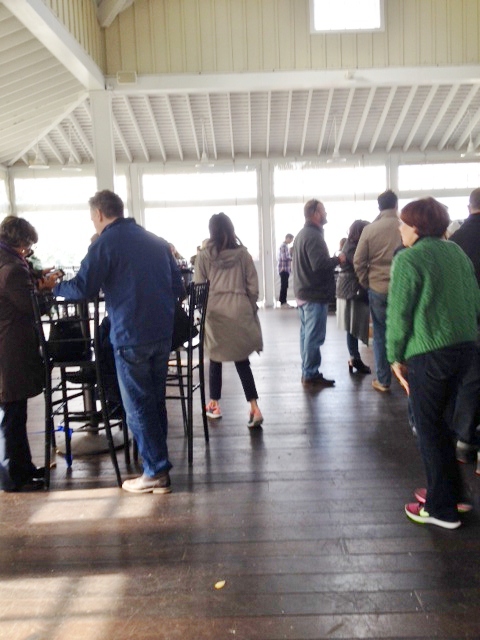
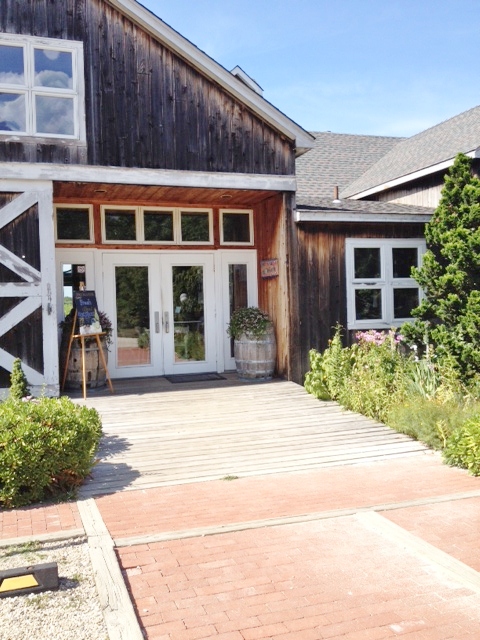
The first winery you come to on Sound Avenue, traveling west to east as most visitors do, is Baiting Hollow, and I can’t help but wonder if that has contributed to its popularity.  To be fair, its tasting room is located in an attractive building that is based on what was originally a farmhouse built around 1861, it has an extensive food menu so you can easily have lunch there, and it has an attractive charity to which it donates the profits of certain wines.  It also frequently features musical entertainment, welcomes limos and buses, and its wines are all crowd pleasers.

The band was warming up when we left.

The band was warming up when we left.

The charity is interesting.  They operate a horse rescue sanctuary, where they house horses which were destined for slaughter.  If the day had been warmer, we might have gone out back to take a peek at them.  We did spot one horse through a window. In the summer, they offer pony rides for children.  A number of their wines are marked with a horse’s head on the menu.  These wines are named for particular horses, and the profits from their sale are donated to their charity, as are the profits from the pony rides.

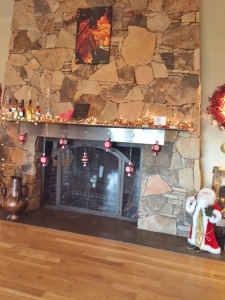
Considering their charity, this photo was not surprising.

Considering their charity, this photo was not surprising. Note the clever use of a wine bottle, too.

The food menu, in addition to the expected snacks and cheese plates, also included today warm soups and chili, and such dishes as “merlot meatball sliders” for $12.99.  We saw several family groups eating lunch when we were there, early in the day on Saturday.

We were glad we went early, since most of the time when we go past Baiting Hollow we are scared away by the crowds of cars and limos.  Today it was nice and quiet, though a band warming up promised livelier times to come.  Instead we had peace in which to savor the wines, and a server who seemed to know all about them.
IMG_2421

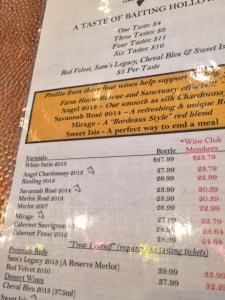
The tasting menu offers several options for one ounce tastes:  one taste for $4, three for $9, four for $11, or six for $16.  We opted to share one six-taste flight, chosen from a menu of three whites, two rosés, four reds, and two dessert wines.  Our server apologetically gave us tickets for the six, assuring us that he would remember where we were.  We opted to sample our choices at a nearby table, returning to the bar for each new one.

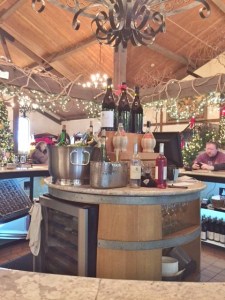
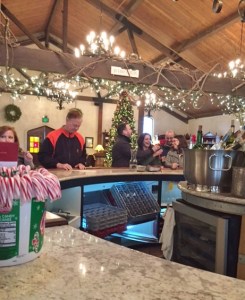
One of the bars.

One of the bars.

  1. White Satin 2013            $27.99

This is a blend of a couple of different whites with an aroma of chalk or stone and peach pit.  Happily, it tastes better than it smells.  White Satin is a dry, fairly tart white with tastes of blood orange or tangelo and maybe kumquat, with some interest.  My tasting buddy objects to the finish, saying, “I don’t want that taste in my mouth.”  It would be better with food, maybe a nice fresh bluefish.  I like to bake bluefish fillets on top of potatoes, with a few slices of bacon on top.

IMG_2425

  1. Angel Chardonnay 2013 $27.99

One of the horse charity wines, this is typical of those Long Island chardonnays which have spent some time in oak and some in stainless steel.  When you smell it you can detect traces of the wood, plus some mineral and lemon aromas, and the taste includes both lots of lemony citrus and a touch of vanilla (from the oak).  Nice.  It would also go well with local fish, perhaps the blackfish I oven “fried” several times this fall.

  1. 2007 Merlot $26.99

We decide to skip the rosés and the riesling, thinking they might be too sweet for our tastes, and move on to the reds. No new glass.  Sniff.  “Gasoline?” says my husband, perhaps a bit influenced by all the time he spent last week behind our snow blower.  I tilt more towards berries, but I get what he means.  There is a sweet slightly chemical aroma.  The taste is light and pleasant, with a touch of smoke but not enough to be unpleasant.  While not for sipping, this would be fine with chicken or game birds.
IMG_2430

  1. Mirage $27.99

Another wine named for a horse, with proceeds going to the horse rescue, this is their Bordeaux blend, a mixture of cabernet franc, cabernet sauvignon, and merlot.  Again, this is a fairly light red, not complex, dry, with berry tastes, and is pleasant enough.  Though it would not stand up to a steak, it would be fine with veal or lamb.  The tasting notes say “bold.”  I say not so much.

  1. Cabernet Sauvignon 2012 $28.99

You can’t tell a wine by its smell, an adage I just made up, is certainly exemplified by this wine, which smells kind of funky but tastes quite good.  It’s my favorite so far, with lots of mouth-watering acidity and fruit.  It is easy to drink, either as a sipper or with food, and is just the right amount of dry.

  1. Cabernet Franc 2012 $28.99

Just as my husband wonders whether one can actually tell one North Fork red from another, we try this one.  The aroma is quite different from the cab sauv—somewhat reminiscent of Cheracol, that old cough syrup, with no funkiness—and so is the taste.  Lots of blackberry, we decide simultaneously, nice and dry, and less fruity than you’d expect from the aroma.   If I were having roasted Crescent Farms duck breast I’d pair this wine with them.
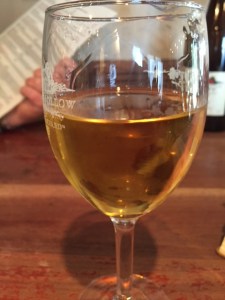
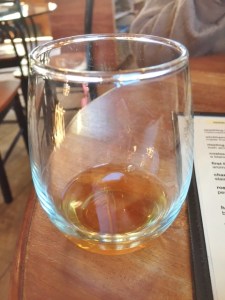
The glass of Sweet Isis.

The glass of Sweet Isis.

  1. Sweet Isis $32.99 (for 375 ml.)

No, we did not get a free taste!  I decided I wanted to taste one of the dessert wines, and my husband accidentally came back to our table with a whole glass of Sweet Isis.  A taste would have been $5.  The last of the horse rescue wines (thus named for a horse, not a certain group), this is a white wine dessert wine, with lots of fresh pear and apple tastes.  I was concerned that a whole glass of it with no food (blue cheese would have been perfect) would cloy, but somehow as we sat and chatted and sipped it all disappeared.  It was sweet, but appropriately so, and could also go with charcuterie as well as with a cheese platter.  Very likable.
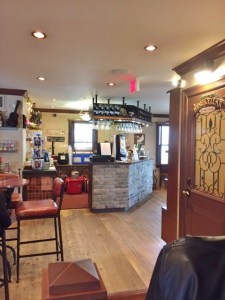
Food was served at this bar.

Food was served at this bar.

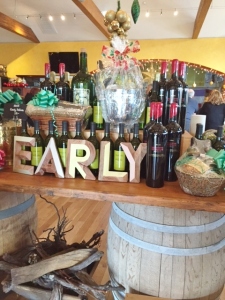
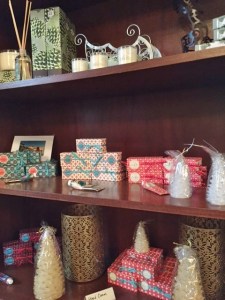
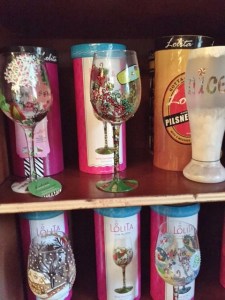
Gift items

Gift items

Reasons to visit:  it’s the first winery you come to; horses!; lots of food options; music; you don’t mind crowds; lots of gift items; the Angel Chardonnay, the cabernet sauvignon, the cabernet franc, the Sweet Isis.

IMG_2435

IMG_2436

Their rules

Their rules
IMG_2434


Kontokosta Winery: Sounds Good to Me January 17, 2016

http://kontokostawinery.com/

Windows line the walls of the tasting room.

Windows line the walls of the tasting room.

It was time to revisit Kontokosta Winery, with its lovely location overlooking the Long Island Sound, and we found the perfect reason to go there.  We recently learned that old friends of ours had bought a house near Greenport, but, what with work on the house and not much time for other activities, had yet to visit a winery.  Well, we said, it is high time to remedy that situation, and they were happy to go with Nofowineaux to a winery so close to their house.

Proving that you can’t rely on last year’s review, a major change in the menu switched the Anemometer white and red from their least expensive wines to their priciest—and they weren’t even on the regular tasting menu, but needed a supplement of $5 each to taste.  So I can’t tell you if they’re worth it, but many of the other wines are.

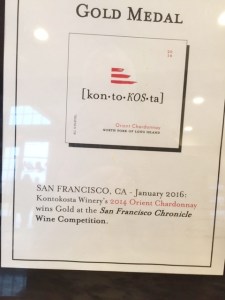
Our server was proud to point out that they had won some gold medals.

Our server was proud to point out that they had won some gold medals.

The menu offers five whites for $15 or four reds for $15, so we opted to share one of each, and our friends chose to follow our lead.  Since it is a carefully metered one-ounce pour, that was fine.  They also have a menu of snacks and sweets and non-alcoholic drinks (called “Sound Bites,” a play on their location and their motto of “Sound Wines”), and forbid outside foods.

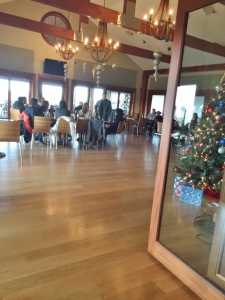
The tasting room is a high-ceilinged large space, with tables and a bar, where we opted to stand.  Considering it is January, we were impressed by how many people were there, but it was a three-day weekend.  Our server did a good job of keeping track of where we were in our tasting, and, as she saw our seriousness, began to give us more information on each wine.

A few gift items, including olive oil, are offered.

A few gift items, including olive oil, are offered.

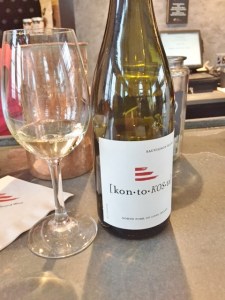
  1. 2014 Orient Chardonnay              $22

Like many North Fork tastings, this one began with their steel-fermented chardonnay, which our friend compared to a “non-sweet Limoncello.”  Not a bad comparison, since this had plenty of lemon flavor and aroma, plus some nice minerality, and maybe even a salty tang.  Good.

IMG_2396

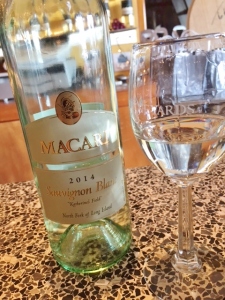
  1. 2014 Sauvignon Blanc $25

As we sniffed the aroma of mango and citrus, one of our friends compared it to “Joe Malone perfume.”  Not being familiar, I can’t confirm or deny this, but the wine does have a lovely flowery scent.  The taste is equally pleasant, with good grapefruit and pineapple and other tropical fruits, plus mouth-watering acidity.  When we comment that this would be good with oysters, a discussion of North Fork oysters and where to get them ensues.  When the Old Mill Inn re-opens in the spring, we’ll have to meet there for their happy hour oysters.
  1. 2014 Viognier $25

Getting into the spirit of commenting on each wine, our friends describe the viognier as “more restrained and less dramatic” than the first two wines, and we agree.  The aroma is a bit sweet, with some mineral or rock and maybe a spice.  Cinnamon?  Nutmeg?  We can’t decide.  But this is another very drinkable wine, again on the tart, dry side, and would be good with creamy clam chowder.

  1. 2014 Field Blend $22

63% viognier and 37% sauvignon blanc.  Why?  Because they had that much of each left over last year, and only one vat in which to ferment them!  Nice to be able to drink your experiments, though we don’t like this as much as the previous wines.  It is quite light, and smells just like the viognier.

  1. 2014 Riesling $22

Dry!  Just .2% residual sugar, says our server, and we believe her.  It tastes more like a sauvignon blanc than their sauvignon blanc, very tart, with lots of acidity.  If you like a fruity somewhat sweet riesling, or even if you are thinking of a riesling to complement spicy food, this is not it.

IMG_2397

  1. 2008 Blum Merlot $19

A year ago we had the 07 Blum Merlot, and was told this was the last of it, but I guess they had one more year of these vines before Ray Blum’s vineyard was sold to Sparkling Pointe, which tore out the merlot vines.  The aroma has lots of sweet cherry in it, and none of the barnyard which we detected in the 07.  Our friend thinks there’s a bit of a whiff of creosote, which is possibly from the French oak it was aged in.  It tastes less fruity than it smells, with some woody notes but no vanilla.  We get new glasses for the reds, by the way.

  1. 2013 Estate Merlot $34

We like this merlot much better, and all agree that we taste and smell lots of blackberry, plus minerals and flowers.  “Easy on the tongue,” opines our friend.  That may be the tannins, since the end taste is quite dry.  This one is aged in Hungarian oak, as are the rest of the reds.

  1. 2013 Cabernet Sauvignon $29

As our server pours this, she brings out another bottle and two fresh glasses and pours us another wine, the 2012 Cab Sauv (about which more in a moment).  Our friends are impressed with what I call the power of the book.  Often, when wineries see you are serious about the wine, they give you a little something extra.  Sometimes it is another taste of a wine not on the menu, or other times just some extra attention and more stories about the making of the wine.  I appreciate both.  We like this one, as it has lots of rich fruit flavors and aromas but is still pleasantly dry.

Our special extra taste!

Our special extra taste!

  1. 2012 Cabernet Sauvignon $29

I should really label this 8A, since it is an “extra.”  Our server explains that she thinks we should try this, as there are only a few cases left, and she thinks it is really excellent.  She’s right.  It is similar to the ’13, but mellower and smoother and fruitier.  We buy a bottle.

  1. 2013 Cabernet Franc $40

“Hmmm,” muses our friend, “I think I detect a note of Robitussin.”  Ha ha.  But it does taste of dark fruits, perhaps plums, again with some nice minerality and some promising tannins.  We get into a discussion of the meaning of “terroir,” and wonder if Kontokosta’s wines have more minerality than some others because of their location on the Sound, which we can see out of the windows.

Yes, that is the Long Island Sound in the background.

Yes, that is the Long Island Sound in the background.

Reasons to visit:  you are in or near Greenport and don’t want to travel too far; almost all of the wines, but especially the Orient Chardonnay, the Sauvignon Blanc, the Estate Merlot, and the 2012 Cabernet Sauvignon (but hurry before they sell out); the location on the Sound (maybe some time we’ll get there in the warm weather so we can stroll towards the water).

IMG_2404

The day was cold and grey, with the first snow of the season, but the welcome was warm.

The day was cold and grey, with the first snow of the season, but the welcome was warm.

Macari: Still a Good One January 2, 2016

http://www.macariwines.com/

The entrance

The entrance

For our first winery of the new year, we headed to Macari, which we had last visited when it boasted the award of “Best Winery of 2014.”  We would have been back sooner, but cancelled our visits when the attractive tasting room proved too crowded and noisy for us.  This time, in the doldrums of January, there were still plenty of people, including a large group in the room off to one side, but we found a place at the bar and a smart and attentive server.

Plenty of space for large groups in the side room.

Plenty of space for large groups in the side room.

The menu offers three options—Estate, of four of their lower priced wines for $10; Cuvee, of five for $15; and Vintage, of five of their best wines for $20.  Since none of the lists overlapped, we decided to share two tastings, one of the Cuvee and one of the Vintage.  Because both menus included whites and reds of varying types, we wanted to alternate so as not to try to follow a riesling with a sauvignon blanc.  Why?  As we’ve learned, if you try to taste a light dry wine like a steel-fermented sauvignon blanc after a sweeter, more substantial wine like a riesling, you won’t be as able to appreciate the lighter wine.

Our server first wanted to pour our two tastings simultaneously, but after we explained the philosophy behind our preference she quickly caught on, and made sure to pour the wines in an order that made sense.    We were particularly impressed with her ability to keep track of what we were doing since she also was serving other customers and running off to the side room as well.  She also was enthusiastic about the wines, sharing her preferences and knowledge about the wine, only once having to resort to a “cheat sheet” to give us information we requested.

IMG_2371

As we sipped, we admired the nicely done holiday decorations and the attractive labels on the wines, and afterwards we browsed the small but good collection of wine-related gifts. Note they don’t allow outside foods, and sell a variety of snack and cheese items.   I’m listing the wines in the order in which we had them, marking the Vintage wines with an *.

IMG_2372

  1. Sauvignon Blanc ’14       $24

This is a steel –fermented sauvignon blanc, with an aroma that reminds me of the water in a vase after the flowers have begun to decay—which doesn’t sound all that appealing, but is fine when combined with citrus.  Good, we decide, nicely crisp, but delicate, with a touch of sweetness—perhaps more Meyer lemon than lemon.  Of course it would pair well with local oysters or clams, but if you had it with shrimp I would leave out the cocktail sauce, which would overwhelm this wine.

IMG_2356

  1. Sauvignon Blanc ’14 (concrete egg) $27

Ooh, this is just the sort of exercise I love: Trying two wines side by side, made from the same grapes, but treated differently.  In this case, “concrete egg” refers to the egg-shaped concrete cask they use to ferment the wine, our server explains, and adds that since concrete is more porous than steel but less porous than wood, and without the flavor added by a wood cask, the results are quite different and, she thinks, better.  We agree.  The aroma is complex, with perhaps a hint of nutmeg or other spices and a taste that is a touch sweeter without being too sweet, with some acidity and a taste of greengage plums.  No finish.  Mysteriously, the label bears the word “Lifeforce.”

  1. *Dos Aguas ’13 $27

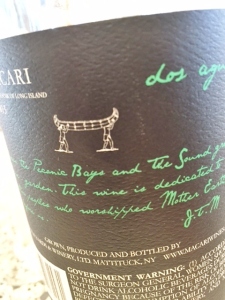
“Dos Aguas” refers to the two waters between which the vineyards are located:  Peconic Bay and Long Island Sound.  Many people feel that these “two waters” contribute to the North Fork’s excellence as a grape-growing region, since they have the effect of moderating the climate.  This is a blend of chardonnay, viognier, riesling, and sauvignon blanc, and is another good wine.  The aroma makes me think of sticky fruits and the taste includes minerality, figs, and tangerines.  Though the riesling does contribute some sweetness, it is well balanced with some acidity.  It would go well with one of my favorite dishes, pasta tossed with a variety of seafood.

  1. *Riesling ’13 $23

Ah yes, we are definitely glad that we tasted this one last of the whites, as its sweetness would have interfered with appreciating the others.  This is the only wine, our server informs us, that uses grapes not grown on the estate, since the riesling grapes in this come from the Finger Lakes region (not unusual for Long Island wineries, as upstate is known for its good riesling).  The aroma is honey, the taste like a green apple on the sweeter side, like a Mutsu, not a Granny Smith.  “Toot suite,” jokes my husband, as he complains that this wine is sweeter than he likes.  It is sweeter than a dry riesling, but I don’t find it unpleasantly so.  With spicy food you’d welcome that flavor.

IMG_2365

  1. Merlot Estate $15

Burnt sugar?  Cinnamon toast?  We discuss the smell, which in any event is not typical for a Long Island merlot.  Our server lets us in on the secret that although this wine is more than 80% merlot it also has some syrah, cabernet franc, and cabernet sauvignon, which may help explain the aroma.  It may also explain the taste, which is quite good for an inexpensive merlot, and makes this a good choice for a table wine.  It is fairly soft, with no tannins and some acid, and would go well with veal or pork, rather than steak.

Full disclosure:  We already knew we like Sette.

Full disclosure: We already knew we like Sette.

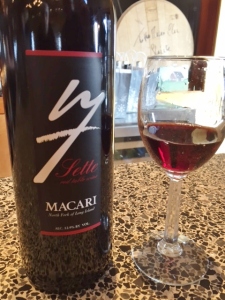
  1. Sette NV $19

We are quite familiar with Sette, since we often order it in local restaurants.  In fact, we just shared a bottle of it at Michelangelo’s last week, when it went well with eggplant parmesan and pasta with sausage and broccoli rabe.  This is a blend of 50/50 merlot and cabernet franc (not of seven wines, as you might assume from the name, which instead refers to the town Settefratti, which was the home town of the Macari family).  The smell is warm, with some spice and wood, the taste cherry with again some acid but not much tannin.

Cute drawing on the Dos Aguas.

Cute drawing on the Dos Aguas.

  1. *Dos Aguas Red Blend ’10 $30

Blend?  Yes, of cabernet franc, cabernet sauvignon, and merlot.  We smell wet hay and wood, taste pleasant dark fruits. This is a soft, easy to drink red, and would be good, I opine, to sip while cooking—and ruining the food? theorizes my husband.  Ha.

  1. *Merlot Reserve ’10 $36

After aging 26 months in French oak, this wine has more tannins than the previous reds, with a typical merlot aroma of cherry plus oak.  Not powerful, but pleasant, this is a good wine if you want to introduce someone to Long Island merlots.

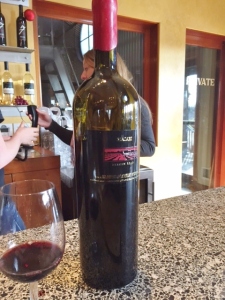
Apparently the Bergen Road is also available in a huge bottle.

Apparently the Bergen Road is also available in a huge bottle.

  1. *Bergen Road ’10 $46

Since I ask, our server looks up the proportions of this red blend:  56% merlot, 26% cabernet sauvignon, 13% cabernet franc, 3% malbec, and 2% petit verdot.  A Right Bank Bordeaux.  The color is quite dark, and so is the taste, with plenty of tannin and acid and delicious dark fruits.  Yum.

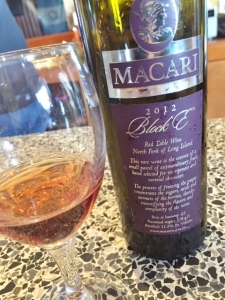
Block "E" looks and tastes very like a sherry.

Block “E” looks and tastes very like a sherry.

  1. Block “E” ’12 $32 (for a small bottle)

Ice wine is supposed to be made with grapes picked after the first frost, but since that frost tends to come pretty late on the North Fork (as in it just happened), instead the grapes are picked fairly late, when they have developed quite a bit of sugar, and then frozen before being made into a dessert wine.  In both color and taste this reminds us of a semi-sweet sherry, with a bit of a honey aroma.  When I ask, we are informed it is made from merlot, cabernet sauvignon, cabernet franc, and malbec grapes.  Good dessert wine, it would be nice with some almonds.

IMG_2358

Reasons to visit:  good all-around winery, with plenty of tasty options and a big room with tables for groups; nice selection of gifts; reasonable prices (if we didn’t have all the wine we need at the moment we would have bought several of the wines); the “concrete egg” Sauvignon Blanc, the Dos Aguas white and red, the Merlot Estate, the Sette, the Bergen Road.

IMG_2368IMG_2373IMG_2374

IMG_2377

Raphael: Better for an Event than a Tasting? December 26, 2015

IMG_2346http://www.raphaelwine.com/

With their beautiful building, modeled after an Italian monastery, and spacious tasting room, Raphael is often in use as a venue for private events.   This time of year the room sparkles with Christmas lights, so it is no surprise to note that it will be closed New Year’s Eve for such an event.  In fact, if you plan to go for a tasting make sure to check their web page first to make sure they are open.  You may also choose to go or not depending on whether they have musical entertainment planned.  The performers we heard were all quite talented and we liked their music, but not the sound level, which made conversation difficult.  The other difficulty we encountered was that the servers were clearly understaffed, having to cater to a crowd around the circular bar plus many people sitting at the tables, drinking glasses of wine and listening to the music.

IMG_2333

The menu lists 18 choices, all priced by the taste, glass, or bottle.  We happened to have a coupon for two free tastings, which entitled us to three tastes each, which would have cost us $17 for the six tastes.  Since we knew we already liked the Portico—which proved to be a popular after-Thanksgiving-dinner drink—we decided to focus on the standard whites and reds, skipping the reserves, the rosés, and the dessert wines.  The menu mentions ratings by both Wine Enthusiast and Wine Advocate in the high 80s and low 90s for a number of the wines.

The pour is fairly generous.

The pour is fairly generous.

  1. 2014 Sauvignon Blanc                   $22

We decided to start by trying their two sauvignon blancs side by side, and our request for information about the wines was referred by our server to another one who was more knowledgeable.  This is the less expensive of the two, steel fermented for a shorter time, and not the preference of our server.  We agree, though it is a fine example of Long Island sauvignon blanc, with lots of minerality and soft lemon taste at the end, and a refreshing acidity.  It would go well in the summer, or well-iced with oysters.

  1. 2014 First Label Sauvignon Blanc             $28

The tasting menu informs us that this one is “made from our oldest sauvignon blanc vines,” and it is fascinating to see that it is quite different from the previous wine, with more interesting aromas and flavors.  We smell a touch of funk in the aroma, plus various fruits.  The taste is complex, with a touch of sweetness at the end but plenty of mouth-watering acidity.  It would complement pasta with cream sauce, we decide.

  1. 2014 Chardeaux $22

A mixture of 80% chardonnay and 20% sauvignon blanc, this wine is more interesting than a straight chardonnay, with lots of citrus and minerality, and some tastes of unripe peach.  It’s a good chard for people who think they don’t like chard, and would go well with chicken kabobs.

Not sure if you can tell from this picture, but the two rieslings looked quite different.

Not sure if you can tell from this picture, but the two rieslings looked quite different.

  1. 2013 First Label Riesling $26

There are two rieslings on the menu, and since one is described as “semi-sweet” we order the other one, not being a fan of sweet wines (except when we’re talking dessert wines).  As we take our first sniffs and tastes we note a chemical aroma and that it is quite sweet for a supposedly dry riesling.  We get the attention of the more knowledgeable server and discover that, indeed, we have accidentally been served the sweet riesling.  We put that glass aside and happily enjoy the correct pour.  Really good, with kumquat orange tastes and some leather notes in the aroma.  My husband—whose identification of the first pour as the wrong wine has deeply impressed our server—notes that he would not buy this for our usual use for a riesling (to go with spicy food), but that though he likes it he would prefer a riesling with more interest.

La Fontana and the fountain

La Fontana and the fountain

  1. 2012 La Fontana $28

Now we switch to reds, and by the way we get a new glass with each taste, a practice I appreciate.  La Fontana is their Bordeaux blend—merlot, cabernet sauvignon, malbec, petit verdot, and cabernet franc—but no one has information on the proportions, including the web page.  A glance at the Raphael label will give you a cue as to the source of this wine’s name—a drawing of the fountain which graces the middle of the parking lot in front of the entrance.  We like this one, too.  The smell reminds me of cassis—the menu says blackberry and eucalyptus –and I taste some nice fruit, with oak at the end and some layers of flavor.  However, compared with a French Bordeaux this is a bit on the thin side.

  1. 2010 First Label Merlot $40

Like the Fontana, this is aged 18 months in French oak, and you can smell the oak when you sniff, as well as cherries.  As it sits in the glass we start to like it better.  It is fairly dry and tannic but with nice fruit.  By the way, I would have liked a cracker to cleanse my palate between the whites and reds but, although there are bowls of them around the bar, there are none anywhere near us and no one offers us any.  As I said, they’re busy.

The fountain--and the Italian flag!

The fountain–and the Italian flag!

Reasons to visit:  you like to admire a beautiful room; the well-stocked gift shop; the First Label Sauvignon Blanc, the Chardeaux, the First Label Merlot, the Portico.

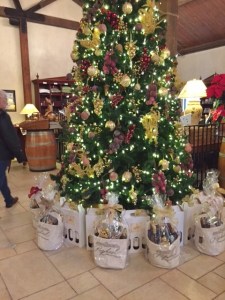
Tis the season

Tis the season

Father Christmas was guarding the well-stocked gift shop, which included food items as well.

Father Christmas was guarding the well-stocked gift shop, which included food items as well.

IMG_2343IMG_2344

Another view of the bar

Another view of the bar


Shinn Estate Vineyards: Country Road December 20, 2015

http://shinnestatevineyards.com/

The Farmhouse B & B

The Farmhouse B & B

As we drove slowly along Oregon Road I began humming “Country roads, take me home…”  We had just paid our first of what I hope will be many visits to the East End Mushroom Company, and two baskets of mushrooms sat in the back seat, awaiting culinary inspiration.  Meanwhile, we were enjoying the bucolic scenery along Oregon Road, on our way back to Shinn’s tasting room after more than a year away.

IMG_2311

I like the cozy rustic look of the tasting room, and today we had it to ourselves for a while, and then later a few other small groups arrived.  No buses are allowed here, and limos or groups of more than six by appointment only, which makes sense, given the small room.  Check out their web site for info on their B and B in the adjoining farmhouse.

But we are here to taste some wine.  The menu offers four wines for $14 out of a menu of 16, plus a few other choices which cost $7 per taste, including their brandy, about which more later.  We decided to do one tasting of whites and another of reds, not sharing tastes because I have a bit of a cold.  I’ll tell you about the whites first, then the reds.  We sit at a small table for two and are served each wine as we choose it.

  1. Sparkling Brut 2012                        $40

Given the festive season, I decided to start with their sparkling wine, made in the Méthode Champenoise and fermented in the bottle.  The first pour is from a bottle that has been open and is clearly somewhat flat, so our server quickly opens a fresh bottle.  Ah, nice frothy bubbles!  Typical yeasty aroma, then a nice dry light taste, with good acidity.  I recently learned that acidity is what makes your mouth water, and this one does.  I like it better than Sparkling Pointe’s sparklers.

I liked the glasses.

I liked the glasses.

  1. Coalescence 2014           $16

I liked Coalescence, a blend of sauvignon blanc, chardonnay, and a touch of riesling, the first time I had it, then didn’t care for it the second time, and now I have to say third time is not the charm.  Although it has a pleasant aroma of gooseberry and honey, the taste has a funky forest floor edge that does not appeal to me.  Not that it’s bad, and I think it would be nice with a plate of salumi, but it’s just not for me.

  1. Pinot Blanc 2014 $35

I’m happy that the server gives me a new glass, since I don’t want the taste of Coalescence to influence the next one, which turns out to be a happy choice, since I like it very much.  This wine spends eleven months in new oak, we are informed, and it has a bit of that oaky vanilla scent.  However, the taste is quite nice, with some interesting layers of flavor, a bit tingly on the tongue.  It has just a touch of sweetness, especially at the end, and is sippable on its own, but would be even better with some Catapano goat cheese.

An explanation of the sherry and their label.

An explanation of the sherry and their label.

  1. Veil “Sherry” 2009 $48 (for a small bottle)

Why is sherry in quotation marks, I wonder?  Because it is not fortified, they can’t actually call it a sherry, we are told.  However, it does taste very like a medium dry sherry and smells like sherry, too.  Made from late harvest savoy, sauvignon blanc, and semillon grapes, it is fermented for so long that a “veil” forms on the top of the wine, hence the other part of the name.  19% alcohol, this would make a great aperitif.  I would drink it!  It has tastes of baked pear and a bit of oak, and would be perfect with some toasted almonds or manchego cheese.

IMG_2317

  1. Estate Merlot 2012       $26

My husband admires the beautiful dark color of the wine, which seems to be typical of all their reds.  Not much aroma, he says, and a spicy tart taste, ending with black cherry.  Somewhat mono dimensional, he adds, with not much tannin and over the top on acid.  (Acid does not mean bad, remember!)

  1. Estate Merlot 2009 $32

Always fun to compare different vintages of the same grape, we say, and our server agrees.  This merlot has more aroma than the 2012, with some notes of forest and wood, plus sweet cherry, with more tannin and less acid.  It would be good with a meat that was not too flavorful, like a filet mignon.

  1. Wild Boar Doe 2012 $32

Say the second two words quickly and you’ll get the joke.  Yes, this is a Bordeaux blend, of 40% Merlot, 23% Cabernet Sauvignon, 17% Malbec, 15% Petit Verdot, and 5% Cabernet Franc, aged in oak for 20 months.  When my tasting buddy sniffs, he says he smells toast, which must come from the oak aging, plus some fruit.  Again, it has a beautiful dark color, but, he adds, it lacks gravitas.  If you compare it with a French Bordeaux, he says, you’ll say the French is better, but there’s nothing wrong with this.  It would pair well with a veal chop, since it does not have too much acid or body.

  1. Cabernet Sauvignon 2012 $40

This has just been released, we are told, and again, this is a pleasant if not complex wine.  There’s “more at the end,” my husband notes, than the other reds.  Overall, I think the whites fare better than the reds.

The brandy

The brandy

  1. Julius Drover Alembic Brandy $75

We have some discussion about this additional taste ($7), since there are several “hard” liquor options to try, and settle on this brandy.  It is named for owner David Page’s maternal grandfather, who was a farmer/bootlegger in Wisconsin during Prohibition.  Since it is 86 proof, we are perfectly happy with the very small taste, which I give my companion first.  Mmm, mellow.  Smells like brandy, with some vegetable and wood aromas.  Dried fruit taste.  Warms the cockles (whatever those are) I say.  Doesn’t bite you back, says my pal.

Another view of the room

Another view of the room

Reasons to visit:  a chance to drive down a country road; the Sparkling Brut, Pinot Blanc, Wild Boar Doe, Veil “Sherry,” and Julius Drover Alembic Brandy; a winery that is quiet and relaxing; their use of wind and solar power and biodynamic farming (check out their web site for details); the chance to taste some types of drinks not made in other places, like the brandy, eau de vie, and “sherry.”  And do stop and get some mushrooms from East End Mushroom Company on Cox Lane: http://www.theeastendmushroomcompany.com/ .

Stop in to East End Mushroom and they'll tell you all about how they grow their shrooms.

Stop in to East End Mushroom and they’ll tell you all about how they grow their shrooms.

Signs like these line the walls of the tasting room.

Signs like these line the walls of the tasting room.

IMG_2319


Raphael: Serendipity November 15, 2015

The last few times we drove past Raphael Winery thinking about going in for a tasting, we noted they were “Closed for a Private Event.”  It’s no surprise that that happens there fairly frequently, since they have a beautiful facility with plenty of room for large parties.  But instead of us going there, Raphael came to us!  We walked into our favorite Nassau County wine store to find a manager from Raphael busily setting up a free tasting.  The tiny sips and short time were not conducive to an in-depth review, so here are just a few quick notes.  At some point this winter we hope to get there when the room is not being used for a wedding or other event to do a more in-depth assessment.

We tried the cabernet franc, the merlot, the sauvignon blanc, and the Portico, an unusual white port.  We like all three wines, but we especially enjoyed the 2013 Portico, made from a combination of grappa and sauvignon blanc grapes.  It is sweet without being at all cloying, and I could see it as going well with paté or dark chocolate—a little taste of which the manager was able to provide.  Mmm…yes, it did go well.  We bought a bottle, planning to offer it as an after dinner drink on Thanksgiving.  Happy Thanksgiving everyone!

The La Fontana fountain at Raphael the last time we were there.

The La Fontana fountain at Raphael the last time we were there.

P.S.  The manager also gave us a schedule of their free concert series, scheduled for Sundays through January.  Check their website to confirm:  www.raphaelwine.com.

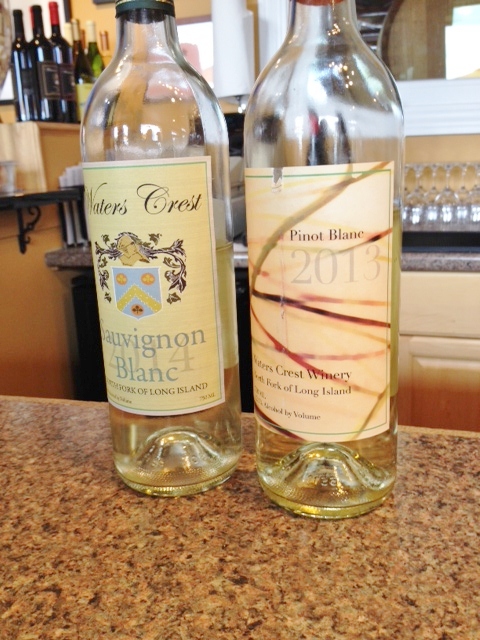
Waters Crest: A Learning Experience October 18, 2015

http://www.waterscrestwinery.com/

One view of the cozy tasting room

One view of the cozy tasting room

“This was a great year for whites, but probably not for reds,” opined our enthusiastic and knowledgeable server, Adam, at Waters Crest winery, one of the semi-hidden gems of the North Fork.  I love to listen to people talk about something they are passionate about, and Adam certainly fit that description.  Though he is working for Waters Crest at the moment, he hopes someday to have his own winery, and meanwhile the good part about working for a small place like this is “you get to do everything.” The good part for those of us who are curious about various aspects of wine making is that the servers here have always been able to do a great job of answering our questions.

Though you can see the wine-making facility through a window in the tasting room, you may wonder where the vines are.  Jim Waters buys his grapes from local North Fork vineyards, then makes the wines himself.  When we first arrived we had the room to ourselves, but then a couple of small groups came in, all clearly regular customers who knew exactly what they wanted, including which cheese from the small refrigerator to get and which pizza they wanted heated up.

The tasting room is hidden in a strip of stores off Sound Avenue, with the entrance on Cox Lane, just to make finding it even harder, but they hope to soon have a spot on the Main Road, which will be great.  We have been a fan of this tiny place ever since our first visit, as the wines tend to be both tasty and interesting.  The room is small, but newly furnished with comfortable leather stools and chairs.  The tasting menu offers all seven of their wines for $15, and so we opted to share a tasting.

  1. 2014 Sauvignon Blanc $25.99

“We treat this more like a Sancerre,” noted Adam, using cold fermentation and no oak.  The aroma is quite floral, with notes of pineapple and lemon, which also describes the taste.  As is often the case with this grape, it would be perfect with local oysters.

Two of the whites

Two of the whites

  1. 2013 Pinot Blanc $24.99

What is “indigenous yeast” and how does it work?  If you want to know, ask Adam! Most winemakers will treat their grapes with SO2 when they come in from the field in order to kill off the naturally occurring yeasts so that they can then introduce the yeasts they have bought, thus controlling the effect of the yeast.  With this pinot blanc (and also, as we discussed, Channing Daughters’ L’Enfant Sauvage and Roanoke’s The Wild!) the natural yeasts were allowed to stay on, which also meant that fermentation took longer.  The wine was fermented mostly in steel, with just a touch of oak.  The result?  Lovely.  Aromas of green apple and minerals, with a touch of funkiness preceded a taste of tart green apple and pear salad, with some nice minerality.

  1. 2013 Dry Riesling $24.99

Dry?  Bone dry!  This wine is made with grapes from upstate, from Gold Seal Vineyards, but it is not at all sweet.  .025 residual sugar, says Adam.  Interesting flavor, with notes of citrus and stone and a touch of funkiness.  Unlike most rieslings, which I would choose to have with spicy food, this would go better with duck, sausage, or, suggests Adam, knockwurst.  Good call.

  1. 2013 Reserve Chardonnay $23.99

After a time of steel fermentation, this gets six months in new French oak, so it is not too buttery.  You do get some typical butterscotch flavors, along with lemon and other citrus.  Good, a not untypical chard.

  1. 2012 Red Blend $19.99

The mixture of 50% merlot and 50% cabernet franc is blended in the bottle after being independently fermented.  This has my favorite label, inspired by the famous painting by Charles Demuth which was inspired by his friend William Carlos Williams’s poem “The great number 5.”  The aroma is typically cherry, like a merlot, and so is the taste.  It is fairly dry, and the tasting notes suggest some rhubarb in the flavor.  In any event, it is a good barbeque wine, and would be great with burgers.

The lineup so far, with the Charles Demuth-inspired label on the far right.

The lineup so far, with the Charles Demuth-inspired label on the far right.

  1. 2008 Cabernet Franc $39.99

“Now you can see how our wines age,” notes Adam.  “The tannins have fallen off.”  This has a very distinct taste, combining black pepper, tobacco, and smoke with the fruit flavors, and is balanced and mellow.  I start to say roast chicken, and then we agree it would be great with lamb.  The 08 is almost all gone, as they found a few cases forgotten in the warehouse!

  1. 2010 Merlot Grand Vin $59.99

After three days on the skins (which is fairly long) the wine spends two years in new French oak.  It was worth waiting for!  2010 was a great year for reds on the North Fork, and this one, which garnered 90 points in Wine Spectator, is excellent, with lots of tannins, black cherry , and a delicious aroma.  It could stand up to a good steak.

Nice color

Nice color

  1. 2010 and 2007 Campania Rosso $56 for the ‘07

If you’re counting, you know we should be done, but as a reward for our intense interest in the wines, Adam gives us small tastes of two Bordeaux blends from two different years just to show what else they can do.  These are Right Bank blends of mostly merlot, plus cabernet franc, cabernet sauvignon, and petit verdot.  Though the only difference in the wines is how long they have aged and the year of harvest, they are quite different.  The 2010 is dark red, while the ’07 is more of a garnet color.  The ’10 is really good, with tannins which finally make sense to me of the term “chewy tannins” and lots of layers of flavors.  The ’07 is almost over the hill, with asparagus in the aroma and a lack of depth.   Though it is not bad, I would definitely choose the ’10, and drink it soon!

Our bonus tastes. It pays to be serious about your tasting!

Our bonus tastes. It pays to be serious about your tasting!

Reasons to visit:  a chance to talk to knowledgeable servers (one time it was Jim Waters himself) and learn all about the wines; the Pinot Blanc, the Red Blend, the Cabernet Franc, the Merlot Grand Vin, the 2010 Campania Rosso; no crowds on a busy weekend (though this may change once they move to a more public spot).

wa outside

Bedell Cellars: High Art October 17, 2015

http://www.bedellcellars.com/

The bottles feature works of art by contemporary artists.

The bottles feature works of art by contemporary artists.

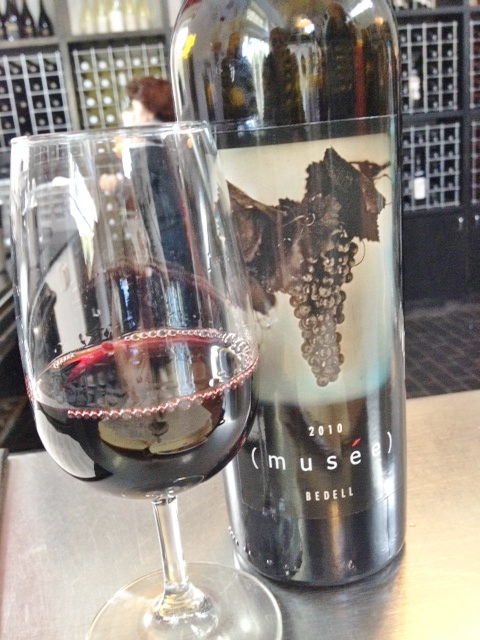
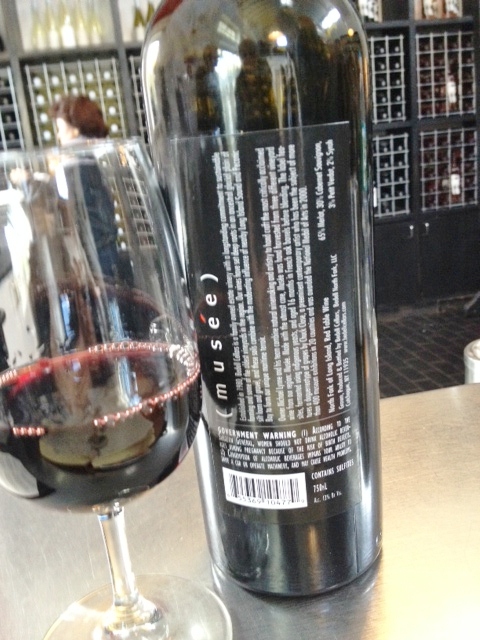
“Our owner is on the board of the Museum of Modern Art,” explained our well-informed server when we commented on the art on the wine bottle labels.  “He commissioned Chuck Close to do that one,” she added, as we admired the bunch of grapes on one label.  Wow.  And the prices of the wines also elicited a wow, including the Musée 2010, which is $125 a bottle.  You can learn more about the artists and the labels on Bedell’s web page, so I’m just going to discuss what’s in the bottles.

be room

And what’s in the bottles is quite good—though I’m not sure it’s $125 good.  The tasting menu offers two options:  five Estate wines for $15, or five Premium wines for $20, both featuring three whites and two reds.  We decide to share a Premium tasting, which turns out to be a good idea, as the pour is generous.  We also decide to return later in the winter to try the other menu.

One view of the large porch tasting room.

One view of the large porch tasting room.

We are standing at the bar, our favorite place for tastings, as this gives us the chance to chat with the servers and observe the scene.  This part of the tasting room is not very large, but an enclosed porch off to one side is much bigger, and is where most of the people doing tastings have congregated on this brisk sunny fall day.   It looks to us as though they could use more help behind the bar as it gets quite busy, but the servers do a good job of keeping us in mind, and we’re impressed that they never stop smiling.

This is my favorite label

This is my favorite label

  1. Blanc de Blanc 2010 $60

We start off with a 100% chardonnay sparkling wine, fermented in the bottle using the Méthode Champenoise.  Whoa, this is REALLY dry, also crisp and quite good, with a nice minerality and lots of flavor.  The aromas include yeast, mushrooms, and celery.  As it sits in the glass we get some hints of sweetness.  Definitely lighter than a California sparkling chardonnay, it would pair well with goat cheese or a mushroom terrine.  Mushrooms are on our mind lately, since we hope soon to check out the local mushroom growers whose storefront always seems to be closed.

  1. 2014 Viognier $40

Mmm, this smells nice, maybe some sticky peach, and my husband says French toast.  Maybe.  Light, dry, with what the tasting notes call “flinty minerality,” and also some peach tastes, this is a delicate wine that would go well with local flounder lightly sautéed in butter.

be viognier

  1. 2013 Gallery $75

This is a blend of 70% chardonnay, 24% viognier, and 6% sauvignon blanc, and is described by our server as a “white wine for red wine lovers.”  I want to ask her why, but she’s called away at that moment.  Perhaps it is because of the complexity of the flavors or the richness of the taste.  The wine is first fermented in steel, then spends ten months in new French oak, so it does have some buttery vanilla notes, but not too much.  We taste unripe peach, minerals, “hay” (according to my husband), and a touch of something chemical.  This starts off seeming quite tart, then gets sweeter, with a slight tingle on the tongue, and I could see drinking it as an aperitif.  It would also be fun to give this to people at a tasting and see what they make of it.

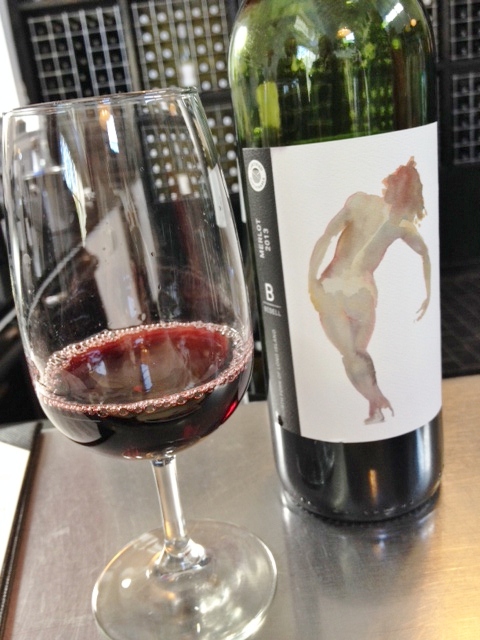
Merlot art

Merlot art

  1. 2013 Merlot $35

We get a new glass for each red.  The merlot spends ten months in French oak, so not very oaky.  We smell some chocolate, maybe Reese’s Peanut Butter Cups, then taste.  Briermere blueberry crunch pie, my tasting pal insists.   Hmmm.  It is very soft, not at all tannic, though dry, and does not have lots of the cherry flavor you usually get in a Long Island merlot.  It’s okay, but I see no reason to buy it over many other merlots.

I guess you could soak off the label and say you own a Chuck Close print.

I guess you could soak off the label and say you own a Chuck Close print.

  1. Musée 2010 $125

A Right Bank Bordeaux blend, this is 65% merlot, 30% cabernet sauvignon, 3% petit verdot, and 2% syrah, and features the Chuck Close label.  Though the price somewhat takes our breath away, this is a pleasure to drink.  It is aged 14 months in French oak, and has lots of layers of fruit flavors, with very soft tannins.  Nice mouth feel, and the aroma reminds us of raisins or Craisins.  We have had the opportunity to taste very high end French Bordeaux, and this does not quite equal those (at least in memory—don’t know what we’d think in a head to head tasting), but it is quite good.

be muse label

Reasons to visit:  the chance to admire some very artistic labels; the Blanc de Blanc, the Gallery, the Musée.

Patient pooch on the porch

Patient pooch on the porch

Another view of the porch

Another view of the porch

Paumanok: A Bit of a French Accent 8/29/15

https://www.paumanok.com/

Watch for the oyster sign!

Watch for the oyster sign!

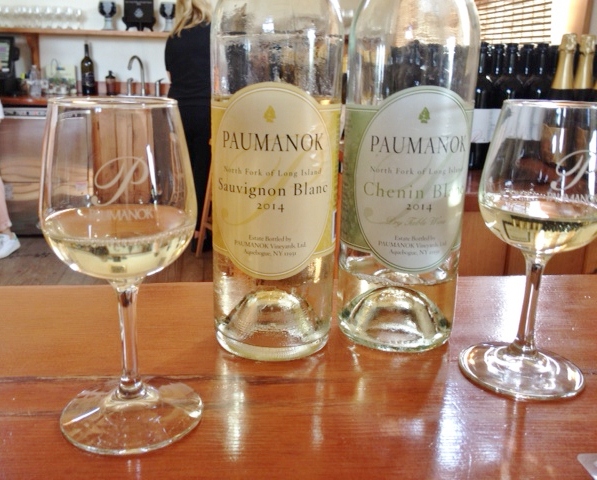
“We have the only chenin blanc in New York State,” asserts our server, so we are interested to taste the wine made from this French grape.   But more about that later.  On this beautiful late summer afternoon, the outside deck is filled with small groups enjoying the weather and Paumanok’s menu of raw oysters ($25 for a dozen) or large variety of cheese or charcuterie plates from Catapano goat farm and Lombardi’s Market.

Most people elected to sit outside on this beautiful day.

Most people elected to sit outside on this beautiful day.

The tasting room is small, but we manage to find room at the bar where we assess our choices.  The tasting menu lists nine options, from one taste of their sparkling wine to four whites or four reds for $12 each flight.  We opt to share one of each, but that still does not get us tastes of all their wines, in particular most of the Festival line.  Maybe next year.  The sign outside says “Winery of the Year,” but I’m not sure what that is based on.  However, it is a pleasant place, especially in the good weather when you can sit outside; the wines, while none of them send us into outer space, are fine; and I have to favor a place that quotes Walt Whitman on their labels (Walt, born on Long Island, liked to use the Native American name for Long Island—Paumanok—in his poetry.).  The gift area has a small selection of t-shirts and other gift items, but no volumes of Whitman’s poems!

The menu of tastings

The menu of tastings

  1. 2014 Sauvignon Blanc                    $24

If we had decided to have oysters, this is the wine I would have chosen to have with them.  The aroma is grassy and minerally, the taste tart and lemony with some tropical fruit notes.  Excellent.

Our first two tastes

Our first two tastes

  1. 2014 Chenin Blanc $28

I suppose because the bar is crowded, our server pours our tastes two at a time, which is good, because the wines are too cold, so our deliberate style of tasting—sniff, discuss, take notes, swirl, taste, discuss, take more notes—gives them time to warm up a bit. This is also a pleasant wine, a touch sweeter than the Sauvignon Blanc, with not much smell.  We decide we taste some sweet orange, perhaps tangelo.  A nice light summer wine, and you wouldn’t want to pair it with any food that was too assertive, as it would get lost.

A good oaked chardonnay if you don't like oaked chardonnays.

A good oaked chardonnay if you don’t like oaked chardonnays.

  1. 2013 Barrel Fermented Chardonnay $24

Our charmingly French-accented server points out that they have a steel-fermented chard on the Festival list, as we discuss the differences between steel versus oak and what we like about each.  We also notice that almost all the wines have screw caps, a boon to the corkscrew-use-challenged.  This is not overly oaky, with a toasty aroma and some vanilla taste, but not too sweet.  “A crowd pleaser,” we decide.  I think it would pair well with shrimp.

The riesling about which we disagreed.

The riesling about which we disagreed.

  1. 2014 Dry Riesling $22

My husband, a riesling fan, doesn’t particularly care for this one, which he finds not “riesling enough.”  I like it.  It has a bit of that cat pee aroma, plus some apple.  Our server says it has green apple tastes, and we agree, and would add a touch of Key lime citrus.  Simple and refreshing, this is a good riesling if you are not particularly a riesling fan.

  1. 2014 Semi-Dry Riesling $20

If you are counting, you realize that this is our fifth out of four white wine tastes, which we get courtesy of our server who, noticing our seriousness, wants us to try a different style of riesling and gives us a small sample of a wine from a different flight.  This is fairly sweet, almost candy-like, also relatively simple, and not to our taste—but it might go well with Thai food.

pau fest red

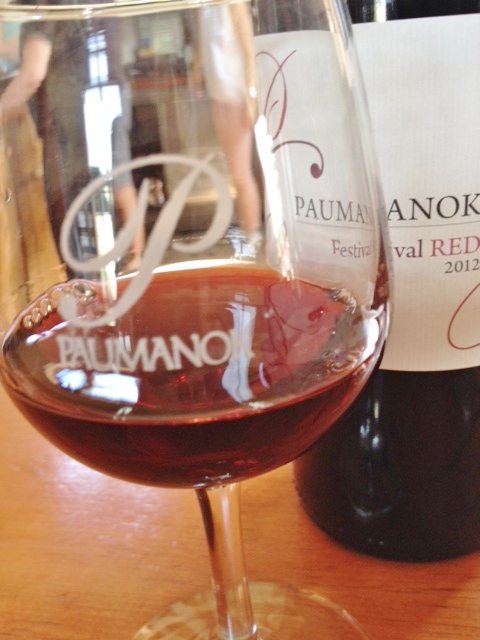
  1. 2012 Festival Red $20

The label says this “should be enjoyed with red meat,” but I would say not too red.  Maybe pork chops or veal or a cheese plate, as it would not stand up to a big steak.  A blend of 52% cabernet sauvignon and 48% merlot, this has a slightly piney aroma and is quite drinkable.  It is mellow, not complex, with a touch of tannin.  “I get a tingle on my tongue,” says my drinking pal.

  1. 2012 Merlot $24

Eh.  No aroma, not much taste,rather underwhelming.  Pischochs, I say, which my husband says I can’t use in a review.  It’s a Yiddish term meaning…watery.

photo (52)

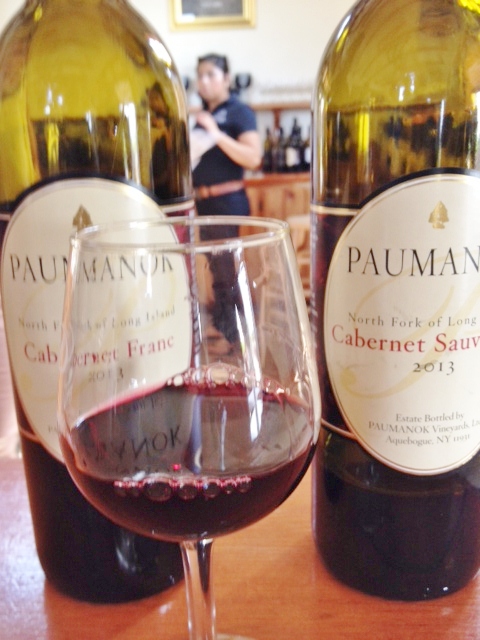
  1. 2013 Cabernet Franc $30

One of the servers gives us some more information on this wine, noting that 2013 was a very good year, and that this wine, a combination of mostly cabernet franc with “a touch of merlot,” drinks more like a pinot noir than a cab.  I would agree.  It is another nice wine, with a bit of a funky and blackberry smell and cherry and berry taste.  It’s not powerful, though it has some depth.

  1. 2013 Cabernet Sauvignon $30

Our server, who reveals she is from Toulouse, is pleased when we note that this is actually a Bordeaux blend, a mixture of 16% merlot, 2% petit verdot, and 86% cabernet sauvignon.  After she steps away we add to each other “Bordeaux light.”  Aromas of cherry, oak and red candy; tastes of red fruit, maybe plums, pleasantly dry.  Not a serious wine, we decide, but like almost all the wines we tried, fine.

At this point, we notice that there is no tip jar, which is too bad, since we would definitely have left a nice tip.  If we had elected to buy four bottles the cost of one tasting would have been deducted from the total, but we decide we don’t want any of the wines enough to buy four bottles.  However, there is nothing wrong with any of them (except that merlot!), so I wouldn’t cross this winery off your list if you were planning a visit.  It is particularly a good place to sit outside and get one of their food items with a glass of wine.  I’d recommend the Sauvignon Blanc with oysters or the Festival Red or Cabernet Sauvignon with a cheese or charcuterie plate.

I love that they quote Walt Whitman on the label!

I love that they quote Walt Whitman on the label!

Reasons to visit:  the Sauvignon Blanc, the only Chenin Blanc in New York State, the Festival Red, the Cabernet Sauvignon; a nice outside deck where you can enjoy their cheese or charcuterie or oysters with a glass of wine; labels that quote Walt Whitman.

One view of the outside deck.

One view of the outside deck.

photo (23)

photo (26)

Mattebella Vineyards: Science Experiment! August 9, 2015

The small tasting cottage

The small tasting cottage

http://www.mattebellavineyards.com/

“So first you’re going to try the 2009 chardonnay and the 2013 steel chardonnay,” our charming server explains, pointing out the ways in which they compare.  She also sets down in front of us two pieces of baguette topped with double cream brie, about which more later.  Mattebella gives you the opportunity to make side by side comparisons of their wines, and in the process you can learn some interesting aspects of wine making, which I’ll tell you along with my discussion of each wine.  We started to compare our experience with doing a fun science experiment.

What amazing hydrangeas!

What amazing hydrangeas!

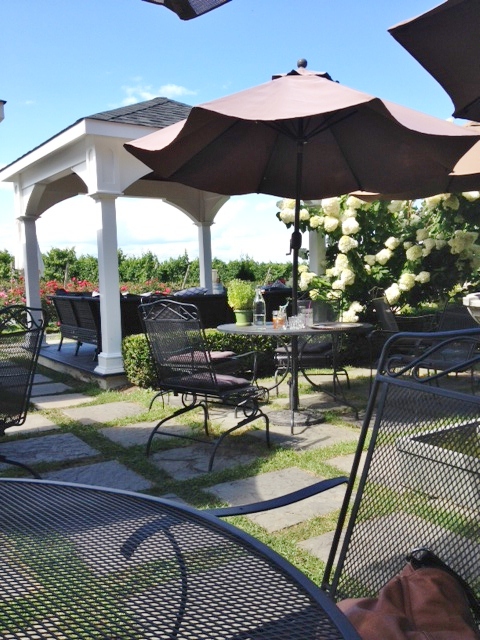
Another attractive feature of the winery is their beautiful outdoor patio setting, with a variety of comfortable seating surrounded by lush hydrangea and rose bushes.  The tasting “cottage” itself is quite small, so this is a place we reserve for beautiful days when we can sit outside and relax while being served.  Others clearly think so, too, for though the patio was very quiet when we arrived, several groups walked in shortly after we did and all seemed to be enjoying the experience, including one group of young people who entered into a lively discussion with Mr. Tobin, the owner (with his wife, who was also there) of the winery.  It is quite a family place, as evidenced by the active participation of the owners in the tasting room, the name of the vineyard—named for their two children—and the name of most of their wines: Famiglia, Italian for family.

Mr. Tobin entertaining a group.

Mr. Tobin entertaining a group.

Service is warm and personal, and the wine tasting includes some small tastes of food, since they believe that food affects how wines taste.  The menu has two main options:  the Light Flight is $17 for 6 whites and 2 rosés, or the Red Flight, $19 for five reds.  (Note—they do not accept American Express, though they take other cards.)  You can also order individual tastes for $2-$6, glasses of any of the wines, or a glass of their wine cocktail or sangria for $14.  Non-drinkers can order their house-made lemonade or water.   We decide to share one of each flight, so we can try all the wines.  Though there are a lot of tastes on the menu, our server tells us that it is a one ounce pour, so we figure we can handle it!

Light Flight

  1. 2009 Chardonnay            $21

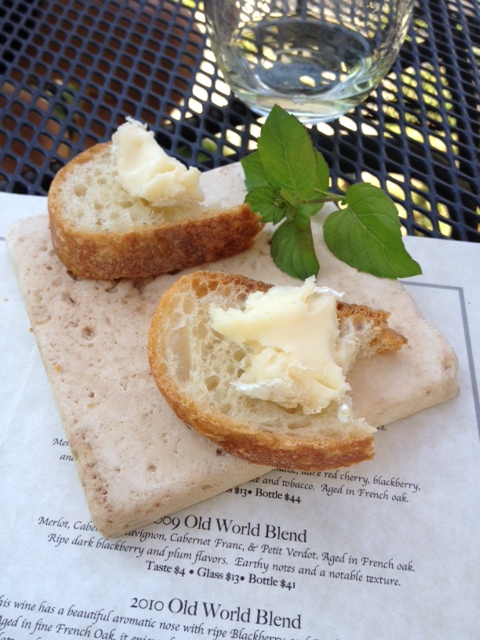
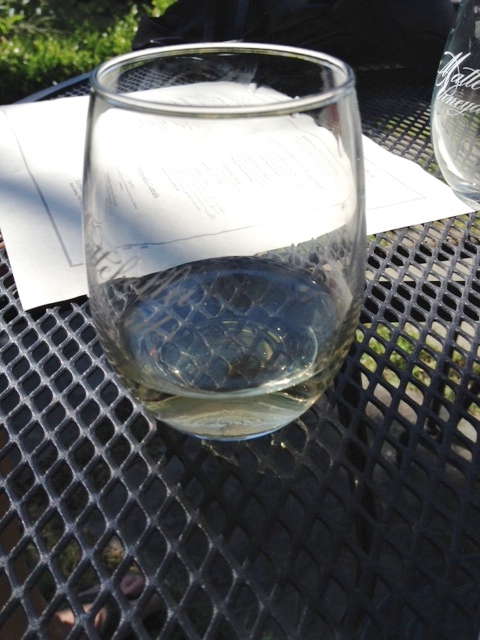
We thought the server might have been a little confused when she set two glasses down on the table, but she soon explained that she was serving two wines side by side so we could compare them.  The 09 is an oaked chard from a cold season, she noted, which made it fairly “crisp and sharp” and an interesting foil for the 2013 steel-fermented chardonnay.  She also set down a pretty pottery plate with two pieces of baguette topped with double cream brie.  She recommended that we experiment by tasting each wine, then taking a bite of the cheese, and then sipping the wine again to see how having it with the creamy cheese changed the effect of the wine.   Okay!  The ’09 has a perfume-y aroma of pear and citrus, with, says my husband, “a fair amount going on.”  Once we take a bite of the cheese, we note more vanilla and baked pear tastes, as well as a surprising amount of citrus for an oaked chard.  On to the ’13.

Double cream brie on baguette.  Yum.

Double cream brie on baguette. Yum.

  1. 2013 Steel Chardonnay $21

The aroma is faintly grassy, the taste good, with some fruit but fairly dry, maybe a touch of bitter orange.  We don’t see as much change with this one after the bite of cheese as the other, but it is a good complement to the cheese.  Usually I think of red wine with cheese, but with a soft rich cheese I will now consider whites as well.

  1. 2010 Chardonnay $21

Now we are asked to consider another pairing of the same grape, treated similarly (both lightly oaked, this one 20% oak and 80% steel fermented), but from very different years.  2010 is generally considered to have been a very good year on the North Fork, with warm dry weather which led to great ripening of the grapes.  No surprise, this is a lovely rich chard, with great depth of flavor, the aroma grassy, fruity, and sweet.  If we needed a white at the moment, we’d buy it.

m white

  1. 2011 Chardonnay $21

In contrast, 2011 was a very rainy year, and so the grapes contain a lot of water.  Wow—this wine is waterier!  Although it is only 5% oaked, the taste has lots of oak in it, perhaps because there’s not as much chard taste to counteract it.  We smell the expected woodsy vanilla aroma, and the taste is quite light, almost evanescent.  Our server characterizes this as a sipping wine.  I think if you put an ice cube in it on a hot day you could almost forget you were drinking wine.

  1. Famiglia 2012 $21

Now we get to try two wines from the same vintage year, same grape, but treated differently.  This is fun, we tell each other.  2012 was another good year.  The Famiglia is 20% oaked, with aromas of vanilla, baked pear, and butterscotch.  It is lighter than one might expect of an oaked chard (so for those of you who say “I don’t like chardonnay,” you need to try a bunch of differently treated chards), with some sweetness at first taste which then dissipates.  Fine, but we like the 2010 better.

  1. Reserve 2012 $28

This chardonnay has been 38% aged in French oak, and we have no trouble telling which is which just on appearance, since this wine has a darker gold color than the other.  Mmm…smells good and tastes good, too.  Lots of oak and fruit tastes, mouth-watering, “softer and sweeter,” opines my drinking pal.  Very easy to drink.  It would be good with spaghetti and fresh clam sauce or sautéed scallops, though you wouldn’t want it with anything too creamy.

  1. 2014 Rosé $20

Mrs. Tobin stops by to say hello and give us a bit of background on the rosé.  It is 90% merlot and 10% cabernet franc and chardonnay, she tells us; the merlot is a Pomerol, the 181 clone also used by Croteaux.  The grapes are picked when they are still “crunchy.”  We smell and taste strawberry, green apple, and a touch of lime.  Very light.

The

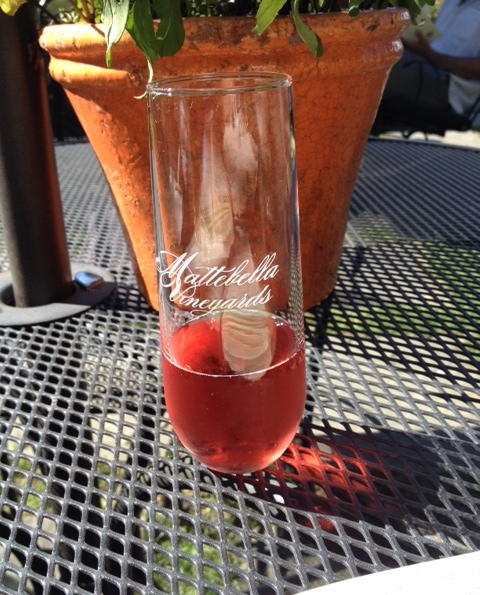
The “fun, party” sparkling rose.

  1. 2014 Sparkling Rosé $27

We get a new glass for the sparkling rosé, a tall slim one.  This is a fun wine, Mrs. T. tells us, not at all serious, and the syrah grape juice accidentally spent too long on the skins, hence its dark pink color.  Lots of over-ripe strawberry smells and tastes, almost soda-pop-y, this is much too easy to drink.  I decide to dub it the bachelorette party wine, and indeed I observe the young woman at the next table order a full glass of it, while her companion opts for a glass of sangria.

Red Flight

  1. Famiglia Red         $23

In 2012 we bought the Famiglia Red for $15, and last year it was $21, but prices do tend to rise, even on the non-vintage wines, though this is still a bargain compared to their other reds.  This is a good everyday wine, and goes with pizza and pasta, as our server tells us.  It spends a year in French oak, and then is put into steel to stop the aging.  (By the way, Mattebella is one of the vineyards that uses the facilities at Premium Wine Group to produce their wines.)  We smell leather and fruit, taste some cherry.

m red

  1. 2008 Old World Blend $44

With this wine a small plate arrives with pairs of treats—fig jam and gorgonzola on baguette, bacon jam and grana cheese on baguette, and little bits of brownie—which we are advised to pair with our next wines.  These are all Bordeaux blends, with varying percentages of the grapes.  The ‘08 is 86% merlot, 7% cabernet franc, and 7% cabernet sauvignon (The petit verdot didn’t ripen in time, we hear.)  We smell dark fruits, though the wine is on the light side.  The taste improves after a bite of the yummy fig jam and gorgonzola, a combo I will definitely try at home.

More yummy snacks!

More yummy snacks!

  1. 2009 Old World Blend $41

Since I asked about the percentages on the last wine, our intelligent server makes sure to tell me these:  93% merlot, 3% cabernet franc, 3% petit verdot, 1% cabernet sauvignon.  Remember, this was a cold, rainy year.  The wine is fairly tannic, with aromas of earth and minty candy, not very complex.   Having it with a bite of bacon jam and grana cheese does help.  Then again, what wouldn’t be helped by bacon jam!?

  1. 2010 Old World Blend $48

If you come here for a tasting, you will definitely understand the difference a year makes.  We tend to forget that winemaking is farming, dependent on earth and weather, but this progression of vintages makes that clear.  If their “biodynamic” farming methods are as effective in the fields as they are on the huge hydrangeas we are admiring, they must work amazingly well.  The blend here is 88% merlot, 8% cabernet franc, 3% cabernet sauvignon, and 1% petit verdot, and we are also advised that this could be cellared for 4-5 years.  We smell dark fruits, taste lots of cherry, a touch of chocolate, good tannins, though not a lot of complexity.  It is good with the brownie!

  1. 2007 Old World Blend $63

84% merlot, 12% cabernet franc, 2% cabernet sauvignon, 2% petit verdot.  Of course, they saved the best for last—and also the costliest.  The aroma is delicious and so is the taste, with a “nice mouth feel,” says my pal.  It is very good, but we have had the privilege of tasting world-class Bordeaux, which this is not—on the other hand, it doesn’t cost as much as they do, either!

The herb garden near the tasting patio.

The herb garden near the tasting patio.

Reasons to visit:  a beautiful outdoor setting with friendly table service; the fun of experimenting with tasting wine with and without food (and where else is food included in your tasting?); the fun of comparing vintages and methods of winemaking; a chance to learn about the influence of weather on grape crops and hence on the wines; the 2010 chardonnay; the 2012 Reserve Chardonnay; the 2014 Sparkling Rosé for a fun party drink; the Famiglia Red; the 2010 Old World Blend.

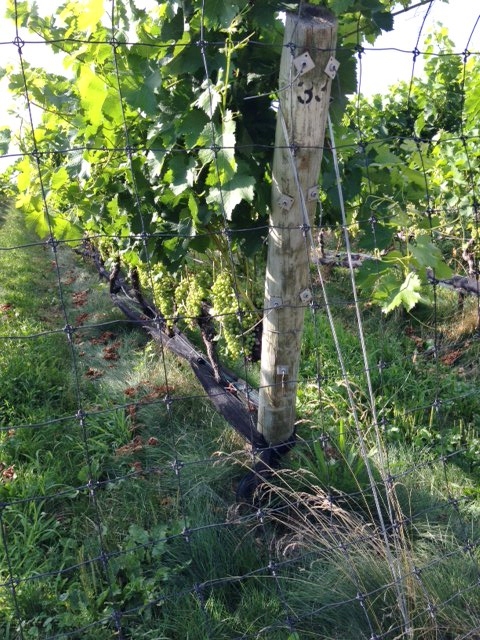
If you look carefully at this picture of the grape vines, you'll notice that they don't use herbicides.

If you look carefully at this picture of the grape vines, you’ll notice that they don’t use herbicides.

m garden 2

m pavillion