RGNY: On a Winter’s Day

February 19, 2024

It is quiet on the North Fork in February. Snow fences stretch across fields, farm stands have “See you in the Spring” signs, and roadside platforms have little stacks of firewood, $5 per pile. However, our visitors found plenty to do, including a trip to Tanger and an odyssey to the end of the island, where we had a cold, windy, but invigorating hike along the trail in Orient Point County Park and participated in the Great Backyard Bird Count (34 seagulls, three little ducks, and two immature cormorants).

The end of the North Fork and some birds.

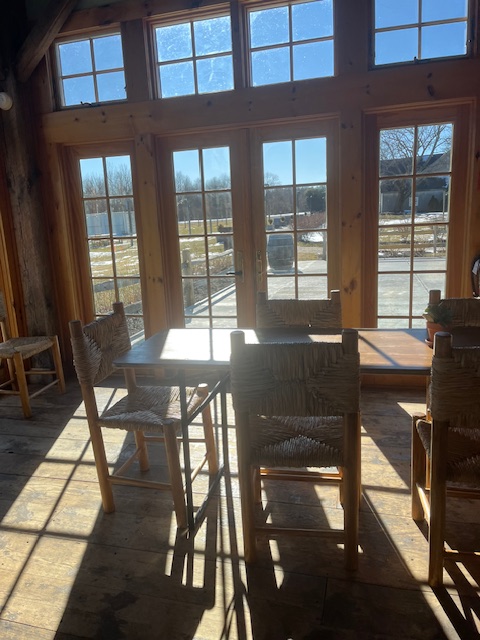
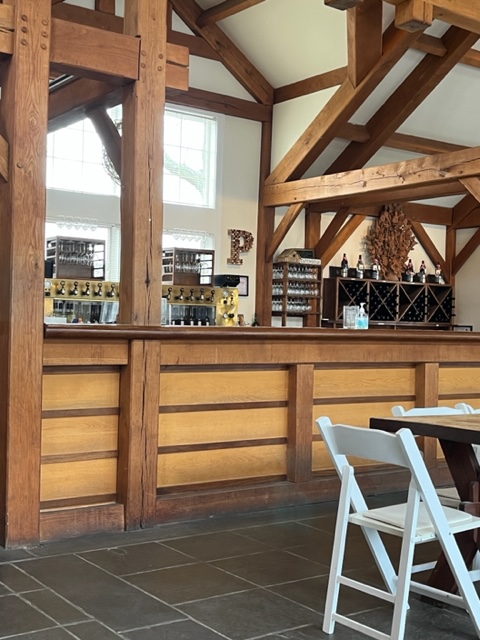
Then it was time to do a wine tasting.  Where to go?  I realized we hadn’t been to RGNY since 2021, and it is close to our house, so off we went.  The main entrance now seems to be the one to the right, as you face the building, so we opened that door and were greeted by John, whom I recognized from other wineries!  He quickly showed our party of six (4 adults, 2 children) to a nice round table in the high-ceilinged, wood-beamed tasting room (which one young guest noted “smells like wood”—sort of like a cabin on a lake), where a QR code on the table sent us to the menus.    

Don’t be fooled by that sunshine; it was cold outside!

There is a fairly typical menu of snacks, with more substantial choices available on the weekend, but we had just had a delicious and very filling lunch of sandwiches from Ammirati (on Love Lane in Mattituck), so we went straight to the menu of flights.  There are four choices of flights, all featuring four wines: the RG Reserve for $34, the Scielo for $24, the White Wine for $27, or the I (Heart) NY for $27.  Since the last one includes non-North Fork wines, we opted for the first three, planning to do some sharing of tastes.  Well, even with sharing we left some wine in the glasses, because you get a VERY generous pour there.  The youngsters in the group were not forgotten, as Donna, our pleasant waitress, offered them glasses of orange juice—served in tall sparkling-wine glasses—as they had leftover OJ from a brunch on Sunday (no charge!).

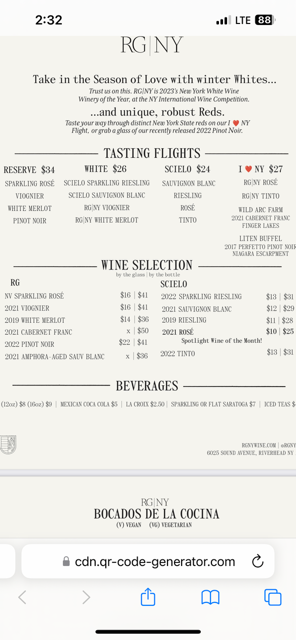
Donna gave us a quick overview of the wines in our tastings—there were a couple of overlaps—and then left us to ourselves, checking back at regular intervals.  At the end, we had an interesting discussion with John about the wine philosophy of RGNY—low intervention, nature-friendly practices.  Overall, there were no wines we disliked, and several we liked very much, though our group had some differences of opinion (As the French say, to each his own.).

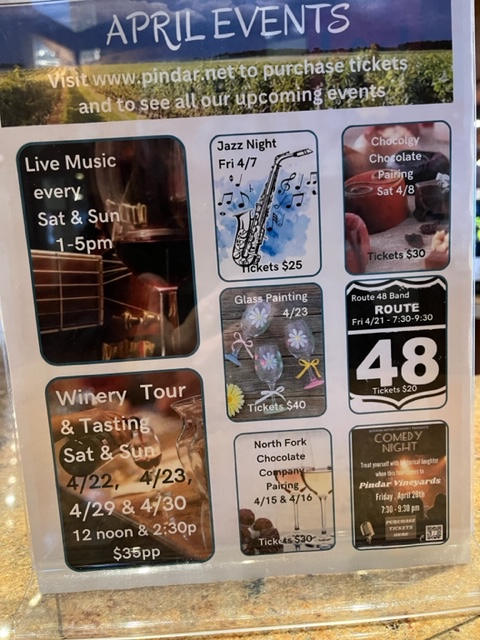
Some of the special events that are available at RGNY.

I started out trying to keep the wines from each tasting separate, but that didn’t work out, so here are the wines as I took note of them.

Tiny cacti decorate every table, perhaps a nod to the Mexican origins of the Rivero Gonzalez family.
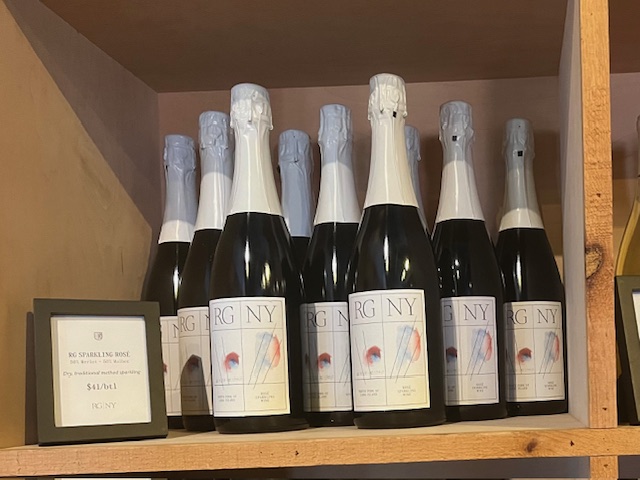
  •  NV Sparkling Rosé        $41

I like starting a tasting with a sparkler, as it feels very festive.  This has the typical rosé aroma and flavor of strawberry, and is dry, with definite minerality and tiny bubbles.  There’s also a slight flowery aroma.  This is a pleasant, cocktail-time bubbly, though I think the price is a bit high.

The Reserve flight
  • 2021 Sauvignon Blanc  $29

“Melon on the nose,” says one of our guests, and I agree, though I try to eschew “wine words.”  Speaking of “eschew,” he also describes the wine as a bit chewy.  It has more body than one would expect from a sauvignon blanc, with what I describe as a silky mouth feel, and a taste of lemon zest.  It is aged in neutral oak. I like it, but our other guest says her appreciation of this wine is lessened due to “unmet expectations,” as it lacks the grassiness she likes in New Zealand sauvignon blancs.  Not being a cow, I’m perfectly happy to drink this. 

  • 2022 Sparkling Riesling               $31

However, she very much likes this next wine, a cloudy (because not disgorged) sparkler with lemon/lime and kiwi flavor, very dry.  I am not as fond of it, but agree it would be good with some local oysters (like the Peconic Bay ones we had the night before) or even fried calamari or fish and chips.

The Scielo flight
  • 2021 Viognier    $41

Donna explained to us that most of the wines here that are aged in wood are aged in second use (also described as neutral) oak barrels, which means that the wood plays less of a role in the taste of the wines than if they had used new barrels.  Though this is only slightly oaked, which smooths it out, it also has not much taste.  I say it is inoffensive.

  • 2019 Riesling    $28

I will almost never order a riesling unless I have tasted it before, since they can be too sweet for me, but this is a riesling I would order.  It is dry, with pleasant minerality and some taste of herbs.  We discuss the typical “cat pee” smell, which one guest suggests could more appetizingly be described as “musky.”  I compare it to the smell of water in which cut flowers have sat perhaps a day too long.  Fortunately, it doesn’t taste like that!

The White Flight: note the cloudiness of the Sparkling Riesling on the left.
  • 2019 White Merlot         $38

We have quite a divergence of opinion on this wine, a white wine made from red wine grapes (Wine color comes from the grape skins, so if you don’t let red wine grape juice sit on the skins at all, you get white wine; sit briefly, rosé; longer, reds.).  My husband doesn’t like it at all, I think it is nice, and one guest notes it has some of that “Long Island foxiness” one used to get more frequently with merlots.  It does have lots of flavor, including some earthiness and an aftertaste of mandarin orange.
  • 2021 Rosé          $25

Strawberry aroma and flavor, light, dry, minerality, pleasant…I say meh.  Still prefer Croteaux!

  • 2022 Pinot Noir               $41

Because this is fermented in steel, not oak, it has a pure, clean taste.  It has a light red color, with surprisingly nice tannins and an aroma and flavor of cherries.  I say this is easy to drink, and it would go well with roast duck, one of our mutual favorite dishes.  Our guest agrees, and notes that “pinot noir and duck are best friends.”

  • 2022 Tinto          $31

Donna rattled off all the grapes in this blend, but I don’t remember them all, or the proportions:  cabernet franc, cabernet sauvignon, merlot, malbec, etc.  This is a lovely red, very refined, with flavors of blackberry and currant, and lots of tannins.  This could definitely stand up to a hearty beef stew, or even a burger.  I could see ordering it if it appeared on a wine list.

The little gift shop features some objets from Mexico.

Reasons to visit: spacious tasting rooms, plus ample outdoor areas; child-friendly atmosphere (we were not the only ones there with youngsters); some very good wines, all very drinkable; I especially liked the White Merlot, the Pinot Noir, and the Tinto, while our guests bought to take home the Sparkling Riesling and the Pinot Noir; very generous pour; good menu of snacks and other dishes.  If you do the math, you may be wondering how we had three tastings of four wines each, and I only ended up describing nine of them.  Some wines appeared in more than one tasting!

Here’s a great gift idea–a “blending kit,” so one can produce one’s own blended red. Like a chemistry kit for grown-ups, noted John, who nodded when I compared it to the blend-your-own gin experience at Matchbook Distilling Company.

Lenz Winery: Party Time

November 4, 2023

Our friends the winery aficionados invited us to join them for the Lenz pick-up party for members, so of course we said yes.  Though we’d been to Lenz not that long ago—in August, with a friend who brought his dogs along—we were happy to see what their pick-up party was like.  We also got to try some wines we had not tried before.

Pellegrini used to do a pick-up party with generous spreads of charcuterie and cheeses, but since they now charge $35, we stopped bothering to go.  No way will we eat $35/person-worth of cheese!

The event was well attended.

When we arrived at Lenz at 5 p.m., our group was ushered into the tasting room, where tables were set with glasses—four per person—and bamboo utensils.  Soon, we were served food provided by Lombardi Love Lane Market:  a couple of ravioli, a small bowl of lentil soup, and bruschetta topped with caponata and chopped tomato and garlic.  The food was fine, especially given that it was free!

After we tried the four wines on offer, the director of sales, Jerol Bailey, made a short speech about the harvest and the wines, and then went around from table to table offering a few additional tastes.  Lenz is one of the oldest wineries on the North Fork, and they take their wines very seriously.  We liked all the wines we tasted, though some more than others. 

Jerol Bailey addressing the group.

Since this was mainly a social occasion, my notes are brief.

  •  2017 Estate Selection Chardonnay $22

I was a bit leery of this one, since it is a 100% oaked chardonnay, but even though the tasting notes described it as “buttery,” it was not overly so.  The butterscotch flavor was balanced by some nice citrus and green apple notes.

  • 2015 Old Vines Gewürztraminer $30

I remember years ago, before I started this blog, heading to Lenz to buy their gewürztraminer for Thanksgiving.  Good move.  Though it did not go well with the bruschetta, it would pair beautifully with roasted turkey and other savory dishes.  It has a lovely floral aroma and spicy tastes.  I think it would also go well with ham, since I taste a bit of cloves.

  • 2018 Estate Selection Malbec $45

Malbec is often blended with other grapes—more about that in a moment—but here it stands on its own.  They say “medium” body, though I find it rather light for a red.  Still, it is dry, with some tannins that make me think it might improve with age.  I smell olives and tobacco.

  • 2017 Estate Selection Merlot $37

So here’s the thing about Long Island merlots—just about every winery has one, or more, at varying price points.  I don’t think any of them can compete with North Fork Project merlots, at about $11 for a liter.  However, this is an easy to drink red, with good cherry taste and aroma, and goes well with the lentil soup.

  • Cabernet Sauvignon

That’s the end of the flight, but Jerol comes to our table with a couple of other reds, and so we get to try the cabernet sauvignon, which is quite delicious, with lots of red fruit and some complex tastes.  I don’t know which of the three cabernet sauvignons this is, so I don’t know the price, which could be $27, $35, or $60. As we are discussing the wines, I ask him, speaking about the malbec, why they don’t do a Bordeaux blend, given that they have all the grapes.  Next thing I know, I get another extra taste.

  • Firefly Red Blend $22

This is their red blend, with an aroma of flowers and fruit and a light, fruity, juicy taste.  Yum, and very buy-able.

Reasons to visit:  VERY dog friendly; a pleasant tasting room and outside area; a well-run pick-up party for club members; all the wines are good, to varying degrees, but I particularly liked the gewürztraminer and the Firefly Red.

Paumanok Vineyards: Lunch Again!

October 19, 2023

I love the barn-like aesthetic of so many of the vineyards on the North Fork.

We enjoyed our lunch at Jamesport Vineyards so much, we decided to head a little further down the road and do it again at Paumanok.  We hadn’t been there since before the pandemic, so it was definitely time to go back.  We were planning to sit outside on their pleasant wooden deck, but just as we got there the sun hid behind some clouds and a breeze made us shiver.  Of course, shortly after we were settled inside the sun came back out—it was that kind of a if-you-don’t-like-the-weather-wait-five-minutes day—but we were happy with our table by the large windows.

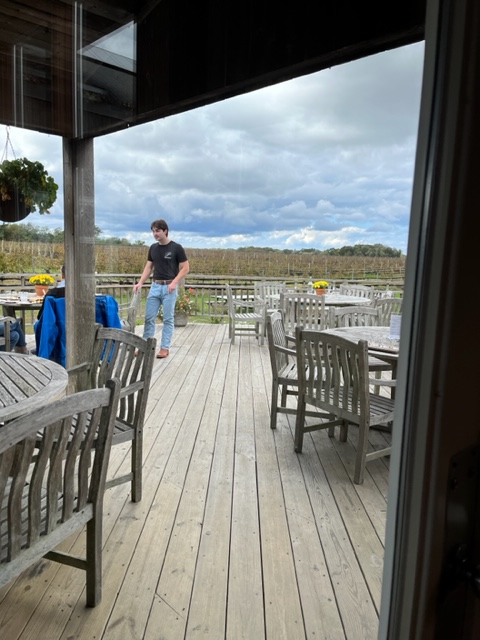
That’s our waiter Rob out on the deck.
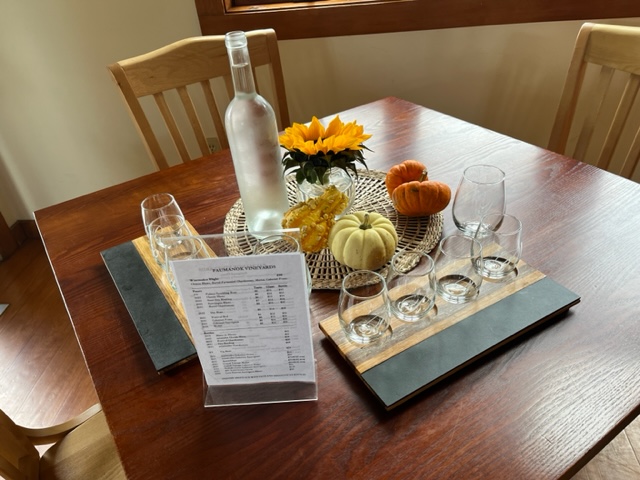
The tables were pre-set with glassware and seasonal flora.

We were shown to our seat by a pleasant young woman, who also provided us with a bottle of chilled water.  The tables were all already set, with sets of four glasses for tastings and larger glasses for the water, plus very attractive seasonal arrangements of gourds, etc.  We perused the menus, one for wine and another for food, and decided to share a Winemaker Flight, of two whites and two reds for $22, and get the Cheese and Charcuterie Board for $35. 

Our flight arrived about ten or fifteen minutes before our lunch, so we had plenty of time to sample all the wines before starting on the bountiful tray of food.  That meant that we knew which wines we liked the best, and then had the chance to decide which went best with the snacks.

We found the pour generous enough that it was easy to share.

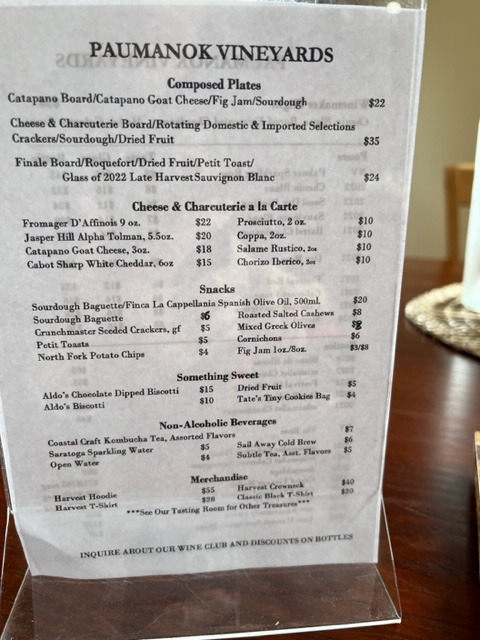
The board was ample, enough for at least four people, and we ended up taking home many crackers (including some very tasty gluten-free ones), half the little loaf of bread—which arrived warm, a nice touch—most of the olives and cornichons, some cheese, and a couple of slices of prosciutto and salami.  We enjoyed the brie the most, as the other cheeses were…undistinguished, but overall we were happy with the food.  Another time, I might think about ordering a la carte, though that might end by costing more.  It is nice that they use compostable bamboo utensils and plates, though those knives and forks, unfortunately, don’t work very well.  By the way, they don’t allow outside food, and dogs are only permitted during the week.  I guess they figure it gets too busy on weekends to allow for dogs.

Lots of yummy stuff!

Our waiter, Rob, checked back with us at proper intervals, and shared his knowledge of and enthusiasm for the wines, which enhanced our experience.

  •  2022 Chenin Blanc          $32

“Multi-dimensional,” opined my tasting buddy, as we enjoyed our first sips.  The aroma reminds me of white grape juice, and the flavor mixes sweet and tart, with notes of ripe pineapple.  Very good, we decide, and move on to our next wine, leaving about half the glass to consume with our cheese and charcuterie.

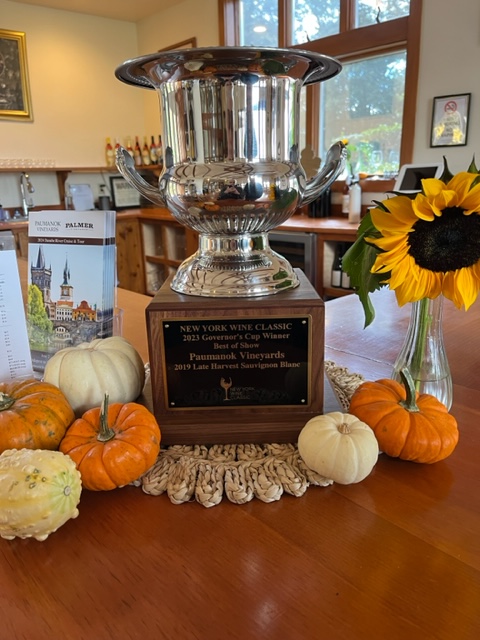
The bar featured a nice award they won.
  • 2021 Barrel Fermented Chardonnay          $32

I was a bit concerned about this, as I often dislike oaked chardonnays, but Rob assures us that this is aged in neutral, or used, oak barrels for only six months, so it is not too oaky.  He’s right, and we find this pleasantly smooth, “fruit forward,” according to my pal, who has been reading Wine Spectator.  I think it has a taste that is a nice balance between steel and barrel fermented chards.  It also goes the best with our lunch.  I used to think that charcuterie, being meat, should be paired with reds, but now I prefer whites.

  • 2020 Merlot       $36

There are so many versions of merlot on the North Fork that there is surely one for every taste.  This one has aromas of cherry and oak shavings, but does not have much fruit taste.  I say it is rather light, and my husband says, “It’s kind of quiet,” which I think is apt.

The Massoud family photo, behind which you can see into the winemaking area.
  • 2021 Cabernet Franc       $36

We prefer the cab franc, which, though it is also light, with soft tannins, has more interesting fruit flavors and a longer finish.  I think it also goes better with the cheese than the merlot. By the way, we felt the pour was more than adequate for sharing the flight.

Reasons to visit:  pleasant deck and tasting room; good service; the chenin blanc, though all the wines were drinkable; a pricey but bountiful cheese and charcuterie board; dogs allowed during the week.

The grapes have been harvested. It was a day of alternating sun and clouds.

Old Field Vineyards: A Family Affair

September 2, 2023

Why do I title this “A Family Affair”?  Two reasons:  I went there with a number of family members, and the winery is very emphatically family owned.  Perry, who greeted us cheerfully at the sign-in desk, and her mother are the winemakers and owners.  In addition, this is a good place to come with a family, as there is room for children to roam about the lawn and they can buy a little container of mealworms to feed the chickens.  In fact, Perry started our visit by warning us that someone had left the door to the chicken coop open, and they were wandering the lawn, just in case any member of our party had chicken-phobia (Well, she didn’t quite put it that way.)  Sounds more like a feature than a cause for a warning, I replied.

This visit to Old Field, while still having that laid-back vibe, felt somewhat different.  First of all, there were many more people there than I have seen in the past, though that could be due to it being Saturday of Labor Day weekend.  Then, instead of moseying over to the deck and sitting at a calico-tableclothed table, we ordered at the sign-in desk and were directed to find a table on the lawn, and told our flights would be brought to us.  We picked up two bags of popcorn for the little ones and a small container of meal worms ($1 each) for the chickens. By the way, they still allow visitors to bring their own picnics, just requesting that one clean up after oneself.

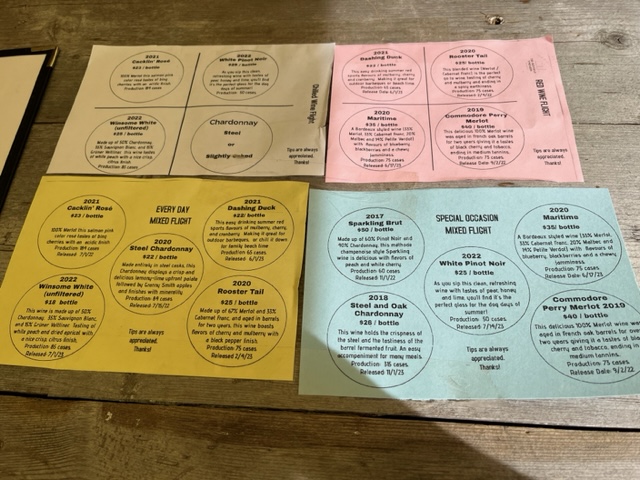
After a very short wait, during which the youngsters in our group, accompanied by their mother, walked over to the icehouse and the little pond, our flights were set down on the table.  The tasting menu offered four options: four whites, four reds ($20), the everyday mixed flight of five wines ($24), or the special occasion mixed flight of five wines ($30).  We decided that each couple would share one of the mixed flights, so that in all we tasted ten wines.  The flights were served on a tray, in compostable plastic cups, with glasses for each of us, which made sharing easy and hygienic.  As we sipped and chatted, a curious chicken stopped by our table to check if we had any snacks, but we were not planning to share our popcorn, and the children had already fed the mealworms to some other fowl.

At the end of your tasting, you walk back past the sign-in desk, where you can pay and also get any bottles to take home.

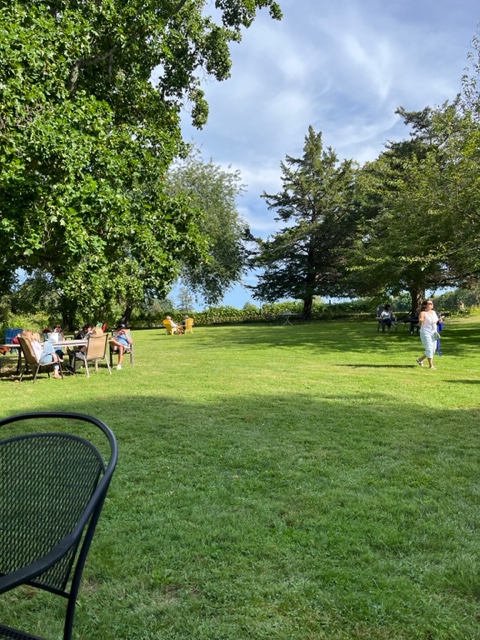
One view of the capacious lawn. We are headed to the blue table, with its comfortable chairs.

The following notes are in more or less the order in which I tasted the wines, so you might want to refer to the menu to see which wine was in which flight.

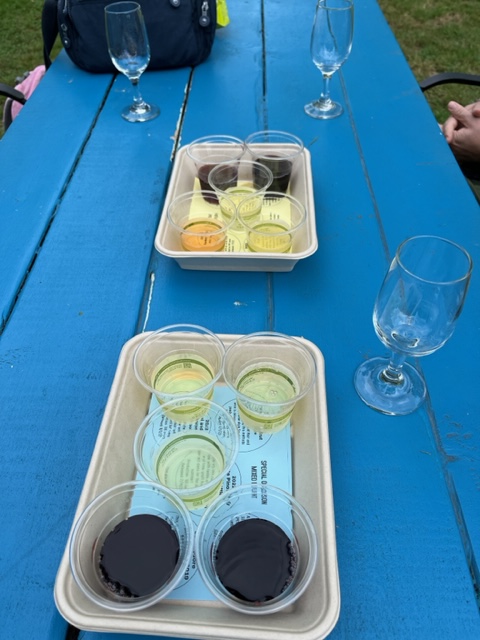
Our two flights, with the glasses for each individual.
  •  Sparkling Brut   $50

Good, but not $50 good was the group assessment of this very nice, dry, yeasty sparkling wine, which started off the special occasion mixed flight.

  •  2021 Cracklin’ Rosé        $23  

Made from 100% merlot, this is an unusual rosé, with not much fruit and a slightly funky undertone, with some cherry taste.  This was the first wine in the everyday mixed flight.

Though these cups look like plastic, they are actually corn-based and can be composted.
  • 2018 Steel and Oak Chardonnay                $26

This is made from a combination of steel-aged and oak fermented chardonnay. The leftovers? joked my husband.  For a combined wine, this is surprisingly simple, noted one guest.  It is pleasant, but a bit oakier than I like.  It has some citrus taste but also a bit of that I chewed on my pencil flavor.

This is the one we brought home.
  • 2022 Winsome White     $18

A blend of 50% chardonnay, 35% sauvignon blanc, and 15% grüner veltliner, this very winsome white has a touch of effervescence and some lovely peach flavor.  We like it so much that we buy two bottles at checkout.

  • 2022 White Pinot Noir    $25

Another winner.  Our guests like this the best of their tasting, and find it delicious, with tastes of pears and honey and some depth.  We discuss how one makes white wine with red wine grapes with the children, who understand that if you take off the skins right away, you get white wine. 

  • 2020 Steel Chardonnay                  $22

Not my favorite of the day, as it has a somewhat metallic taste and some earthiness.  It is light and dry. 

  • 2019 Commodore Perry Merlot                 $40

What’s Commodore Perry’s name doing on a North Fork wine?  The famous seafarer, who opened up Japan to Western trade, is an ancestor of the owners of the winery, and this 100% merlot is named in his honor.  Aged in French oak, it is quite tannic, with tastes of black cherry and tobacco.  I could see aging it.

  • 2021 Dashing Duck          $22

A light red, we all agree, which would go well with roast chicken.  Then we get into a discussion of the “red-feathered” chickens raised by 8 Hands Farm, as opposed to the “rouge” chickens our guests get in a Queens green market.  “In Jackson Heights, we say ‘rouge,’” jokes a guest, in a mock-haughty accent.  In any event, this wine has a lovely aroma and tastes of cherry and cranberry, with “some brio,” notes a guest.

  • 2020 Maritime $35

“Oh, that is chewy,” says the same guest, reading the notes while sipping this Bordeaux blend of 33% merlot, 33% cabernet franc, 20% malbec, and 14% petit verdot.  Very tasty, with blackberry and other dark fruit flavors. 

Is this chicken annoyed because we won’t share our snack or because we’re drinking Rooster Tail?
  • 2020 Rooster Tail             $25

We have in the past bought this wine by the case, and we actually have a bottle in our wine cellar at the moment, brought to us by a dinner guest.  A blend of 67% merlot and 33% cabernet franc, this is a good everyday pizza and pasta red, with some cherry and spice tastes. 

Reasons to visit:  the bucolic, laid-back vibe; chickens!; you can bring a picnic and children (but not dogs, I think the chickens would object); we liked almost all the wines, but particularly the Winsome White, the White Pinot Noir, the Commodore Perry merlot, the Maritime, and the Rooster Tail; it is close to Greenport’s restaurants and shops.

Coffee Pot Cellars: Learn Something New

August 21, 2023

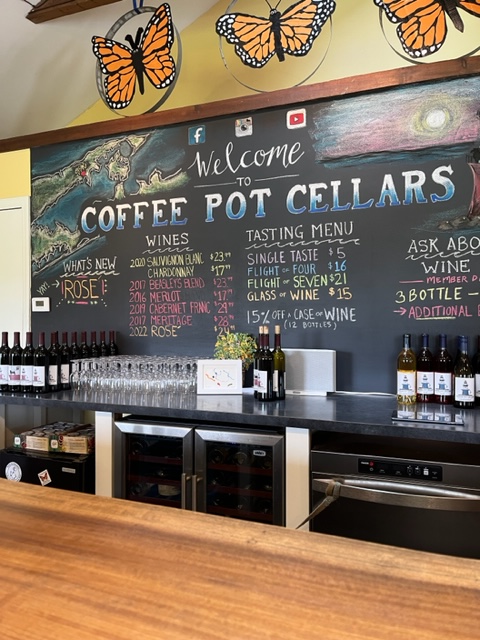
What a winning combination–prize winning wine and prize-winning jam.

I’ve learned so much over the years of going to wineries, from the differences between steel-fermented chardonnay and barrel-fermented chardonnay to how varied wines made from the same grape on the same terroir can taste.  I’ve also learned a lot from my visits to Coffee Pot Cellars—about wine, yes, but also about all sorts of other topics, from bees to butterflies.  Why?  Because Laura Klahr, who owns Coffee Pot with her husband, Adam Suprenant, is always happy to share her latest enthusiasms with visitors.  Her cheery, chatty personality is part of what makes a visit to this tiny winery fun.

Laura and Anna, with half of the monarch image painted on the wall behind them. Visitors are welcome to pose as butterflies.

On this visit, we learned about Sphinx moths, the part moths play in pollination, and about how certain caterpillars fluoresce under black light.  This fall, said Laura, I want to put black lights in the broom closet and have a rave with caterpillars.  We also admired the “snail art” hanging on the wall, art produced by snails crawling over paper.  Though she no longer raises bees and makes honey, she does make jam, which has won prizes, as have the wines.  The 2015 merlot won best merlot in New York State.  We tried the 2016, and it wouldn’t surprise me if it won awards, too.

The name Coffee Pot comes from the North Fork lighthouse, which is shaped like a coffee pot.

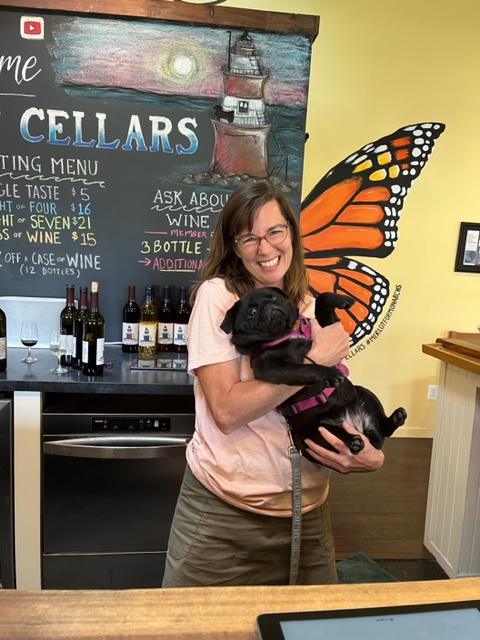
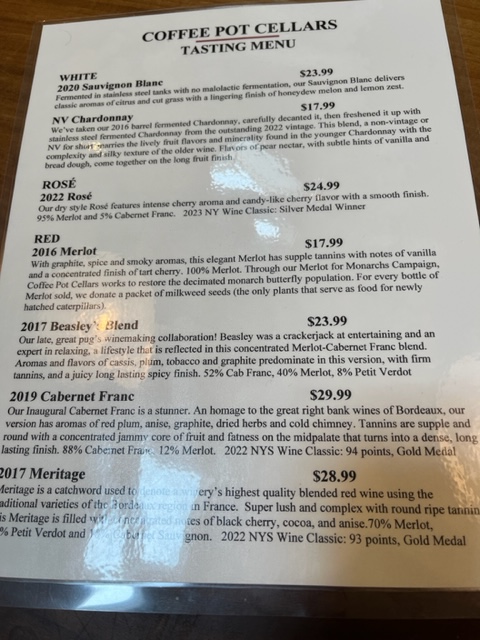
Now that Adam has retired from being the winemaker at Osprey’s Dominion, he has more time to devote to Coffee Pot, and they now have seven wines, all of which one can taste for $21.  As we sipped, we also chatted about her new dog, Anna, a black pug who has, not replaced, but fills the role, of Beasley, also a black pug, who gave his name to a red blend.  Anna is featured on their Facebook page, in a very cute little video, wearing a tutu. 

On a technical note, they source their grapes from Mccullough’s vineyard, and use the facilities at Lenz for fermentation. 

  •  2020 Sauvignon Blanc                  $23.99

Fermented in steel for six months, this is exactly what you want a sauvignon blanc to be—light, lemony, with some nice fruit tastes and a lovely floral aroma.

  • Chardonnay                        $17.99

You might notice the lack of a vintage year.  That is because this white is a blend of the 2016 barrel-fermented chard and the 2022 steel fermented.  I’m not a fan of barrel-fermented chards, especially if they are very oaky and buttery.  This is not, though it still has some of that woody taste I don’t care for.  However, the wine is quite drinkable, and is a good compromise between the two styles of chard, with some nice lemon and pear notes.

  • 2022 Rosé           $17.99

While we were at Coffee Pot, a couple came in and bought two bottles of this rosé, plus several jars of jam.  I can see why, as this is a lovely example of rosé, with strawberry and cherry tastes and aromas.  It’s made from a combination of merlot and cabernet sauvignon grapes. We buy a bottle to take home.

  • 2016 Merlot                      $17.99

Buy a bottle of merlot, help save a monarch butterfly.  How?  For every bottle of merlot bought, Blossom Meadow farm plants a milkweed plant, essential nutrition for monarch caterpillars.  In addition, this is a very good merlot, with the typical North Fork cherry taste and aroma.  It has some tannins, and could probably even age a bit, but we buy two bottles for current consumption.

There’s Beasley, standing on the lighthouse.
  • 2017 Beasley’s Blend       $23.99

Gone, but not forgotten, Beasley will continue to give his name to this Bordeaux-style blend, of 52% cabernet franc, 40% merlot, and 8% petit verdot.  Anna can’t give her name to a wine yet, Laura explained, because she is not old enough to drink!  This iteration is a new release, with enough tannins that I think it could age quite a few years yet.  There’s a touch of funky forest floor in the aroma, which also has lots of dark fruit notes.  It also has some delicious brambly dark fruit tastes.

  • 2019 Cabernet Franc       $29.99

Here’s where I learned something about wine.  Adam, says Laura, asserts that every wine tells a story, with a beginning, a middle, and an end.  He felt this cab franc had a rather “flabby” middle, so he added 12% merlot to give it more structure.  I’d say he built a fine structure, as this is a red strong enough to stand up to a steak.  Yummy tastes of blackberries, and more.

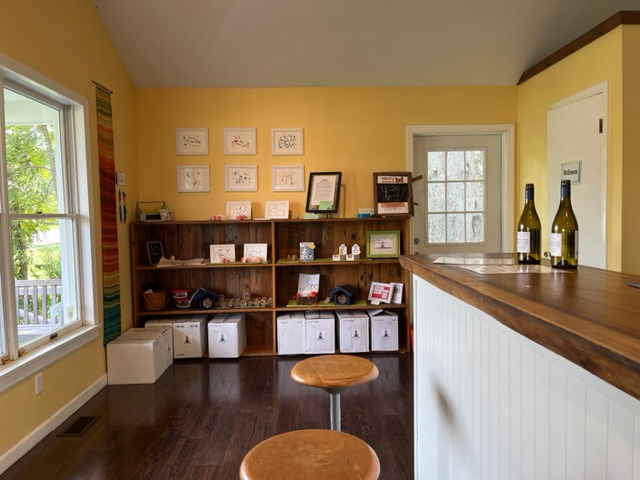
Half of the room, with snail art on the wall. The stools are not very comfortable.
  • 2017 Meritage                  $28.99

Another delicious red!  This one is 70% merlot, 20% petit verdot, and 10% cabernet sauvignon, with a distinct cherry aroma from the merlot, but more complex tastes from the other two grapes.  Mouth-watering, my husband and I agree.

Reasons to visit:  intimate tasting room where you can talk with Laura and/or Adam (Laura told us that Monday is usually Adam’s day) and meet little Anna; all seven of their wines, but especially the rosé, the merlot, and the cabernet franc; the possibility of learning something new from Laura.  One note: the bar stools are still not comfortable, though they do have tables on the front porch and out back with better seating. 

One can sit in the yard, but then one wouldn’t get to chat with Laura.

Lenz Winery: Intangibles

July 18, 2023

The rain seemed to be holding off, and a breeze made the temperature pleasant, so we decided to do an outdoor tasting.  We also wanted to be outside because our guest had brought his dogs, and we wanted to include them in the day’s activities, so we headed to Lenz. 

Primrose and Chewbacca quite enjoyed their first winery experience.

Sometimes I wonder whether how much I like a particular wine or winery is based on certain intangible factors, like the weather, or my mood, or little facets of service.  How objective is wine tasting anyway?  So much depends upon individual likes and dislikes.  On this day, we combined the peace of the courtyard (there was only one other party there), the nice breeze, the good company, and two happy dogs with wines we generally liked, with a few extras thrown in, to decide this was a great tasting experience. 

The courtyard offers a selection of shaded and unshaded tables.

Why were the dogs happy?  In addition to not being left at home, they were quickly provided with their own water dish and then—with permission from their owner—treats from the excellent server.  In addition to pampering the pooches, she timed the delivery of our tastes perfectly, falling in with our leisurely schedule and giving us just the right amount of information about each.

The North Fork wine country is celebrating its 50th anniversary, based on its beginnings with the Hargraves’ winery, and Lenz is not far behind, this year observing their 45th year in operation.  They say the older the vines, the better the wines, and that does seem to ring true here.

After perusing the menu, we decided my husband and I would share a Summer Flight, $30 for five fairly generous samples, and our guest would have the same flight, so we could compare notes.  We could also have opted for the Grand Flight, which features five of their pricier wines for $35.  There is also a chocolate pairing flight…maybe another time.  We also got a little $2 bag of North Fork potato chips, deciding to eschew the heftier options since I had cheeses and charcuterie waiting at home (including a nice chunk of 8 Hands pâté). 

  •  2016 Sauvignon Blanc                  $27 (for the ’22)

What an auspicious start to the afternoon!  We all found this sauvignon blanc delicious, with an aroma of honeysuckle and lots of fruit tastes, with a touch of lemon on the finish.  In fact, we liked it so much that we each bought a bottle to take home.

The pour was generous enough to share.
  • 2021 Firefly Rosé                             $20

Why Firefly, we asked.  Because it is named after the owner’s boat.  Ah.  A blend of malbec, merlot, and cabernet sauvignon, this is a yummy rosé, with tastes of tropical fruit—not quite pineapple, but sort of reminiscent of pineapple. 

I didn’t stop to ask about it, but Lenz often has displays of art for sale, which I assume this was. (It was about to rain, so we left quickly.)
  • 2022 Blanc do Noir Rosé               $24

If you look on the menu, you will see that this is not included in the tasting, but our lovely server brought it out for us, saying she wanted us to taste this before the other rosé, which we did.  Power of the book or the charm of the doggies?  Who knows.  In any event, this was a very light rosé, with a slight aroma of strawberry and tastes of strawberry and cherry, ending with some citrus and acidity.  Though we like it, we find it a bit too light, and actually prefer the Firefly.

  • 2017 Estate Selection Chardonnay             $22

We had a good chat with our server about oak vs. steel-fermented chardonnays.  As I’ve mentioned before, I tend to favor steel—I don’t like that buttery, oaky taste of oaked chards—but I have had some I liked.  This one is aged 50/50 in oak and steel, so sort of the best of both worlds.  I introduce our friend to the actual wine descriptor of “cat pee aroma,” which he finds amusing, but I do detect a trace of it in this wine.  However, the wine itself is quite drinkable—our friend says smooth—with a touch of citrus and not too much oak.

  • 2015 Gewürztraminer                    $30

Another gift!  Before you move on to the reds, says our server, is there any other white you’d like to try?  Hmmm…yes, I say, how about the gewürtz?  I like One Woman’s version of this wine very much, so let’s see how Lenz does.  I sniff and sense orange blossoms, a very flowery aroma.  A sip.  This wine is not shy, I opine, by which I mean it has a lot of taste!  Ripe fruit, spice…what would you eat with it, asks our friend.  Charcuterie!  Yes, it needs food that can stand up to it. Good.

  • 2016 Cabernet Sauvignon             $27

Pleasant, is the word we settle on for this light, easy-drinking red.  It has “not much depth,” notes my husband, but not every red has to be powerful.  For example, this one would go well with roast chicken.  It has some nice berry tastes and aromas.

  • 2017 Estate Selection Merlot       $22

Last wine!  We hasten our leisurely pace, as storm clouds are starting to gather. This is a good, fairly typical North Fork merlot, with an aroma I compare to Cheracol (a cough medicine you have to be of a certain age to know), and tastes of cherry and dark berries.  Nice, and a good price, too. 

The tasting room inside is cozy.

Reasons to visit: pleasant courtyard; dogs not just allowed, but pampered; the sauvignon blanc, the Firefly Rosé, the gewürztraminer, the merlot; a menu of real food, in addition to the usual cheese, etc.; an old-school winery where they take their wine-making very seriously.  By the way, though they have a small restroom inside, they also have the most deluxe port-a-potties I’ve ever seen, with air conditioning and a real sink.

I generally avoid port-a-potties, but these were deluxe.

Pellegrini:  Lagniappe

June 20, 2023

Our flight in progress. Note that every tasting comes with a little bag of oyster crackers, useful for clearing the palate between tastes.

In New Orleans, “lagniappe” refers to a little something extra, which this blog post is.  I don’t usually do two blogs in such quick succession, but it was time to pick up our wine club shipment at Pellegrini, and we decided to do a quick tasting.  I didn’t even bring my notebook!  But as we sipped, I started to take a few sketchy notes, and before I knew it, I had decided to do a short blog post.

On this Tuesday afternoon, we had the tasting room to ourselves.  We were greeted cheerily by Ryan, who was delighted to serve us.  After acquiring our shipment, we circled on the tasting menu the three wines we were already buying, plus a few others that seemed of interest.  When Ryan saw that I had circled the gewürztraminer, he suggested that I add a new wine, the BBQ white, which includes gewürztraminer grapes, thinking that we would like it.  He was not wrong.

So here are a few notes on the wines we sampled.  If you want to know more about the tasting room, check out my past posts on Pellegrini!

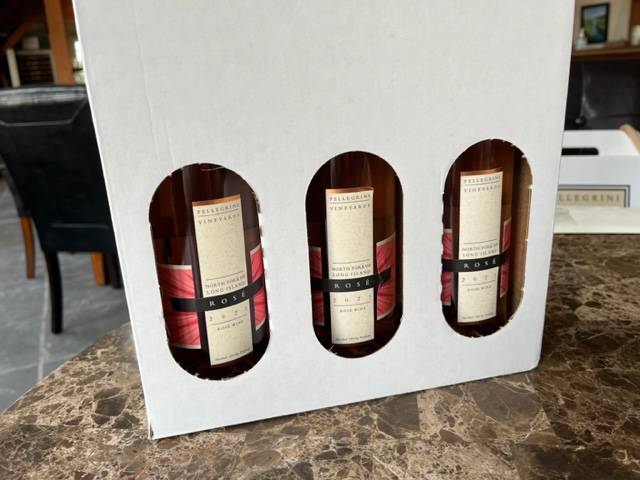
We went home with three boxes like this: our wine club selections, the roses, and North Fork Project merlot (Three bottles for $36).
  •  2021 Rosé          $24.99

I wanted a bottle of rosé to bring to a party, so I knew I wanted to try this.  Plus, it’s on sale!  A blend of 80% cabernet sauvignon and 20% Merlot 181 (the number refers to the merlot clone they used), this is a many-faceted rosé, and is quite tasty.  We buy some for ourselves and some to give away.

  • 2020 Gewürztraminer                    $24.99

I wanted to try this because it is also on sale, and we love One Woman’s gewürztraminer.  This is nice, but I don’t like it as much as hers, though it is fruity and delicious.  It just seems a bit one-note-ish.

  • 2022 East End Select BBQ White                $26.99

As much as I like a bargain, I also like to buy what I like, and we both like this one.  It is 46% gewürztraminer and 54% stainless steel chardonnay, a winning combination.  Ryan’s suggestion that we try this pans out, as we buy a bottle.  Yummy, with the sweetness of the gewürztraminer tamed by the citrus of the chardonnay.

  • Steakhouse Red                $21.99

This is their basic table red, and indeed it is a good hamburger/pasta red, light but with nice tannins and a bit of a funky aroma.  “It has an edge,” says my tasting pal.

  • 2017 Cabernet Franc       $32.99

A blend of 95% cabernet franc plus 5% merlot, aged 18 months in French oak, this is a somewhat light but very pleasant red. 

  • 2015 Regalo        $49.99

Regalo means gift, and this is a gifted wine, a Bordeaux-style blend of 50% petit verdot, 30% cabernet sauvignon, 15% merlot, and 5% cabernet franc.  So good.  Complex, with lots of varied fruit flavors.  We put our wine club bottle in the cellar to age.

Reasons to visit:  join the wine club!  We joined for reds only, and have never regretted it.  We liked all the wines we tried, but especially the BBQ White and the Regalo.

Pindar Vineyards: Special Day for Locals

March 31, 2023

The day was gray and chilly, but we had a good time anyway.

Pindar is proud of being one of the early vineyards on the North Fork, with their vines planted over 40 years ago.  I came by this bit of knowledge on a free tour and tasting at Pindar, part of an effort by a number of vineyards to attract locals to come and taste their wines.  Friends of ours had noted this program and invited us to join them at Pindar, whose perks seemed the best (other places offered such bargains to locals as ten percent off bottles or two for one).  Good move! We had a good time, learned a lot, and got to taste some wines we then bought and took home.

Nancy is showing us a gewurztraminer vine, one of the original ones planted at Pindar. The roots can go very deep.

Nancy, our tour guide, started us off by the vines, and then took us through all the steps of making wine, from the crush pad to the stainless steel tanks to the French oak barrels to the warehouse, and then back to the tasting room where we got to try five wines.

“Viticulture is farming for masochists,” she informed us, as she explained the work involved in pruning the vines, which she characterized as “an art and a science,” and the perils faced by grape growers.  There are migrating birds who will peck at the grapes, so they look fine but then shrivel into nothing; there are hurricanes on Long Island, whose arrival coincides with harvest season; and there is the lack of crop insurance, because how can you insure for their current value vines that have been growing for over 40 years.  In addition, you have to wait four years after you plant those vines before you can expect to harvest the grapes. The issue of birds has been taken care of, through an ingenious system of nets, which you can see in many vineyards, which remain furled up below the vines and are then raised when the grapes ripen.  As to the other issues…not much one can do about them!

Despite these problems, Pindar has 325 acres of vines, resulting in 60 to 70,000 cases of wine every year.  At first, Dr. Dan Damianos, the visionary who started Pindar (named, like one of his sons, for the classic Greek poet, in homage to their Greek heritage), planted gewürztraminer grapes, judging that the climate and soil would work well for this varietal.  Now they grow twenty-four varietals, and they list twenty-nine different wines on their tasting menu, which includes a number of blends.

The bottling machine, which is about to be replaced by an even better one.

They bottle these wines with their own bottling line, which can do 3,000 a day.  Not every winery has their own bottling facility, with many using Premium Wine Group for this.  Nancy gave a brief lecture on the issue of corks vs. screw caps, with corks reading as “better” wines, and screw caps okay for more casual, cheaper wines. Screw caps work just fine, though corks have the advantage of being biodegradable.

I never knew why the vats have this dimpled jacket.

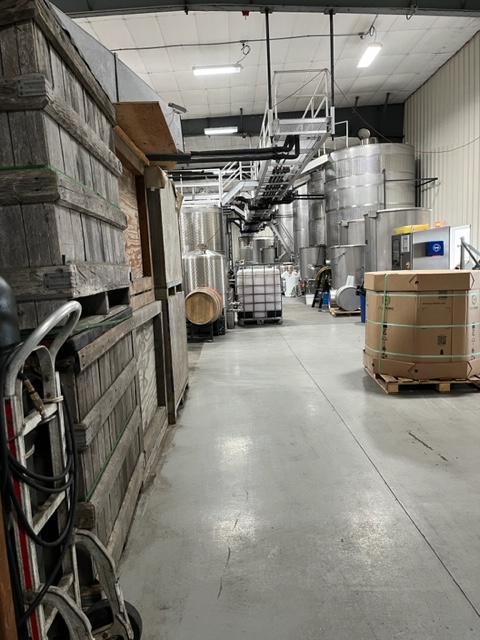
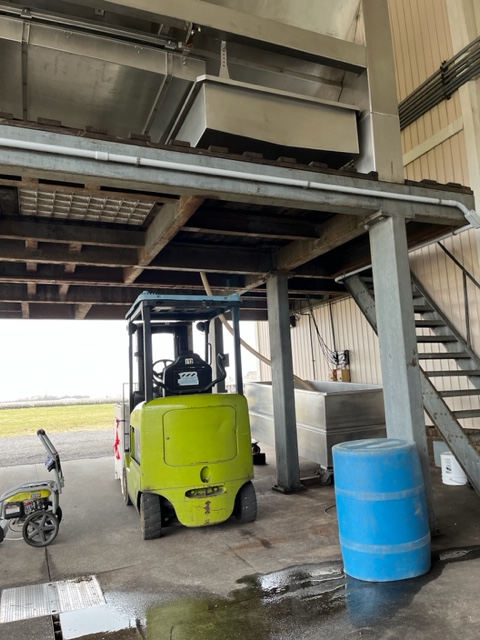
We then walked into a huge room filled with vast stainless steel vats, where Nancy explained something I’d always wondered about.  The vats are partially encases in a dimpled steel jacket.  It is a glycol jacket, containing polyglycol, used to help regulate the temperature in the vats, and the dimples keep the polyglycol from settling to the bottom.  Too hot or too cold, and the wine is ruined.  They use a windmill to provide about 60% of the energy needed in the warehouse and wine “cellar”—not a cellar, because…polyglycol.  We also learned about another hazard of viticulture—carbon dioxide.  As the juice ferments into wine, carbon dioxide rises to the top of the tanks, where the solid matter must be pushed down into the liquid.  Catwalks provide access to the tops of the tanks, and open doors help dissipate the CO2.

Part of the filtration system.

She showed us their filtration system, and we learned, by the way, that Guinness Stout used isinglass, obtained from the bladders of sturgeon, to filter their brew.  I like Guinness, but I also like caviar!

She also took us outside to see the crush pad, where a machine crushes the grapes. Because Pindar is so big, a lot of the work is done by machines.

The crush pad.

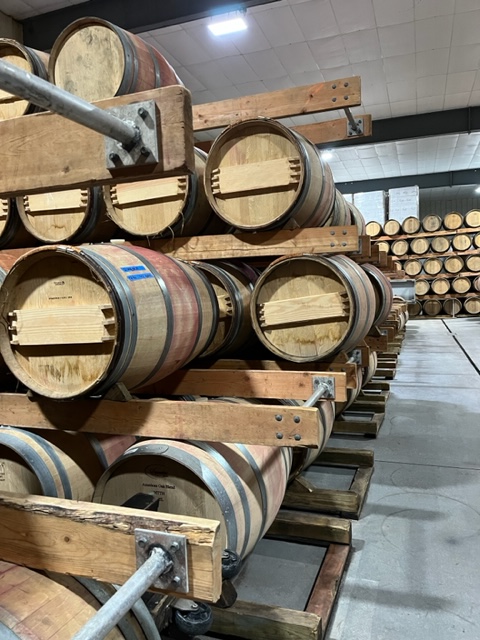
The huge space where red wine ages in French oak barrels smelled enticingly like a forest or lumberyard.  We found out that there are different tastes imparted to wines by French and American oak, with some adding notes of vanilla and others cinnamon, etc.  Pindar now uses only French oak, buying 300 barrels a year, and has phased out their American oak barrels, which they sometimes sell to breweries or to people who want to use them in their gardens.  We also learn about the “angel’s share,” the wine which evaporates from the barrels, meaning they need to be constantly watched and topped up, so that too much oxygen doesn’t turn the wine into vinegar.  The angels must reserve a special place in heaven for wine makers!

Despite the bung stopper, some evaporation is unavoidable.

Finally, our last stop before the tasting room, we saw the warehouse where cases of wine are stacked high.  Nancy held up a four-pack of cans of Winter White, and explained that Dr. Dan, noting the American taste for soda and other sweet drinks, decided to make some sweeter wines, like Winter White, which is the most popular white on Long Island.  More recently, the decision was made to offer it in cans; again, to attract those who might otherwise opt for soda or beer.

Cans of Winter White, ready to go.

Now it was time to taste the fruits of their labor!  The group of about thirty locals lined up around the bar, where glasses stood ready.  Here are my tasting notes:

Nice sized pour.
  •  2020 Dr. Dan’s Selection White Blend      $24.99

Our first taste is a blend of, this vintage, of 53% viognier, plus pinot grigio, sauvignon blanc, and riesling.  The percentages may vary year to year.  This is a very drinkable white, with aromas of pineapple and citrus, and tropical fruit flavors like guava and pineapple.

  • 2021 Dr. Dan’s Selection Gewürztraminer               $24.99

We are quite interested to taste this, after learning the history of the vines, and we quite like it.  In fact, we and our friends each buy a bottle to take home.  It is not too sweet, which can happen with gewürztraminers, with an aroma of peaches and tastes that include tangerine and apricot.  “Yummy,” we and our friends agree.

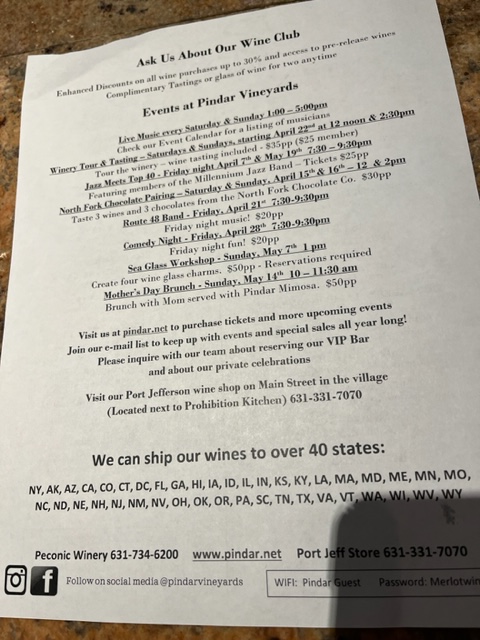
At the tasting, I turned over my menu to see the events list.
  • 2019 Mythology                $42.99

A Bordeaux blend called Meritage, this includes malbec, cabernet sauvignon, merlot, petit verdot, and cabernet franc.  Delicious.  Lots of dark fruit taste and enough tannins that one could probably age it.

  • 2019 Cabernet Sauvignon Reserve            $34.99

Nancy, who is still informing us about the wines, explains that cabernet sauvignon used to be harder to grow on Long Island, since it needs a longer growing season to mature.  However, with climate change, the growing season on Long Island has gotten longer.  I guess that’s an upside to global warming! This is another very good red, with tastes of blackberry and other fruits, and an aroma of cedar and tobacco.

Pindar Damianos chatting with a guest.
  • 2015 Cabernet Port         $28.99 for 750 ml, $16.99 for 375 ml

I’m not sure if this was in the original tasting or if it was included after our friend shared his enthusiasm for the port with Nancy and with Pindar Damianos, who was hanging around and talking to the guests.  He discovered that Pindar makes award-winning port in an old issue of a wine magazine shortly after moving to the North Fork, and was happily buying and drinking it.  I can see why.  This is a dessert wine—in English novels, they are always sipping it after dinner while they crack walnuts and chat—but it is not too sweet, with an appealing depth of flavor.  It is made 100% from cabernet franc.  We each buy a bottle to take home.

Cases filled with awards Pindar wines have won.

Reasons to visit:  roomy tasting room with two outside areas; a wide variety of wines for every taste, from sweet to dry, and price, from $14.99 (Winter White and others) to $42.99; all the wines we tasted—White Blend, Gewürztraminer, Mythology, and Cabernet Sauvignon Reserve—plus the port; our friends had also tasted the Gamay Noir before we went on the tour, and bought a bottle of that light red to take home; they have a refrigerated case full of cheeses, etc., to consume there; they have a variety of special events.

Pindar Vineyards: Special Day for Locals

March 31, 2023

The day was gray and chilly, but we had a good time anyway.

Pindar is proud of being one of the early vineyards on the North Fork, with their vines planted over 40 years ago.  I came by this bit of knowledge on a free tour and tasting at Pindar, part of an effort by a number of vineyards to attract locals to come and taste their wines.  Friends of ours had noted this program and invited us to join them at Pindar, whose perks seemed the best (other places offered such bargains to locals as ten percent off bottles or two for one).  Good move! We had a good time, learned a lot, and got to taste some wines we then bought and took home.

Nancy is showing us a gewurztraminer vine, one of the original ones planted at Pindar. The roots can go very deep.

Nancy, our tour guide, started us off by the vines, and then took us through all the steps of making wine, from the crush pad to the stainless steel tanks to the French oak barrels to the warehouse, and then back to the tasting room where we got to try five wines.

“Viticulture is farming for masochists,” she informed us, as she explained the work involved in pruning the vines, which she characterized as “an art and a science,” and the perils faced by grape growers.  There are migrating birds who will peck at the grapes, so they look fine but then shrivel into nothing; there are hurricanes on Long Island, whose arrival coincides with harvest season; and there is the lack of crop insurance, because how can you insure for their current value vines that have been growing for over 40 years.  In addition, you have to wait four years after you plant those vines before you can expect to harvest the grapes. The issue of birds has been taken care of, through an ingenious system of nets, which you can see in many vineyards, which remain furled up below the vines and are then raised when the grapes ripen.  As to the other issues…not much one can do about them!

Despite these problems, Pindar has 325 acres of vines, resulting in 60 to 70,000 cases of wine every year.  At first, Dr. Dan Damianos, the visionary who started Pindar (named, like one of his sons, for the classic Greek poet, in homage to their Greek heritage), planted gewürztraminer grapes, judging that the climate and soil would work well for this varietal.  Now they grow twenty-four varietals, and they list twenty-nine different wines on their tasting menu, which includes a number of blends.

The bottling machine, which is about to be replaced by an even better one.

They bottle these wines with their own bottling line, which can do 3,000 a day.  Not every winery has their own bottling facility, with many using Premium Wine Group for this.  Nancy gave a brief lecture on the issue of corks vs. screw caps, with corks reading as “better” wines, and screw caps okay for more casual, cheaper wines. Screw caps work just fine, though corks have the advantage of being biodegradable.

I never knew why the vats have this dimpled jacket.

We then walked into a huge room filled with vast stainless steel vats, where Nancy explained something I’d always wondered about.  The vats are partially encases in a dimpled steel jacket.  It is a glycol jacket, containing polyglycol, used to help regulate the temperature in the vats, and the dimples keep the polyglycol from settling to the bottom.  Too hot or too cold, and the wine is ruined.  They use a windmill to provide about 60% of the energy needed in the warehouse and wine “cellar”—not a cellar, because…polyglycol.  We also learned about another hazard of viticulture—carbon dioxide.  As the juice ferments into wine, carbon dioxide rises to the top of the tanks, where the solid matter must be pushed down into the liquid.  Catwalks provide access to the tops of the tanks, and open doors help dissipate the CO2.

Part of the filtration system.

She showed us their filtration system, and we learned, by the way, that Guinness Stout used isinglass, obtained from the bladders of sturgeon, to filter their brew.  I like Guinness, but I also like caviar!

She also took us outside to see the crush pad, where a machine crushes the grapes. Because Pindar is so big, a lot of the work is done by machines.

The crush pad.

The huge space where red wine ages in French oak barrels smelled enticingly like a forest or lumberyard.  We found out that there are different tastes imparted to wines by French and American oak, with some adding notes of vanilla and others cinnamon, etc.  Pindar now uses only French oak, buying 300 barrels a year, and has phased out their American oak barrels, which they sometimes sell to breweries or to people who want to use them in their gardens.  We also learn about the “angel’s share,” the wine which evaporates from the barrels, meaning they need to be constantly watched and topped up, so that too much oxygen doesn’t turn the wine into vinegar.  The angels must reserve a special place in heaven for wine makers!

Despite the bung stopper, some evaporation is unavoidable.

Finally, our last stop before the tasting room, we saw the warehouse where cases of wine are stacked high.  Nancy held up a four-pack of cans of Winter White, and explained that Dr. Dan, noting the American taste for soda and other sweet drinks, decided to make some sweeter wines, like Winter White, which is the most popular white on Long Island.  More recently, the decision was made to offer it in cans; again, to attract those who might otherwise opt for soda or beer.

Cans of Winter White, ready to go.

Now it was time to taste the fruits of their labor!  The group of about thirty locals lined up around the bar, where glasses stood ready.  Here are my tasting notes:

Nice sized pour.
  •  2020 Dr. Dan’s Selection White Blend      $24.99

Our first taste is a blend of, this vintage, of 53% viognier, plus pinot grigio, sauvignon blanc, and riesling.  The percentages may vary year to year.  This is a very drinkable white, with aromas of pineapple and citrus, and tropical fruit flavors like guava and pineapple.

  • 2021 Dr. Dan’s Selection Gewürztraminer               $24.99

We are quite interested to taste this, after learning the history of the vines, and we quite like it.  In fact, we and our friends each buy a bottle to take home.  It is not too sweet, which can happen with gewürztraminers, with an aroma of peaches and tastes that include tangerine and apricot.  “Yummy,” we and our friends agree.

At the tasting, I turned over my menu to see the events list.
  • 2019 Mythology                $42.99

A Bordeaux blend called Meritage, this includes malbec, cabernet sauvignon, merlot, petit verdot, and cabernet franc.  Delicious.  Lots of dark fruit taste and enough tannins that one could probably age it.

  • 2019 Cabernet Sauvignon Reserve            $34.99

Nancy, who is still informing us about the wines, explains that cabernet sauvignon used to be harder to grow on Long Island, since it needs a longer growing season to mature.  However, with climate change, the growing season on Long Island has gotten longer.  I guess that’s an upside to global warming! This is another very good red, with tastes of blackberry and other fruits, and an aroma of cedar and tobacco.
Pindar Damianos chatting with a guest.
  • 2015 Cabernet Port         $28.99 for 750 ml, $16.99 for 375 ml

I’m not sure if this was in the original tasting or if it was included after our friend shared his enthusiasm for the port with Nancy and with Pindar Damianos, who was hanging around and talking to the guests.  He discovered that Pindar makes award-winning port in an old issue of a wine magazine shortly after moving to the North Fork, and was happily buying and drinking it.  I can see why.  This is a dessert wine—in English novels, they are always sipping it after dinner while they crack walnuts and chat—but it is not too sweet, with an appealing depth of flavor.  It is made 100% from cabernet franc.  We each buy a bottle to take home.

Cases filled with awards Pindar wines have won.

Reasons to visit:  roomy tasting room with two outside areas; a wide variety of wines for every taste, from sweet to dry, and price, from $14.99 (Winter White and others) to $42.99; all the wines we tasted—White Blend, Gewürztraminer, Mythology, and Cabernet Sauvignon Reserve—plus the port; our friends had also tasted the Gamay Noir before we went on the tour, and bought a bottle of that light red to take home; they have a refrigerated case full of cheeses, etc., to consume there; they have a variety of special events.

Pellegrini Vineyards: Perks of Being in a Club

March 17, 2023

Perhaps because everyone else was elsewhere drinking green beer, we had the tasting room to ourselves.

No St. Patrick Day parades for us and our friends; instead, we were off to do a wine tasting at Pellegrini, where we are members of the wine club.  Many wineries offer clubs, with varying perks and policies.  We have only opted for two:  Pellegrini and Channing Daughters.  Both of them offer special prices for their wines, quarterly releases of wines for club members, special events, and free tastings.  Our friends are members of some wine clubs, but not Pellegrini, so they were curious about what would be on offer.

Unlike more and more local wineries, Pellegrini does not offer much in the way of snacks (You can buy NOFO potato chips.), though a little bag of oyster crackers comes with each tasting.  However, the advantage is you can bring your own snacks, and I offered to supply some.  Well, I got a bit carried away, but we all enjoyed the cheese, crackers, prosciutto, and Marcona almonds from Village Cheese Shop and the charcuterie from 8 Hands Farm.  Since I brought a nice slab of 8 Hands pâté, I felt obliged to also pack Dijon mustard and cornichons.  To continue the theme of local goodies, I also opened a bag of North Fork potato chips.  Lunch accomplished!
Most of the goodies I brought, including a little jar of truffled honey. The cheeses are an aged gouda, Village Cheese Shop’s homemade truffled brie (So good!), and Humboldt Fog.

We had so much fun eating and talking that my wine notes are a bit sketchy, but I will say we all liked every taste, though to different degrees.  We got four tastings, of four wines each, with some overlap.  The tasting room felt like our own private space, since the only party that entered quickly decided to sit up in the little balcony. I also recommended that our friends try the North Fork Project Merlot, a bargain at three one liter bottles for $30, which we both bought before we left, sated and happy.

In no particular order (though our lovely server Kasey carefully informed us of the recommended order of tastes for each flight), here are the wines I took at least a note or two on, some based on the flights my husband and I got, and others on the flights our friends chose.

This flight includes the ice wine, the almost orange wine on the right.
  • 2020 Stainless Steel Chardonnay                $22.99

This was my first taste, and I quite enjoyed it.  In the car on the way to the winery we had discussed the merits of steel vs. oaked chardonnays, with one friend very much preferring oaked, and me…not.  As they say, in wine there are no wrong answers.  This is a light, fruity, minerally wine, with tastes of pear and apple.

  •  2019 Vintner’s Pride Chardonnay              $34.99

Our friend ordered this, and characterized it as smooth and buttery, but not overly oaky—the latter a term he actually refuses to use, since he denies tasting oak in any oaked chard.  This one is aged 100% in French oak puncheons for 18 months, and for contrast his wife ordered the next chard on this list.

  • 2019 Pellegrini Vineyards Chardonnay      $24.99

Not that different from the VP chard, opined our friend, though this one is aged 90% in oak barrels and 10% in stainless steel, 9 months in French oak puncheons.  Is stainless steel chardonnay a plot by wine makers to make less expensive wine they can sell for a higher price, or is it a way to accommodate differing tastes?  The world may never know… 

  • 2021 Pellegrini Vineyards Rosé                   $24.99

If you like a very light, almost tasteless rosé, this is the rosé for you.  I continue to prefer Croteaux rosés.

  • 2017 PV Cabernet Franc                $32.99

Although this is simply called cab franc, it is actually a blend: 85% cab franc, 4% cab sauvignon, 8% merlot, and 2% petit verdot.  In any event, it is a rather light red—Kasey had recommended we drink this before the other reds—with some cherry and spice flavors.  Our friend thinks one might even serve this lightly chilled, like in the summer.  It goes well with the charcuterie.

  • PV Steakhouse Red          $21.99

One feature of Pellegrini we like is that they have some reds that are not too pricy yet drink very well, and this is one of them.  A blend of 72% cabernet sauvignon and 28% merlot, this has a nice minerality with soft tannins and some dark fruit tastes, and would, indeed, go well with a steak.   

  • 2017 Merlot       $32.99

Another blend, this is 85% merlot, plus 10% cabernet sauvignon and 5% petit verdot, though it basically tastes like a merlot.  It’s fine, but I actually prefer the—much cheaper—North Fork Project Merlot.  This, however, could be characterized as more sophisticated.

  • 2020 PV Gewürztraminer              $24.99

My recollection from past tastings is that the gewürztraminer is not overly sweet, and our amiga confirms that this is so.  Easy to drink.

  • 2018 Cabernet Sauvignon             $24.99

Our friend likes this blend of 94% cabernet sauvignon, 4% merlot, and 2% cabernet franc better than the merlot.

  • 2015 Regalo                       $49.99

Pricey, but really good, is my verdict on this wine, which is the last in my tasting.  Regalo means gift, and this is a gift reserved for wine club members. A blend of 50% petit verdot, 30% cabernet sauvignon, 15% merlot, and 5% cabernet franc, this is a complex, delicious wine, with lots of blackberry, plum, and other dark fruit flavors and aromas. 

  • 2021 East End Select BBQ Red                    $26.99

Although this doesn’t have a varietal designation, this iteration of their steel-fermented red is 100% petit verdot.  I have a sip, as it is in my husband’s tasting, and note that it has more sweetness than, say, the Steakhouse Red.  I guess it would go well with ribs or pulled pork, though my wine of choice with barbeque (like from Meats Meat) is beer.

  • Finale Ice Wine                 $39.99 (375 ml)

Time for dessert!  A blend of gewürztraminer and sauvignon blanc, ice wine is made by freezing and then pressing the grapes, resulting in a sweet taste.  The vineyard web site notes it pairs well with nuts, so I am glad I provided Marcona almonds for our friend.  She likes it, and compares it to savoring one’s platonic ideal of a fruity sucking candy, with some notes of honey.

I love the comfy chairs!

Reasons to visit:  pleasant tasting room where buses and limos are verboten; you can bring your own snacks; dogs are allowed; the comfy chairs are conducive to lingering; with fourteen wines to choose from (twelve of which I’ve mentioned), there are wines for every taste; my favorites are the steel chardonnay, the Steakhouse Red, and Regalo; one friend likes the gewürztraminer and the ice wine, the other the VP chardonnay and the cabernet sauvignon, plus the North Fork Project Merlot.