Osprey’s Dominion: It’s a Party!

October 5, 2024

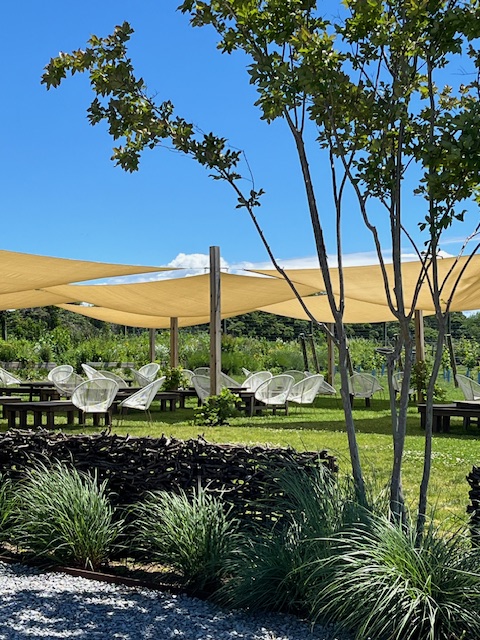
One view of the expansive lawn, with the musicians in the distance.

Where do you go when your guests would like to do a tasting, but the party includes a six-year-old and a three-year-old?  Fortunately, the weather was warm and sunny, which increased our options, because being outside is best with little ones.  We thought about Old Field, but we’d been there last summer, and this family loves music.  Aha.  Osprey’s Dominion offers a large outside area, plus they usually have music on the weekend, they let you bring your own snacks, and we like their wines (which, the six-year-old observed, was probably the most important part—smart little kid!).

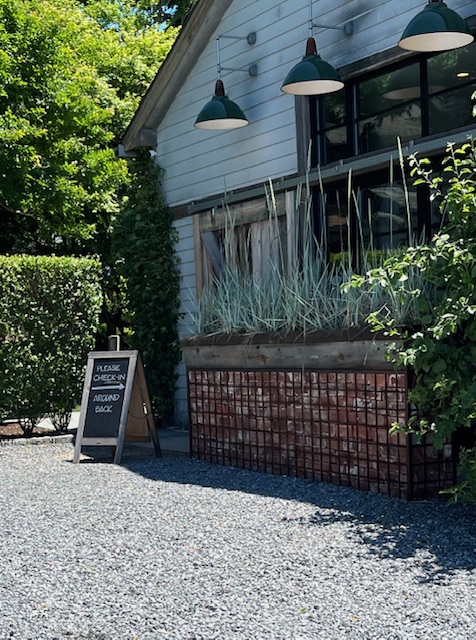
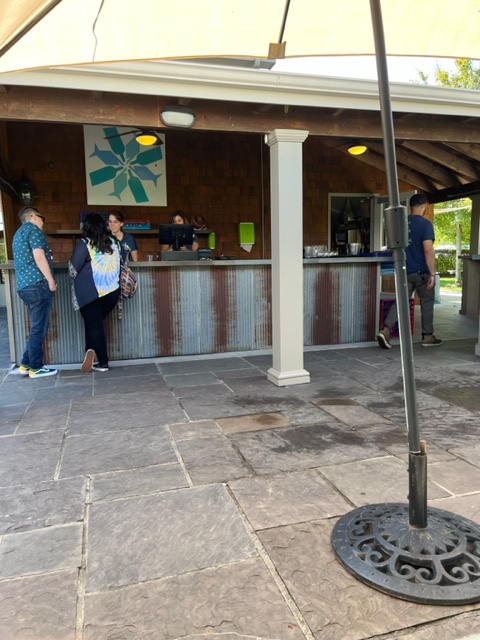
So off we went on this busy four-day weekend, passing winery after winery that looked crowded.  Osprey’s was no exception, but we pulled around to the back parking area where we were directed by a genial traffic guy to join a line of cars parked on the grass.  The scene before us looked like a party, with many tables filled with happy people, eating snacks they’d brought and listening to the music of a small band (just two people, but they sounded like more).  Dogs and children abounded and bounded.  Could we find a table in the shade?  We did!  Leaving most of the group to hold the table, two of us ventured forth.  At the gazebo in the middle of the lawn they offered wine by the glass or bottle, so we continued on inside, where it was much more sedate.  The busy servers handed us a menu, and soon were ready to help.
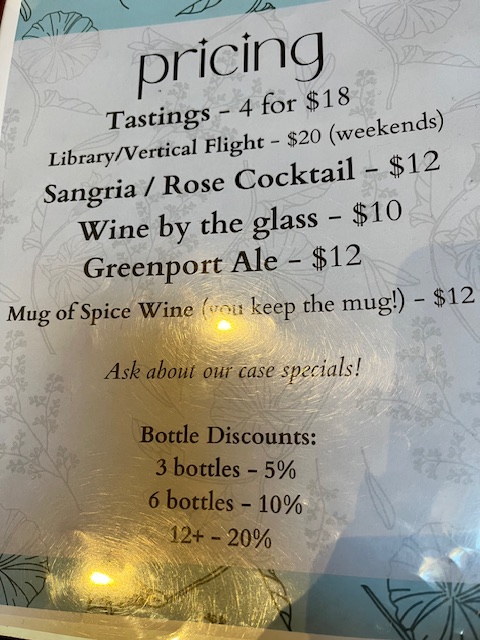
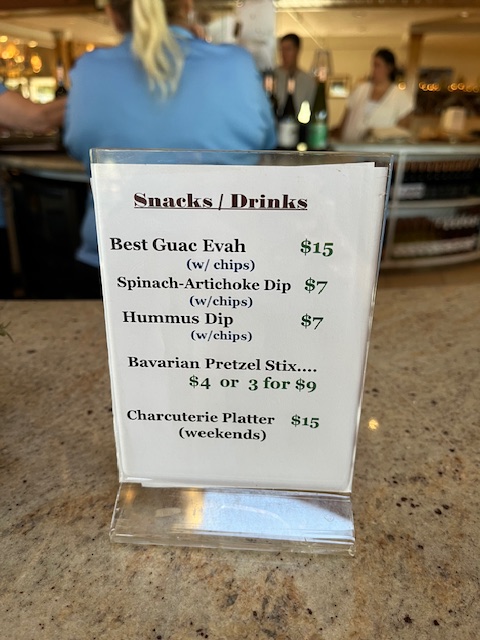
Tastings consist of four samples for $18, chosen from their extensive lists.  There are eight whites, plus one rosé, and ten reds.  We decided to do two tastings, shared, with four whites and four reds, which we marked on sheets sporting four circles, just the right size for a little plastic cup of wine.  We requested two extra cups, and carefully carried the tray back to our table, where the little ones had discovered the bag of potato chips and the fruit we’d brought.  (If I’d thought carefully, I would have brought more snacks, though Osprey does offer a little menu of snacks one can buy.) 
We doled out equal shares of each sample—just enough for a couple of sips each—and as we sat and chatted the little ones ran around and danced to the music.

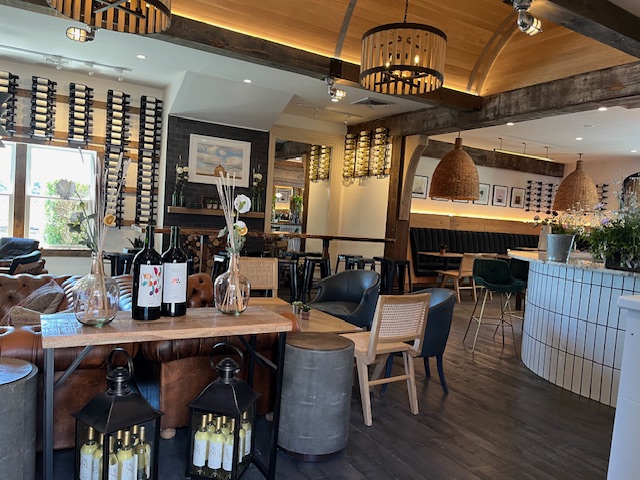
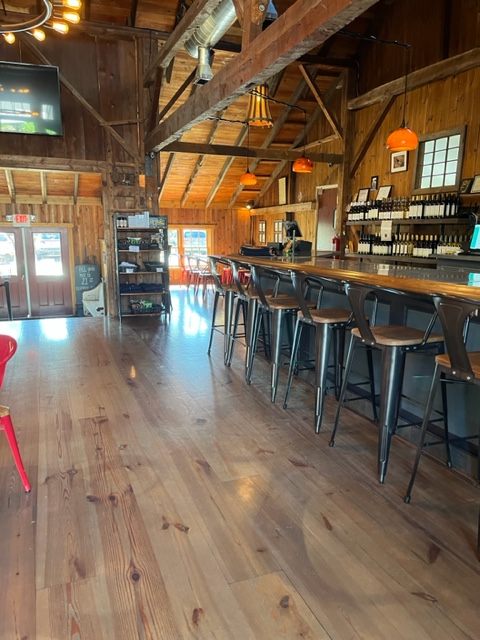
Inside, it was much calmer.
  • 2023 Fumé Blanc           $24

In case you’re wondering, fumé blanc is sauvignon blanc that has been aged in oak.  This one has an aroma of pineapple and tastes of grapefruit.  It is good and tart.

  • 2022 Unwooded Chardonnay                  $22

This ended up being our favorite white of the day, a pleasant chard with aromas of pear and a slight funkiness.  It tastes crisp, with slight fruitiness, and is, according to one guest, a “perfect chicken wine.”

One bit of the large circular bar.
  •  2021 Gewürztraminer        $25

Lovely aroma of honeysuckle and spice made this a wine we let the six-year-old smell—not taste!—as we discussed how you are never supposed to say a wine smells or tastes like grapes.  Well, sometimes they do!  One guest compared the taste to prickly pear.  I say apple-y and pineapple-y.

  • 2021 Riesling    $25

“This would be a good lunch wine,” opined one guest, to which the other wondered when she had last had wine with lunch.  It has a floral aroma, maybe roses, plus a woodsy cedar smell.  The taste is mild, a bit sweet, though this is a dry riesling.
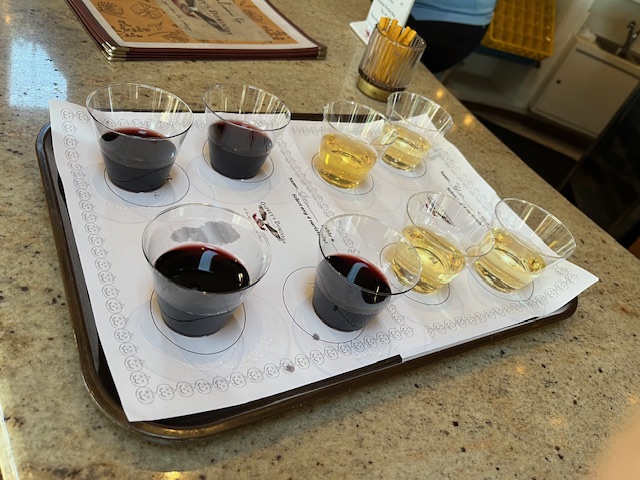
Our two flights. Note that they will place the wines in the order in which you list them, so be careful to list them in a good order for tasting, from lightest to strongest.
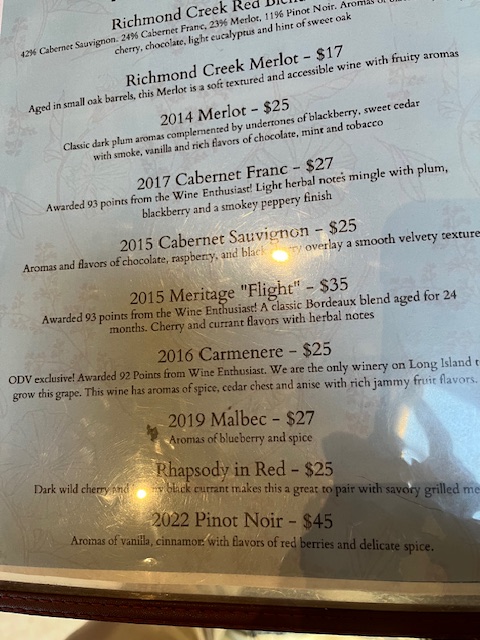
  • 2017 Cabernet Franc    $27

Now we move on to the reds, after a couple of palate-cleansing potato chips.  We don’t detect much aroma, though there is a trace of cinnamon and cigar, maybe herbs.  I taste red plums.  This was a great year for plums in the farm stands, though the season was too short for me.  I did get to make one plum tart.

  • 2015 Meritage “Flight”  $35

Delicious aroma of cherries, and, said one of us, “smells grape-y.”  We decided it was “promising,” but needs to age some more, since it is very tannic.  This is a Bordeaux blend.

  • 2016 Carmenere             $25

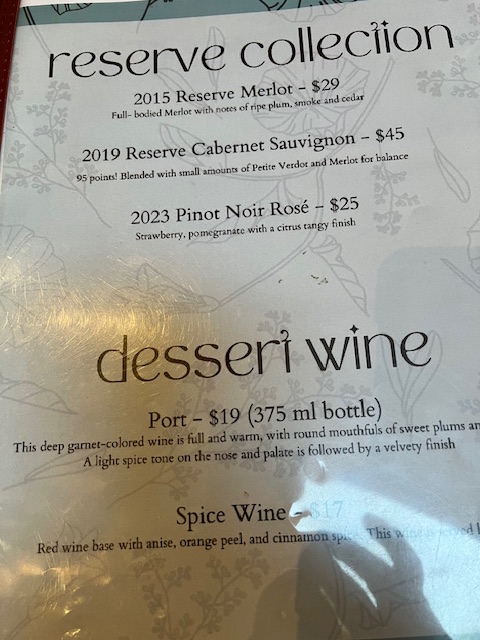
According to the wine list, Osprey is the only winery to grow this grape on Long Island.  Too bad, because it makes a nice wine.  We smell cut grass and crushed ferns, and note a cherry licorice taste, plus blackberry and a hint of pepper.  I think it would be a good burger wine, and one guest suggests a hearty beef stew.  Yep, that would work.

  • 2019 Malbec     $27

Another favorite, this has aromas of plums and spice and is dry yet has plenty of fruit.  Pork braciole, suggests a guest. Why not!

Reasons to visit: plenty of good wines at reasonable prices, but especially the Unwooded Chardonnay and the Malbec; the Richmond Creek line is particularly well priced; dogs allowed; outside snacks allowed; casual party atmosphere outside, with music on many weekends; good place if you have children in your group (even inside, where the room is large enough for them).

Rose Hill Vineyards: Change Can Be Good

June 9, 2024

When Rose Hill was Shinn, I liked the somewhat hippie-ish vibe it had, a bit off the beaten path, on Oregon Road (allegedly so named because it was so far away it might as well have been in Oregon—really, it’s not that far).  However, the changes have been improvements, with a lovely shaded patio for outside tastings, plus a much larger indoor room for cold or rainy days.  There’s now a large area of lawn set up with tables as well. 

Roses for Rose Hill

When you enter the parking area from Oregon Road, you will see four parking spots reserved for the overnight guests of the Inn, plus a pebbled lot for everyone else.  The parking used to be around the back, but no more, though that is where you’ll find the entrance to the tasting room.  We were cheerfully greeted by one of several pleasant young women who circulated around the patio, and told we could choose whichever table we liked.  We picked a table for the four of us that was well shaded, and settled down to read the menu, which one acquires via a QR code embedded in the table top. 

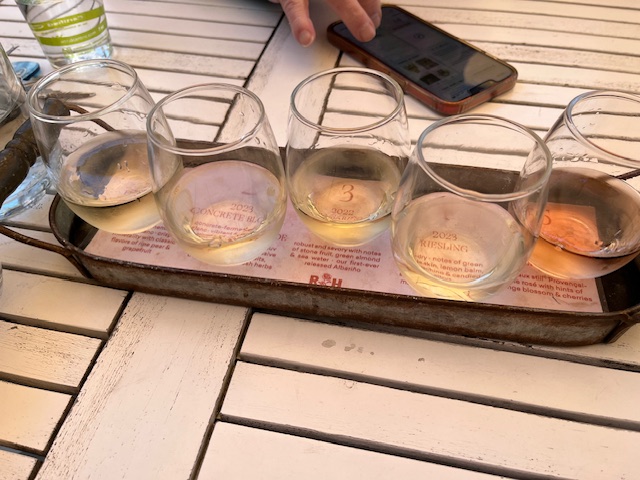
The menu offers three different flights:  the Estate Flight, of five varied wines for $30, the Summer Flight, of five whites and a rosé for $30, and a Red Flight of five reds, also $30.  We decided we would get the Estate and Summer flights, as there was no overlap, and requested extra glasses so we could share the generous tastes.  We also ordered a sparkling pink lemonade for our designated driver, which he said was quite good. 

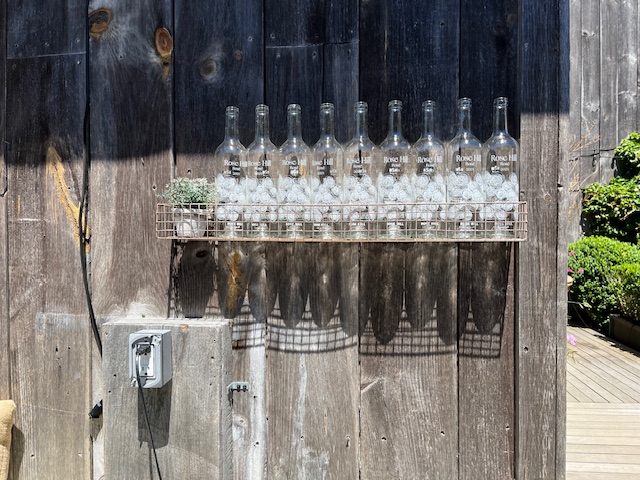
We assumed this is an outside bar, which can be used in the summer if it gets crowded.

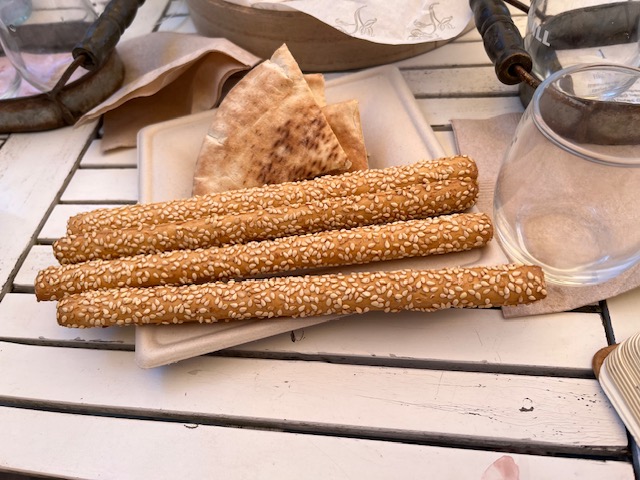
Since it was lunchtime, we also perused the menu of “Light Bites,” and settled on the Mediterranean Board, for $32, thinking if it was not enough food we might order something else.  However, as it happened, the serving of three dips—a hummus, a goat cheese and sweet red pepper puree, and a yogurt somewhat like a tzatziki—with toasted pita triangles and some breadsticks, plus black and green olives, was plenty, especially since we asked for and got some additional pita triangles when, as so often happens, we ran out of dippers before dips.  We liked all three very much.

Somehow I forgot to take a photo of the dips, but here are our extra bread sticks!

Our attentive waitress brought us a large bottle of chilled water with compostable plastic cups, and happily answered all the questions we had, though she had to ask someone else to tell us why the winery is called Rose Hill.  Apparently, the owners used to live on a street called Rose Hill. 

Our table.

Since I tried all the wines, the following list includes all ten, with the wines from the Estate Flight first, except for the last two, when we tried the Merlot after the Rosé.  At the end, we decided we’d like to try one more wine, while we finished off the last of our dips, and the waitress recommended the 2020 Cadence, a lovely red we found tasty and very drinkable, though not worth $45.  The menu also offers a port and a brandy.

The Estate Flight
  •  2022 Brut Rosé              $48

This sparkling wine, made using the méthode champenoise, has a lovely aroma of toast and red berries, with some berry and lemon taste.  Very nice.

The Summer Flight, and very light and summery it was.
  • 2022 First Fruit                $28

A steel-fermented sauvignon blanc, this is a very light white, with an interesting aroma of almond extract.  We could see having this with—believe it or not—ice cubes in it, on a very hot day, as it is refreshing but not very flavorful.

  • 2023 Concrete Blonde                $48

Why concrete?  I was able to answer this question, as I have learned that, in addition to steel and wood, wine can be fermented in a concrete “egg,” which I find adds some depth and interest to whites without the oakiness I dislike.  We all like this one, which had just a touch of sweetness and much more body than the other sauvignon blanc.  My friend pronounces this “versatile,” and we agree that you could pair it with cheeses, fruits, seafood, or chicken.  Very nice to drink on its own, as well.

Beneath each glass are tasting notes.
  • 2023 Palmilla   $34

I forgot to ask about the name, but this is a blend of albariño, gewürztraminer, sauvignon blanc, sémillon, and chardonnay.  It smells like oranges, and tastes like various tropical fruits.  We like it.

Water! Very welcome on this warm day.
  • 2022 Albariňo                  $65

My friend and I, who often agree about all sorts of things, agree about albariño as well—it is a wine we often order when, for example, we are in a wine bar and want to get a glass of something.  What I like about albariño is that it is never too sweet, and usually has some pleasant citrus tastes without being too tart.  This is fairly classic, though over-priced.

  •  Rose Hill Rosé $30

Most rosés around here taste and smell like strawberries, which this one does, too, with a slightly woodsy aroma as well.  Pleasant.

  • 2023 Riesling    $28

There’s a reason why I never order a riesling unless I’ve tasted it, since they are often too sweet for me, and this one, though it is described as “off dry,” is a perfect example of why that is a wise policy.  “Horrible,” says my pal.  “Smells like candy,” I note.  Yes, it is sweet.

  • 2022 Merlot 3 Rosé                      $30

The menu notes that this is a Croteaux rosé, and I remember that the same people who bought Shinn also bought Croteaux, which only makes rosés.  This is an extremely light rosé, almost white, very dry, with not much flavor.

  • 2020 Estate Merlot        $34

Though this has the usual cherry aroma of North Fork merlots, the flavor is very light and dry, with almost no fruit, “more like a pinot noir,” opines my friend.  Just okay.

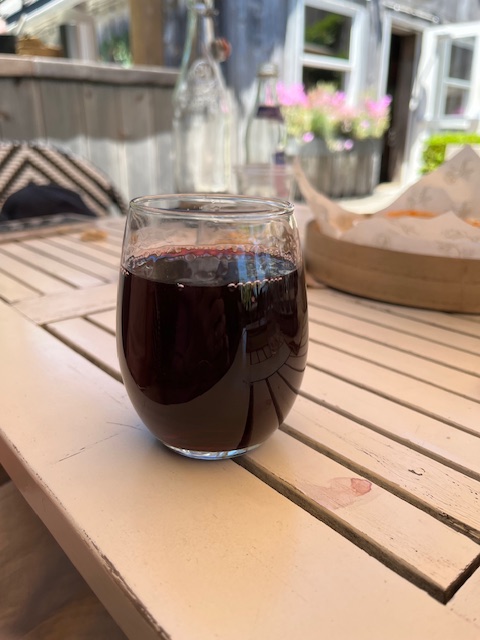
The merlot.
The glass of Cadence we ordered to sip as we finished our dips. It is a blend of merlot and petit verdot.

Reasons to visit:  lovely patio; excellent service; good snacks; the Concrete Blonde (no blond jokes!), the Palmilla, the Albariňo, and the Cadence.

I peeked into the inside room, just to see what it was like. Looks nice.

Jamesport Vineyards:  Pizza and Wine Again

October 5, 2023

Our wait was very brief.

We were discussing the possibility of going to do a tasting while examining the refrigerator for lunch ideas, when it hit us—why not combine lunch and a tasting?  A quick check of the Internet confirmed that Jamesport Vineyards offers their “wood fired” pizza on Thursdays, and in fact they have a Thursday special, of a Margherita pie and a bottle of any of their East End label wines for $45.  So we slathered on some sun screen (not really needed, as the patio is amply shaded), put on our shoes, and headed out.

This was a perfect day for sitting outside, but I don’t know how many more of these we will have this year.

We were quickly greeted at the entrance and escorted to a table on the pretty patio, which looks out on beds of flowers, a lawn, and groupings of tables and chairs.  A number of other couples must have had the same idea, because bottles or flights of wine and pizzas appeared on most tables.  Glasses of ice water, a welcome amenity on this warm afternoon, were set on our table as we perused the menus. 

The wine menu offered three tastings, one of all whites, one all reds, and a mixed flight, of four wines for $27, which we decided to order.  There are 16 wines on the list, all available as a glass or a bottle.  Then we turned the menu over to check out the food offerings, which are quite extensive, from snack-type items like olives and cheeses to real meals, including a lobster roll.  But the main attraction is the pizzas, of which seven varieties are listed.  We decided to get the “Larry,” for $26, which features house-made mozzarella and house-made hot Italian sausage, plus tomato sauce, onions, roasted red peppers, chili oil, and fresh oregano.  It arrived at our table hot from the oven, appropriately singed at the edge, and delicious.  It is worth going there for a glass of wine and a lunch pizza any time.  The menu says one pie serves two, but we took home enough to reheat (in the oven, please, not the microwave) for dinner.  One downer: the plastic knife is totally inadequate to cut the pizza (I know, I do the NYC fold to eat mine, but my tasting buddy prefers to knife and fork his.). 

The pizza is divided into six slices, and we found one each to be enough for lunch.

Another note: no children allowed on the weekends, and no dogs except service dogs at any time.

Our waitress brought out the bottles and poured a generous amount for each taste, giving a brief spiel to describe each wine.  As we sipped and munched, we discussed what an asset wineries like this are to the North Fork.

  •  2022 Estate Albariño      $38

I am generally fond of albariños, and often order one when getting wine by the glass in restaurants.  I wish more North Fork wineries used this grape.  They tend to be crisp, with nice fruit tastes of pineapple and guava, with some notes of lemon, and this one is no exception.  The waitress says she smells banana, which we debate after she leaves.  Maybe a very ripe banana?  Very good.  I’d buy a bottle, but I think I can get it for less at Vintage, our local liquor store.

  • 2019 Estate Riesling         $35

Happily, this is not a sweet riesling, as I tend not to like sweet wines (except for dessert).  It has very little aroma, and is dry, with lots of minerality.  It is not at all fruity, but I find it has an edge to it I don’t care for.  I let my husband drink most of it.

The “East End” wines have screw caps, which I have to admit I am coming to prefer.
  • 2022 East End Rosé         $38

On the other hand, I like this rosé better than he does.  It is crisp and dry, with a touch of fizz.  It’s not very fruity, but goes well with the pizza.  It is definitely a food wine, not a sipper.

  • 2020 Estate Cabernet Franc         $36

“What I smell,” says my seasonally allergy afflicted pal, “smells good.”  I agree, and note aromas of cherry and other dark fruits plus tobacco.  The taste, however, is a little disappointing, as it is a very light red, with no depth.  But it goes the best with the pizza, and is certainly pleasant to drink.  “Not bad,” opines my fellow taster.

No surprise, no one wanted to sit inside on this beautiful day.

Reasons to visit:  beautiful outdoor setting, with lawn and flower gardens; menu of real foods, particularly the pizzas; the albariño and the rosé; excellent service; laid-back vibe (at least on a weekday).

You can see into the wine-making area from the tasting room.

Pindar Vineyards: Special Day for Locals

March 31, 2023

The day was gray and chilly, but we had a good time anyway.

Pindar is proud of being one of the early vineyards on the North Fork, with their vines planted over 40 years ago.  I came by this bit of knowledge on a free tour and tasting at Pindar, part of an effort by a number of vineyards to attract locals to come and taste their wines.  Friends of ours had noted this program and invited us to join them at Pindar, whose perks seemed the best (other places offered such bargains to locals as ten percent off bottles or two for one).  Good move! We had a good time, learned a lot, and got to taste some wines we then bought and took home.

Nancy is showing us a gewurztraminer vine, one of the original ones planted at Pindar. The roots can go very deep.

Nancy, our tour guide, started us off by the vines, and then took us through all the steps of making wine, from the crush pad to the stainless steel tanks to the French oak barrels to the warehouse, and then back to the tasting room where we got to try five wines.

“Viticulture is farming for masochists,” she informed us, as she explained the work involved in pruning the vines, which she characterized as “an art and a science,” and the perils faced by grape growers.  There are migrating birds who will peck at the grapes, so they look fine but then shrivel into nothing; there are hurricanes on Long Island, whose arrival coincides with harvest season; and there is the lack of crop insurance, because how can you insure for their current value vines that have been growing for over 40 years.  In addition, you have to wait four years after you plant those vines before you can expect to harvest the grapes. The issue of birds has been taken care of, through an ingenious system of nets, which you can see in many vineyards, which remain furled up below the vines and are then raised when the grapes ripen.  As to the other issues…not much one can do about them!

Despite these problems, Pindar has 325 acres of vines, resulting in 60 to 70,000 cases of wine every year.  At first, Dr. Dan Damianos, the visionary who started Pindar (named, like one of his sons, for the classic Greek poet, in homage to their Greek heritage), planted gewürztraminer grapes, judging that the climate and soil would work well for this varietal.  Now they grow twenty-four varietals, and they list twenty-nine different wines on their tasting menu, which includes a number of blends.

The bottling machine, which is about to be replaced by an even better one.

They bottle these wines with their own bottling line, which can do 3,000 a day.  Not every winery has their own bottling facility, with many using Premium Wine Group for this.  Nancy gave a brief lecture on the issue of corks vs. screw caps, with corks reading as “better” wines, and screw caps okay for more casual, cheaper wines. Screw caps work just fine, though corks have the advantage of being biodegradable.

I never knew why the vats have this dimpled jacket.

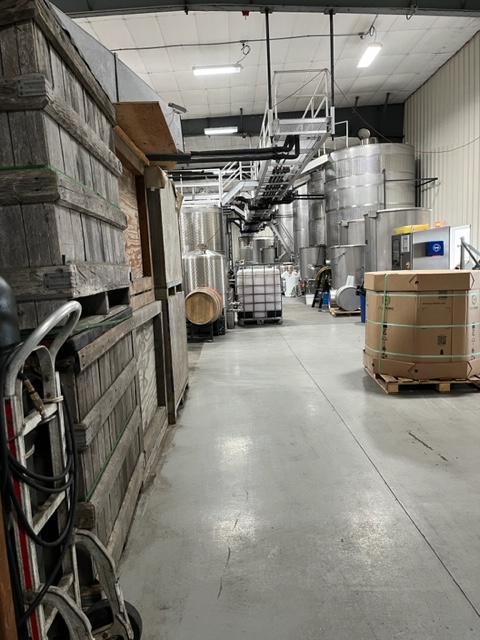
We then walked into a huge room filled with vast stainless steel vats, where Nancy explained something I’d always wondered about.  The vats are partially encases in a dimpled steel jacket.  It is a glycol jacket, containing polyglycol, used to help regulate the temperature in the vats, and the dimples keep the polyglycol from settling to the bottom.  Too hot or too cold, and the wine is ruined.  They use a windmill to provide about 60% of the energy needed in the warehouse and wine “cellar”—not a cellar, because…polyglycol.  We also learned about another hazard of viticulture—carbon dioxide.  As the juice ferments into wine, carbon dioxide rises to the top of the tanks, where the solid matter must be pushed down into the liquid.  Catwalks provide access to the tops of the tanks, and open doors help dissipate the CO2.

Part of the filtration system.

She showed us their filtration system, and we learned, by the way, that Guinness Stout used isinglass, obtained from the bladders of sturgeon, to filter their brew.  I like Guinness, but I also like caviar!

She also took us outside to see the crush pad, where a machine crushes the grapes. Because Pindar is so big, a lot of the work is done by machines.

The crush pad.

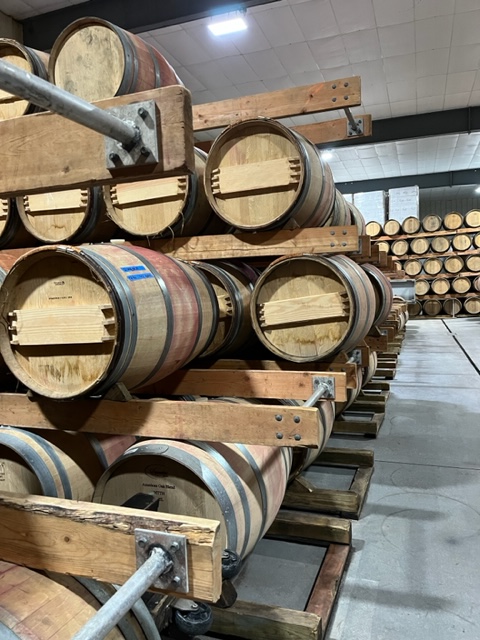
The huge space where red wine ages in French oak barrels smelled enticingly like a forest or lumberyard.  We found out that there are different tastes imparted to wines by French and American oak, with some adding notes of vanilla and others cinnamon, etc.  Pindar now uses only French oak, buying 300 barrels a year, and has phased out their American oak barrels, which they sometimes sell to breweries or to people who want to use them in their gardens.  We also learn about the “angel’s share,” the wine which evaporates from the barrels, meaning they need to be constantly watched and topped up, so that too much oxygen doesn’t turn the wine into vinegar.  The angels must reserve a special place in heaven for wine makers!

Despite the bung stopper, some evaporation is unavoidable.

Finally, our last stop before the tasting room, we saw the warehouse where cases of wine are stacked high.  Nancy held up a four-pack of cans of Winter White, and explained that Dr. Dan, noting the American taste for soda and other sweet drinks, decided to make some sweeter wines, like Winter White, which is the most popular white on Long Island.  More recently, the decision was made to offer it in cans; again, to attract those who might otherwise opt for soda or beer.

Cans of Winter White, ready to go.

Now it was time to taste the fruits of their labor!  The group of about thirty locals lined up around the bar, where glasses stood ready.  Here are my tasting notes:

Nice sized pour.
  •  2020 Dr. Dan’s Selection White Blend      $24.99

Our first taste is a blend of, this vintage, of 53% viognier, plus pinot grigio, sauvignon blanc, and riesling.  The percentages may vary year to year.  This is a very drinkable white, with aromas of pineapple and citrus, and tropical fruit flavors like guava and pineapple.

  • 2021 Dr. Dan’s Selection Gewürztraminer               $24.99

We are quite interested to taste this, after learning the history of the vines, and we quite like it.  In fact, we and our friends each buy a bottle to take home.  It is not too sweet, which can happen with gewürztraminers, with an aroma of peaches and tastes that include tangerine and apricot.  “Yummy,” we and our friends agree.

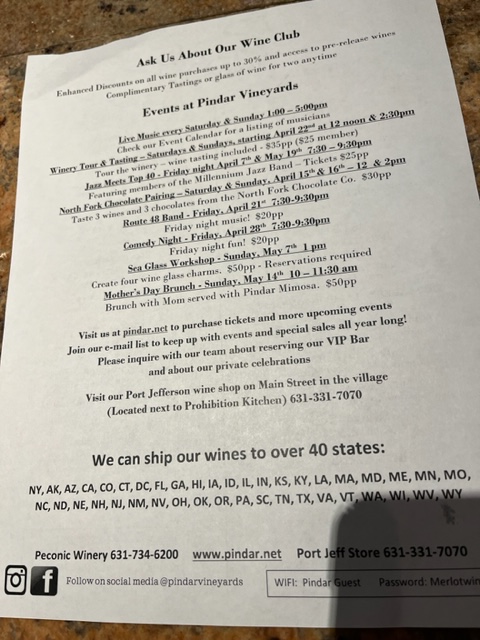
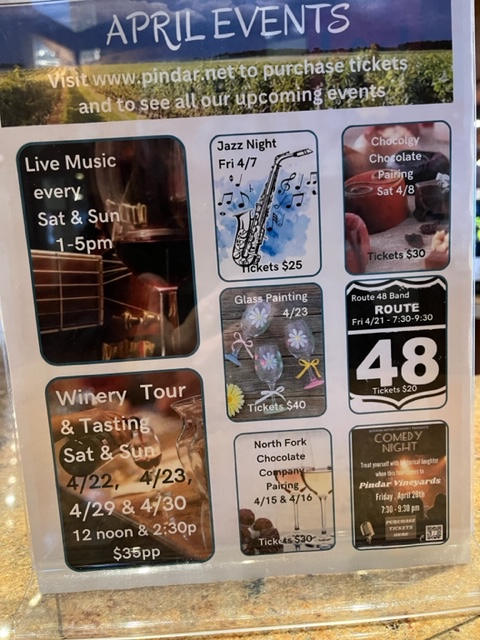
At the tasting, I turned over my menu to see the events list.
  • 2019 Mythology                $42.99

A Bordeaux blend called Meritage, this includes malbec, cabernet sauvignon, merlot, petit verdot, and cabernet franc.  Delicious.  Lots of dark fruit taste and enough tannins that one could probably age it.

  • 2019 Cabernet Sauvignon Reserve            $34.99

Nancy, who is still informing us about the wines, explains that cabernet sauvignon used to be harder to grow on Long Island, since it needs a longer growing season to mature.  However, with climate change, the growing season on Long Island has gotten longer.  I guess that’s an upside to global warming! This is another very good red, with tastes of blackberry and other fruits, and an aroma of cedar and tobacco.

Pindar Damianos chatting with a guest.
  • 2015 Cabernet Port         $28.99 for 750 ml, $16.99 for 375 ml

I’m not sure if this was in the original tasting or if it was included after our friend shared his enthusiasm for the port with Nancy and with Pindar Damianos, who was hanging around and talking to the guests.  He discovered that Pindar makes award-winning port in an old issue of a wine magazine shortly after moving to the North Fork, and was happily buying and drinking it.  I can see why.  This is a dessert wine—in English novels, they are always sipping it after dinner while they crack walnuts and chat—but it is not too sweet, with an appealing depth of flavor.  It is made 100% from cabernet franc.  We each buy a bottle to take home.

Cases filled with awards Pindar wines have won.

Reasons to visit:  roomy tasting room with two outside areas; a wide variety of wines for every taste, from sweet to dry, and price, from $14.99 (Winter White and others) to $42.99; all the wines we tasted—White Blend, Gewürztraminer, Mythology, and Cabernet Sauvignon Reserve—plus the port; our friends had also tasted the Gamay Noir before we went on the tour, and bought a bottle of that light red to take home; they have a refrigerated case full of cheeses, etc., to consume there; they have a variety of special events.

Pindar Vineyards: Special Day for Locals

March 31, 2023

The day was gray and chilly, but we had a good time anyway.

Pindar is proud of being one of the early vineyards on the North Fork, with their vines planted over 40 years ago.  I came by this bit of knowledge on a free tour and tasting at Pindar, part of an effort by a number of vineyards to attract locals to come and taste their wines.  Friends of ours had noted this program and invited us to join them at Pindar, whose perks seemed the best (other places offered such bargains to locals as ten percent off bottles or two for one).  Good move! We had a good time, learned a lot, and got to taste some wines we then bought and took home.

Nancy is showing us a gewurztraminer vine, one of the original ones planted at Pindar. The roots can go very deep.

Nancy, our tour guide, started us off by the vines, and then took us through all the steps of making wine, from the crush pad to the stainless steel tanks to the French oak barrels to the warehouse, and then back to the tasting room where we got to try five wines.

“Viticulture is farming for masochists,” she informed us, as she explained the work involved in pruning the vines, which she characterized as “an art and a science,” and the perils faced by grape growers.  There are migrating birds who will peck at the grapes, so they look fine but then shrivel into nothing; there are hurricanes on Long Island, whose arrival coincides with harvest season; and there is the lack of crop insurance, because how can you insure for their current value vines that have been growing for over 40 years.  In addition, you have to wait four years after you plant those vines before you can expect to harvest the grapes. The issue of birds has been taken care of, through an ingenious system of nets, which you can see in many vineyards, which remain furled up below the vines and are then raised when the grapes ripen.  As to the other issues…not much one can do about them!

Despite these problems, Pindar has 325 acres of vines, resulting in 60 to 70,000 cases of wine every year.  At first, Dr. Dan Damianos, the visionary who started Pindar (named, like one of his sons, for the classic Greek poet, in homage to their Greek heritage), planted gewürztraminer grapes, judging that the climate and soil would work well for this varietal.  Now they grow twenty-four varietals, and they list twenty-nine different wines on their tasting menu, which includes a number of blends.

The bottling machine, which is about to be replaced by an even better one.

They bottle these wines with their own bottling line, which can do 3,000 a day.  Not every winery has their own bottling facility, with many using Premium Wine Group for this.  Nancy gave a brief lecture on the issue of corks vs. screw caps, with corks reading as “better” wines, and screw caps okay for more casual, cheaper wines. Screw caps work just fine, though corks have the advantage of being biodegradable.

I never knew why the vats have this dimpled jacket.

We then walked into a huge room filled with vast stainless steel vats, where Nancy explained something I’d always wondered about.  The vats are partially encases in a dimpled steel jacket.  It is a glycol jacket, containing polyglycol, used to help regulate the temperature in the vats, and the dimples keep the polyglycol from settling to the bottom.  Too hot or too cold, and the wine is ruined.  They use a windmill to provide about 60% of the energy needed in the warehouse and wine “cellar”—not a cellar, because…polyglycol.  We also learned about another hazard of viticulture—carbon dioxide.  As the juice ferments into wine, carbon dioxide rises to the top of the tanks, where the solid matter must be pushed down into the liquid.  Catwalks provide access to the tops of the tanks, and open doors help dissipate the CO2.

Part of the filtration system.

She showed us their filtration system, and we learned, by the way, that Guinness Stout used isinglass, obtained from the bladders of sturgeon, to filter their brew.  I like Guinness, but I also like caviar!

She also took us outside to see the crush pad, where a machine crushes the grapes. Because Pindar is so big, a lot of the work is done by machines.

The crush pad.

The huge space where red wine ages in French oak barrels smelled enticingly like a forest or lumberyard.  We found out that there are different tastes imparted to wines by French and American oak, with some adding notes of vanilla and others cinnamon, etc.  Pindar now uses only French oak, buying 300 barrels a year, and has phased out their American oak barrels, which they sometimes sell to breweries or to people who want to use them in their gardens.  We also learn about the “angel’s share,” the wine which evaporates from the barrels, meaning they need to be constantly watched and topped up, so that too much oxygen doesn’t turn the wine into vinegar.  The angels must reserve a special place in heaven for wine makers!

Despite the bung stopper, some evaporation is unavoidable.

Finally, our last stop before the tasting room, we saw the warehouse where cases of wine are stacked high.  Nancy held up a four-pack of cans of Winter White, and explained that Dr. Dan, noting the American taste for soda and other sweet drinks, decided to make some sweeter wines, like Winter White, which is the most popular white on Long Island.  More recently, the decision was made to offer it in cans; again, to attract those who might otherwise opt for soda or beer.

Cans of Winter White, ready to go.

Now it was time to taste the fruits of their labor!  The group of about thirty locals lined up around the bar, where glasses stood ready.  Here are my tasting notes:

Nice sized pour.
  •  2020 Dr. Dan’s Selection White Blend      $24.99

Our first taste is a blend of, this vintage, of 53% viognier, plus pinot grigio, sauvignon blanc, and riesling.  The percentages may vary year to year.  This is a very drinkable white, with aromas of pineapple and citrus, and tropical fruit flavors like guava and pineapple.

  • 2021 Dr. Dan’s Selection Gewürztraminer               $24.99

We are quite interested to taste this, after learning the history of the vines, and we quite like it.  In fact, we and our friends each buy a bottle to take home.  It is not too sweet, which can happen with gewürztraminers, with an aroma of peaches and tastes that include tangerine and apricot.  “Yummy,” we and our friends agree.

At the tasting, I turned over my menu to see the events list.
  • 2019 Mythology                $42.99

A Bordeaux blend called Meritage, this includes malbec, cabernet sauvignon, merlot, petit verdot, and cabernet franc.  Delicious.  Lots of dark fruit taste and enough tannins that one could probably age it.

  • 2019 Cabernet Sauvignon Reserve            $34.99

Nancy, who is still informing us about the wines, explains that cabernet sauvignon used to be harder to grow on Long Island, since it needs a longer growing season to mature.  However, with climate change, the growing season on Long Island has gotten longer.  I guess that’s an upside to global warming! This is another very good red, with tastes of blackberry and other fruits, and an aroma of cedar and tobacco.

Pindar Damianos chatting with a guest.
  • 2015 Cabernet Port         $28.99 for 750 ml, $16.99 for 375 ml

I’m not sure if this was in the original tasting or if it was included after our friend shared his enthusiasm for the port with Nancy and with Pindar Damianos, who was hanging around and talking to the guests.  He discovered that Pindar makes award-winning port in an old issue of a wine magazine shortly after moving to the North Fork, and was happily buying and drinking it.  I can see why.  This is a dessert wine—in English novels, they are always sipping it after dinner while they crack walnuts and chat—but it is not too sweet, with an appealing depth of flavor.  It is made 100% from cabernet franc.  We each buy a bottle to take home.

Cases filled with awards Pindar wines have won.

Reasons to visit:  roomy tasting room with two outside areas; a wide variety of wines for every taste, from sweet to dry, and price, from $14.99 (Winter White and others) to $42.99; all the wines we tasted—White Blend, Gewürztraminer, Mythology, and Cabernet Sauvignon Reserve—plus the port; our friends had also tasted the Gamay Noir before we went on the tour, and bought a bottle of that light red to take home; they have a refrigerated case full of cheeses, etc., to consume there; they have a variety of special events.

Jason’s Vineyard: Ahoy, Matey!

December 7, 2022

The nautical theme begins outside; note the roped pilings.

As we settled ourselves around Jason’s ship-shaped bar (mast and all), I joked, “And it’s not a pirate ship!”  I expected the server to agree, and explain that its design is a reference to the famous Greek ship, the Argo, whose captain was the hero, Jason.  Instead, he offered, “It’s a Viking ship.”  Assuming he was kidding, I laughed—but he wasn’t.  Though he’s worked for the Damianos family for years (They also own Pindar and the two Duck Walk tasting rooms.), no one had ever explained to him the mythological inspiration for the bar.  Jason Damianos, sadly, died in an auto accident not long after opening the tasting room, but the family continues to run it.  Though pleasant and attentive, our server was similarly not informed about the wines.  I hope after our gentle teasing he will be better informed for the next visitors.

The mast is designed like a classic Greek sailing ship‘s mast.

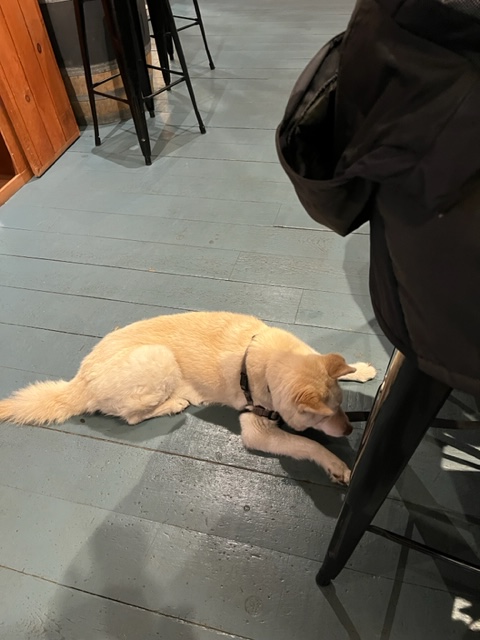
We had chosen to go to Jason’s because our visitors brought with them their very well-behaved pooch, and, according to the web site, they welcome dogs.  Then the sign on the door said, “No Pets.”  What to do?  I poked my head into the empty room, and asked, and the server welcomed us in, doggie and all. Whew. 

Our visiting pup.

We hadn’t been to Jason’s since February 2019, both due to the pandemic and because we had found the wines overall too sweet for our taste.  They seem to have partially corrected that, although Golden Fleece (a reference to the object of Jason’s quest), their most popular wine, is still much too sweet.  By the way, if you like to look at animals, you can stop outside to see the sheep and alpacas, another reference to the famous quest.  Oh, and the rest rooms are labeled Gods and Goddesses, reinforcing the mythological theme.

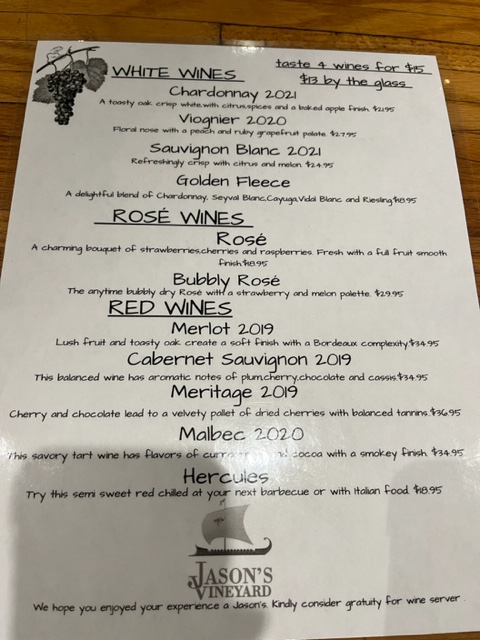
A tasting consists of four wines for $15, chosen from the list of eleven, served in little plastic cups on a labeled tray.  The servings were adequate for each couple to share a tasting.  We decided to mostly have the same wines, so we could compare notes, and all decided not to buy any wines to take home. They allow you to bring in snacks, and also sell a selection of crackers and cheeses.  Our guests bought a package of crackers as palate cleansers.

  • 2020 Viognier   $27.95

I often find viogniers quite pleasant, and this one was okay.  The aroma reminded me of fresh-cut grass, and the taste was somewhat grassy as well, with some herbal notes.  However, one guest found it somewhat vinegary, and too sharp for her taste.

The plate has an insert of numbers, and our server explained to taste them in a clockwise order.
  • 2021 Sauvignon Blanc    $24.95

Consulting my notes, I see that the last time we were here I characterized the sauvignon blanc as watery, and it still is.  It’s a very light white, with some notes of melon with lemon squeezed over it.

  • Golden Fleece    $18.95

Our guests ordered this one, and gave us a sip to taste as well.  A blend of chardonnay, seyval blanc, Cayuga, vidal blanc, and riesling—according to the tasting menu, though our server was unable to tell us in what proportions—this tasted mostly like a rather sweet riesling.  Not my type, though, as I mentioned above, this is apparently their most popular wine.

There’s an outside porch area, though not for a chilly rainy day.
  • 2019 Merlot       $34.95

“This is a competent merlot,” opined one guest, and I agree.  It is dry, with some cherry taste and aroma, somewhat light, with some notes of oak and smoke.  As we were sipping, we got into a discussion with our server, who by this time had exactly one other group to attend to, about how the Damianos family run three separate wineries.  He explained that, in addition to the eleven wines at Jason’s, the other two places offer thirty different wines each, with each meeting different requirements as to taste.  However, the same winemaker does them all.  That’s impressive, and part of why I find wine so fascinating.  The same grape, grown in the same area and type of soil, can end up tasting quite different, depending on time of harvest and after harvest treatment.

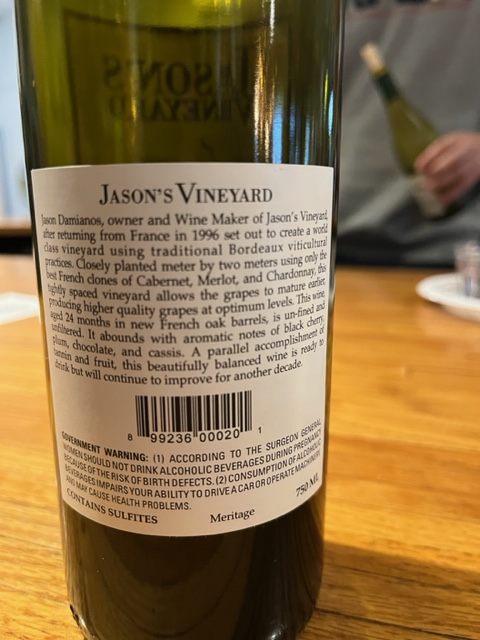
The bottles are adorned with an image of the Argo. It was manned by a group of heroes dubbed the Argonauts.
  • 2019 Meritage   $36.95

Although this is their Bordeaux blend (again, I don’t know proportions or grapes), it is thin, almost watery, with a slight taste of black olives.  Meh.

Reasons to visit:  you like to look at sheep and alpacas; you are fascinated by Greek mythology; you need to bring a dog with you (despite the sign on the door, the website does say, “Pets are welcome!”); you like sweet wine.

This alpaca seemed quite curious about us.

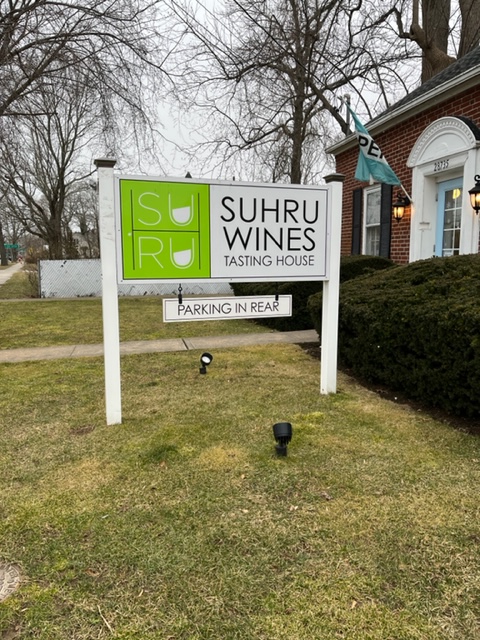
Suhru Wines: Early Return (Not Election Related)

November 12, 2022

This photo was taken in February, the last time I was here.

Because there are so many wineries on the North Fork, I generally don’t return to one more often than once a year.  However, my daughter and a group of her friends were having a little reunion of their group, and invited me to meet them at Suhru, which I had last been to in February.  How could I resist? 

Suhru was a perfect venue for the six of them (plus me) to get together, since they were able to sit comfortably at a table, the room was cozy and quiet, and the server combined just the right amount of service and letting be.  She started the afternoon off right by bringing us chilled bottles of water and glasses.

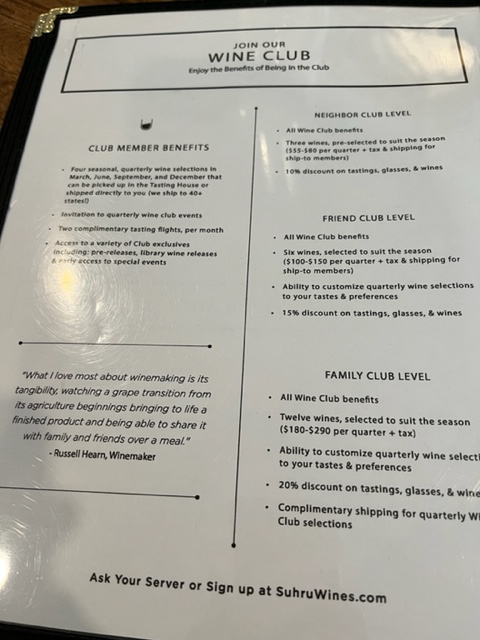
I still wasn’t going to blog this visit, but then I saw that the menus, both for drinks and food, had changed, so I fished some scrap paper out of my purse and jotted down a few notes.

The menu of flights has four possibilities:  Holiday Favorites ($19), Whites & Rosé ($14), and Red Wines ($19), each consisting of four tastes.  You could also put together your own four tastes for $19.  As it happened, everyone opted for the Holiday Favorites, with much discussion about who was hosting Thanksgiving and what wines would go with turkey.  We all agreed, as my daughter learned when she and her husband toured the Champagne region of France, that sparkling wines go with everything. 

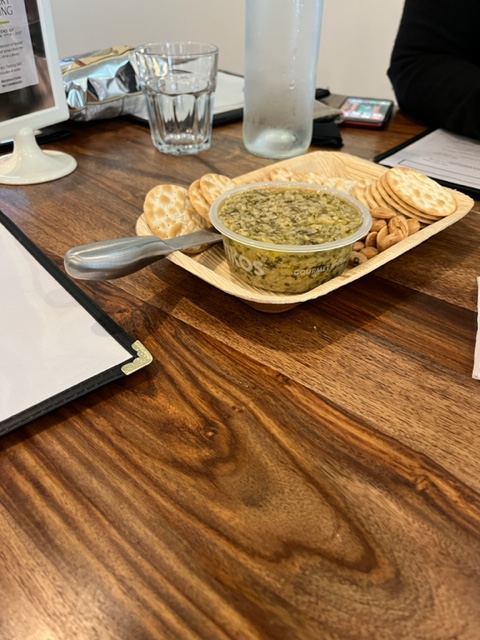
The snack menu has also changed.  I was glad to see they no longer offered the measly portion of marcona almonds for $2.  The group, wanting to try local products, ordered the North Fork Cheese Plate, which, for $32, included a good-sized scoop of Goodale Farms herb chevre and a small slab of goat gouda, plus crackers, honey, and candied orange rind (all out of apricots).  They also got artichoke and lemon spread, a small container whose label we read to be sure it was okay for the lactose intolerant in the group, which came with (at least a dollar’s worth of) marcona almonds and crackers.  Plus two bags of North Fork potato chips.  It was plenty.

  •  NV Brut               $29

According to the tasting notes, this has won a number of medals, and I can see why.  It has a lovely bready aroma and tastes of ripe apple and minerals. Lots of tiny bubbles.  Everyone likes it.

  • 2020 Sauvignon Blanc                   $21

“Grassy,” says my daughter as she sniffs and sips this one, and I agree.  It reminds me of the smell of fresh-cut grass.  I also taste green apple and some minerality, and smell thyme honey.  Very nice.

  • 2021 Riesling                     $19

Our server explains that Suhru is a winery without a vineyard, and they buy all their grapes from various North Fork vineyards—except the riesling, which they buy from the Finger Lakes, a region famous for its rieslings.  I was glad this was a dry riesling, since I often find sweet rieslings undrinkable (except for dessert, or with very spicy food).  I explain the aroma, which some describe as “cat pee,” but for me reminds me of the smell of water that has had flowers in it for a bit too long.  Fortunately, it tastes better than it smells, with some stone fruit and flower notes.

  • 2021 Teroldego                $30

This and the sauvignon blanc are both new releases.  (The emphasis, by the way, is on the second syllable.)  This is an easy-to-drink red, and could go with turkey (as could all of the wines we tasted!).  It has notes of cherry and tobacco (from aging in oak), and is dry, with a touch of tannins. 

You can see how distracted I was by the lively conversation–I forgot to take a photo of the tasting until it was gone!

Reasons to Visit:  cozy, intimate tasting room with a beachy vibe; all the wines, including one I did not taste but others in the group tried, Ember; nice menu of snacks.

Raphael: Pretend You’re in Italy

July 15, 2022

Looking like a villa in Tuscany, the Raphael tasting room sits on the Main Road in Peconic.  A covered veranda in the back looks out onto the grape vines, and the warm weather this week made it really feel like Italy.  We drove in past the miniature villa gateposts, around the Italianate fountain, and parked in the lot.  Through heavy wooden doors that would not be out of place on a palazzo we went, entering a huge space where a disembodied voice said, “Welcome!”

The voice soon materialized into a young woman, who cheerily asked us if we wanted to sit inside or outside.  Noting that there was plenty of room to be socially distant from other tasters, we opted to sit inside at a table facing outside, where she left us with a couple of menus.

As we perused the menus, she returned with two bottles of Poland Spring water.  I no longer buy bottled water, but these would be convenient for the future.  It was lunch time, and on a previous visit we’d had very good flatbread pizzas.  However, they no longer have them (or at least, not during the week), and the menu features a selection of cheeses, crackers, hummus, etc., all a la carte (so if you want crackers with your cheese, you need to order them).  We also noticed that every tasting comes with a “snack.”  “What is that?” we asked.  “Sort of a grown-ups Lunchables,” she replied. Ah.  We decided to add a serving of hummus ($8) and tortilla chips ($10), most of which we ended up taking home, as the chips were a huge bag and the humus a 10-ounce container (very good, by the way). The snack was indeed quite mini, consisting of about four crackers and as many slices of bland cheese, plus some slices of spicy sausage. However, it did remind us of how in Italy one is often served some sort of snack with a glass of wine, like a dish of olives, or like the time in Bologna when there were three of us sharing a bottle of wine, and the waiter brought a plate of cheeses and sausages (no charge).
Meanwhile, we were debating over which flight to get, as they have six different options.  We could see by looking at other tables that the serving per taste is quite generous, but we wanted to try a panoply of wines, so we decided to just plan not to finish each glass, and get a flight of four whites for $25 and four reds for $25.  Both flights were brought to our table on labeled strips of paper.  Our waitress launched into her little scripted speech about each wine, enlivened by her personal preferences, with which we agreed.  For example, we had a little chat about riesling, which she noted she sometimes dislikes as too sweet, but felt the current iteration of Raphael’s riesling is one she likes.   I was a bit concerned when she described a couple of the reds as “summer reds,” and when I tasted them I saw why.
As we sat and sipped and munched and looked out at the vines, my tasting buddy said that Raphael gets an A+ for service and setting.  As to the wines…

  •  2021 Rosé of Pinot Noir               $30

Our server explained that this is a “true” rosé, made from red wine grapes treated like white grapes.  It is a pretty color, and had a pleasantly fruity aroma.  We liked the taste, too, with notes of citrus and black cherry, not too sweet, not too dry.  A good summer sipper.

The snack.
In an effort to counteract the blandness of the cheese and the spiciness of the sausage, I combined them.
  •  2021 Sauvignon Blanc                  $30

All their whites are fermented in steel, which sometimes leaves a slightly metallic aroma, which this has.  It is a touch petillant, crisp and light.  A little fruity.  Nice.

  • 2021 Pinot Grigio             $30

In France, they call this grape pinot gris.  We like this wine the best so far, with a taste of baked pears.  Not much aroma.  Good for sipping or with food, like roast chicken, or even pork chops.

  • 2021 Riesling      $30

Many rieslings have a smell described as “cat pee,” which, having had a cat in the past, I can say this one has, though faintly.  There is some sweetness here, but there is also a bit of a funkiness which takes the edge off the sweetness.  Pleasant.  Though my husband finds it too sweet for him, I think it would be fine with something spicy, like Thai food.

  • 2019 Cabernet Franc       $36

This is one of the wines she described as “summery,” and I think I know why.  It is soft and fresh and easy to drink, with slight tannins, a berry aroma, and tastes of ripe dark fruits.

  • 2019 Pinot Noir                $50

“Not a very exciting red,” opines my drinking pal, and I agree.  It’s not bad, just kind of mellow and soft.  When I tell him the price, he says, “We’re not getting it!”  He also thinks that people may not, in general, want strong reds, which would account for the popularity of a wine like this.

If you plan to go, check their website, and the winery is sometimes closed for private parties.
  • 2019 Estate Merlot          $30

As our waitress noted, we are in the middle of merlot country here, as that grape is “happy” on the North Fork.  This is a fairly typical North Fork merlot, with nice cherry flavor, but ultimately meh.

The Malbec.
  • 2020 Estate Malbec         $36

This is my favorite of the reds, with a beautiful dark color, yummy fruit aroma, and dark fruit tastes—though again, no tannins.  “It’s not oomphy,” says my husband, and I agree.

Reasons to visit:  beautiful building and veranda, with vineyard views; attentive service; generous pour for the flights; the whites more than the reds, though all the wines were drinkable; the Rosé of Pinot Noir, the Pinot Grigio, the Malbec; nice place to come with a couple of friends.

There’s a fairly extensive gift shop, which may be another reason to visit.

Duck Walk: Time to Par-tee

March 26, 2022

Our visiting pooch.

This time the only complicating factor—we thought—was the well-behaved pooch our visitors brought with them.  So we carefully planned to go to Jason’s Winery for a tasting, even though we knew Jamesport was holding a St. Patrick’s Day Parade that Saturday.  Looking at a map of the parade route, we thought we could get to Jason’s.  A couple of detours later, we got there—only to discover that it was the site of an after-parade party, with the grounds packed with cars.  Plan B.  We parked on a side road and called a couple of other tasting rooms.  No dogs; no dogs; okay for a dog, but there’s one here now, said the lovely woman at McCall’s, and the room is small.  We popped our heads in anyway, and were barked at.  Never mind.  Then I remembered that Duck Walk is owned by the same family that owns Jason’s and Pindar—the family of Dr. “Dan” Damianos—and is also “pet friendly.” 

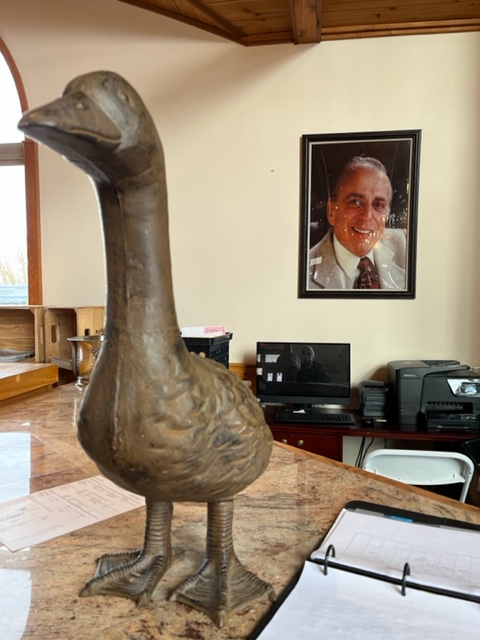
Dr. “Dan” Damianos overlooks the tasting room.

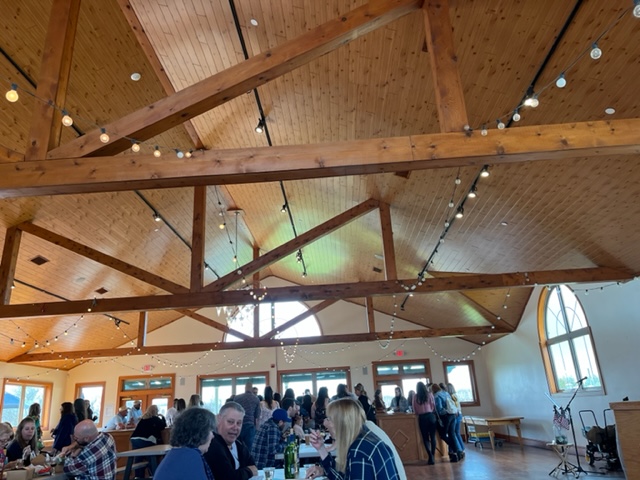
Though the rain had commenced to fall heavily, we decided to head to Duck Walk as our last possibility, as the afternoon was slipping away.  In we went, to be greeted by a wall of sound. Though the live entertainment consisted of one man with a guitar, his amp and mic must have been set on the loudest settings, and the room is cavernous, so it was so noisy we could barely hear the woman at the cash register inside the door.  The noise was abetted by perhaps five or six bachelorette parties, easily identifiable by the woman in the midst of each wearing a white veil, including one group whose theme was “disco,” and who were dressed in sparkling outfits.  Should we stay?  We decided to stay. 

The bride-to-be is easily identifiable.
By the time we left, the sun was out. That’s March–if you don’t like the weather, wait five minutes.

The visiting pooch was a big hit with the bachelorettes, who had a great time petting him and receiving doggie kisses in exchange.  We also noted that Duck Walk allows outside food, and one party was happily consuming picnic lunches, most likely provided by the limo company.  Some bags of pretzels and popcorn are for sale, plus bottles of water.

We paid for two tastings, at $13 for four tastes, and received a little slip of paper to present at the bar.  You can also pay directly at the bar, as we observed.  However, considering how hard the two—later three—servers were working, I’m glad we didn’t give them that additional task.  After seating ourselves at a picnic table as far as possible from the music—which would have been fine at a lower decibel level—we headed to the bar and perused a menu.  There we were confronted with twenty-three possibilities on a complicated list which has the categories “white wine varietal,” “white blends and rosé,” “red blends,” “red wines varietal,” and “dessert & sparkling wines.”  Whew.  One guest prefers her wines on the sweet side, so she consulted with Matt, a superlative server, who kindly marked the sweeter wines—eight in all—on her menu.  Also on offer, they make Absenthe, the “traditional distilled spirit with wormwood,” for $5 per taste.  At the bar, I noted a couple of taps for Greenport Harbor beers.  As I went to get one of my tastes, a couple walked up to the bar and the young man told his companion, “I want a beer,” so I hope they were happy with what they found.

Not sure what the plastic cups are for. Our tastes, of about an ounce and a half, came in nice glasses.

We opted to get up and get each taste, since there was no way to carry all four to our table and we didn’t want to stand at the bar.  Matt did a great job of remembering me each time I came back, and helping me keep track of what we had had.  I’m not sure how he did it, with the crowd around the bar.

I’ll list the wines in the order in which I tasted them, indicating which were in our guests’ tasting with an *.

  •  2020 Reisling*  $21.95

Reislings can vary in their level of sweetness, which is why I rarely buy one I haven’t tasted, and this one is definitely on the side of sweeter.  Our guest compared the taste to “sucking on a lollipop.”  I smell honeysuckle; she tastes peach and butterscotch.

  • 2020 Sauvignon Blanc    $21.95

This is a light, dry sauv, with lots of citrus.  I say lemon/lime, and my tasting buddy says more on the lime-y side.

  • Windmill Red *                $18.95

Yuk.  This smells like dirt—and not the somewhat pleasant petrichor smell—and tastes worse.  It has no depth and an unpleasant taste.  None of us wants to drink it, so I return the glass to the bar, where Matt very kindly replaces it with a red he hopes we’ll like better, for no extra charge.

  • 2020 Pinot Grigio            $21.95

Finally, a wine we like.  This has a pleasantly peachy flavor, with lemon at the end.

  • 2019 Pinot Meunier *    $26.95

Matt gave us this as a replacement, probably thinking of my friend’s penchant for sweet wines.  “Shades of Manischevitz,” is the comment.  Yes, I agree, this tastes very like grape juice.

  • 2018 Merlot      $21.95

We have a brief discussion of merlot, and how it is so popular on the North Fork.  This is a fairly typical merlot, with some nice cherry flavor and good mouthfeel.  Nothing special, but drinkable.

  • 2020 Cabernet Sauvignon *        $21.95

“Not as good as the merlot,” is our consensus, “but okay.”  It is dry, with a hint of tannins, and some dark fruit flavor.

  • 2019 Pinot Noir               $38.95

I get a pleasant bramble aroma and taste, with very soft tannins.  I can see how someone who is put off by big reds would find this pleasant.  Just okay.

  • 2020 Aphrodite *            $21.95

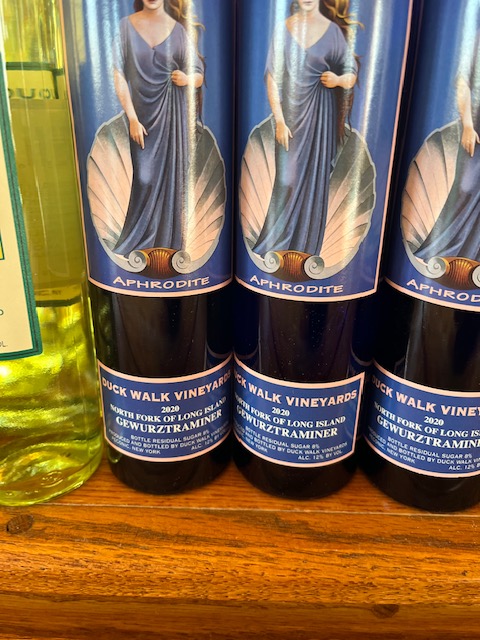
Save this for last, counsels Matt.  Right.  It is, after all, a dessert wine, and comes in a slim, pretty 375 ml. bottle featuring a picture of the goddess of love.  But we don’t love it.  It’s too sweet even for my sweet-loving guest.  It tastes like a sugary fruit salad, though I guess if you paired it with foie gras or walnuts it would be tolerable.  The menu suggests pouring this gewürztraminer wine over vanilla ice cream.  Yes, it is that sweet.

Reasons to visit:  you need a place that welcomes dogs and/or outside food; you are with a group of bachelorettes; the pinot grigio and the merlot; you like sweet wine.

Disco-themed bachelorettes!

Peconic Bay Vineyards: Under New Ownership

October 21, 2021

I expect I will be able to use the subtitle “under new ownership” quite a few times this year, as recently a number of wineries have changed hands.  In some cases, already existing wineries have expanded by buying their neighbors, while in others new owners have entered the North Fork wine scene.  Peconic Bay is a case of the latter, as the Soloviev family has been actively investing in the North Fork over the past few years.  Peconic has been officially closed for about eight years, though we stopped in there in 2017 when it was briefly open, as the previous owner was, according to our server, trying to sell out his stock.

Since they have been closed, they have been selling their grapes to other local wineries, which is why they only have limited quantities of certain varieties.  However, we were told by Sam, our charming and chatty server, those contracts are about to end, so she is looking forward to seeing what their winemaker—who is the same one who worked at Peconic before—will come up with.  For now, they offer seven wines, though two of them—the sauvignon blanc and the merlot—are in such limited quantity that they are not selling them by the bottle. 

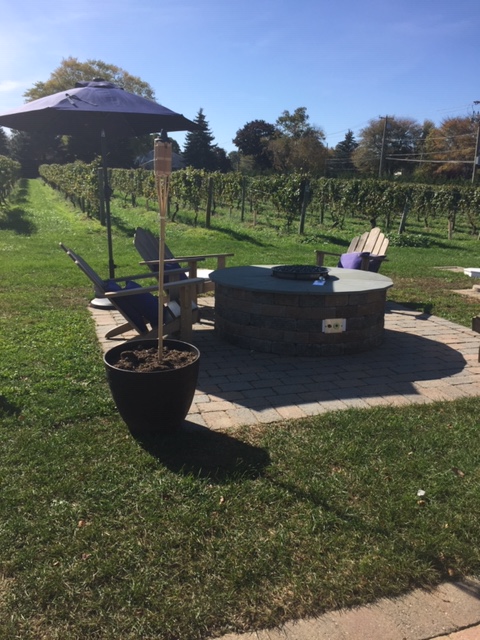
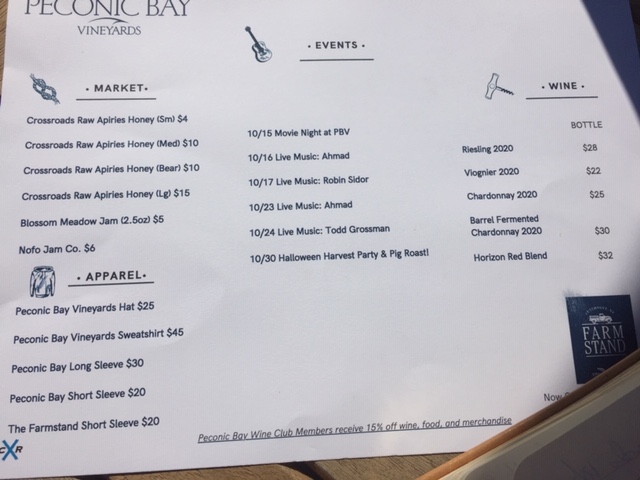
It was another beautiful warm day, so we planned to sit outside wherever we went, and when we walked into Peconic we were sure, as the inside area is quite small, with uncomfortable-looking stools at the bar.  Outside, however, featured a roomy patio, with nice wooden chairs (maybe they could add seat cushions in the future?) and comfy Adirondack chairs grouped around fire pits.  The fire pit areas, we were told, are all reserved already for “movie night,” when they will be showing Hocus Pocus.  They also plan to have live music at various times.  However, today we and one other couple were the only visitors, though Sam assured us it was busier on the weekends.

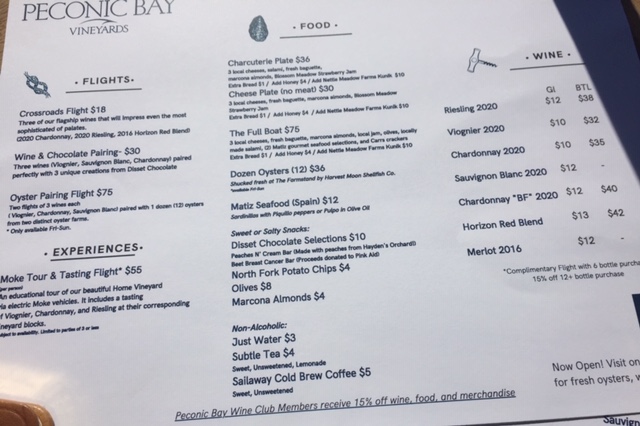
The menu offers a flight of three wines, called the “Crossroads Flight” for $18, and seemed to be limited to just the chardonnay, riesling, and red blend.  However, Sam told us we could substitute any other wines if we preferred, and after she described the riesling as semi-sweet, we did prefer—not to have it—so we opted for the viognier instead.  Good choice.  After we shared the small flight, we decided we would like to sit and enjoy the beautiful afternoon a while longer, so we shared a glass of the sauvignon blanc and a bag of North Fork potato chips.  The food menu features the usual cheese and charcuterie choices, as well as a chocolate tasting from Disset, a new fancy chocolatier in Cutchogue, and, on the weekends, local oysters.   As we contemplate the menu, Sam brings us a carafe of chilled water, always a nice touch.

  •  2020 Viognier   $22

I get a touch of kerosene and metal when I sniff, but fortunately it tastes of pineapple, not gas!  We like it.  It is dry with nice fruit tastes, refreshing, and different from most North Fork wines.

  • 2020 Chardonnay           $25

Sam informs us that this is the “musque” clone of chardonnay grape, which I have not knowingly encountered before.  In any event, the taste is quite distinct, a smooth, mellow sip that reminds me of thyme honey, though it is not sweet.  Most local chardonnays have a citrus flavor, but this does not.  The menu suggests pairing it with hard cheese, and I think it would go well with a truffle-infused pecorino we had from the Love Lane Cheese Shop recently.

  • Horizon Red Blend          $32

We decided to describe this as a “starter” red, or in other words a red for someone who is not yet into reds.  It is light and dry, with soft tannins, and tastes of wood and cherry.  Sam suggests calling it a “summer” red.  A blend of 73% malbec, 18% merlot, and 9% cabernet sauvignon, the aroma, of cherry, wood, tobacco, and coffee, promises more than the wine delivers.

  • 2020 Sauvignon Blanc

As I mentioned, we decided to share a glass of wine, and, based on a discussion with Sam, we opted for the sauvignon blanc, at $12 for a glass, plus a $4 bag of North Fork potato chips.  Again, this is a different-tasting sb than the usual out here.  It is mellow, not citrusy, with an almost thick mouth feel, and a trace of saltiness and fruit.  We chuckle over the observation that it actually goes very well with the chips.

Reasons to visit:  someplace new; nice outdoor area, with firepits for colder weather; local oysters on the weekend; the viognier and the sauvignon blanc; oh, and for $55 per person you can tour the vineyard in the Moke, an adorable electric vehicle that looks like a mini safari car, with tastings of three wines next to the vines where they grow.

The Moke!