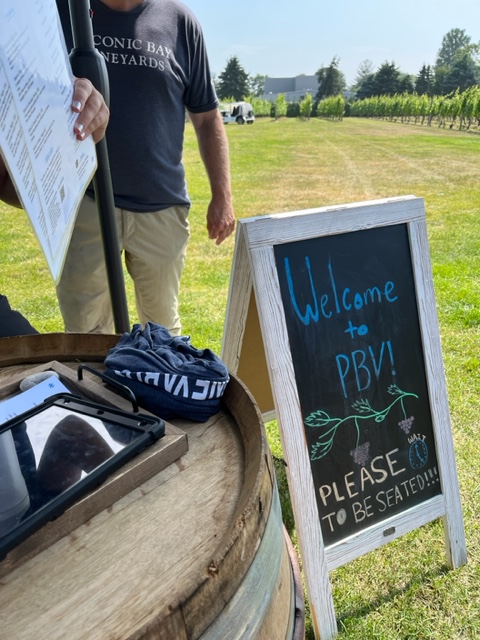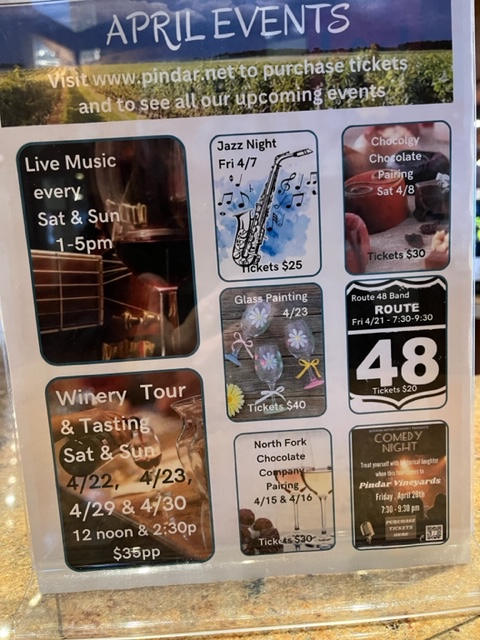
Peconic Bay Vineyards: Celebrating the Fourth on the Second

July 2, 2023

#peconicbayvineyards #northfork #winetasting #barrelfermentedsauvignonblanc #theMoke

www.peconicbayvineyards.com

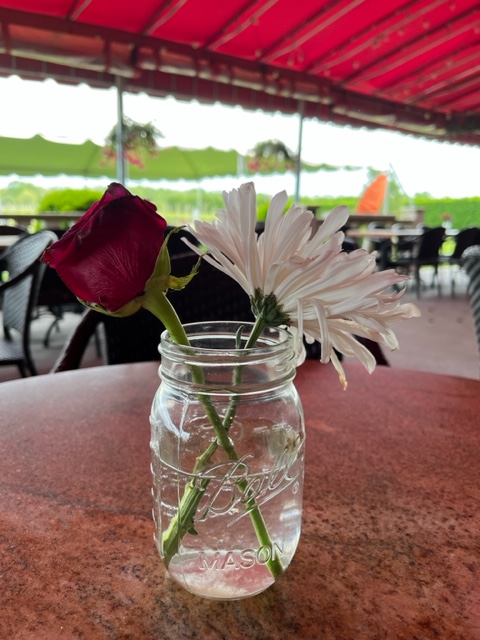
A patriotic flower pot.
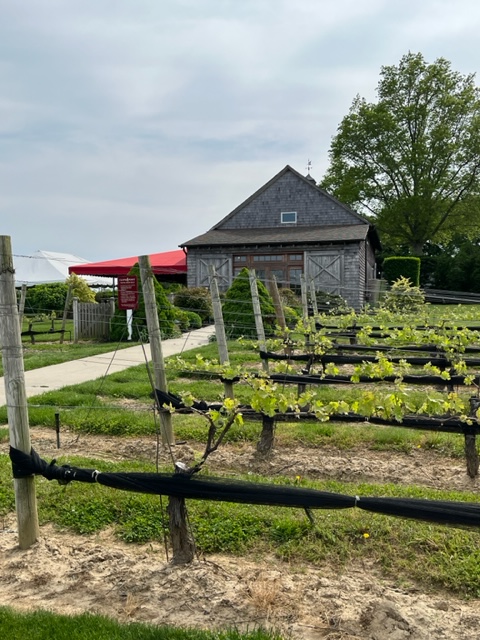
The vines make a perfect photo backdrop.

We were a little wary of venturing out to a winery on the weekend before July Fourth, but Peconic Bay proved to be an excellent choice—just enough people to feel celebratory, not so many that it felt crowded.  It was also a good choice since it fit with our plans for the day, which included a visit to the Horton Point Lighthouse (If you haven’t ever been there, go. Note that it is only open on weekends, but the volunteers who staff it are lovely, and very well-informed, and the little museum is well set up.  Our guests braved the climb up the tower, but I had been, and once was enough.  We paid $5 to park in the lot and $10 for the family to enter.)  Then, we needed to be at Braun’s at 4:30 to pick up our steamed lobsters for dinner, and Peconic Bay is right next door.  The timing worked out perfectly.
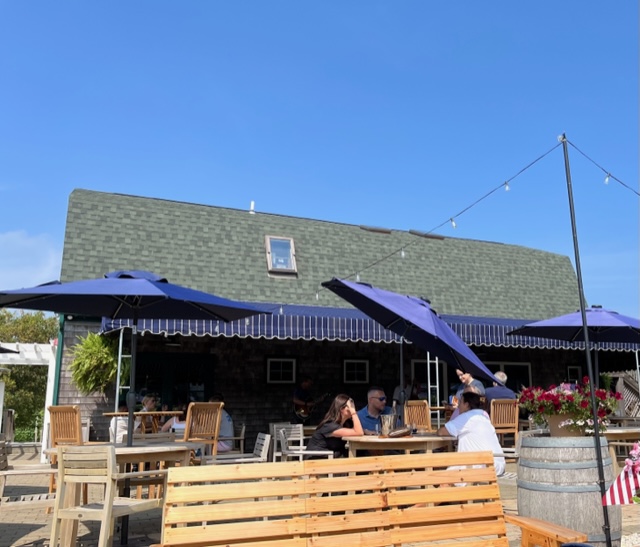
The outdoor space is more comfortable than the indoor room.

I had made a reservation, and they sat our party of six around a firepit (obviously not lit on this warm afternoon) shaded by an umbrella.  The outside patio is a lovely place on a nice day, but the indoor tasting room is small and rather spartan, so I think this is one of those places I’ll go to in the summer.  As we perused the menu, we enjoyed the cool jazz of a group whose name I couldn’t quite catch.  The menu offers two flights, the Crossroads of three wines for $18, and Reserve, of three wines for $20.  One could also opt for pairings of three wines with chocolate, cheese, or oysters.  We were planning to pick up some oysters with out lobsters, and we wanted to try the full panoply of wines, so we decided that each couple would share both flights.  That worked out well, and there was plenty of wine, but the sequence ended up being a bit of an issue, since both tastings include some whites and some reds. As a result, we kept going back and forth between the two flights.  My notes, therefore, are in the order in which I tasted the wines, not separated by flight.

We also ordered a little dish of Marcona almonds ($4), and another of olives ($8), both quite good, and two non-alcoholic drinks for the minors in the party.  They both gave positive reviews to the Beach Ball cold brew strawberry hibiscus caffeine free tea ($5) and the Subtle Tea lemonade ($4).  They also enjoyed seeing a few dogs on the patio, and noting the cute Moke, a jeep-like vehicle in which one can tour the vines.

We asked our server if they made the wines on the premises, and he enthusiastically explained that the separate building on the other side of the parking lot contains their wine-making facility and their cellar, filled with stainless steel tanks and oak barrels.    

  •  2021 Sauvignon Blanc                  $28

We all agree that the aroma is lovely, which I describe as flowery.  The taste is tart, with lots of acidity and a long finish.  It would go well with oysters, but I am planning to make martinis for my guests, one of my favorite beverages to go with oysters—another is a dry sparkling wine.

  • 2021 Barrel Fermented Sauvignon Blanc $35

This is from the Reserve flight, and we decided it would be fun to taste the two side by side.  One member of the party explained to the minors that two wines made from the same grape, grown in the same place, could taste very different depending on how they were made.  I like this better than the steel sauvignon blanc, which surprised me a little, but it is not oaky, and our comments are:  “nice, round, smooth, yum.”  It has a bit of a vanilla aroma, and would go well with lobster.
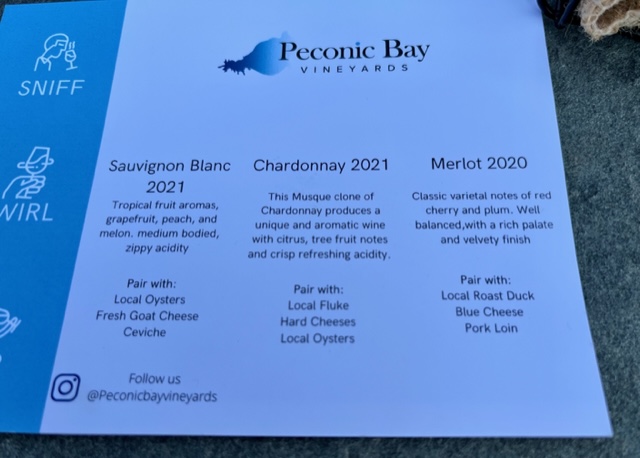
The flights come with handy little tasting notes.
  •  2016 Blanc de Blancs                    $40

The collective decision is to try the Blanc de Blancs next, as it is starting to lose its bubbles already.  One guest compares the aroma to privet, a flower we’ve been smelling all day.  Maybe.  It is quite tart, and not a sparkler for sipping on its own.  I eat a few almonds and then try it, and find it improves when paired with food.

  • 2021 Steel Chardonnay   $28

“The more I drink it, the more I like it,” opines our guest.  It has a bit of a funky aroma and taste, but otherwise is similar to most North Fork chardonnays, with citrus tastes and some green apple.

  • 2020 Merlot       $35

“Not exciting,” is the group judgment on this “serviceable” merlot.  I taste and smell cherry, as is typical, with a touch of tobacco from the oak.  Someone observes that it is “too tangy.”

  • 2020 Malbec      $35

Though it has no body, this wine is spicy and herbal, with tastes and smells of dark fruit, lavender, and rosemary.  “Meh,” says one guest.  I say it’s a nice wine.

Reasons to visit:  pleasant outdoor patio overlooking the vines; convenient location next door to Braun’s; the barrel fermented sauvignon blanc; all the wines were drinkable, if not exciting; live music; oysters and other pairings; the Moke!

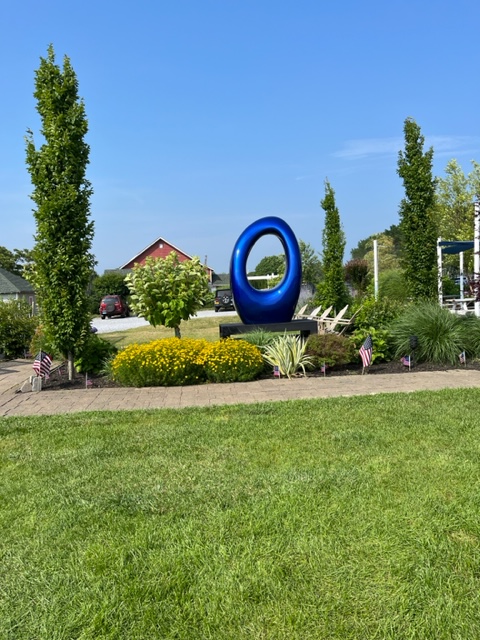
The winemaking facility is on the other side of the parking lot.

Pellegrini:  Lagniappe

June 20, 2023

Our flight in progress. Note that every tasting comes with a little bag of oyster crackers, useful for clearing the palate between tastes.

In New Orleans, “lagniappe” refers to a little something extra, which this blog post is.  I don’t usually do two blogs in such quick succession, but it was time to pick up our wine club shipment at Pellegrini, and we decided to do a quick tasting.  I didn’t even bring my notebook!  But as we sipped, I started to take a few sketchy notes, and before I knew it, I had decided to do a short blog post.

On this Tuesday afternoon, we had the tasting room to ourselves.  We were greeted cheerily by Ryan, who was delighted to serve us.  After acquiring our shipment, we circled on the tasting menu the three wines we were already buying, plus a few others that seemed of interest.  When Ryan saw that I had circled the gewürztraminer, he suggested that I add a new wine, the BBQ white, which includes gewürztraminer grapes, thinking that we would like it.  He was not wrong.

So here are a few notes on the wines we sampled.  If you want to know more about the tasting room, check out my past posts on Pellegrini!

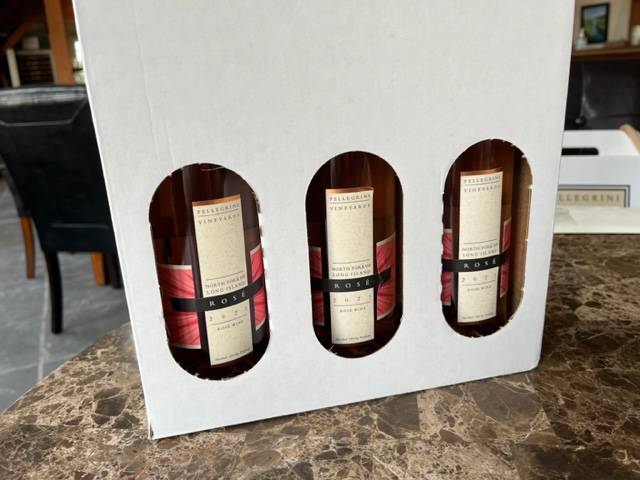
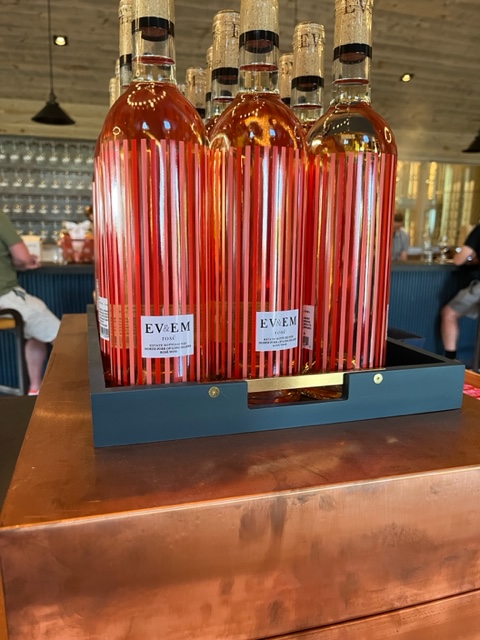
We went home with three boxes like this: our wine club selections, the roses, and North Fork Project merlot (Three bottles for $36).
  •  2021 Rosé          $24.99

I wanted a bottle of rosé to bring to a party, so I knew I wanted to try this.  Plus, it’s on sale!  A blend of 80% cabernet sauvignon and 20% Merlot 181 (the number refers to the merlot clone they used), this is a many-faceted rosé, and is quite tasty.  We buy some for ourselves and some to give away.

  • 2020 Gewürztraminer                    $24.99

I wanted to try this because it is also on sale, and we love One Woman’s gewürztraminer.  This is nice, but I don’t like it as much as hers, though it is fruity and delicious.  It just seems a bit one-note-ish.

  • 2022 East End Select BBQ White                $26.99

As much as I like a bargain, I also like to buy what I like, and we both like this one.  It is 46% gewürztraminer and 54% stainless steel chardonnay, a winning combination.  Ryan’s suggestion that we try this pans out, as we buy a bottle.  Yummy, with the sweetness of the gewürztraminer tamed by the citrus of the chardonnay.

  • Steakhouse Red                $21.99

This is their basic table red, and indeed it is a good hamburger/pasta red, light but with nice tannins and a bit of a funky aroma.  “It has an edge,” says my tasting pal.

  • 2017 Cabernet Franc       $32.99

A blend of 95% cabernet franc plus 5% merlot, aged 18 months in French oak, this is a somewhat light but very pleasant red. 

  • 2015 Regalo        $49.99

Regalo means gift, and this is a gifted wine, a Bordeaux-style blend of 50% petit verdot, 30% cabernet sauvignon, 15% merlot, and 5% cabernet franc.  So good.  Complex, with lots of varied fruit flavors.  We put our wine club bottle in the cellar to age.

Reasons to visit:  join the wine club!  We joined for reds only, and have never regretted it.  We liked all the wines we tried, but especially the BBQ White and the Regalo.

Sherwood House:  No Robin Hood Here

June 18, 2023

#Sherwoodhouse #winetasting #Northfork

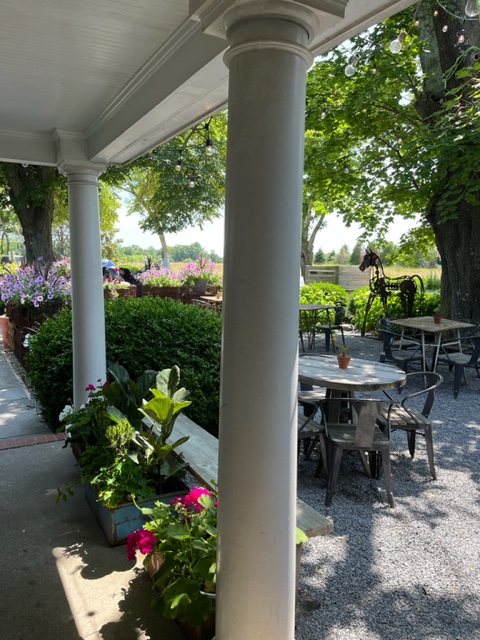
The front area is quite pretty.

The confluence of our anniversary and Father’s Day on a sunny afternoon made us decide to brave the weekend crowds and do a wine tasting. And the crowds were definitely here, as the time of year approaches when one plans carefully for left turns.  There’s a traffic light on Cox Lane, for example.  Many of the wineries we passed had full parking lots, with cars parked on the grass in some cases, but Sherwood House was not crowded.

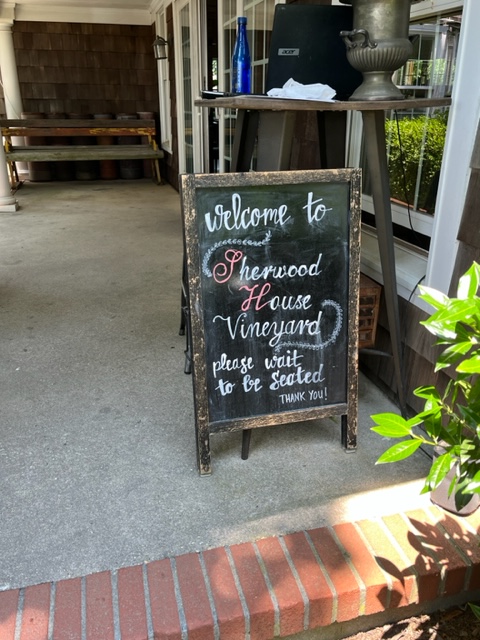
The building is unassuming, and easy to miss.
We were greeted promptly and given our choice of tables.

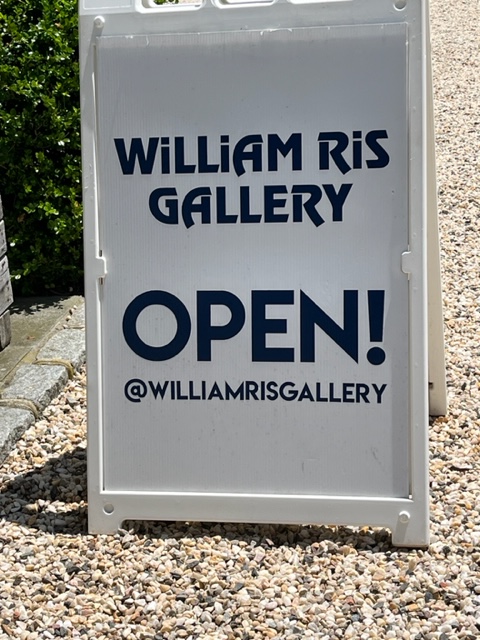
We hadn’t been to Sherwood House since 2018, when it featured a somewhat complex menu of two different owners, so we were curious to see what had changed since we’d last been there.  Not a lot externally, it turned out, but quite a lot in terms of the wines.  The tasting room is still in a house, with a rather discreet sign on Main Road (I missed it and had to turn around!), adjacent to the William Ris Gallery.  The pleasant garden area out front was occupied by a large table of bachelorettes, who were having a good time, so we asked if we could sit elsewhere.  The lovely hostess escorted us to the back deck, which we had to ourselves.  As we walked through the inside, we remembered sitting on the comfy couches in front of the fireplace on a winter visit.  The overall esthetic is modernized rustic farmhouse.

Cozy setting for winter tastings.

The tasting menu lists one flight, of six wines for $35, but the server informed us that the final red, the Sherwood Manor, is no longer available, as they are phasing it out.  It will be replaced by a merlot, which is not yet bottled.  Five wines for $30 sounded fine to us, and we sipped the cool water we were served as we waited for our flight to be prepped.  We also ordered North Fork potato chips and a dip, for $16 (a bit steep, though the dip, a blend of spinach, Greek yogurt, and lemon, with a touch of garlic, was very good).

Our snack of a very good dip and a bag of chips.

The flight came in cute little bottles, which we shared out into attractive large glasses.  After we finished, we ordered a glass of the Blanc de Blancs as we sat and finished our dip (the rest of the chips came home with us), and the server brought us clean glasses so we could share.

The flight.
  • 2020 Estate Blanc de Blancs         $60

We were glad to start with a bubbly, as it gave us a chance to toast our dual holiday.  This is a rather classic sparkling wine, with a yeasty aroma, dry, with the taste one expects from a chardonnay-based wine, of citrus, plus a bit of a funky olive-y note.  The cost, however, did give us pause.

This is my half of the full glass of bubbly we ordered after the flight. Not a lot of bubbles…
  • 2020 Brut Rosé                 $55

Another sparkling wine, this one a very light pink, made from merlot, pinot noir, and “a splash” of chardonnay.  It has not much aroma, and nice bubbles, but the taste is very light, so light as to be almost non-existent.  As my tasting buddy quipped, “I can’t even remember what it tasted like now.”

  • 2019 Oregon Road Chardonnay                  $37

Why Oregon Road?  Because that is where their vineyard is, and they do some of their winemaking at Lenz.  This is their steel-fermented chard, and it is a pretty classic North Fork chardonnay, with aromas of honeysuckle and lemon, and a nice dry taste of lemon and fruit.  It would go well with scallops.  On the other hand, you can get a liter bottle of North Fork Project chardonnay for $13 (sometimes as little as $10 if you buy three at the winery).

The back deck was a pleasant place to spend an afternoon.
  • 2019 Estate Chardonnay                $50

“Not objectionable,” says my husband.  Talk about damning with faint praise…this is their oaked chardonnay, and it is not too heavily oaked, though it does have tastes of vanilla and is somewhat creamy.  It smells sweet, with some touches of forest floor.  I generally prefer steel-fermented chards, but I don’t mind drinking this one—though again, the price seems a bit much.

This is my half of the red wine.
  • 2019 Estate Cabernet Franc         $60

The aroma is of cherries and other berries and tobacco, which seemed promising.  However, the wine is rather light and nondescript, though quite drinkable.  At a lower price it would be fine.

Before or after your tasting you can tour the gallery.

Reasons to visit:  pleasant setting, with a pretty garden out front, a rustic porch out back, and comfy couches in front of a fireplace for winter visits; the Estate Blanc de Blancs, though overpriced, is quite good; a usual menu of snacks, with a very good dip; they use bamboo plates, which are recyclable.  Note:  they do not seem to have a web page, but you can find them on Facebook.

Wondering what to do with all your corks?

Eastern Front Brewery: Celebration Time

June 3, 2023

The front entrance of Eastern Front is on Main Road, but they also have a parking lot off to one side.

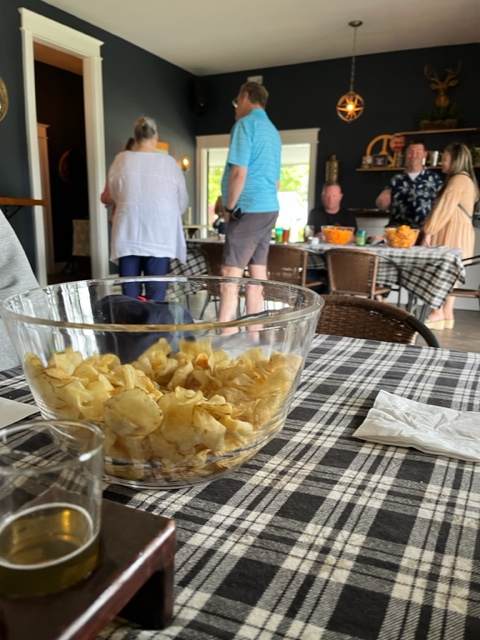
We were in a celebratory mood, because dear friends had come for a visit.  One of them is a beer aficionado, so we decided it was time to return to Eastern Front Brewery, which we had last been to in 2019.  When we arrived, we discovered that they were also in celebration mode, hosting the opening of an artist’s exhibit.  Lindsay Lange, the artist, had set out huge bowls of chips, and, she confessed, been “up all night baking” some of the best chocolate chip cookies I’ve had.  Woohoo!

The table at which we sat.

We settled down at a table and proceeded to make steep inroads in a bowl of potato chips while we tasted our flights of beer.  By the way, one flight is more than enough for two people to share, and we didn’t even finish all of ours.

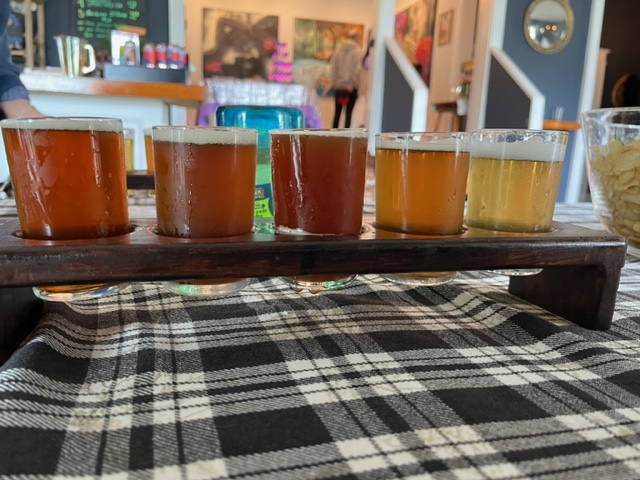
Eastern Front’s flight consists of five beers, two of which are regulars, and the other three vary according to season and the whims of the brew master.  A flight only costs $12. 

We’ve already made some inroads on that bowl!

The tasting room is small, though it is augmented by some outdoor tables, and tends to be noisy, even with not many people there.  They often host live music, so I would go there for music only if I could sit outside, since I tend not to like places that are too noisy.

The art exhibit

They don’t usually have free chips available, but they do allow outside food, and I discussed with our server various options.  Right across the street is Meats Meat barbeque (only open Thursday-Sunday), and in the comments you’ll find my recommendation on which beer to sip with their ribs, pulled pork, and/or brisket.  Then, literally across the parking lot, is Lucia, which says it serves “Spanish” cuisine; which, we were informed, is mainly Salvadoran, with the pupusas being heartily recommended.  Just a few doors down is a pizzeria—so no lack of good food-to-go-with-beer options.

Our flight–from right to left…
  •  Fat Old Sun American Lager        5.5% ABV (Alcohol by Volume)

My first comment is that it “smells like a frat house,” and my friend has a similar reaction.  This is a crisp, light beer, which she characterizes as “an immature beer for immature people.”  Well, to each his own.

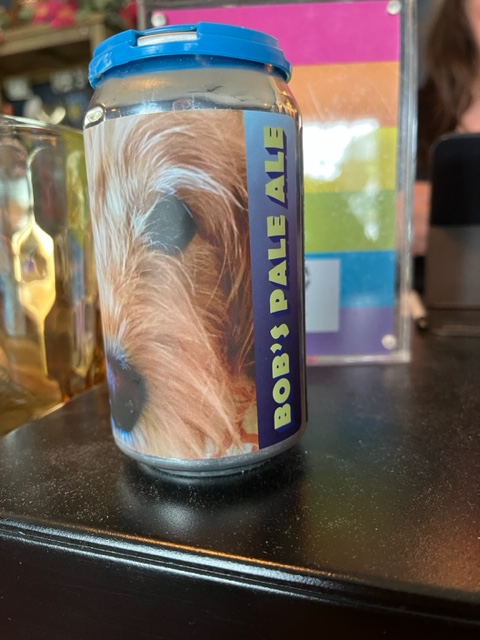
Some of the beers are available in cans.
  • Bob’s Pale Ale                    5.8%

This is one of the “regulars,” a rather typical pale ale, with a touch of sweetness to counteract some spiciness, and a funky, grainy taste.  We think it would go well with a Meats Meat pulled pork sandwich, especially if you add in their hot sauce.

Yummy treats.
  • Love Lane Lager                5.8%

I’m sorry to note that this is not a regular, since it is our favorite so far.  My friend says to her it seems more like an English brown ale than like a lager.  It is balanced, with a touch of nuttiness and sweetness, and very drinkable.  I fantasize sitting in a pub and sipping this, and that seems just right.  It is also the best choice to go with Meats Meat, especially the brisket (which we had the last time these friends visited us).

  • North Shore Irish Red Ale             6.3%

Ooh, I like this one even better, and so does my friend.  It is another regular, always on tap.  I may have to stop in and get a growler of it one of these days.  It is nicely bitter, with subtly piney hops.

  • Belgian Strong Ale           9.5%

“This is good,” I assert after the first sip, and my friend notes that it is a very “me” beer.  She adds that it has all the flavor of a heavy beer without the heaviness.  It is complex, with notes of clove and brown sugar.  Yummy.

The artist!

Reasons to visit:  good brewery with a changing roster of beers; you can bring in food, including from some very local places; dogs are allowed; they often have live music and art exhibitions; the Love Lane Lager, the North Shore Irish Red Ale, and the Belgian Strong Ale.

Ev & Em:  Summer Is a Coming In

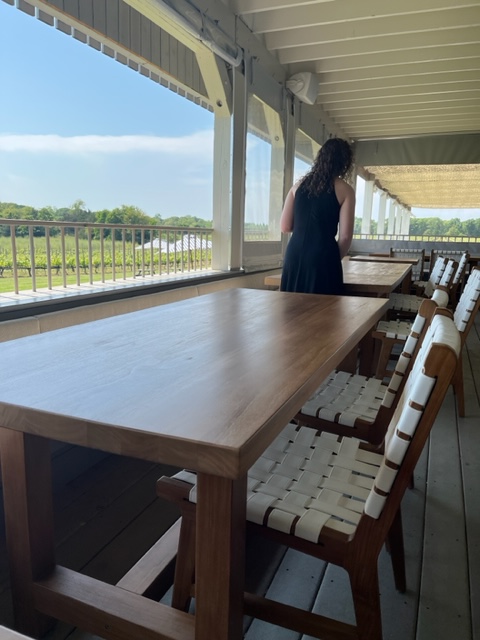
From the outside, it looks like Laurel Lake, but the inside is quite different.

June 2, 2023

Strawberries at the farm stands!  83 degrees and sunny!  It finally felt like summer, and we decided this warm, breezy afternoon was the perfect time to do a tasting.  We had tried Ev & Em (the strange name is the result of Dan Abrams, the owner, wanting to name the winery after his children) in March 2022, when they really weren’t fully open.  For one thing, they didn’t yet have their furniture.  So we figured by now they’d have it together; and they do.

I’m wondering if they’ll add more inside seating in the winter.

We were met at the door by a hostess, who escorted us out onto the breezy porch, which has roll-up plastic windows we’ve also seen on boats, and to a table for two.  I had asked if we could be seated at a table for four, but she demurred, saying she didn’t know if it was reserved.  Really?  At 3:30 in the afternoon in the middle of the week?  And as it happened, the only other people who entered were a family group with children, who were escorted down the stairs to a table on the lawn, which is apparently the policy.  But okay, we were fine.

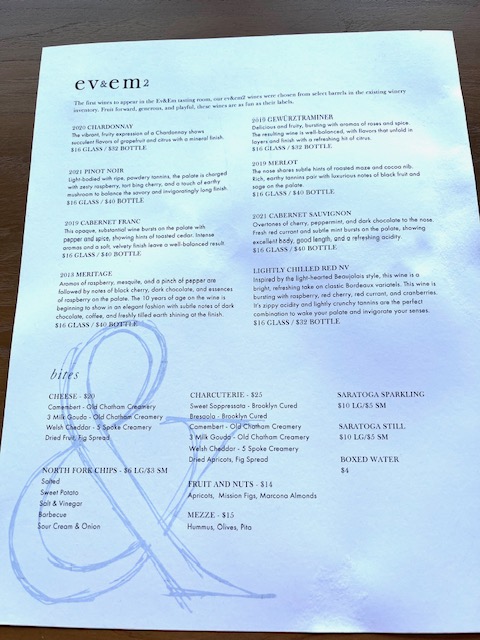
As we perused the menu—which asserts that this is “where Napa meets the Hamptons” (um, this is not the Hamptons, but okay)—we were served a nice cold bottle of water and two cups.  Our waiter appeared, and asked if we had any questions.  We discussed the fact that they still have the same winemaker as the winery’s previous iteration, when it was called Laurel Lake, and that there are still a few bottles of Laurel Lake wines around.  On the other hand, he noted that this is the first vintage that is really an expression of their wine-making philosophy.  As we chatted, I thought he looked familiar, and suddenly he said, “I’ve seen you before! I used to work at One Woman.”  Ah ha.  It is a small world out here.

There were three flight options available—the Classic Flight, of four wines for $35; the Chocolate Pairing Flight, of four wines and four chocolate truffles for $50; and the Ev&Em2 flight, of four Ev&Em2 wines for $32.  We decided to share a Classic flight, with the thought that we might get a glass afterwards of any other wine we wanted to try from their list of eighteen wines.  We also ordered a $6 bag of North Fork potato chips (and used the leftover chips to make a delicious omelet the next day from a recipe I found in the New York Times).  They also have a variety of cheeses and charcuterie available.  Soft pop jazz played in the background as we sipped and chatted.

  •  2021 Rosé          $32

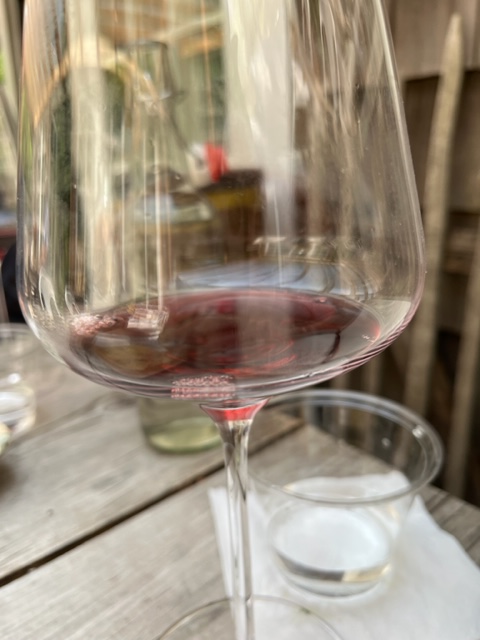
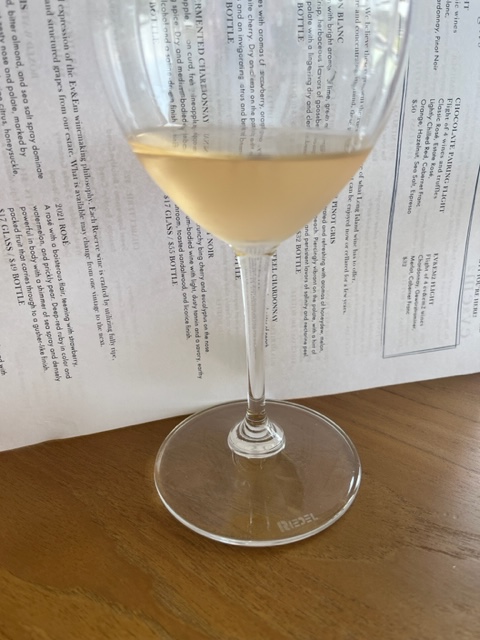
I expressed surprise at the appearance of the rosé, which is so pale as to look almost like a white wine, or as my tasting buddy said, “You wouldn’t know by looking that it’s a rosé.”  Our waiter had me hold the glass against the white of the menu, and then I could see the faint pink tinge.  The wine is a blend of sauvignon blanc, chardonnay, gewürztraminer, and pinot noir, so three whites and one red, which must account for how pale it is.  It also drinks like a crisp, mineral-y white.  It has some complexity, but if you are looking for a fruity rosé, this is not it.

In this close-up, you can see the faint pink tinge of the rose.
  • 2022 Sauvignon Blanc                   $40

This steel-fermented sauvignon blanc has almost no aroma, and again is a crisp, refreshing wine, though my husband says it is “not exciting.”  The menu describes the taste as “gooseberry and grass,” and if you’ve ever chewed on a blade of grass you get that.  I think it is sophisticated, and would pair well with charcuterie, but we agree that the price is somewhat out of line for the North Fork.

  • 2022 Stainless Steel Chardonnay                $40

Another white with lots of minerality, and not much fruit.  Maybe white peaches, but no citrus.  Pleasant.

  • 2021 Pinot Noir                $55

Our waiter informs us that this is aged 70% in new oak and 30% in neutral oak.  I get lots of minerality again, which seems to be part of their style, with an aroma of eucalyptus and berries.  I taste a bit of licorice in this fairly light red.  The price? Hmmm…

  • 2019 Merlot       $40

If you’re keeping count, you can tell that we’ve come to the end of our tasting, but we have plenty of potato chips and time, so we decide we might like a glass of some other wine.  I ask our server, who had been properly attentive—as in there when you want him to be, and not when you don’t—which wines he thinks are the best, and he brings us a small taste of this merlot.  It is lean, not fruity, with some minerality.  I’m not in love with it, so he offers a taste of one more wine.

On this warm afternoon, we really appreciated the nice cool water.
  • 2021 Barrel Fermented Chardonnay          $45

He’s a bit chagrined when I say I’m not fond of oaked chards, but this one is fine, not too oaky.  It fits the general style here, which is lean, not fruity, and sophisticated.

Reasons to visit:  pleasant outdoor porch setting; all the wines if you like them with more minerality than fruit, none if you don’t; nice menu of cheeses and charcuterie.  Though my tasting pal says he “wouldn’t go out of my way,” I’d come here again for the nice setting and relaxed vibe.  Note:  they say on their website that groups including children will be seated down on the lawn.

The area where they seat parties including children. Looks comfy!

Ten Signs of Spring on the North Fork

May, 2023

Mamas and babies heading out to the pasture at 8 Hands.
Want to buy a used car? Just take a drive along Sound Avenue or Main Road, especially in the spring.
  1.  Piping plover nesting areas on the beaches have been roped off.  Don’t disturb their nests!
  2. Bud break in the vineyards cloaks the vines with fresh green leaves.
  3. Farm stands are re-opening, featuring asparagus, spinach, and leeks.
  4. Some stores and restaurants which had closed for the winter are open, or have “opening soon” signs up.
  5. Briermere is open.  Time for pie!
  6. The world’s longest used car, truck, boat, RV, and farm vehicle lot is open.  I’m referring to the vehicles you see parked mostly along Sound Avenue or Main Road, decorated with “For Sale” signs. Once, while riding my bike along Sound, I observed a teenaged boy and his father driving from one car for sale to another, getting out, and peering through the windows.
  7. Cherry blossom time in Greenport has come and gone.
  8. The few wineries which had closed for the winter are opening up, and some which had limited open days are back to being open every day.
  9. The gardening companies and sprinkler installers are out and about, and the buzz of power mowers fills the air.
  10. Baby goats and sheep can be seen in the fields, especially at Catapano’s and 8 Hands.
Bud break has happened!

Clovis Point:  A Civilized Afternoon

May 16, 2023

#Clovispoint #Blacklabelchardonnay #northfork #winetasting #nopets

Bud break has happened!

We had done our civic duty and voted in the Board of Education election, and found ourselves at 3:30 in the afternoon with nothing to do, so we took ourselves to Clovis Point.  As we sat on the shaded deck, looking out at the sunlit vines and listening to some soft classic rock, I commented to my tasting buddy that this was a very civilized way to spend an afternoon. The chairs are comfortable, and the flowers on each table are a nice touch. We also appreciated the way our tasting was served to us—in a series of little carafes, with each of us getting our own glass.  We had told our cheerful and attentive server that we’d be sharing one tasting, since it consisted of seven wines for $30.  And indeed, it was plenty, and we left feeling no pain, but also perfectly compos mentis. 

Only one other table was occupied, by a small group speaking French, who seemed to be enjoying themselves very much.  We took our time with our tastes, discussing the wines and munching on North Fork Potato Chips ($6 for a large bag).  Our server also supplied us with a plate and napkins, so we could dole out each serving.

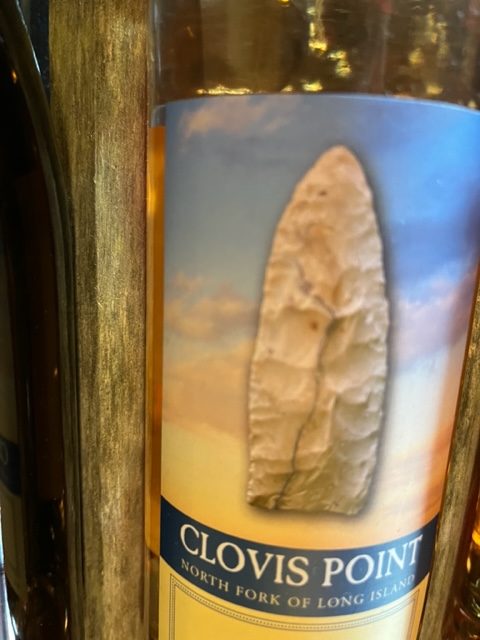
One more note on civilization—the name “Clovis point” refers to a projectile point originally used during the Ice Age, 12,000-13,000 years ago, a mark of very early civilization!  Now you know what the meaning is of the symbol of the winery, which is found on their bottles. 

  •  2021 Sauvignon Blanc   $29

Our tasting started, as many local ones do, with the sauvignon blanc, a light, easy-to-drink white.  It has a pleasant, flowery aroma, and a bit of a funky taste, plus definite minerality.  “There’s not a lot to it,” opined my husband, and I replied that it would go well with oysters.

We really liked this way of serving a shared tasting, as it is more hygienic than sipping from the same glass. Quite civilized.
  • 2021 Chardonnay             $25

This is their steel-fermented chard, another light white, with a touch of petrichor in the aroma.  It has some lemon tastes, and actually complements the potato chips very well, which leads me to think that it would go well with charcuterie.  My tasting buddy notes that the taste is a bit floral at the end.

  • 2021 Black Label Chardonnay       $28

Some people like oaked chards, and some don’t, so this combo—80% steel and 20% barrel aged—might please everyone.  At least, it pleases me!  It smells similar to the previous chard, but the taste is different—smoother, juicier.  Mouth-watering, we decide, and buyable, though we don’t get a bottle this time. 

  • 2021 Rosé           $22.50

Interestingly, though this is 95% cabernet franc and only 5% chardonnay, the aroma reminds me of the chardonnays.  It has some typical strawberry flavor, and though my husband says he is “neither up nor down” on it, I think it is a nice summer sipper.  This is another light wine, and I could see pairing it with a Catapano goat cheese and some crackers.

  • 2020 Merlot       $29

Merlots are very common on the North Fork, and often very similar, with a taste and aroma of cherries.  This one is no exception, with also some notes of spice and pencil shavings (What, you never chewed on a pencil when you were a kid?). 

  • 2019 Cabernet Franc       $45

Oh my.  That’s quite a price jump, but, on the other hand, this is quite a wine.  The tasting notes suggest mocha and coffee, and I add complex and interesting, with a brambly aroma.  I could see pairing this with a nice steak dinner.

  • 2016 Artifact      $45

Though I caution my husband that this is a port, he complains that it is too sweet.  Well, but for a port it is not too sweet.  It is aged 44 months in neutral oak.  I think it smells a bit like licorice (I, unlike many people, like black licorice.) and berries.  Yes, I could see lingering after dinner over a glass of this, cracking walnuts and pretending to be in an English novel.  The name, by the way, is a nod to the Clovis point concept.

Lees left in the glass after drinking the port.

Reasons to visit:  pleasant outdoor area; music on the weekends; they have a menu of snacks but also allow outside food, as long as you don’t bring a cooler; the Black Label Chardonnay and the Cabernet Franc, plus the  Artifact if you want a not very sweet port.

One Woman Winery: What’s in a Name?

April 14, 2023

What’s in a name?  In this case, the literal truth.  Claudia Purita planted, tends, harvests, and produces the wines herself—well, there’s some help, notably from her daughter who is often in the tasting room, but basically this is her show.  We saw the truth of this as we sat on the deck doing our tasting, when Ms. Purita and her daughter walked past us, schlepping a shelving unit into the tasting room, where they quickly set it up. 

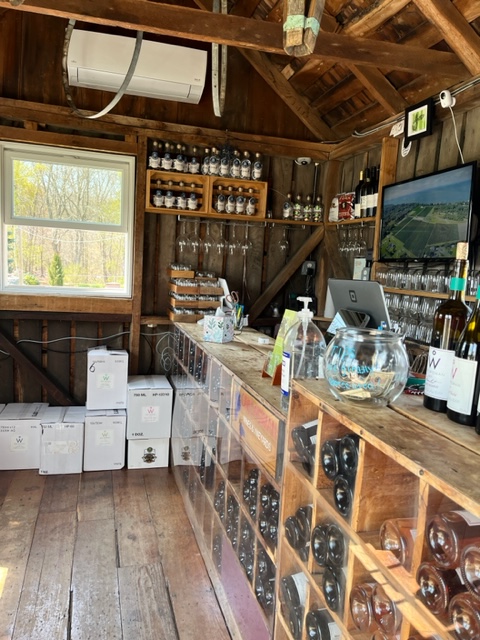
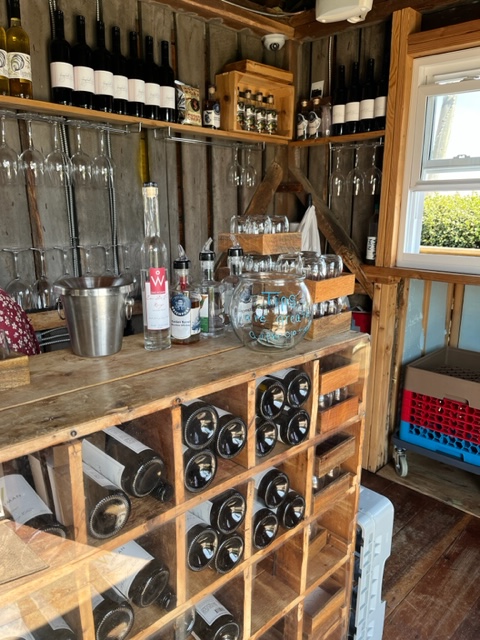
And that careful supervision has resulted in some lovely wines.  But first, a few words about the tasting room—or should I say shack, as it is a tiny building with room for maybe half a dozen people to stand at the bar, surrounded by a small deck with room for maybe twenty more, plus some picnic tables on the grass.  The sign at the entrance asserts in big letters “NO BUSES, NO LIMOS, NO GROUPS OVER SIX PEOPLE,” because clearly, they just don’t have room.

Half of the petite tasting room.
And the other half!

We hadn’t visited the tasting room since before the pandemic, making do with bottles of the grüner veltliner from Vintage, the excellent liquor store in the Mattituck strip mall, so we were happy to head there on this warm, sunny day.  Maybe too warm—by the time I got to tasting the merlot, it was approaching deck temperature, which was 84 degrees.  In the summer they put up awnings, giving the deck some shade, but who expects 84 degrees in April?

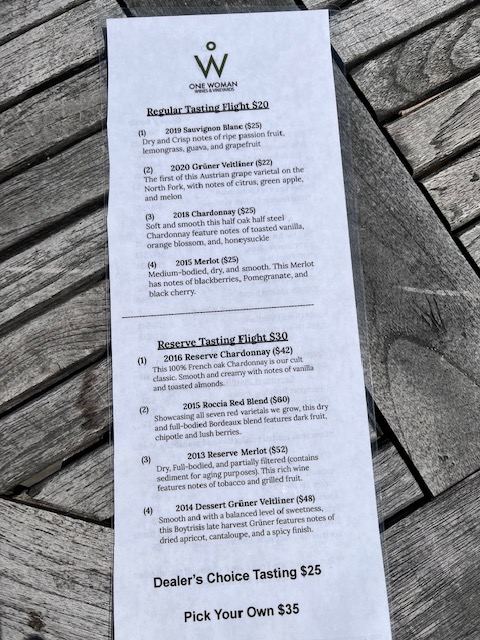
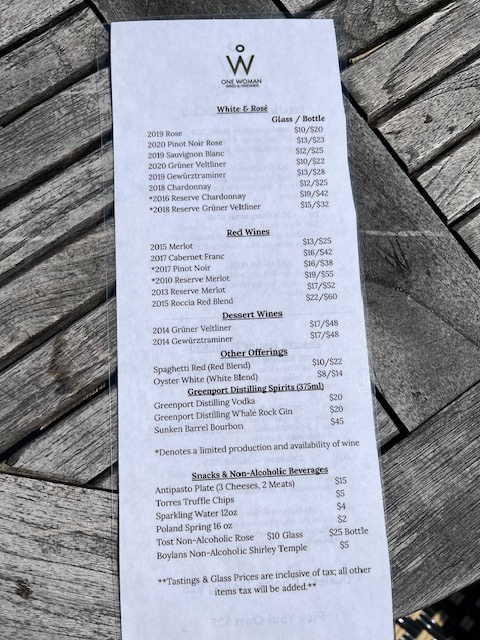
In any event, our welcome was warm, and the young woman behind the bar greeted us and presented us with the menu of tastings, explaining our options, and assuring us that we could sit outside and she would be happy to bring our tastings to us.  There are two set flights, one dubbed “Regular,” of four wines for $20, and the other labeled “Reserve,” with four pricier wines for $30.  We could also have crafted our own lists for a little more, but we opted to share a Regular flight, as that seemed to offer a good range of wines we might likely buy.  They also have wines available by the glass.  We noted that they now offer an antipasto plate and bags of truffle potato chips, as well as a few non-alcoholic beverages and vodka, gin, and rye from Montauk Distilling.

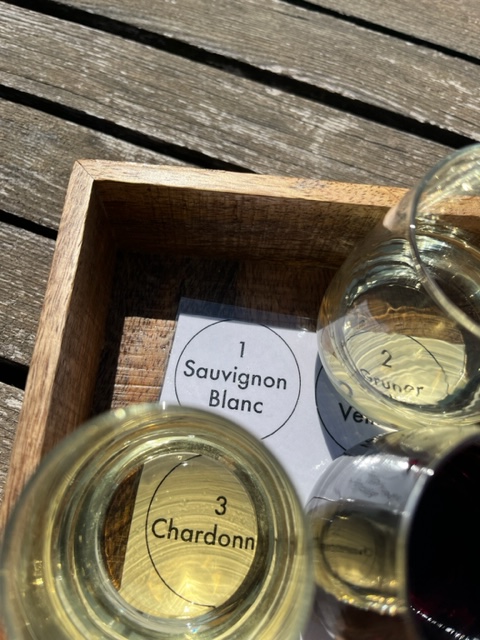
Our flight was brought out in a cute little wooden box, with each wine and the order in which to drink them clearly labeled. Our server explained each wine, and then left us to our tasting, checking back a couple of times to see if we needed anything else.

  •  2019 Sauvignon Blanc   $25

Dry, crisp, with tastes of tropical fruit and tangerine, this is a perfect wine to sip on a porch on a hot day.  It has “some zip to it,” commented my tasting buddy.  It would go well with charcuterie.

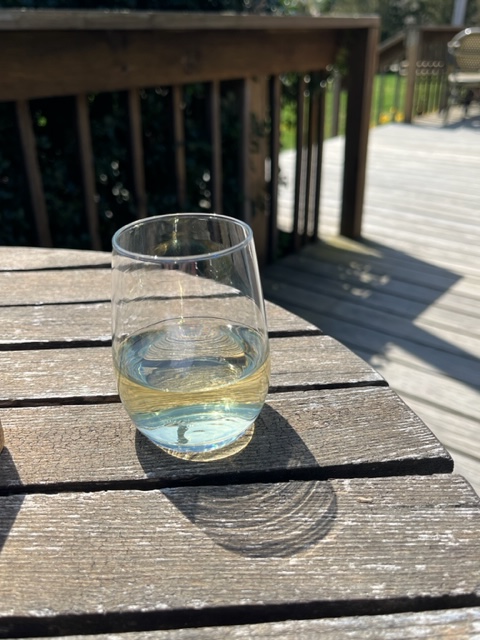
The gruner. The pour was generous enough that we were happy to share one tasting.
  • 2020 Grüner Veltliner     $22

This is one of our favorite North Fork whites, and this vintage does not disappoint.  We taste Granny Smith apple and other fruit in this light but complex wine, which my husband dubs “tasty.”  We like to drink it with Chinese take-out, especially dumplings.

  • 2018 Chardonnay             $25

Our server notes that this is aged, half in oak and half in steel, making it the “best of both worlds.”  I don’t care for it, and leave it for my fellow taster to finish.  To me, it has a chemical smell and taste, almost like the chlorine in a swimming pool.  That may not be a good thing, my husband quips, “but at least it keeps the place clean.”  He likes it, so maybe it’s just some quirk of my taste buds!

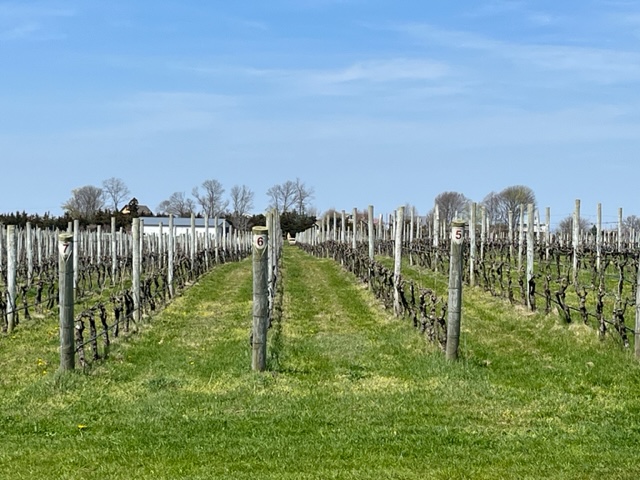
The view of the vines. One year, a hailstorm decimated her crop, but Ms. Purita has persevered.
  • 2019 Merlot       $25

As our server foretold, this is a typical North Fork merlot, with lots of cherry flavor and aroma. It has some light tannins, and would go great with a burger or pasta dish.  My buddy notes it has a lot of body, but I wonder whether that’s a perception based on how warm it has gotten. We sit back and finish our wine—he has the chard, and I have the merlot—as we listen to some pleasant, soft guitar music.  I thought about getting a glass of something else, but we really need to get out of the sun, so perhaps we’ll come back another day to try some other wines.

A view of Ms. Purita’s daughter, working in the tasting room.

Reasons to visit:  an intimate setting where you may get to meet the owner/winemaker; the sauvignon blanc, the grüner veltliner, the merlot; a relaxed vibe. We buy a bottle of the grüner and another of the merlot to take home.

Pindar Vineyards: Special Day for Locals

March 31, 2023

The day was gray and chilly, but we had a good time anyway.

Pindar is proud of being one of the early vineyards on the North Fork, with their vines planted over 40 years ago.  I came by this bit of knowledge on a free tour and tasting at Pindar, part of an effort by a number of vineyards to attract locals to come and taste their wines.  Friends of ours had noted this program and invited us to join them at Pindar, whose perks seemed the best (other places offered such bargains to locals as ten percent off bottles or two for one).  Good move! We had a good time, learned a lot, and got to taste some wines we then bought and took home.

Nancy is showing us a gewurztraminer vine, one of the original ones planted at Pindar. The roots can go very deep.

Nancy, our tour guide, started us off by the vines, and then took us through all the steps of making wine, from the crush pad to the stainless steel tanks to the French oak barrels to the warehouse, and then back to the tasting room where we got to try five wines.

“Viticulture is farming for masochists,” she informed us, as she explained the work involved in pruning the vines, which she characterized as “an art and a science,” and the perils faced by grape growers.  There are migrating birds who will peck at the grapes, so they look fine but then shrivel into nothing; there are hurricanes on Long Island, whose arrival coincides with harvest season; and there is the lack of crop insurance, because how can you insure for their current value vines that have been growing for over 40 years.  In addition, you have to wait four years after you plant those vines before you can expect to harvest the grapes. The issue of birds has been taken care of, through an ingenious system of nets, which you can see in many vineyards, which remain furled up below the vines and are then raised when the grapes ripen.  As to the other issues…not much one can do about them!

Despite these problems, Pindar has 325 acres of vines, resulting in 60 to 70,000 cases of wine every year.  At first, Dr. Dan Damianos, the visionary who started Pindar (named, like one of his sons, for the classic Greek poet, in homage to their Greek heritage), planted gewürztraminer grapes, judging that the climate and soil would work well for this varietal.  Now they grow twenty-four varietals, and they list twenty-nine different wines on their tasting menu, which includes a number of blends.

The bottling machine, which is about to be replaced by an even better one.

They bottle these wines with their own bottling line, which can do 3,000 a day.  Not every winery has their own bottling facility, with many using Premium Wine Group for this.  Nancy gave a brief lecture on the issue of corks vs. screw caps, with corks reading as “better” wines, and screw caps okay for more casual, cheaper wines. Screw caps work just fine, though corks have the advantage of being biodegradable.

I never knew why the vats have this dimpled jacket.

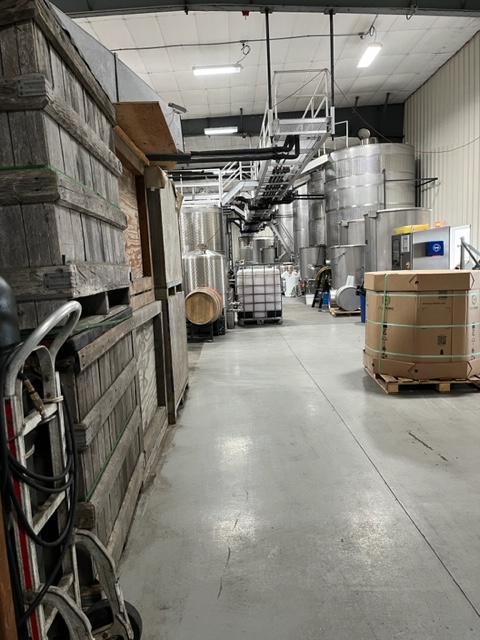
We then walked into a huge room filled with vast stainless steel vats, where Nancy explained something I’d always wondered about.  The vats are partially encases in a dimpled steel jacket.  It is a glycol jacket, containing polyglycol, used to help regulate the temperature in the vats, and the dimples keep the polyglycol from settling to the bottom.  Too hot or too cold, and the wine is ruined.  They use a windmill to provide about 60% of the energy needed in the warehouse and wine “cellar”—not a cellar, because…polyglycol.  We also learned about another hazard of viticulture—carbon dioxide.  As the juice ferments into wine, carbon dioxide rises to the top of the tanks, where the solid matter must be pushed down into the liquid.  Catwalks provide access to the tops of the tanks, and open doors help dissipate the CO2.

Part of the filtration system.

She showed us their filtration system, and we learned, by the way, that Guinness Stout used isinglass, obtained from the bladders of sturgeon, to filter their brew.  I like Guinness, but I also like caviar!

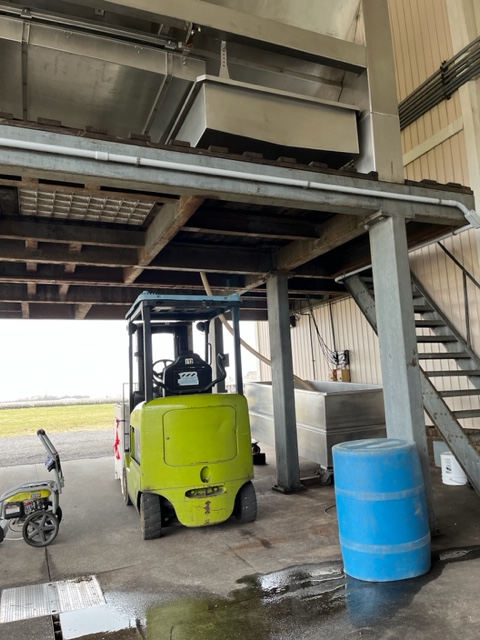
She also took us outside to see the crush pad, where a machine crushes the grapes. Because Pindar is so big, a lot of the work is done by machines.

The crush pad.

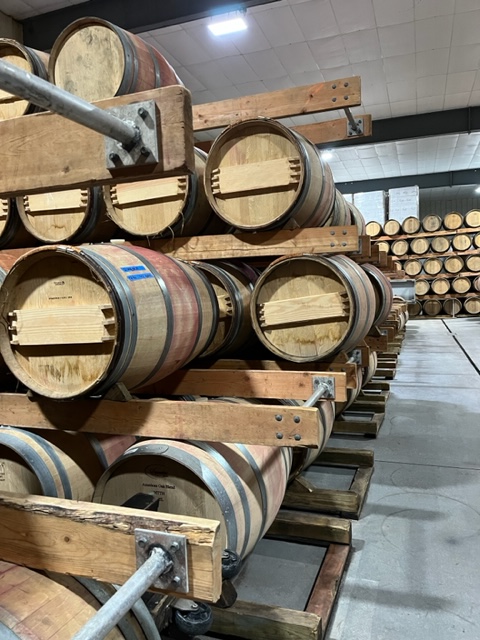
The huge space where red wine ages in French oak barrels smelled enticingly like a forest or lumberyard.  We found out that there are different tastes imparted to wines by French and American oak, with some adding notes of vanilla and others cinnamon, etc.  Pindar now uses only French oak, buying 300 barrels a year, and has phased out their American oak barrels, which they sometimes sell to breweries or to people who want to use them in their gardens.  We also learn about the “angel’s share,” the wine which evaporates from the barrels, meaning they need to be constantly watched and topped up, so that too much oxygen doesn’t turn the wine into vinegar.  The angels must reserve a special place in heaven for wine makers!

Despite the bung stopper, some evaporation is unavoidable.

Finally, our last stop before the tasting room, we saw the warehouse where cases of wine are stacked high.  Nancy held up a four-pack of cans of Winter White, and explained that Dr. Dan, noting the American taste for soda and other sweet drinks, decided to make some sweeter wines, like Winter White, which is the most popular white on Long Island.  More recently, the decision was made to offer it in cans; again, to attract those who might otherwise opt for soda or beer.

Cans of Winter White, ready to go.

Now it was time to taste the fruits of their labor!  The group of about thirty locals lined up around the bar, where glasses stood ready.  Here are my tasting notes:

Nice sized pour.
  •  2020 Dr. Dan’s Selection White Blend      $24.99

Our first taste is a blend of, this vintage, of 53% viognier, plus pinot grigio, sauvignon blanc, and riesling.  The percentages may vary year to year.  This is a very drinkable white, with aromas of pineapple and citrus, and tropical fruit flavors like guava and pineapple.

  • 2021 Dr. Dan’s Selection Gewürztraminer               $24.99

We are quite interested to taste this, after learning the history of the vines, and we quite like it.  In fact, we and our friends each buy a bottle to take home.  It is not too sweet, which can happen with gewürztraminers, with an aroma of peaches and tastes that include tangerine and apricot.  “Yummy,” we and our friends agree.

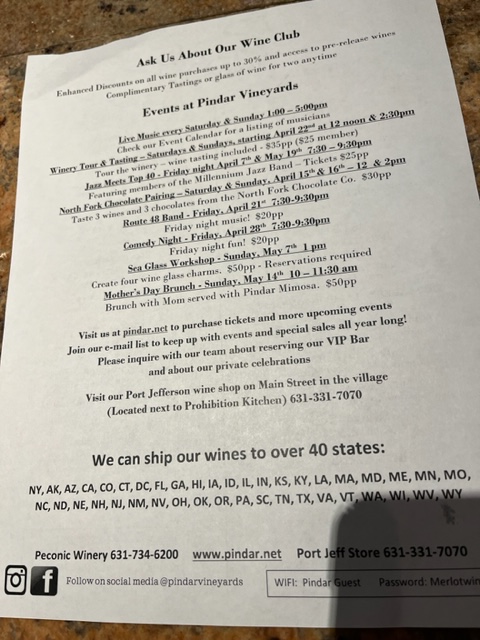
At the tasting, I turned over my menu to see the events list.
  • 2019 Mythology                $42.99

A Bordeaux blend called Meritage, this includes malbec, cabernet sauvignon, merlot, petit verdot, and cabernet franc.  Delicious.  Lots of dark fruit taste and enough tannins that one could probably age it.

  • 2019 Cabernet Sauvignon Reserve            $34.99

Nancy, who is still informing us about the wines, explains that cabernet sauvignon used to be harder to grow on Long Island, since it needs a longer growing season to mature.  However, with climate change, the growing season on Long Island has gotten longer.  I guess that’s an upside to global warming! This is another very good red, with tastes of blackberry and other fruits, and an aroma of cedar and tobacco.

Pindar Damianos chatting with a guest.
  • 2015 Cabernet Port         $28.99 for 750 ml, $16.99 for 375 ml

I’m not sure if this was in the original tasting or if it was included after our friend shared his enthusiasm for the port with Nancy and with Pindar Damianos, who was hanging around and talking to the guests.  He discovered that Pindar makes award-winning port in an old issue of a wine magazine shortly after moving to the North Fork, and was happily buying and drinking it.  I can see why.  This is a dessert wine—in English novels, they are always sipping it after dinner while they crack walnuts and chat—but it is not too sweet, with an appealing depth of flavor.  It is made 100% from cabernet franc.  We each buy a bottle to take home.

Cases filled with awards Pindar wines have won.

Reasons to visit:  roomy tasting room with two outside areas; a wide variety of wines for every taste, from sweet to dry, and price, from $14.99 (Winter White and others) to $42.99; all the wines we tasted—White Blend, Gewürztraminer, Mythology, and Cabernet Sauvignon Reserve—plus the port; our friends had also tasted the Gamay Noir before we went on the tour, and bought a bottle of that light red to take home; they have a refrigerated case full of cheeses, etc., to consume there; they have a variety of special events.

Pindar Vineyards: Special Day for Locals

March 31, 2023

The day was gray and chilly, but we had a good time anyway.

Pindar is proud of being one of the early vineyards on the North Fork, with their vines planted over 40 years ago.  I came by this bit of knowledge on a free tour and tasting at Pindar, part of an effort by a number of vineyards to attract locals to come and taste their wines.  Friends of ours had noted this program and invited us to join them at Pindar, whose perks seemed the best (other places offered such bargains to locals as ten percent off bottles or two for one).  Good move! We had a good time, learned a lot, and got to taste some wines we then bought and took home.

Nancy is showing us a gewurztraminer vine, one of the original ones planted at Pindar. The roots can go very deep.

Nancy, our tour guide, started us off by the vines, and then took us through all the steps of making wine, from the crush pad to the stainless steel tanks to the French oak barrels to the warehouse, and then back to the tasting room where we got to try five wines.

“Viticulture is farming for masochists,” she informed us, as she explained the work involved in pruning the vines, which she characterized as “an art and a science,” and the perils faced by grape growers.  There are migrating birds who will peck at the grapes, so they look fine but then shrivel into nothing; there are hurricanes on Long Island, whose arrival coincides with harvest season; and there is the lack of crop insurance, because how can you insure for their current value vines that have been growing for over 40 years.  In addition, you have to wait four years after you plant those vines before you can expect to harvest the grapes. The issue of birds has been taken care of, through an ingenious system of nets, which you can see in many vineyards, which remain furled up below the vines and are then raised when the grapes ripen.  As to the other issues…not much one can do about them!

Despite these problems, Pindar has 325 acres of vines, resulting in 60 to 70,000 cases of wine every year.  At first, Dr. Dan Damianos, the visionary who started Pindar (named, like one of his sons, for the classic Greek poet, in homage to their Greek heritage), planted gewürztraminer grapes, judging that the climate and soil would work well for this varietal.  Now they grow twenty-four varietals, and they list twenty-nine different wines on their tasting menu, which includes a number of blends.

The bottling machine, which is about to be replaced by an even better one.

They bottle these wines with their own bottling line, which can do 3,000 a day.  Not every winery has their own bottling facility, with many using Premium Wine Group for this.  Nancy gave a brief lecture on the issue of corks vs. screw caps, with corks reading as “better” wines, and screw caps okay for more casual, cheaper wines. Screw caps work just fine, though corks have the advantage of being biodegradable.

I never knew why the vats have this dimpled jacket.

We then walked into a huge room filled with vast stainless steel vats, where Nancy explained something I’d always wondered about.  The vats are partially encases in a dimpled steel jacket.  It is a glycol jacket, containing polyglycol, used to help regulate the temperature in the vats, and the dimples keep the polyglycol from settling to the bottom.  Too hot or too cold, and the wine is ruined.  They use a windmill to provide about 60% of the energy needed in the warehouse and wine “cellar”—not a cellar, because…polyglycol.  We also learned about another hazard of viticulture—carbon dioxide.  As the juice ferments into wine, carbon dioxide rises to the top of the tanks, where the solid matter must be pushed down into the liquid.  Catwalks provide access to the tops of the tanks, and open doors help dissipate the CO2.

Part of the filtration system.

She showed us their filtration system, and we learned, by the way, that Guinness Stout used isinglass, obtained from the bladders of sturgeon, to filter their brew.  I like Guinness, but I also like caviar!

She also took us outside to see the crush pad, where a machine crushes the grapes. Because Pindar is so big, a lot of the work is done by machines.

The crush pad.

The huge space where red wine ages in French oak barrels smelled enticingly like a forest or lumberyard.  We found out that there are different tastes imparted to wines by French and American oak, with some adding notes of vanilla and others cinnamon, etc.  Pindar now uses only French oak, buying 300 barrels a year, and has phased out their American oak barrels, which they sometimes sell to breweries or to people who want to use them in their gardens.  We also learn about the “angel’s share,” the wine which evaporates from the barrels, meaning they need to be constantly watched and topped up, so that too much oxygen doesn’t turn the wine into vinegar.  The angels must reserve a special place in heaven for wine makers!

Despite the bung stopper, some evaporation is unavoidable.

Finally, our last stop before the tasting room, we saw the warehouse where cases of wine are stacked high.  Nancy held up a four-pack of cans of Winter White, and explained that Dr. Dan, noting the American taste for soda and other sweet drinks, decided to make some sweeter wines, like Winter White, which is the most popular white on Long Island.  More recently, the decision was made to offer it in cans; again, to attract those who might otherwise opt for soda or beer.

Cans of Winter White, ready to go.

Now it was time to taste the fruits of their labor!  The group of about thirty locals lined up around the bar, where glasses stood ready.  Here are my tasting notes:

Nice sized pour.
  •  2020 Dr. Dan’s Selection White Blend      $24.99

Our first taste is a blend of, this vintage, of 53% viognier, plus pinot grigio, sauvignon blanc, and riesling.  The percentages may vary year to year.  This is a very drinkable white, with aromas of pineapple and citrus, and tropical fruit flavors like guava and pineapple.

  • 2021 Dr. Dan’s Selection Gewürztraminer               $24.99

We are quite interested to taste this, after learning the history of the vines, and we quite like it.  In fact, we and our friends each buy a bottle to take home.  It is not too sweet, which can happen with gewürztraminers, with an aroma of peaches and tastes that include tangerine and apricot.  “Yummy,” we and our friends agree.

At the tasting, I turned over my menu to see the events list.
  • 2019 Mythology                $42.99

A Bordeaux blend called Meritage, this includes malbec, cabernet sauvignon, merlot, petit verdot, and cabernet franc.  Delicious.  Lots of dark fruit taste and enough tannins that one could probably age it.

  • 2019 Cabernet Sauvignon Reserve            $34.99

Nancy, who is still informing us about the wines, explains that cabernet sauvignon used to be harder to grow on Long Island, since it needs a longer growing season to mature.  However, with climate change, the growing season on Long Island has gotten longer.  I guess that’s an upside to global warming! This is another very good red, with tastes of blackberry and other fruits, and an aroma of cedar and tobacco.

Pindar Damianos chatting with a guest.
  • 2015 Cabernet Port         $28.99 for 750 ml, $16.99 for 375 ml

I’m not sure if this was in the original tasting or if it was included after our friend shared his enthusiasm for the port with Nancy and with Pindar Damianos, who was hanging around and talking to the guests.  He discovered that Pindar makes award-winning port in an old issue of a wine magazine shortly after moving to the North Fork, and was happily buying and drinking it.  I can see why.  This is a dessert wine—in English novels, they are always sipping it after dinner while they crack walnuts and chat—but it is not too sweet, with an appealing depth of flavor.  It is made 100% from cabernet franc.  We each buy a bottle to take home.

Cases filled with awards Pindar wines have won.

Reasons to visit:  roomy tasting room with two outside areas; a wide variety of wines for every taste, from sweet to dry, and price, from $14.99 (Winter White and others) to $42.99; all the wines we tasted—White Blend, Gewürztraminer, Mythology, and Cabernet Sauvignon Reserve—plus the port; our friends had also tasted the Gamay Noir before we went on the tour, and bought a bottle of that light red to take home; they have a refrigerated case full of cheeses, etc., to consume there; they have a variety of special events.