Osprey’s Dominion: It’s a Party!

October 5, 2024

One view of the expansive lawn, with the musicians in the distance.

Where do you go when your guests would like to do a tasting, but the party includes a six-year-old and a three-year-old?  Fortunately, the weather was warm and sunny, which increased our options, because being outside is best with little ones.  We thought about Old Field, but we’d been there last summer, and this family loves music.  Aha.  Osprey’s Dominion offers a large outside area, plus they usually have music on the weekend, they let you bring your own snacks, and we like their wines (which, the six-year-old observed, was probably the most important part—smart little kid!).

So off we went on this busy four-day weekend, passing winery after winery that looked crowded.  Osprey’s was no exception, but we pulled around to the back parking area where we were directed by a genial traffic guy to join a line of cars parked on the grass.  The scene before us looked like a party, with many tables filled with happy people, eating snacks they’d brought and listening to the music of a small band (just two people, but they sounded like more).  Dogs and children abounded and bounded.  Could we find a table in the shade?  We did!  Leaving most of the group to hold the table, two of us ventured forth.  At the gazebo in the middle of the lawn they offered wine by the glass or bottle, so we continued on inside, where it was much more sedate.  The busy servers handed us a menu, and soon were ready to help.
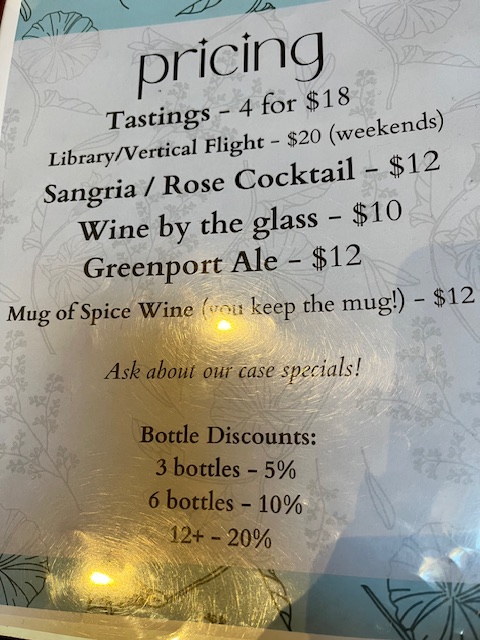
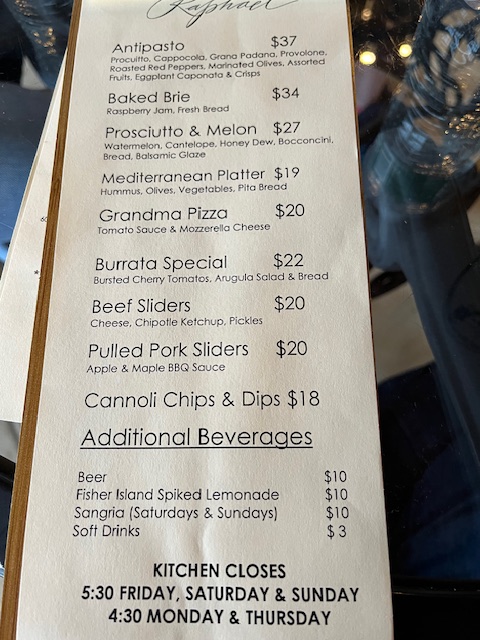
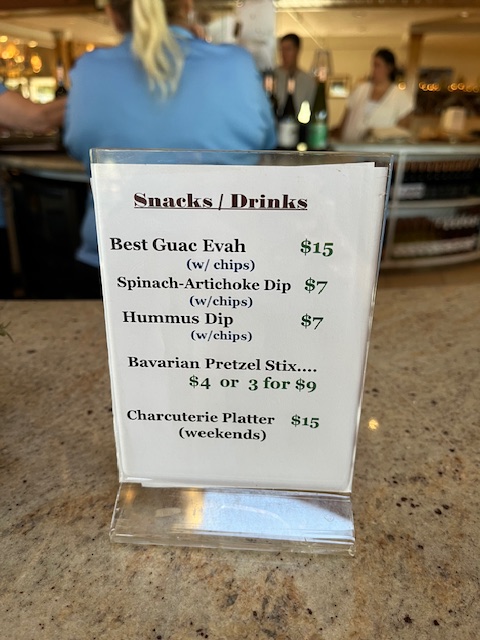
Tastings consist of four samples for $18, chosen from their extensive lists.  There are eight whites, plus one rosé, and ten reds.  We decided to do two tastings, shared, with four whites and four reds, which we marked on sheets sporting four circles, just the right size for a little plastic cup of wine.  We requested two extra cups, and carefully carried the tray back to our table, where the little ones had discovered the bag of potato chips and the fruit we’d brought.  (If I’d thought carefully, I would have brought more snacks, though Osprey does offer a little menu of snacks one can buy.) 
We doled out equal shares of each sample—just enough for a couple of sips each—and as we sat and chatted the little ones ran around and danced to the music.

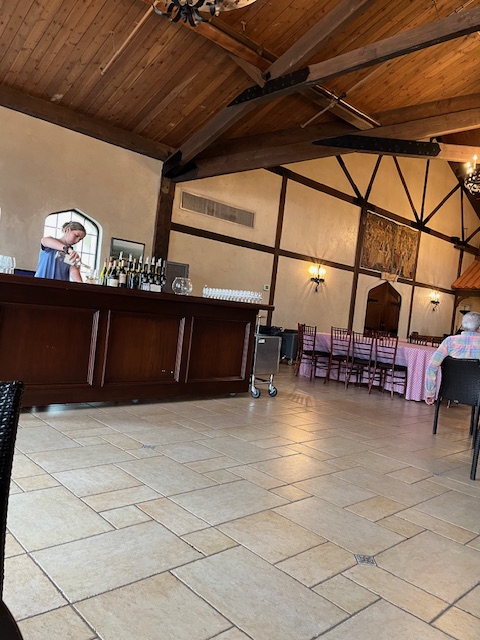
Inside, it was much calmer.
  • 2023 Fumé Blanc           $24

In case you’re wondering, fumé blanc is sauvignon blanc that has been aged in oak.  This one has an aroma of pineapple and tastes of grapefruit.  It is good and tart.

  • 2022 Unwooded Chardonnay                  $22

This ended up being our favorite white of the day, a pleasant chard with aromas of pear and a slight funkiness.  It tastes crisp, with slight fruitiness, and is, according to one guest, a “perfect chicken wine.”

One bit of the large circular bar.
  •  2021 Gewürztraminer        $25

Lovely aroma of honeysuckle and spice made this a wine we let the six-year-old smell—not taste!—as we discussed how you are never supposed to say a wine smells or tastes like grapes.  Well, sometimes they do!  One guest compared the taste to prickly pear.  I say apple-y and pineapple-y.

  • 2021 Riesling    $25

“This would be a good lunch wine,” opined one guest, to which the other wondered when she had last had wine with lunch.  It has a floral aroma, maybe roses, plus a woodsy cedar smell.  The taste is mild, a bit sweet, though this is a dry riesling.
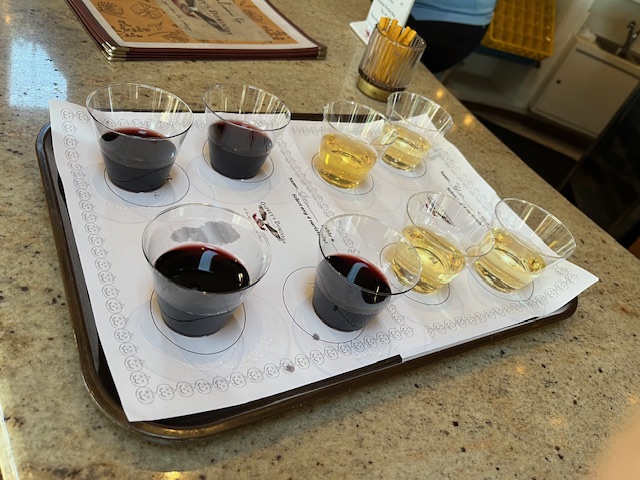
Our two flights. Note that they will place the wines in the order in which you list them, so be careful to list them in a good order for tasting, from lightest to strongest.
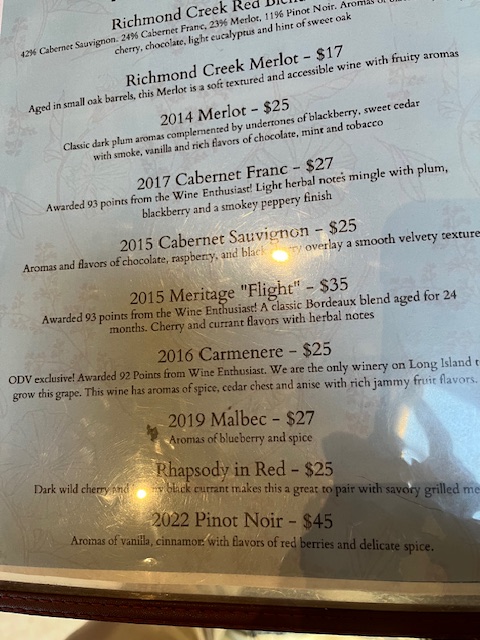
  • 2017 Cabernet Franc    $27

Now we move on to the reds, after a couple of palate-cleansing potato chips.  We don’t detect much aroma, though there is a trace of cinnamon and cigar, maybe herbs.  I taste red plums.  This was a great year for plums in the farm stands, though the season was too short for me.  I did get to make one plum tart.

  • 2015 Meritage “Flight”  $35

Delicious aroma of cherries, and, said one of us, “smells grape-y.”  We decided it was “promising,” but needs to age some more, since it is very tannic.  This is a Bordeaux blend.

  • 2016 Carmenere             $25

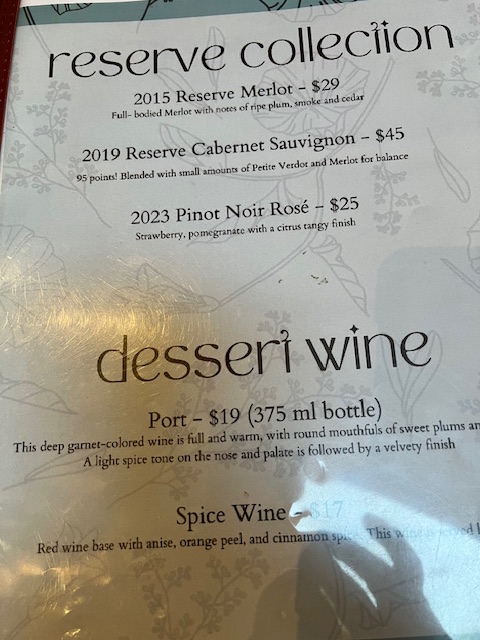
According to the wine list, Osprey is the only winery to grow this grape on Long Island.  Too bad, because it makes a nice wine.  We smell cut grass and crushed ferns, and note a cherry licorice taste, plus blackberry and a hint of pepper.  I think it would be a good burger wine, and one guest suggests a hearty beef stew.  Yep, that would work.

  • 2019 Malbec     $27

Another favorite, this has aromas of plums and spice and is dry yet has plenty of fruit.  Pork braciole, suggests a guest. Why not!

Reasons to visit: plenty of good wines at reasonable prices, but especially the Unwooded Chardonnay and the Malbec; the Richmond Creek line is particularly well priced; dogs allowed; outside snacks allowed; casual party atmosphere outside, with music on many weekends; good place if you have children in your group (even inside, where the room is large enough for them).

Raphael Winery: On a Rainy Day

September 27, 2024

I love how the building looks like it flew over from Tuscany.

We had had a lovely run of warm, sunny days, which, I have been told, is weather vineyard managers like as harvest season begins.  However, this Thursday dawned cloudy, with drizzles forecast for the day, so we needed to think carefully about where to bring our visitors.  No sitting outside, which meant several wineries we had been thinking of were not possible.  Then we remembered that one visitor has Italian roots, and the other French, so we decided to take them first to Raphael, which looks like it was plucked out of Tuscany and dropped on Main Road, and then to Bistro Demarchelier in Greenport. Both choices worked out well!

The back bar.

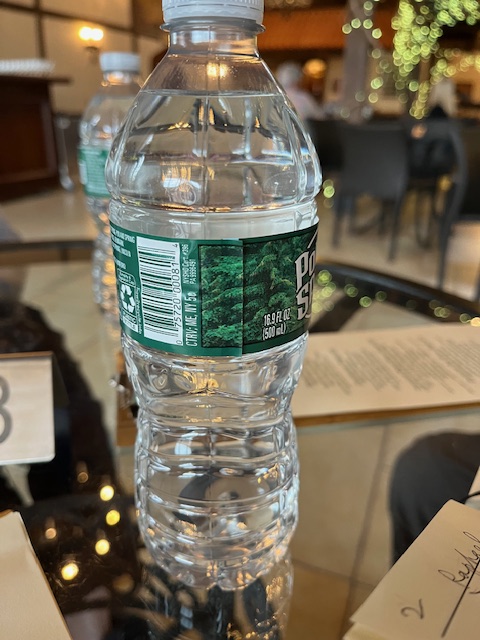
At Raphael we were greeted by a sign telling us to check in at the “back bar,” which we did, and were told we could choose any table.  We decided on one next to the windows that look out onto the vineyard.  Quickly, a server brought us bottles of Poland Spring water and menus.  As our guests admired the view and the large room (Did they have events here?  Oh yes, I always check their website if I want to come here, to be sure they are not closed for a wedding or other party.), we looked over the menu, which offers six different flights.   Flights include all white, all chardonnay, all red, mixed, mixed premium, and premium red.  After some discussion, we decided to both get the mixed premium, of four wines for $35, so we could sample various types of wine and compare notes. 

Did we want any food?  There’s a fairly substantial list of options, from pizzas to sliders, but we had just had lunch (Taking advantage of the fall bounty at the farm stands, I had served a Caprese salad and melon with prosciutto, among other items.), so we declined.  Instead, the server brought us a little plate of water crackers, a nice touch, with our flights.  I forgot to take a picture of the flight, but there was plenty of wine to share.  

As we drank, we discussed the price of the wine, and why wine aged in oak costs more.  I mentioned the “angel’s share,” the idea that the wine which evaporates through the pores of the oak goes to the angels, and our friend said that’s why he wants to go to heaven—to share the angel’s share.  It would be nice if there was a special place reserved in heaven for winemakers and wine drinkers. 

  • 2020 First Label Sauvignon Blanc          $40

Aged in oak, this sauvignon blanc reminded our friend of a white Bordeaux.  It is mellow, not overly oaky, with an aroma of grass and crushed fern.  I think someone who normally found sauvignon blancs too citrusy or “sharp,” as a friend used to say, would like it.  It would go with sole meuniere, opined our friend.

We cleared our palates with these water crackers.
  • 2021 First Label Chardonnay    $50

Oaky? Yes indeed, not my favorite type of chardonnay.  It has an aroma of vanillin and lots of butterscotch taste.  One friend, who doesn’t like many wines, likes this one.  It’s okay, as well as oaky, jokes the other.  Maybe it would go well with charcuterie, but it’s not a wine I would choose to buy.

Oops, I forgot to take a picture until we were almost done!
  • 2019 La Fontana            $45

Named for the lovely fountain out in front of the tasting room, this is a blend of 33% merlot, 25% petit verdot, 17% cabernet sauvignon, 16% cabernet franc, and 9% malbec.  The wine is also lovely, with aromas of plums and berries and a pleasantly fruity taste, though light on tannins, the type of red one could pair with roast chicken.  We like it.

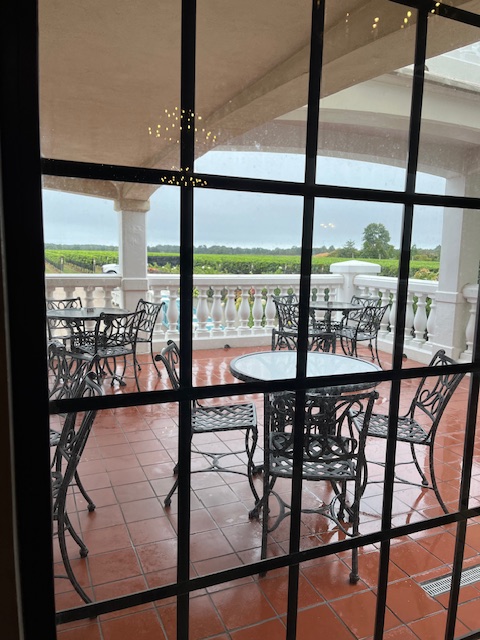
In nice weather, this veranda is a pleasant place to sit. Not today!
  • 2019 Primo        $86

Whew, that’s pricy for out here!  Another blend, this is 60% merlot, 20% petit verdot, 15% malbec, and 5% cabernet franc.  The oak aging is evident in the aroma, which has that tobacco/cigarette aroma one often gets.  I think it also smells a bit like green olives.  It has some depth, with dark fruit tastes, and tannins that make me think it could be better a bit more aged. 

Pretty room.

Reasons to visit:  attractive large space, with a pretty veranda in back; pleasant service, including free bottles of water and a plate of crackers; the First Label Sauvignon Blanc and La Fontana; they have a classy gift shop; more substantial menu of food items than many other places.  It’s also nice to visit during the holiday season, when it is even more decorated than it usually is. Oh, and in case you’re wondering, no Ninja Turtles here!

Main & Mill House: Old House, New Look

http://www.mainandmillhouse.com

August 5, 2024

The view from the parking lot.

As we drove past the corner of Main Street and Mill Lane, we noticed a fair amount of construction, plus new vineyards all along Mill, and now we know why.  The owners of Rose Hill and Croteaux are expanding their wine empire with new vines and a new production facility to supply their new tasting room, which is in the 1870-era house that used to be the home of Sherwood House Winery.  Though the layout of the main room is similar to what it had been, with couches flanking a fireplace and a bar along one wall, the look is very different, thanks to Lumber & Salt.  If you have been to other projects of theirs, like the Terra Vite tasting room, you won’t be surprised to learn that the design features re-used architectural elements from other places. 

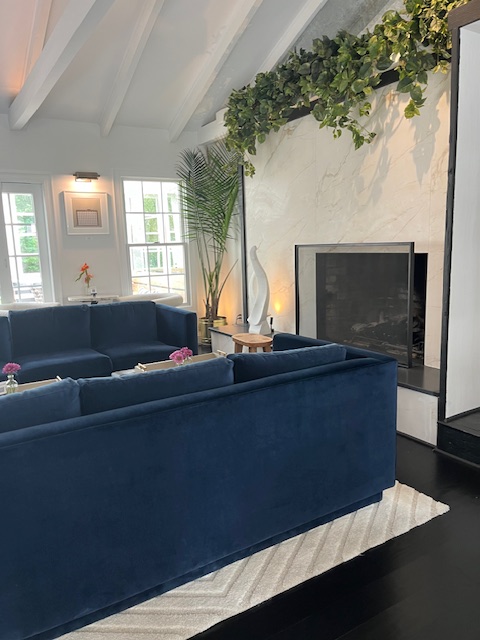
The fireplace and couches are still in the same spots, but they look quite different.
Past the carafe of water (welcome on this hot day), you can see the new bar.

The outside areas, both front and back, have also been redone, with attractive seating and well-placed umbrellas and sun shades.  However, on this quiet Monday, it was too hot to sit outside, so we opted to sit in a comfortable corner of the tasting room. When we were done we thought about browsing the William Ris Gallery, which is adjacent to the winery, but decided we were ready to head home.

The front seating area.
The back deck.

Our server, Margot, greeted us cheerfully and noted we could sit wherever we chose.  She also pointed out the QR code on the table, which led us to the menu.  They have two tastings, $30 each, of five wines, labeled “Main” and “Mill.”  I could see that some of the wines in each were also available at Croteaux or Rose Hill, so I chose Main, which seemed to have more wines that were new to me, since we had recently been to Rose Hill, and we’ve often been to Croteaux, though not so far this summer. 

They also have a rather eclectic menu of snacks, from $5 for a bag of North Fork potato chips to $90 for “Gourmet Tater Poppers & Caviar,” “crispy tots with Osetra caviar & crème fraiche.”  Really? More practically, they also list several non-alcoholic drinks, including a Shirley Temple.

Another seating area.

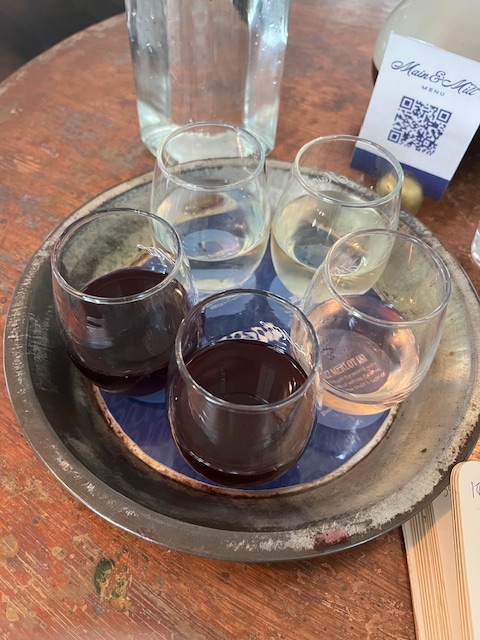
The tastes, a fairly generous pour, came in a round tray, with labels under each little glass explaining the wine on top of it.  As we sat and sipped and chatted, Margot made sure to check on us just the right number of times, and answer any questions we had.  Overall, my tasting buddy said he was “not excited” by the offerings.  Nothing was bad, but also nothing made us sit up and take notice. On the other hand, they are new, so we’ll be interested to see how the wines develop over the years.

  1.  2023 Daisy        $38

Our first wine is made from grapes from the new vineyards on Mill Lane, and was actually our favorite of the day.  It is made from sauvignon blanc grapes, and is light, with tastes of citrus and peach, slightly tingly on the tongue.  Surprisingly complex. It would be great with oysters. 

  • 2023 Palmilla   $34

In June we had this wine at Rose Hill, and liked it.  It is a blend of gewürztraminer, albariño, chardonnay, and pinot grigio.  Though it has very little aroma, it has plenty of tropical fruit and orange tastes, and has enough interest to be served as an aperitif wine, perhaps with an array of charcuterie.

The rose.
  • 2022 Merlot 181             $34

The number 181 refers to the clone of merlot used in this Croteaux rosé.  This is a fairly typical rosé, with a faint strawberry aroma and taste, plus some citrus.  Dry.

  • 2022 Rumor      $38

This red, made from cabernet franc, is so light that I wondered if it had been steel fermented, but Margot informed us that it had indeed been oaked, but only briefly.  It has a slight fruit aroma, perhaps of cherry, and a taste of pomegranates.

  • 2021 XXI             $34

No surprise, if you can read Roman numerals, the name of the wine refers to the year it was harvested.  This is a Bordeaux blend, of cabernet franc, cabernet sauvignon, petit verdot, and malbec, with an aroma of mixed fruits, but not much flavor.  However, it was a bit cold when served, and as it sat it got better, with dark fruit and berry tastes. 

Reasons to visit:  small elegant winery, with ample outside seating and a cozy vibe in the winter; it’s new; you want tater tots with caviar 😊; Daisy and Palmilla.

This is a rather elaborate sculpture/fountain. Not sure if it belongs to the tasting room or the gallery.

Meadowlark:  Pizza Night!

September 8, 2023

Just one part of the capacious grounds.

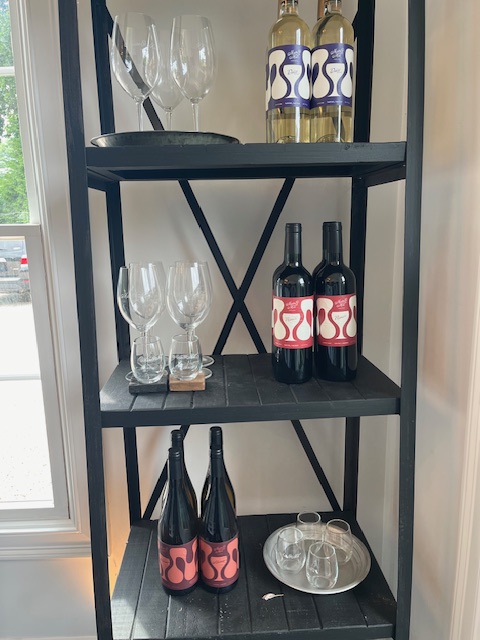
It had been hot all day, but by 5 o’clock it had cooled off enough to sit outside, which we were glad to notice, since that had been our plan.  With our friends the winery aficionados, we headed to Meadowlark for pizza night.  The last time we had been to that property, many years ago, it had belonged to a different winery.  Then Macari took it over, at first running it as simply a second location for tastings, but now they had rebranded it as a somewhat different type of winery.  The emphasis here is on a few wines not available at Macari, as their website says, “limited wines, and innovative winemaking techniques available only at the Meadowlark property.”  In addition, they promote the property as an ideal place for weddings and other events, with two renovated barn-like buildings and extensive beautifully landscaped lawns and gardens.  It is only open to the public Friday afternoons, Saturdays, and Sundays. 

Have rolling pizza oven, will bake!
The comfortable table where we settled in for our evening.

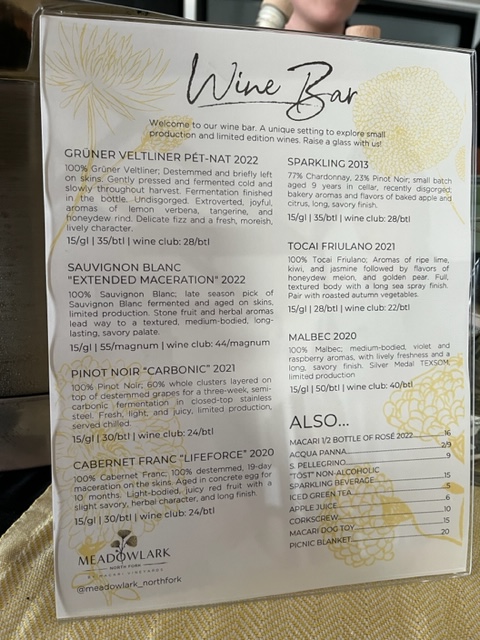
We pulled into the parking lot and strolled up a slight rise to where a pizza oven roared, and then checked out one building, where an oyster bar offered freshly shucked oysters, and then the wine bar, before settling at a table on the deck outside the wine bar.  Music from speakers in the shrubbery included a few Grateful Dead songs.  Inside the wine bar, we acquired four glasses of wine from the limited menu of seven, deciding on two glasses of malbec, one of cabernet franc, and one of a grüner veltliner pet-nat (No flights on Friday nights.). 

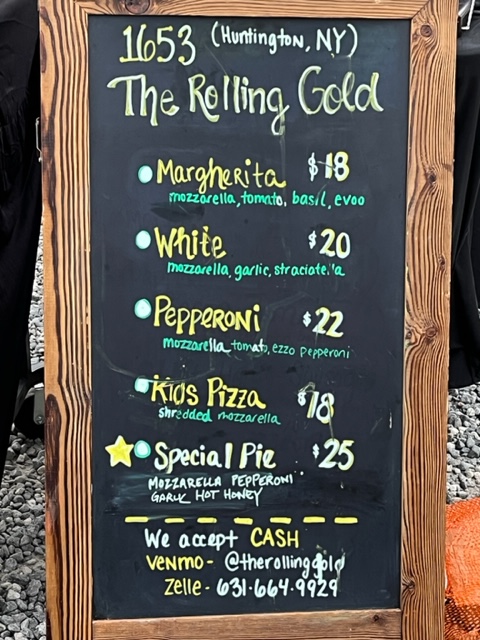
Then we ambled over to the pizza oven, operated by pizza makers from The Rolling Gold, a shop with a “brick and mortar” site in Huntington.  There were five pies on offer, and we decided on one Margherita ($18) and one White ($20).  They gave us a buzzer, and only a few sips of wine later the buzzer went off. 

The pizzas were tasty, the Margherita with a fresh-tasting red sauce and fresh mozzarella, the white with plenty of garlic and melty stracciatella cheese, the crust appropriately slightly charred.  We thought there’d be leftovers, but we only took home one slice.  We had the patio to ourselves, though there were plenty of couples and small groups scattered over the lawns, and we sat and chatted until it began to get dark. 

Yummy pies. However, we would have liked it if plates were included, instead of just napkins.

Only a few notes on the wines:

  •  Grüner Veltliner Pét-Nat 2022                   $35

I’ve never seen a grüner veltliner made into a sparkling wine, so that’s something new to me.  I didn’t get to taste it, but one friend quite enjoyed it.  Meadowlark’s tasting notes describe it as “fresh” and “lively.”

Though it had cooled off enough to make sitting outside pleasant, it was still quite humid, as you can see by the condensation on this glass.
  • 2020 Malbec      $50

Our friend and I both chose this as a good red to go with a pizza, and it was.  Dry and pleasant, with more tannins than fruit, it was a very nice wine, though not a $50 bottle.  We discussed value versus price for a while, since, we agreed, it is perfectly possible to enjoy wines that are not all that expensive, though great wines are something special.

  • Cabernet Franc “Life Force” 2020              $30

“Life Force” is the way Macari characterizes the wines they make using a concrete “egg” for aging.  Their Life Force Sauvignon Blanc is one of my favorites of their wines.  This red is rather light, with tastes of red fruit and herbs.  It also went well with the pizza, and my husband was happy with this choice.

Those are oysters in the “boat.”

Reasons to visit:  excellent pizzas; relaxed, laid-back vibe on a Friday night; beautiful grounds; dogs allowed; some interesting wines to try.  I may go back some time on a Saturday or Sunday so I can try a flight, which they serve in test tubes (!). 

The staff was busy prepping these “test tubes” for Saturday’s wine tastings.

Peconic Bay Vineyards: Celebrating the Fourth on the Second

July 2, 2023

#peconicbayvineyards #northfork #winetasting #barrelfermentedsauvignonblanc #theMoke

www.peconicbayvineyards.com

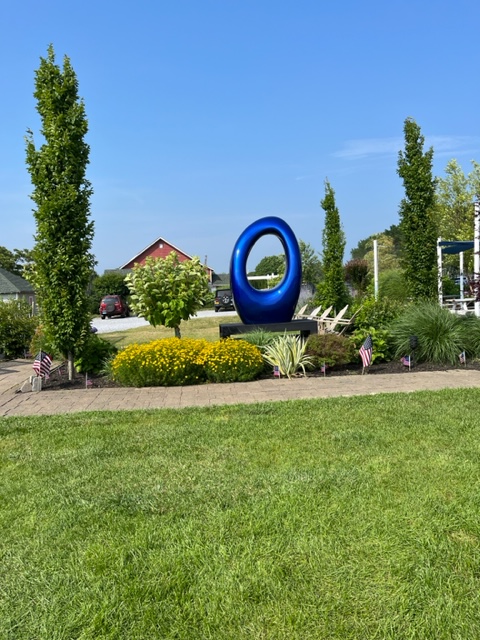
A patriotic flower pot.
The vines make a perfect photo backdrop.

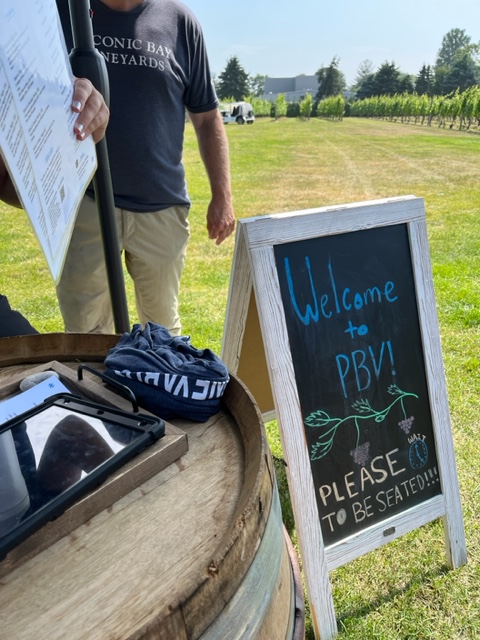
We were a little wary of venturing out to a winery on the weekend before July Fourth, but Peconic Bay proved to be an excellent choice—just enough people to feel celebratory, not so many that it felt crowded.  It was also a good choice since it fit with our plans for the day, which included a visit to the Horton Point Lighthouse (If you haven’t ever been there, go. Note that it is only open on weekends, but the volunteers who staff it are lovely, and very well-informed, and the little museum is well set up.  Our guests braved the climb up the tower, but I had been, and once was enough.  We paid $5 to park in the lot and $10 for the family to enter.)  Then, we needed to be at Braun’s at 4:30 to pick up our steamed lobsters for dinner, and Peconic Bay is right next door.  The timing worked out perfectly.

The outdoor space is more comfortable than the indoor room.

I had made a reservation, and they sat our party of six around a firepit (obviously not lit on this warm afternoon) shaded by an umbrella.  The outside patio is a lovely place on a nice day, but the indoor tasting room is small and rather spartan, so I think this is one of those places I’ll go to in the summer.  As we perused the menu, we enjoyed the cool jazz of a group whose name I couldn’t quite catch.  The menu offers two flights, the Crossroads of three wines for $18, and Reserve, of three wines for $20.  One could also opt for pairings of three wines with chocolate, cheese, or oysters.  We were planning to pick up some oysters with out lobsters, and we wanted to try the full panoply of wines, so we decided that each couple would share both flights.  That worked out well, and there was plenty of wine, but the sequence ended up being a bit of an issue, since both tastings include some whites and some reds. As a result, we kept going back and forth between the two flights.  My notes, therefore, are in the order in which I tasted the wines, not separated by flight.

We also ordered a little dish of Marcona almonds ($4), and another of olives ($8), both quite good, and two non-alcoholic drinks for the minors in the party.  They both gave positive reviews to the Beach Ball cold brew strawberry hibiscus caffeine free tea ($5) and the Subtle Tea lemonade ($4).  They also enjoyed seeing a few dogs on the patio, and noting the cute Moke, a jeep-like vehicle in which one can tour the vines.

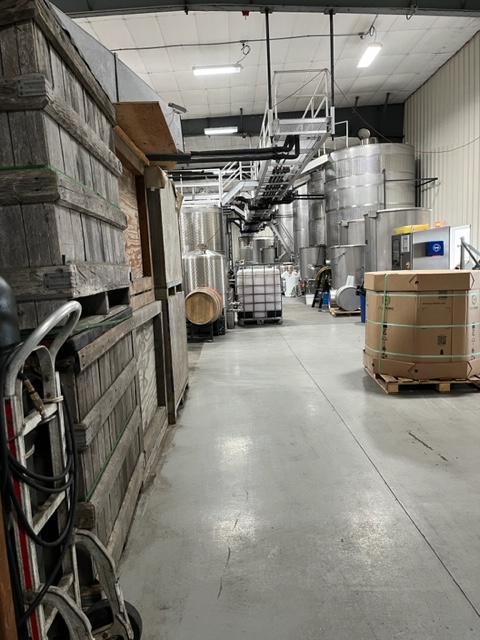
We asked our server if they made the wines on the premises, and he enthusiastically explained that the separate building on the other side of the parking lot contains their wine-making facility and their cellar, filled with stainless steel tanks and oak barrels.    

  •  2021 Sauvignon Blanc                  $28

We all agree that the aroma is lovely, which I describe as flowery.  The taste is tart, with lots of acidity and a long finish.  It would go well with oysters, but I am planning to make martinis for my guests, one of my favorite beverages to go with oysters—another is a dry sparkling wine.

  • 2021 Barrel Fermented Sauvignon Blanc $35

This is from the Reserve flight, and we decided it would be fun to taste the two side by side.  One member of the party explained to the minors that two wines made from the same grape, grown in the same place, could taste very different depending on how they were made.  I like this better than the steel sauvignon blanc, which surprised me a little, but it is not oaky, and our comments are:  “nice, round, smooth, yum.”  It has a bit of a vanilla aroma, and would go well with lobster.

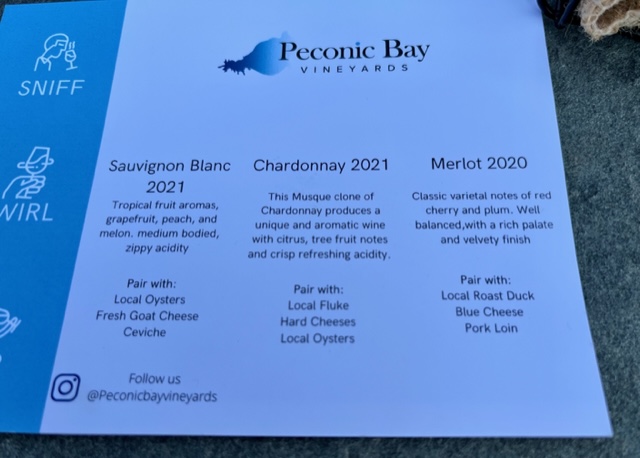
The flights come with handy little tasting notes.
  •  2016 Blanc de Blancs                    $40

The collective decision is to try the Blanc de Blancs next, as it is starting to lose its bubbles already.  One guest compares the aroma to privet, a flower we’ve been smelling all day.  Maybe.  It is quite tart, and not a sparkler for sipping on its own.  I eat a few almonds and then try it, and find it improves when paired with food.

  • 2021 Steel Chardonnay   $28

“The more I drink it, the more I like it,” opines our guest.  It has a bit of a funky aroma and taste, but otherwise is similar to most North Fork chardonnays, with citrus tastes and some green apple.

  • 2020 Merlot       $35

“Not exciting,” is the group judgment on this “serviceable” merlot.  I taste and smell cherry, as is typical, with a touch of tobacco from the oak.  Someone observes that it is “too tangy.”

  • 2020 Malbec      $35

Though it has no body, this wine is spicy and herbal, with tastes and smells of dark fruit, lavender, and rosemary.  “Meh,” says one guest.  I say it’s a nice wine.

Reasons to visit:  pleasant outdoor patio overlooking the vines; convenient location next door to Braun’s; the barrel fermented sauvignon blanc; all the wines were drinkable, if not exciting; live music; oysters and other pairings; the Moke!

The winemaking facility is on the other side of the parking lot.

Pindar Vineyards: Special Day for Locals

March 31, 2023

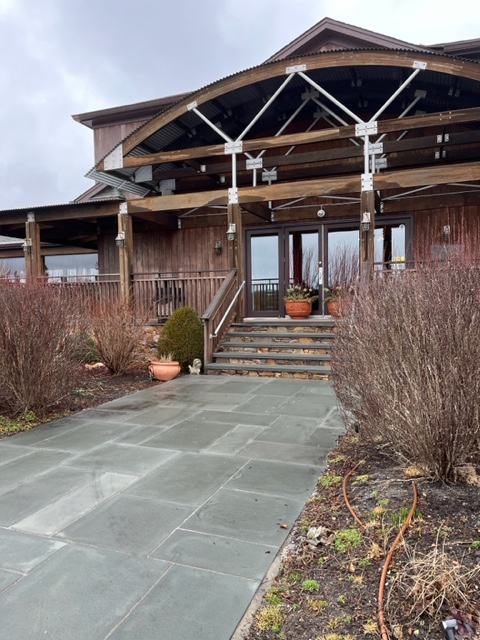
The day was gray and chilly, but we had a good time anyway.

Pindar is proud of being one of the early vineyards on the North Fork, with their vines planted over 40 years ago.  I came by this bit of knowledge on a free tour and tasting at Pindar, part of an effort by a number of vineyards to attract locals to come and taste their wines.  Friends of ours had noted this program and invited us to join them at Pindar, whose perks seemed the best (other places offered such bargains to locals as ten percent off bottles or two for one).  Good move! We had a good time, learned a lot, and got to taste some wines we then bought and took home.

Nancy is showing us a gewurztraminer vine, one of the original ones planted at Pindar. The roots can go very deep.

Nancy, our tour guide, started us off by the vines, and then took us through all the steps of making wine, from the crush pad to the stainless steel tanks to the French oak barrels to the warehouse, and then back to the tasting room where we got to try five wines.

“Viticulture is farming for masochists,” she informed us, as she explained the work involved in pruning the vines, which she characterized as “an art and a science,” and the perils faced by grape growers.  There are migrating birds who will peck at the grapes, so they look fine but then shrivel into nothing; there are hurricanes on Long Island, whose arrival coincides with harvest season; and there is the lack of crop insurance, because how can you insure for their current value vines that have been growing for over 40 years.  In addition, you have to wait four years after you plant those vines before you can expect to harvest the grapes. The issue of birds has been taken care of, through an ingenious system of nets, which you can see in many vineyards, which remain furled up below the vines and are then raised when the grapes ripen.  As to the other issues…not much one can do about them!

Despite these problems, Pindar has 325 acres of vines, resulting in 60 to 70,000 cases of wine every year.  At first, Dr. Dan Damianos, the visionary who started Pindar (named, like one of his sons, for the classic Greek poet, in homage to their Greek heritage), planted gewürztraminer grapes, judging that the climate and soil would work well for this varietal.  Now they grow twenty-four varietals, and they list twenty-nine different wines on their tasting menu, which includes a number of blends.

The bottling machine, which is about to be replaced by an even better one.

They bottle these wines with their own bottling line, which can do 3,000 a day.  Not every winery has their own bottling facility, with many using Premium Wine Group for this.  Nancy gave a brief lecture on the issue of corks vs. screw caps, with corks reading as “better” wines, and screw caps okay for more casual, cheaper wines. Screw caps work just fine, though corks have the advantage of being biodegradable.

I never knew why the vats have this dimpled jacket.

We then walked into a huge room filled with vast stainless steel vats, where Nancy explained something I’d always wondered about.  The vats are partially encases in a dimpled steel jacket.  It is a glycol jacket, containing polyglycol, used to help regulate the temperature in the vats, and the dimples keep the polyglycol from settling to the bottom.  Too hot or too cold, and the wine is ruined.  They use a windmill to provide about 60% of the energy needed in the warehouse and wine “cellar”—not a cellar, because…polyglycol.  We also learned about another hazard of viticulture—carbon dioxide.  As the juice ferments into wine, carbon dioxide rises to the top of the tanks, where the solid matter must be pushed down into the liquid.  Catwalks provide access to the tops of the tanks, and open doors help dissipate the CO2.

Part of the filtration system.

She showed us their filtration system, and we learned, by the way, that Guinness Stout used isinglass, obtained from the bladders of sturgeon, to filter their brew.  I like Guinness, but I also like caviar!

She also took us outside to see the crush pad, where a machine crushes the grapes. Because Pindar is so big, a lot of the work is done by machines.

The crush pad.

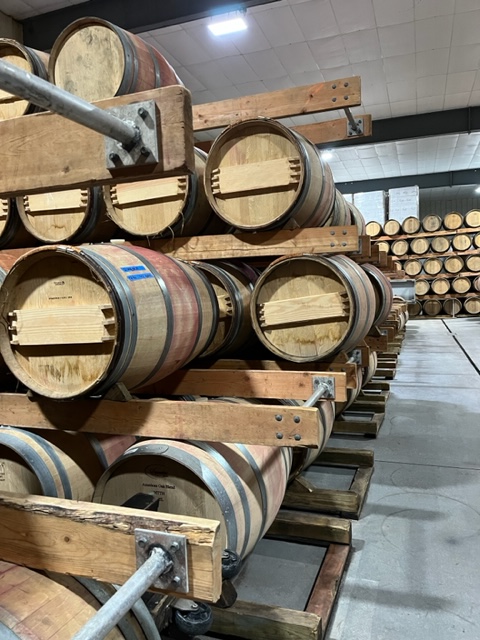
The huge space where red wine ages in French oak barrels smelled enticingly like a forest or lumberyard.  We found out that there are different tastes imparted to wines by French and American oak, with some adding notes of vanilla and others cinnamon, etc.  Pindar now uses only French oak, buying 300 barrels a year, and has phased out their American oak barrels, which they sometimes sell to breweries or to people who want to use them in their gardens.  We also learn about the “angel’s share,” the wine which evaporates from the barrels, meaning they need to be constantly watched and topped up, so that too much oxygen doesn’t turn the wine into vinegar.  The angels must reserve a special place in heaven for wine makers!

Despite the bung stopper, some evaporation is unavoidable.

Finally, our last stop before the tasting room, we saw the warehouse where cases of wine are stacked high.  Nancy held up a four-pack of cans of Winter White, and explained that Dr. Dan, noting the American taste for soda and other sweet drinks, decided to make some sweeter wines, like Winter White, which is the most popular white on Long Island.  More recently, the decision was made to offer it in cans; again, to attract those who might otherwise opt for soda or beer.

Cans of Winter White, ready to go.

Now it was time to taste the fruits of their labor!  The group of about thirty locals lined up around the bar, where glasses stood ready.  Here are my tasting notes:

Nice sized pour.
  •  2020 Dr. Dan’s Selection White Blend      $24.99

Our first taste is a blend of, this vintage, of 53% viognier, plus pinot grigio, sauvignon blanc, and riesling.  The percentages may vary year to year.  This is a very drinkable white, with aromas of pineapple and citrus, and tropical fruit flavors like guava and pineapple.

  • 2021 Dr. Dan’s Selection Gewürztraminer               $24.99

We are quite interested to taste this, after learning the history of the vines, and we quite like it.  In fact, we and our friends each buy a bottle to take home.  It is not too sweet, which can happen with gewürztraminers, with an aroma of peaches and tastes that include tangerine and apricot.  “Yummy,” we and our friends agree.

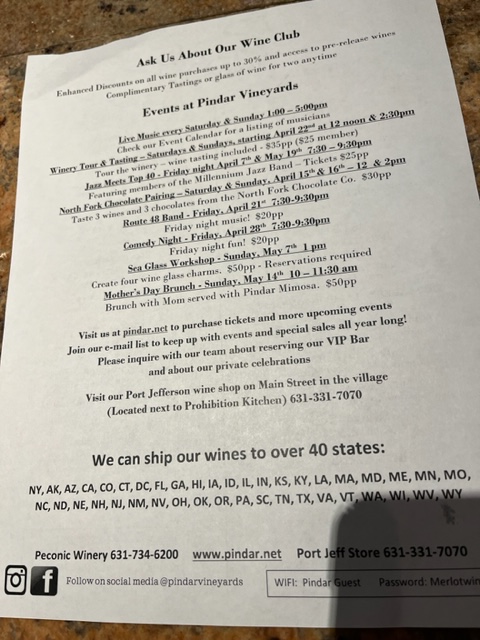
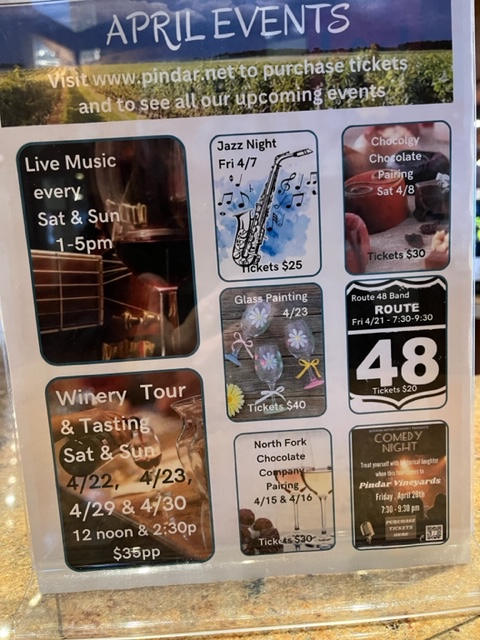
At the tasting, I turned over my menu to see the events list.
  • 2019 Mythology                $42.99

A Bordeaux blend called Meritage, this includes malbec, cabernet sauvignon, merlot, petit verdot, and cabernet franc.  Delicious.  Lots of dark fruit taste and enough tannins that one could probably age it.

  • 2019 Cabernet Sauvignon Reserve            $34.99

Nancy, who is still informing us about the wines, explains that cabernet sauvignon used to be harder to grow on Long Island, since it needs a longer growing season to mature.  However, with climate change, the growing season on Long Island has gotten longer.  I guess that’s an upside to global warming! This is another very good red, with tastes of blackberry and other fruits, and an aroma of cedar and tobacco.

Pindar Damianos chatting with a guest.
  • 2015 Cabernet Port         $28.99 for 750 ml, $16.99 for 375 ml

I’m not sure if this was in the original tasting or if it was included after our friend shared his enthusiasm for the port with Nancy and with Pindar Damianos, who was hanging around and talking to the guests.  He discovered that Pindar makes award-winning port in an old issue of a wine magazine shortly after moving to the North Fork, and was happily buying and drinking it.  I can see why.  This is a dessert wine—in English novels, they are always sipping it after dinner while they crack walnuts and chat—but it is not too sweet, with an appealing depth of flavor.  It is made 100% from cabernet franc.  We each buy a bottle to take home.

Cases filled with awards Pindar wines have won.

Reasons to visit:  roomy tasting room with two outside areas; a wide variety of wines for every taste, from sweet to dry, and price, from $14.99 (Winter White and others) to $42.99; all the wines we tasted—White Blend, Gewürztraminer, Mythology, and Cabernet Sauvignon Reserve—plus the port; our friends had also tasted the Gamay Noir before we went on the tour, and bought a bottle of that light red to take home; they have a refrigerated case full of cheeses, etc., to consume there; they have a variety of special events.

Pindar Vineyards: Special Day for Locals

March 31, 2023

The day was gray and chilly, but we had a good time anyway.

Pindar is proud of being one of the early vineyards on the North Fork, with their vines planted over 40 years ago.  I came by this bit of knowledge on a free tour and tasting at Pindar, part of an effort by a number of vineyards to attract locals to come and taste their wines.  Friends of ours had noted this program and invited us to join them at Pindar, whose perks seemed the best (other places offered such bargains to locals as ten percent off bottles or two for one).  Good move! We had a good time, learned a lot, and got to taste some wines we then bought and took home.

Nancy is showing us a gewurztraminer vine, one of the original ones planted at Pindar. The roots can go very deep.

Nancy, our tour guide, started us off by the vines, and then took us through all the steps of making wine, from the crush pad to the stainless steel tanks to the French oak barrels to the warehouse, and then back to the tasting room where we got to try five wines.

“Viticulture is farming for masochists,” she informed us, as she explained the work involved in pruning the vines, which she characterized as “an art and a science,” and the perils faced by grape growers.  There are migrating birds who will peck at the grapes, so they look fine but then shrivel into nothing; there are hurricanes on Long Island, whose arrival coincides with harvest season; and there is the lack of crop insurance, because how can you insure for their current value vines that have been growing for over 40 years.  In addition, you have to wait four years after you plant those vines before you can expect to harvest the grapes. The issue of birds has been taken care of, through an ingenious system of nets, which you can see in many vineyards, which remain furled up below the vines and are then raised when the grapes ripen.  As to the other issues…not much one can do about them!

Despite these problems, Pindar has 325 acres of vines, resulting in 60 to 70,000 cases of wine every year.  At first, Dr. Dan Damianos, the visionary who started Pindar (named, like one of his sons, for the classic Greek poet, in homage to their Greek heritage), planted gewürztraminer grapes, judging that the climate and soil would work well for this varietal.  Now they grow twenty-four varietals, and they list twenty-nine different wines on their tasting menu, which includes a number of blends.

The bottling machine, which is about to be replaced by an even better one.

They bottle these wines with their own bottling line, which can do 3,000 a day.  Not every winery has their own bottling facility, with many using Premium Wine Group for this.  Nancy gave a brief lecture on the issue of corks vs. screw caps, with corks reading as “better” wines, and screw caps okay for more casual, cheaper wines. Screw caps work just fine, though corks have the advantage of being biodegradable.

I never knew why the vats have this dimpled jacket.

We then walked into a huge room filled with vast stainless steel vats, where Nancy explained something I’d always wondered about.  The vats are partially encases in a dimpled steel jacket.  It is a glycol jacket, containing polyglycol, used to help regulate the temperature in the vats, and the dimples keep the polyglycol from settling to the bottom.  Too hot or too cold, and the wine is ruined.  They use a windmill to provide about 60% of the energy needed in the warehouse and wine “cellar”—not a cellar, because…polyglycol.  We also learned about another hazard of viticulture—carbon dioxide.  As the juice ferments into wine, carbon dioxide rises to the top of the tanks, where the solid matter must be pushed down into the liquid.  Catwalks provide access to the tops of the tanks, and open doors help dissipate the CO2.

Part of the filtration system.

She showed us their filtration system, and we learned, by the way, that Guinness Stout used isinglass, obtained from the bladders of sturgeon, to filter their brew.  I like Guinness, but I also like caviar!

She also took us outside to see the crush pad, where a machine crushes the grapes. Because Pindar is so big, a lot of the work is done by machines.

The crush pad.

The huge space where red wine ages in French oak barrels smelled enticingly like a forest or lumberyard.  We found out that there are different tastes imparted to wines by French and American oak, with some adding notes of vanilla and others cinnamon, etc.  Pindar now uses only French oak, buying 300 barrels a year, and has phased out their American oak barrels, which they sometimes sell to breweries or to people who want to use them in their gardens.  We also learn about the “angel’s share,” the wine which evaporates from the barrels, meaning they need to be constantly watched and topped up, so that too much oxygen doesn’t turn the wine into vinegar.  The angels must reserve a special place in heaven for wine makers!

Despite the bung stopper, some evaporation is unavoidable.

Finally, our last stop before the tasting room, we saw the warehouse where cases of wine are stacked high.  Nancy held up a four-pack of cans of Winter White, and explained that Dr. Dan, noting the American taste for soda and other sweet drinks, decided to make some sweeter wines, like Winter White, which is the most popular white on Long Island.  More recently, the decision was made to offer it in cans; again, to attract those who might otherwise opt for soda or beer.

Cans of Winter White, ready to go.

Now it was time to taste the fruits of their labor!  The group of about thirty locals lined up around the bar, where glasses stood ready.  Here are my tasting notes:

Nice sized pour.
  •  2020 Dr. Dan’s Selection White Blend      $24.99

Our first taste is a blend of, this vintage, of 53% viognier, plus pinot grigio, sauvignon blanc, and riesling.  The percentages may vary year to year.  This is a very drinkable white, with aromas of pineapple and citrus, and tropical fruit flavors like guava and pineapple.

  • 2021 Dr. Dan’s Selection Gewürztraminer               $24.99

We are quite interested to taste this, after learning the history of the vines, and we quite like it.  In fact, we and our friends each buy a bottle to take home.  It is not too sweet, which can happen with gewürztraminers, with an aroma of peaches and tastes that include tangerine and apricot.  “Yummy,” we and our friends agree.

At the tasting, I turned over my menu to see the events list.
  • 2019 Mythology                $42.99

A Bordeaux blend called Meritage, this includes malbec, cabernet sauvignon, merlot, petit verdot, and cabernet franc.  Delicious.  Lots of dark fruit taste and enough tannins that one could probably age it.

  • 2019 Cabernet Sauvignon Reserve            $34.99

Nancy, who is still informing us about the wines, explains that cabernet sauvignon used to be harder to grow on Long Island, since it needs a longer growing season to mature.  However, with climate change, the growing season on Long Island has gotten longer.  I guess that’s an upside to global warming! This is another very good red, with tastes of blackberry and other fruits, and an aroma of cedar and tobacco.

Pindar Damianos chatting with a guest.
  • 2015 Cabernet Port         $28.99 for 750 ml, $16.99 for 375 ml

I’m not sure if this was in the original tasting or if it was included after our friend shared his enthusiasm for the port with Nancy and with Pindar Damianos, who was hanging around and talking to the guests.  He discovered that Pindar makes award-winning port in an old issue of a wine magazine shortly after moving to the North Fork, and was happily buying and drinking it.  I can see why.  This is a dessert wine—in English novels, they are always sipping it after dinner while they crack walnuts and chat—but it is not too sweet, with an appealing depth of flavor.  It is made 100% from cabernet franc.  We each buy a bottle to take home.

Cases filled with awards Pindar wines have won.

Reasons to visit:  roomy tasting room with two outside areas; a wide variety of wines for every taste, from sweet to dry, and price, from $14.99 (Winter White and others) to $42.99; all the wines we tasted—White Blend, Gewürztraminer, Mythology, and Cabernet Sauvignon Reserve—plus the port; our friends had also tasted the Gamay Noir before we went on the tour, and bought a bottle of that light red to take home; they have a refrigerated case full of cheeses, etc., to consume there; they have a variety of special events.

Macari Vineyards: Time to Book a Table

www.Macariwines.com   

February 23, 2023

I’ve become quite familiar with Macari’s tasting room this year, since I now belong to a book club that meets there.  What’s better than sitting around a table with a group of bright people, discussing books and sipping wine?  Oh, and let’s not forget nibbling on truffled potato chips.  However, the book group has settled on one favorite wine—the Life Force Sauvignon Blanc—so when friends who belong to the Macari wine club offered to take us there for a tasting, we accepted with alacrity.  They made the reservation, which, by the way, is required.

Not sure what this is, but it is impressive.

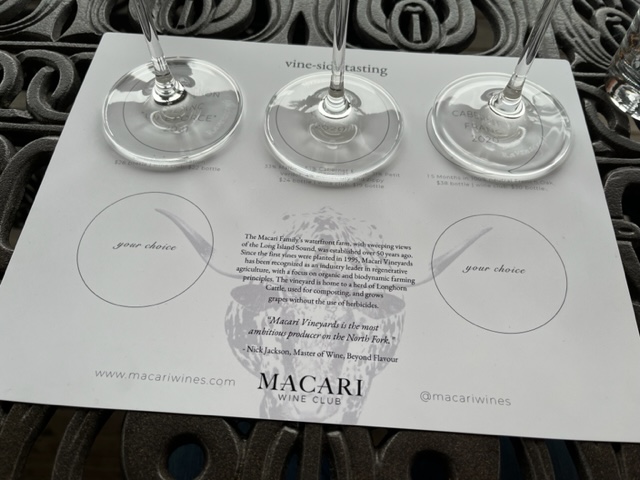
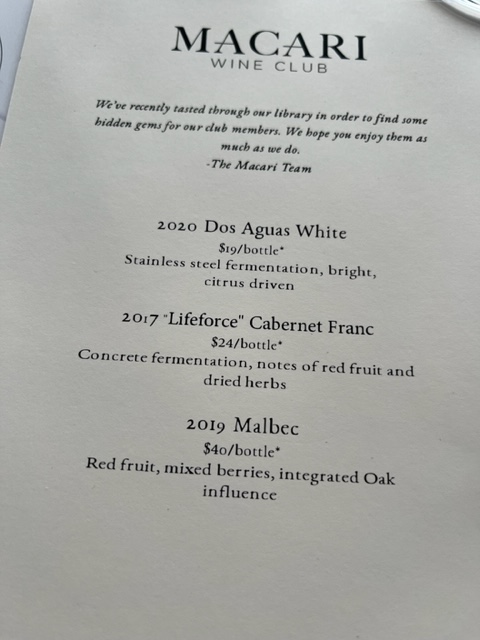
To get to the entrance, you have to wend your way around the wrap-around porch.  The room you enter is dominated by a decorative structure which I think is beautiful, but which defies categorization.  We were shown to a table overlooking the vineyards on a plastic-windowed porch, cozily warm, with chairs decorated with soft furry drapes.  In front of us were place mats with three glasses, and the names of the three wines in the standard tasting.  However, as our cheery server informed us, as wine club members we could choose the special wine club trio of tastes.  It took my husband and me only a moment to decide that he would get the standard group and I would opt for the wine club tastes.  One friend also got the wine club trio, while her husband opted for a glass of his current favorite, the Dos Aguas Red, a blend of 48% Merlot, 28% Cabernet Sauvignon, 17% Cabernet Franc, and 7% Petit Verdot. ($35 per bottle) The Dos Aguas refers to the North Fork’s two waters—the Long Island Sound and Great Peconic Bay—which moderate the climate. 

The tables were set like this. If you didn’t want the three wines on offer, you could substitute others from the list.

As we discussed what to get, the server brought us chilled bottles of water.  We also ordered a charcuterie board for four, which had enough meat, cheese, almonds, olives, bread, hummus, and chips for at least six. ($50)  Yum.  We all agreed that this was a very civilized way to spend a damp, chilly February afternoon.

No outside food allowed, but they have plenty of snacks to choose from.
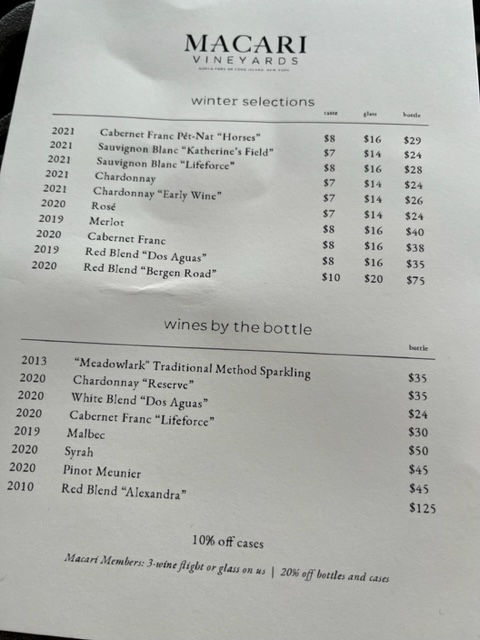
  •  2020 Dos Aguas White  $24

This was the first of the wine club trio, and a very good way to begin.  It is a light, dry, lemony white blend, half grüner veltliner, blended with pinot grigio, sauvignon blanc, and a touch of chardonnay.  The grüner can tend to be a bit sweet, but in this case it was nicely balanced with the other grapes.  It would go well with seafood in a cream sauce.

  • 2022 Life Force Sauvignon Blanc $28

As I noted, this is the book club favorite, and for a good reason.  It is aged in a combination of a concrete “egg,” and stainless steel, which makes it both more complex and smoother than a typical sauvignon blanc.  One time, years ago, we were at Macari and happened to get into a discussion with the winemaker about the concrete egg, and he gave us a long explanation of the benefits of this way of aging wines.  I’ll just say, it seems to work really well.  This is dry but fruity, very easy to drink.

I believe these are the wine club prices.
  • 2019 Life Force Cabernet Franc  $30

My favorite of the day, this is a yummy red, with tastes of berries and plums.  Again, this is aged in concrete.  It was the second of the wine club trio.

  • 2021 Rosé                          $24

On the other hand, this was my least favorite, a very light rosé, tart, with not much fruit.

We had made some serious inroads on the charcuterie platter before I remembered to take a photo.
  • 2019 Malbec                     $50

We had made some inroads on the charcuterie platter by the time I got to the malbec, and I noted that it went very well with the cheese and other snacks in front of us.  Despite its high price, I did not like it as well as the Life Force Cab Franc, though it is a perfectly good wine.  I got some cherry taste, and nice tannins.  Perhaps it needs to age a bit more.

By the time we left, the room had emptied out quite a bit.
  • 2020 Cabernet Franc                      $38

One problem with this red was that it was served too cold, a common problem.  I think if it had had time to warm up, I might have liked it better.  I found it somewhat light for a cab franc, with notes of berries and herbs.  Very drinkable.

Reasons to visit:  pleasant tasting room overlooking the vineyard; excellent service; I liked all the wines, but especially the Life Force Sauvignon Blanc and Cabernet Franc; ample charcuterie board (no outside food).  One unfortunate note—when the room is crowded, it tends to become very noisy, as it was during this holiday week.

I really like these furry throws!

Bedell Cellars: Varied Factors

October 21, 2022

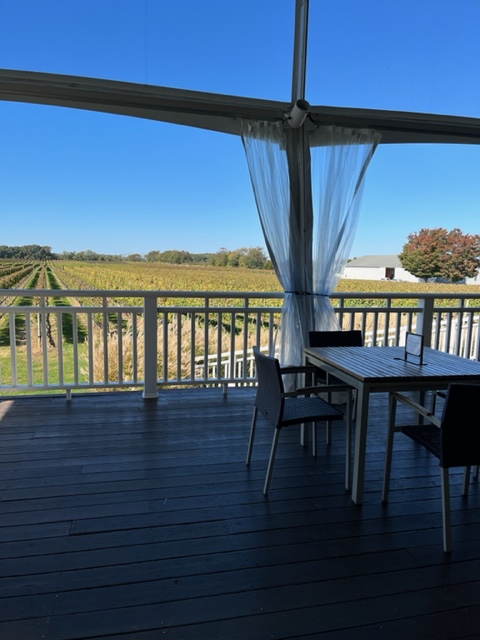
The experience of doing a wine tasting can be affected by many factors, not all of them related to the wines themselves.  For example, the last time we went to Palmer the lackadaisical service made the experience less pleasant than in the past.  On the other hand, the lively presence of Laura Klahre makes every visit to Coffee Pot Cellars a pleasure.  In this case, our feelings about Bedell were colored by the fact that it was a beautiful warm fall day, we had a great seat on the porch looking out at the vines, and we had one of our favorite people in the world with us.  We also had the capacious porch almost entirely to ourselves (no worries about having to vacate our seats, as the sign on the table warned).

Even the parking lot is nicely landscaped.
The walkway leads directly to the porch.
Plenty of room today. Our friend noted it would be a nice venue for a big party or wedding.

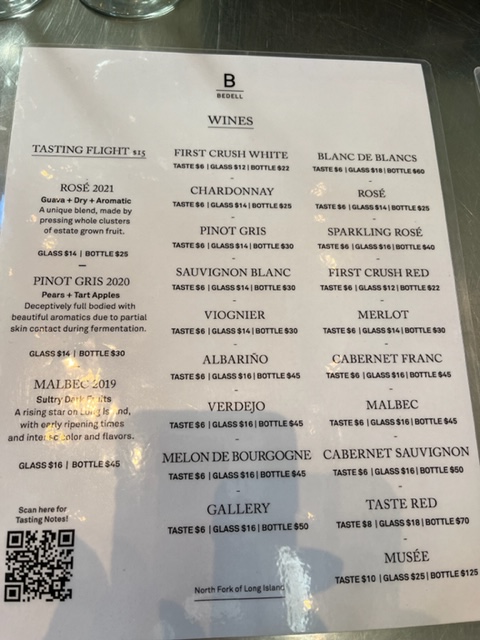
We entered the porch from the prettily landscaped parking area, and were greeted by a young man behind the bar, who provided us with menus.  Bedell offers a basic flight of three of their wines for $15, or you can assemble your own flight from their menu of 19 wines for $6-$10 per taste.  Since we wanted to compare notes, we decided to each get the basic flight (with my husband and me sharing, since I was the designated driver), with the idea of getting an additional taste of something else if we wanted it.  The server poured our three tastes, and we carried them to a corner table where the afternoon sun made a nice warm spot.  We hadn’t had lunch, so we ordered a cheese and one of the salumi and some crackers, which were brought to our table.

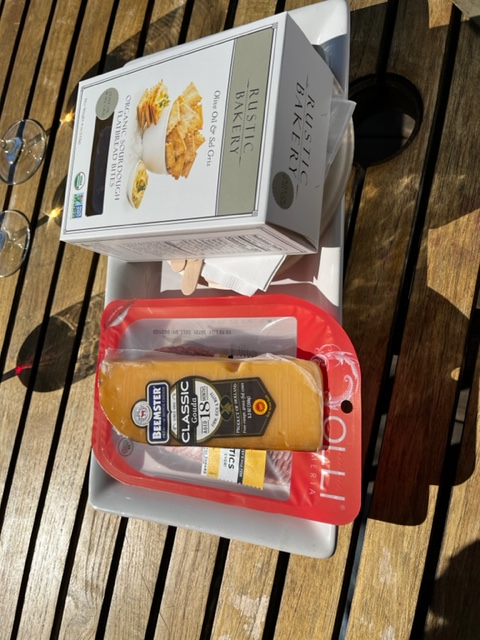
The snacks came wrapped, with plates and those little wooden knives—which were quite inadequate for slicing the cheese, a nice wedge of Beemster.  It would be helpful to get a real knife.  We also were given little wooden picks for picking up the slices of Napoli salami, which fortunately came pre-sliced.  The crackers were…inoffensive.

As we sipped and chatted and enjoyed the view, soft rock of the Beatles and Simon and Garfunkel variety played in the background.  The pour, by the way, was fairly generous, and we felt no need for more wine.

  •  2021 Rosé          $25

The weather was doing a pretty good imitation of late summer rather than early fall, so the rosé felt quite appropriate.  It has an interesting aroma of tropical fruit and minerals, with tastes of guava and minerals.  Nice, dry, and light; our friend notes it would be “nice on an August afternoon,” to sip on its own.

  • 2020 Pinot Gris                 $30

Like the rosé, this has a more interesting aroma than many wines of this variety.  I say mossy and a bit funky, and no one disagrees with me.  The taste is also more complex than many North Fork whites, with some tart Granny Smith apple taste.  We decide that it is best with food, and make some inroads on the cheese and salami.

I noticed the plastic curtains, which should make the porch usable even on not so nice days.
  • 2019 Malbec      $45

But the cheese goes best with this wine, an intense red with crushed berry taste which our friend compares to her favorite soda, Dr. Brown’s Black Cherry, except not sweet.  She starts fantasizing about drinking it with some matzo ball soup, a knish, and a pastrami sandwich.  Maybe!  It is good, though not $45 good, we agree, and I remember that one time when I wrote about Bedell I discussed the issues of price and value in wines.  They still have some very pricey wines, including Musée, at $125 per bottle.  Wow.

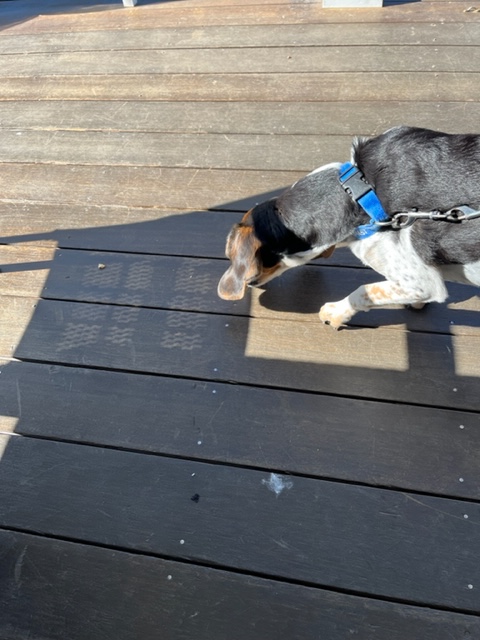
We made friends with Barney, who was focused on a crumb I had dropped.

Reasons to visit:  in warm weather, a pleasant outdoor covered porch with a view looking out over the vines; all three of the wines were good, though not good enough that we bought any; they allow dogs, at least on the porch, since as we were getting ready to leave we had a little visit with Barney; you can build your own tasting from their extensive menu of wines.

Raphael: Pretend You’re in Italy

July 15, 2022

Looking like a villa in Tuscany, the Raphael tasting room sits on the Main Road in Peconic.  A covered veranda in the back looks out onto the grape vines, and the warm weather this week made it really feel like Italy.  We drove in past the miniature villa gateposts, around the Italianate fountain, and parked in the lot.  Through heavy wooden doors that would not be out of place on a palazzo we went, entering a huge space where a disembodied voice said, “Welcome!”

The voice soon materialized into a young woman, who cheerily asked us if we wanted to sit inside or outside.  Noting that there was plenty of room to be socially distant from other tasters, we opted to sit inside at a table facing outside, where she left us with a couple of menus.

As we perused the menus, she returned with two bottles of Poland Spring water.  I no longer buy bottled water, but these would be convenient for the future.  It was lunch time, and on a previous visit we’d had very good flatbread pizzas.  However, they no longer have them (or at least, not during the week), and the menu features a selection of cheeses, crackers, hummus, etc., all a la carte (so if you want crackers with your cheese, you need to order them).  We also noticed that every tasting comes with a “snack.”  “What is that?” we asked.  “Sort of a grown-ups Lunchables,” she replied. Ah.  We decided to add a serving of hummus ($8) and tortilla chips ($10), most of which we ended up taking home, as the chips were a huge bag and the humus a 10-ounce container (very good, by the way). The snack was indeed quite mini, consisting of about four crackers and as many slices of bland cheese, plus some slices of spicy sausage. However, it did remind us of how in Italy one is often served some sort of snack with a glass of wine, like a dish of olives, or like the time in Bologna when there were three of us sharing a bottle of wine, and the waiter brought a plate of cheeses and sausages (no charge).
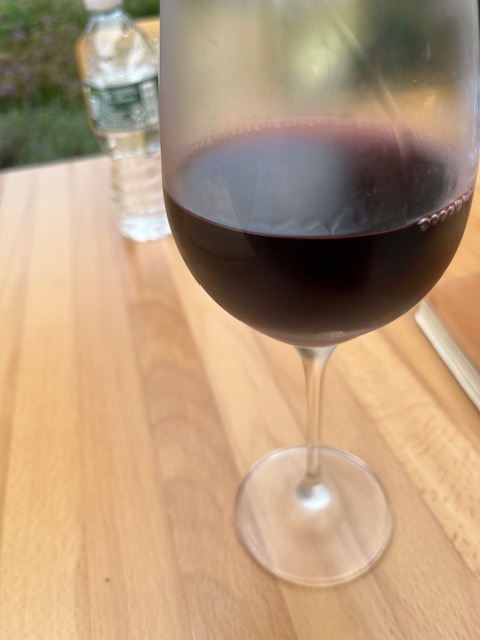
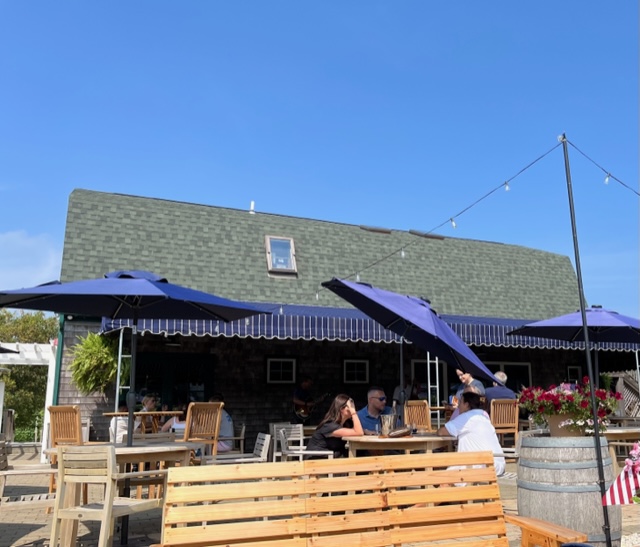
Meanwhile, we were debating over which flight to get, as they have six different options.  We could see by looking at other tables that the serving per taste is quite generous, but we wanted to try a panoply of wines, so we decided to just plan not to finish each glass, and get a flight of four whites for $25 and four reds for $25.  Both flights were brought to our table on labeled strips of paper.  Our waitress launched into her little scripted speech about each wine, enlivened by her personal preferences, with which we agreed.  For example, we had a little chat about riesling, which she noted she sometimes dislikes as too sweet, but felt the current iteration of Raphael’s riesling is one she likes.   I was a bit concerned when she described a couple of the reds as “summer reds,” and when I tasted them I saw why.

As we sat and sipped and munched and looked out at the vines, my tasting buddy said that Raphael gets an A+ for service and setting.  As to the wines…

  •  2021 Rosé of Pinot Noir               $30

Our server explained that this is a “true” rosé, made from red wine grapes treated like white grapes.  It is a pretty color, and had a pleasantly fruity aroma.  We liked the taste, too, with notes of citrus and black cherry, not too sweet, not too dry.  A good summer sipper.

The snack.
In an effort to counteract the blandness of the cheese and the spiciness of the sausage, I combined them.
  •  2021 Sauvignon Blanc                  $30

All their whites are fermented in steel, which sometimes leaves a slightly metallic aroma, which this has.  It is a touch petillant, crisp and light.  A little fruity.  Nice.

  • 2021 Pinot Grigio             $30

In France, they call this grape pinot gris.  We like this wine the best so far, with a taste of baked pears.  Not much aroma.  Good for sipping or with food, like roast chicken, or even pork chops.

  • 2021 Riesling      $30

Many rieslings have a smell described as “cat pee,” which, having had a cat in the past, I can say this one has, though faintly.  There is some sweetness here, but there is also a bit of a funkiness which takes the edge off the sweetness.  Pleasant.  Though my husband finds it too sweet for him, I think it would be fine with something spicy, like Thai food.

  • 2019 Cabernet Franc       $36

This is one of the wines she described as “summery,” and I think I know why.  It is soft and fresh and easy to drink, with slight tannins, a berry aroma, and tastes of ripe dark fruits.

  • 2019 Pinot Noir                $50

“Not a very exciting red,” opines my drinking pal, and I agree.  It’s not bad, just kind of mellow and soft.  When I tell him the price, he says, “We’re not getting it!”  He also thinks that people may not, in general, want strong reds, which would account for the popularity of a wine like this.

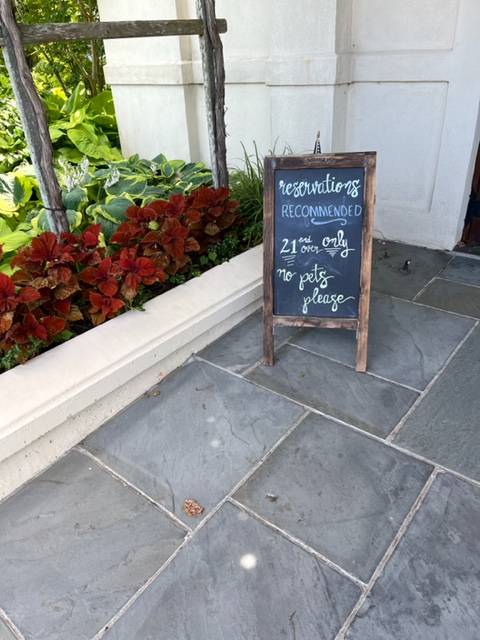
If you plan to go, check their website, and the winery is sometimes closed for private parties.
  • 2019 Estate Merlot          $30

As our waitress noted, we are in the middle of merlot country here, as that grape is “happy” on the North Fork.  This is a fairly typical North Fork merlot, with nice cherry flavor, but ultimately meh.

The Malbec.
  • 2020 Estate Malbec         $36

This is my favorite of the reds, with a beautiful dark color, yummy fruit aroma, and dark fruit tastes—though again, no tannins.  “It’s not oomphy,” says my husband, and I agree.

Reasons to visit:  beautiful building and veranda, with vineyard views; attentive service; generous pour for the flights; the whites more than the reds, though all the wines were drinkable; the Rosé of Pinot Noir, the Pinot Grigio, the Malbec; nice place to come with a couple of friends.

There’s a fairly extensive gift shop, which may be another reason to visit.