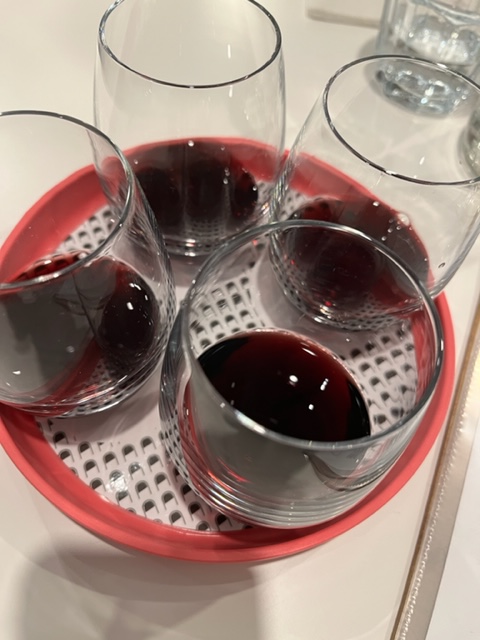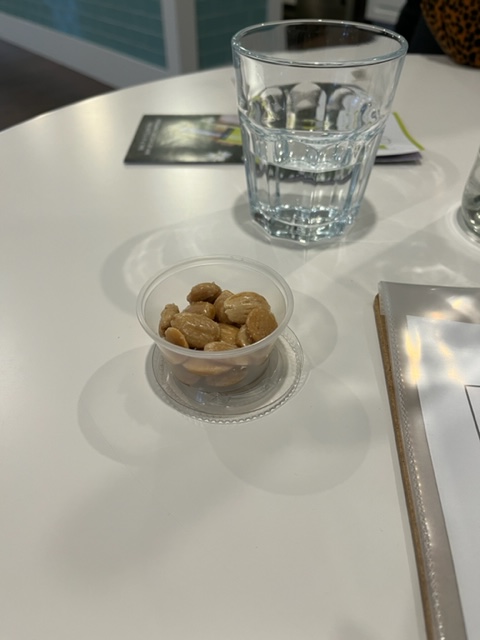
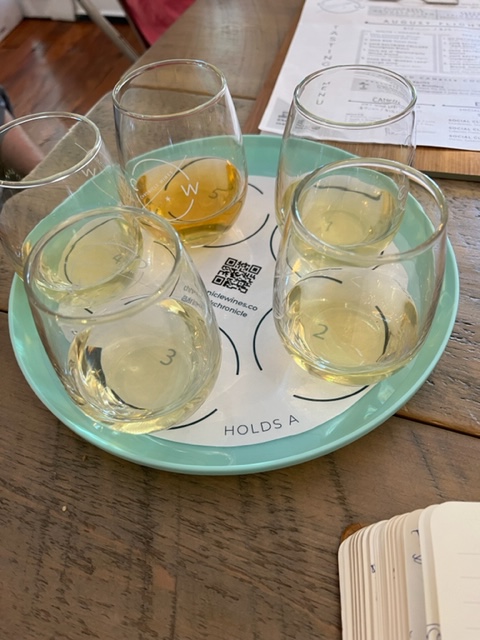
Our flight in progress. Note that every tasting comes with a little bag of oyster crackers, useful for clearing the palate between tastes.
In New Orleans, “lagniappe” refers to a little something extra, which this blog post is. I don’t usually do two blogs in such quick succession, but it was time to pick up our wine club shipment at Pellegrini, and we decided to do a quick tasting. I didn’t even bring my notebook! But as we sipped, I started to take a few sketchy notes, and before I knew it, I had decided to do a short blog post.
On this Tuesday afternoon, we had the tasting room to ourselves. We were greeted cheerily by Ryan, who was delighted to serve us. After acquiring our shipment, we circled on the tasting menu the three wines we were already buying, plus a few others that seemed of interest. When Ryan saw that I had circled the gewürztraminer, he suggested that I add a new wine, the BBQ white, which includes gewürztraminer grapes, thinking that we would like it. He was not wrong.
So here are a few notes on the wines we sampled. If you want to know more about the tasting room, check out my past posts on Pellegrini!
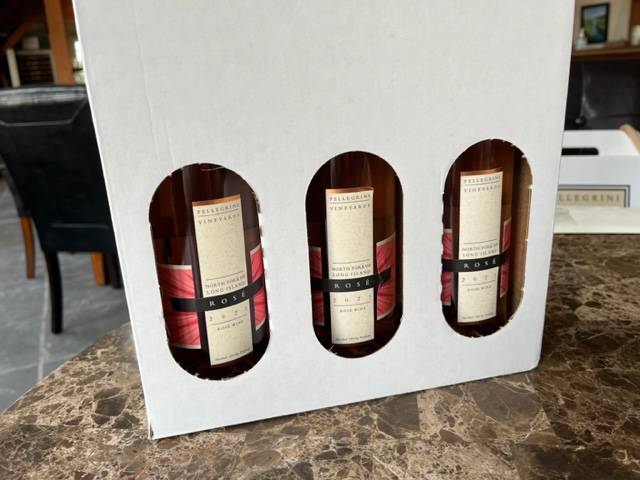
We went home with three boxes like this: our wine club selections, the roses, and North Fork Project merlot (Three bottles for $36).
2021 Rosé $24.99
I wanted a bottle of rosé to bring to a party, so I knew I wanted to try this. Plus, it’s on sale! A blend of 80% cabernet sauvignon and 20% Merlot 181 (the number refers to the merlot clone they used), this is a many-faceted rosé, and is quite tasty. We buy some for ourselves and some to give away.
2020 Gewürztraminer $24.99
I wanted to try this because it is also on sale, and we love One Woman’s gewürztraminer. This is nice, but I don’t like it as much as hers, though it is fruity and delicious. It just seems a bit one-note-ish.
2022 East End Select BBQ White $26.99
As much as I like a bargain, I also like to buy what I like, and we both like this one. It is 46% gewürztraminer and 54% stainless steel chardonnay, a winning combination. Ryan’s suggestion that we try this pans out, as we buy a bottle. Yummy, with the sweetness of the gewürztraminer tamed by the citrus of the chardonnay.
Steakhouse Red $21.99
This is their basic table red, and indeed it is a good hamburger/pasta red, light but with nice tannins and a bit of a funky aroma. “It has an edge,” says my tasting pal.
2017 Cabernet Franc $32.99
A blend of 95% cabernet franc plus 5% merlot, aged 18 months in French oak, this is a somewhat light but very pleasant red.
2015 Regalo $49.99
Regalo means gift, and this is a gifted wine, a Bordeaux-style blend of 50% petit verdot, 30% cabernet sauvignon, 15% merlot, and 5% cabernet franc. So good. Complex, with lots of varied fruit flavors. We put our wine club bottle in the cellar to age.
Reasons to visit: join the wine club! We joined for reds only, and have never regretted it. We liked all the wines we tried, but especially the BBQ White and the Regalo.
The day was gray and chilly, but we had a good time anyway.
Pindar is proud of being one of the early vineyards on the North Fork, with their vines planted over 40 years ago. I came by this bit of knowledge on a free tour and tasting at Pindar, part of an effort by a number of vineyards to attract locals to come and taste their wines. Friends of ours had noted this program and invited us to join them at Pindar, whose perks seemed the best (other places offered such bargains to locals as ten percent off bottles or two for one). Good move! We had a good time, learned a lot, and got to taste some wines we then bought and took home.
Nancy is showing us a gewurztraminer vine, one of the original ones planted at Pindar. The roots can go very deep.
Nancy, our tour guide, started us off by the vines, and then took us through all the steps of making wine, from the crush pad to the stainless steel tanks to the French oak barrels to the warehouse, and then back to the tasting room where we got to try five wines.
“Viticulture is farming for masochists,” she informed us, as she explained the work involved in pruning the vines, which she characterized as “an art and a science,” and the perils faced by grape growers. There are migrating birds who will peck at the grapes, so they look fine but then shrivel into nothing; there are hurricanes on Long Island, whose arrival coincides with harvest season; and there is the lack of crop insurance, because how can you insure for their current value vines that have been growing for over 40 years. In addition, you have to wait four years after you plant those vines before you can expect to harvest the grapes. The issue of birds has been taken care of, through an ingenious system of nets, which you can see in many vineyards, which remain furled up below the vines and are then raised when the grapes ripen. As to the other issues…not much one can do about them!
Despite these problems, Pindar has 325 acres of vines, resulting in 60 to 70,000 cases of wine every year. At first, Dr. Dan Damianos, the visionary who started Pindar (named, like one of his sons, for the classic Greek poet, in homage to their Greek heritage), planted gewürztraminer grapes, judging that the climate and soil would work well for this varietal. Now they grow twenty-four varietals, and they list twenty-nine different wines on their tasting menu, which includes a number of blends.
The bottling machine, which is about to be replaced by an even better one.
They bottle these wines with their own bottling line, which can do 3,000 a day. Not every winery has their own bottling facility, with many using Premium Wine Group for this. Nancy gave a brief lecture on the issue of corks vs. screw caps, with corks reading as “better” wines, and screw caps okay for more casual, cheaper wines. Screw caps work just fine, though corks have the advantage of being biodegradable.
I never knew why the vats have this dimpled jacket.
We then walked into a huge room filled with vast stainless steel vats, where Nancy explained something I’d always wondered about. The vats are partially encases in a dimpled steel jacket. It is a glycol jacket, containing polyglycol, used to help regulate the temperature in the vats, and the dimples keep the polyglycol from settling to the bottom. Too hot or too cold, and the wine is ruined. They use a windmill to provide about 60% of the energy needed in the warehouse and wine “cellar”—not a cellar, because…polyglycol. We also learned about another hazard of viticulture—carbon dioxide. As the juice ferments into wine, carbon dioxide rises to the top of the tanks, where the solid matter must be pushed down into the liquid. Catwalks provide access to the tops of the tanks, and open doors help dissipate the CO2.
Part of the filtration system.
She showed us their filtration system, and we learned, by the way, that Guinness Stout used isinglass, obtained from the bladders of sturgeon, to filter their brew. I like Guinness, but I also like caviar!
She also took us outside to see the crush pad, where a machine crushes the grapes. Because Pindar is so big, a lot of the work is done by machines.
The crush pad.
The huge space where red wine ages in French oak barrels smelled enticingly like a forest or lumberyard. We found out that there are different tastes imparted to wines by French and American oak, with some adding notes of vanilla and others cinnamon, etc. Pindar now uses only French oak, buying 300 barrels a year, and has phased out their American oak barrels, which they sometimes sell to breweries or to people who want to use them in their gardens. We also learn about the “angel’s share,” the wine which evaporates from the barrels, meaning they need to be constantly watched and topped up, so that too much oxygen doesn’t turn the wine into vinegar. The angels must reserve a special place in heaven for wine makers!
Despite the bung stopper, some evaporation is unavoidable.
Finally, our last stop before the tasting room, we saw the warehouse where cases of wine are stacked high. Nancy held up a four-pack of cans of Winter White, and explained that Dr. Dan, noting the American taste for soda and other sweet drinks, decided to make some sweeter wines, like Winter White, which is the most popular white on Long Island. More recently, the decision was made to offer it in cans; again, to attract those who might otherwise opt for soda or beer.
Cans of Winter White, ready to go.
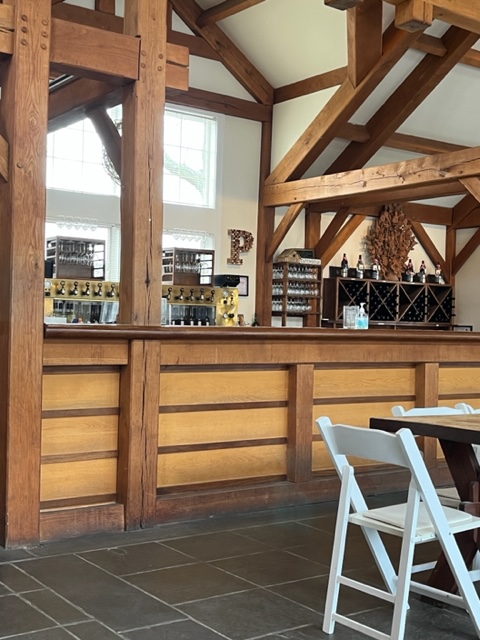
Now it was time to taste the fruits of their labor! The group of about thirty locals lined up around the bar, where glasses stood ready. Here are my tasting notes:
Nice sized pour.
2020 Dr. Dan’s Selection White Blend $24.99
Our first taste is a blend of, this vintage, of 53% viognier, plus pinot grigio, sauvignon blanc, and riesling. The percentages may vary year to year. This is a very drinkable white, with aromas of pineapple and citrus, and tropical fruit flavors like guava and pineapple.
2021 Dr. Dan’s Selection Gewürztraminer $24.99
We are quite interested to taste this, after learning the history of the vines, and we quite like it. In fact, we and our friends each buy a bottle to take home. It is not too sweet, which can happen with gewürztraminers, with an aroma of peaches and tastes that include tangerine and apricot. “Yummy,” we and our friends agree.
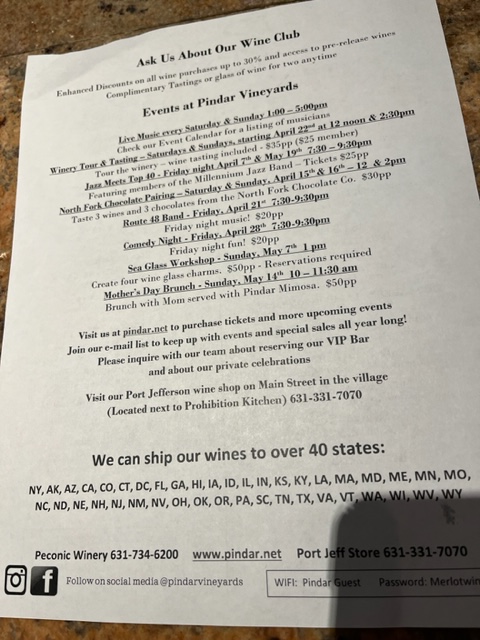
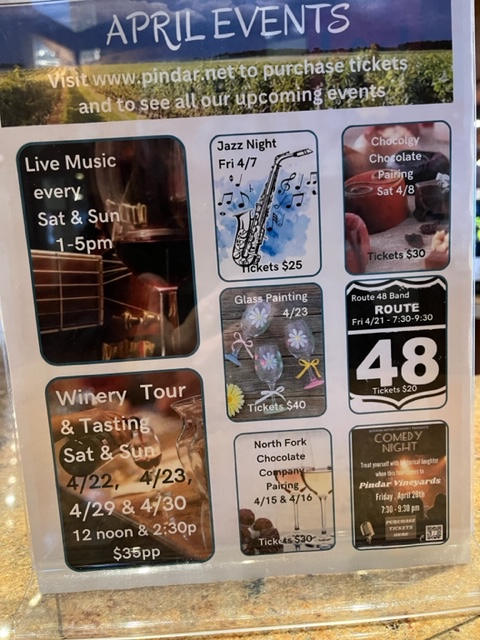
At the tasting, I turned over my menu to see the events list.
2019 Mythology $42.99
A Bordeaux blend called Meritage, this includes malbec, cabernet sauvignon, merlot, petit verdot, and cabernet franc. Delicious. Lots of dark fruit taste and enough tannins that one could probably age it.
2019 Cabernet Sauvignon Reserve $34.99
Nancy, who is still informing us about the wines, explains that cabernet sauvignon used to be harder to grow on Long Island, since it needs a longer growing season to mature. However, with climate change, the growing season on Long Island has gotten longer. I guess that’s an upside to global warming! This is another very good red, with tastes of blackberry and other fruits, and an aroma of cedar and tobacco.
Pindar Damianos chatting with a guest.
2015 Cabernet Port $28.99 for 750 ml, $16.99 for 375 ml
I’m not sure if this was in the original tasting or if it was included after our friend shared his enthusiasm for the port with Nancy and with Pindar Damianos, who was hanging around and talking to the guests. He discovered that Pindar makes award-winning port in an old issue of a wine magazine shortly after moving to the North Fork, and was happily buying and drinking it. I can see why. This is a dessert wine—in English novels, they are always sipping it after dinner while they crack walnuts and chat—but it is not too sweet, with an appealing depth of flavor. It is made 100% from cabernet franc. We each buy a bottle to take home.
Cases filled with awards Pindar wines have won.
Reasons to visit: roomy tasting room with two outside areas; a wide variety of wines for every taste, from sweet to dry, and price, from $14.99 (Winter White and others) to $42.99; all the wines we tasted—White Blend, Gewürztraminer, Mythology, and Cabernet Sauvignon Reserve—plus the port; our friends had also tasted the Gamay Noir before we went on the tour, and bought a bottle of that light red to take home; they have a refrigerated case full of cheeses, etc., to consume there; they have a variety of special events.
The day was gray and chilly, but we had a good time anyway.
Pindar is proud of being one of the early vineyards on the North Fork, with their vines planted over 40 years ago. I came by this bit of knowledge on a free tour and tasting at Pindar, part of an effort by a number of vineyards to attract locals to come and taste their wines. Friends of ours had noted this program and invited us to join them at Pindar, whose perks seemed the best (other places offered such bargains to locals as ten percent off bottles or two for one). Good move! We had a good time, learned a lot, and got to taste some wines we then bought and took home.
Nancy is showing us a gewurztraminer vine, one of the original ones planted at Pindar. The roots can go very deep.
Nancy, our tour guide, started us off by the vines, and then took us through all the steps of making wine, from the crush pad to the stainless steel tanks to the French oak barrels to the warehouse, and then back to the tasting room where we got to try five wines.
“Viticulture is farming for masochists,” she informed us, as she explained the work involved in pruning the vines, which she characterized as “an art and a science,” and the perils faced by grape growers. There are migrating birds who will peck at the grapes, so they look fine but then shrivel into nothing; there are hurricanes on Long Island, whose arrival coincides with harvest season; and there is the lack of crop insurance, because how can you insure for their current value vines that have been growing for over 40 years. In addition, you have to wait four years after you plant those vines before you can expect to harvest the grapes. The issue of birds has been taken care of, through an ingenious system of nets, which you can see in many vineyards, which remain furled up below the vines and are then raised when the grapes ripen. As to the other issues…not much one can do about them!
Despite these problems, Pindar has 325 acres of vines, resulting in 60 to 70,000 cases of wine every year. At first, Dr. Dan Damianos, the visionary who started Pindar (named, like one of his sons, for the classic Greek poet, in homage to their Greek heritage), planted gewürztraminer grapes, judging that the climate and soil would work well for this varietal. Now they grow twenty-four varietals, and they list twenty-nine different wines on their tasting menu, which includes a number of blends.
The bottling machine, which is about to be replaced by an even better one.
They bottle these wines with their own bottling line, which can do 3,000 a day. Not every winery has their own bottling facility, with many using Premium Wine Group for this. Nancy gave a brief lecture on the issue of corks vs. screw caps, with corks reading as “better” wines, and screw caps okay for more casual, cheaper wines. Screw caps work just fine, though corks have the advantage of being biodegradable.
I never knew why the vats have this dimpled jacket.
We then walked into a huge room filled with vast stainless steel vats, where Nancy explained something I’d always wondered about. The vats are partially encases in a dimpled steel jacket. It is a glycol jacket, containing polyglycol, used to help regulate the temperature in the vats, and the dimples keep the polyglycol from settling to the bottom. Too hot or too cold, and the wine is ruined. They use a windmill to provide about 60% of the energy needed in the warehouse and wine “cellar”—not a cellar, because…polyglycol. We also learned about another hazard of viticulture—carbon dioxide. As the juice ferments into wine, carbon dioxide rises to the top of the tanks, where the solid matter must be pushed down into the liquid. Catwalks provide access to the tops of the tanks, and open doors help dissipate the CO2.
Part of the filtration system.
She showed us their filtration system, and we learned, by the way, that Guinness Stout used isinglass, obtained from the bladders of sturgeon, to filter their brew. I like Guinness, but I also like caviar!
She also took us outside to see the crush pad, where a machine crushes the grapes. Because Pindar is so big, a lot of the work is done by machines.
The crush pad.
The huge space where red wine ages in French oak barrels smelled enticingly like a forest or lumberyard. We found out that there are different tastes imparted to wines by French and American oak, with some adding notes of vanilla and others cinnamon, etc. Pindar now uses only French oak, buying 300 barrels a year, and has phased out their American oak barrels, which they sometimes sell to breweries or to people who want to use them in their gardens. We also learn about the “angel’s share,” the wine which evaporates from the barrels, meaning they need to be constantly watched and topped up, so that too much oxygen doesn’t turn the wine into vinegar. The angels must reserve a special place in heaven for wine makers!
Despite the bung stopper, some evaporation is unavoidable.
Finally, our last stop before the tasting room, we saw the warehouse where cases of wine are stacked high. Nancy held up a four-pack of cans of Winter White, and explained that Dr. Dan, noting the American taste for soda and other sweet drinks, decided to make some sweeter wines, like Winter White, which is the most popular white on Long Island. More recently, the decision was made to offer it in cans; again, to attract those who might otherwise opt for soda or beer.
Cans of Winter White, ready to go.
Now it was time to taste the fruits of their labor! The group of about thirty locals lined up around the bar, where glasses stood ready. Here are my tasting notes:
Nice sized pour.
2020 Dr. Dan’s Selection White Blend $24.99
Our first taste is a blend of, this vintage, of 53% viognier, plus pinot grigio, sauvignon blanc, and riesling. The percentages may vary year to year. This is a very drinkable white, with aromas of pineapple and citrus, and tropical fruit flavors like guava and pineapple.
2021 Dr. Dan’s Selection Gewürztraminer $24.99
We are quite interested to taste this, after learning the history of the vines, and we quite like it. In fact, we and our friends each buy a bottle to take home. It is not too sweet, which can happen with gewürztraminers, with an aroma of peaches and tastes that include tangerine and apricot. “Yummy,” we and our friends agree.
At the tasting, I turned over my menu to see the events list.
2019 Mythology $42.99
A Bordeaux blend called Meritage, this includes malbec, cabernet sauvignon, merlot, petit verdot, and cabernet franc. Delicious. Lots of dark fruit taste and enough tannins that one could probably age it.
2019 Cabernet Sauvignon Reserve $34.99
Nancy, who is still informing us about the wines, explains that cabernet sauvignon used to be harder to grow on Long Island, since it needs a longer growing season to mature. However, with climate change, the growing season on Long Island has gotten longer. I guess that’s an upside to global warming! This is another very good red, with tastes of blackberry and other fruits, and an aroma of cedar and tobacco.
Pindar Damianos chatting with a guest.
2015 Cabernet Port $28.99 for 750 ml, $16.99 for 375 ml
I’m not sure if this was in the original tasting or if it was included after our friend shared his enthusiasm for the port with Nancy and with Pindar Damianos, who was hanging around and talking to the guests. He discovered that Pindar makes award-winning port in an old issue of a wine magazine shortly after moving to the North Fork, and was happily buying and drinking it. I can see why. This is a dessert wine—in English novels, they are always sipping it after dinner while they crack walnuts and chat—but it is not too sweet, with an appealing depth of flavor. It is made 100% from cabernet franc. We each buy a bottle to take home.
Cases filled with awards Pindar wines have won.
Reasons to visit: roomy tasting room with two outside areas; a wide variety of wines for every taste, from sweet to dry, and price, from $14.99 (Winter White and others) to $42.99; all the wines we tasted—White Blend, Gewürztraminer, Mythology, and Cabernet Sauvignon Reserve—plus the port; our friends had also tasted the Gamay Noir before we went on the tour, and bought a bottle of that light red to take home; they have a refrigerated case full of cheeses, etc., to consume there; they have a variety of special events.
Perhaps because everyone else was elsewhere drinking green beer, we had the tasting room to ourselves.
No St. Patrick Day parades for us and our friends; instead, we were off to do a wine tasting at Pellegrini, where we are members of the wine club. Many wineries offer clubs, with varying perks and policies. We have only opted for two: Pellegrini and Channing Daughters. Both of them offer special prices for their wines, quarterly releases of wines for club members, special events, and free tastings. Our friends are members of some wine clubs, but not Pellegrini, so they were curious about what would be on offer.
Unlike more and more local wineries, Pellegrini does not offer much in the way of snacks (You can buy NOFO potato chips.), though a little bag of oyster crackers comes with each tasting. However, the advantage is you can bring your own snacks, and I offered to supply some. Well, I got a bit carried away, but we all enjoyed the cheese, crackers, prosciutto, and Marcona almonds from Village Cheese Shop and the charcuterie from 8 Hands Farm. Since I brought a nice slab of 8 Hands pâté, I felt obliged to also pack Dijon mustard and cornichons. To continue the theme of local goodies, I also opened a bag of North Fork potato chips. Lunch accomplished!
Most of the goodies I brought, including a little jar of truffled honey. The cheeses are an aged gouda, Village Cheese Shop’s homemade truffled brie (So good!), and Humboldt Fog.
We had so much fun eating and talking that my wine notes are a bit sketchy, but I will say we all liked every taste, though to different degrees. We got four tastings, of four wines each, with some overlap. The tasting room felt like our own private space, since the only party that entered quickly decided to sit up in the little balcony. I also recommended that our friends try the North Fork Project Merlot, a bargain at three one liter bottles for $30, which we both bought before we left, sated and happy.
In no particular order (though our lovely server Kasey carefully informed us of the recommended order of tastes for each flight), here are the wines I took at least a note or two on, some based on the flights my husband and I got, and others on the flights our friends chose.
This flight includes the ice wine, the almost orange wine on the right.
2020 Stainless Steel Chardonnay $22.99
This was my first taste, and I quite enjoyed it. In the car on the way to the winery we had discussed the merits of steel vs. oaked chardonnays, with one friend very much preferring oaked, and me…not. As they say, in wine there are no wrong answers. This is a light, fruity, minerally wine, with tastes of pear and apple.
2019 Vintner’s Pride Chardonnay $34.99
Our friend ordered this, and characterized it as smooth and buttery, but not overly oaky—the latter a term he actually refuses to use, since he denies tasting oak in any oaked chard. This one is aged 100% in French oak puncheons for 18 months, and for contrast his wife ordered the next chard on this list.
2019 Pellegrini Vineyards Chardonnay $24.99
Not that different from the VP chard, opined our friend, though this one is aged 90% in oak barrels and 10% in stainless steel, 9 months in French oak puncheons. Is stainless steel chardonnay a plot by wine makers to make less expensive wine they can sell for a higher price, or is it a way to accommodate differing tastes? The world may never know…
2021 Pellegrini Vineyards Rosé $24.99
If you like a very light, almost tasteless rosé, this is the rosé for you. I continue to prefer Croteaux rosés.
2017 PV Cabernet Franc $32.99
Although this is simply called cab franc, it is actually a blend: 85% cab franc, 4% cab sauvignon, 8% merlot, and 2% petit verdot. In any event, it is a rather light red—Kasey had recommended we drink this before the other reds—with some cherry and spice flavors. Our friend thinks one might even serve this lightly chilled, like in the summer. It goes well with the charcuterie.
PV Steakhouse Red $21.99
One feature of Pellegrini we like is that they have some reds that are not too pricy yet drink very well, and this is one of them. A blend of 72% cabernet sauvignon and 28% merlot, this has a nice minerality with soft tannins and some dark fruit tastes, and would, indeed, go well with a steak.
2017 Merlot $32.99
Another blend, this is 85% merlot, plus 10% cabernet sauvignon and 5% petit verdot, though it basically tastes like a merlot. It’s fine, but I actually prefer the—much cheaper—North Fork Project Merlot. This, however, could be characterized as more sophisticated.
2020 PV Gewürztraminer $24.99
My recollection from past tastings is that the gewürztraminer is not overly sweet, and our amiga confirms that this is so. Easy to drink.
2018 Cabernet Sauvignon $24.99
Our friend likes this blend of 94% cabernet sauvignon, 4% merlot, and 2% cabernet franc better than the merlot.
2015 Regalo $49.99
Pricey, but really good, is my verdict on this wine, which is the last in my tasting. Regalo means gift, and this is a gift reserved for wine club members. A blend of 50% petit verdot, 30% cabernet sauvignon, 15% merlot, and 5% cabernet franc, this is a complex, delicious wine, with lots of blackberry, plum, and other dark fruit flavors and aromas.
2021 East End Select BBQ Red $26.99
Although this doesn’t have a varietal designation, this iteration of their steel-fermented red is 100% petit verdot. I have a sip, as it is in my husband’s tasting, and note that it has more sweetness than, say, the Steakhouse Red. I guess it would go well with ribs or pulled pork, though my wine of choice with barbeque (like from Meats Meat) is beer.
Finale Ice Wine $39.99 (375 ml)
Time for dessert! A blend of gewürztraminer and sauvignon blanc, ice wine is made by freezing and then pressing the grapes, resulting in a sweet taste. The vineyard web site notes it pairs well with nuts, so I am glad I provided Marcona almonds for our friend. She likes it, and compares it to savoring one’s platonic ideal of a fruity sucking candy, with some notes of honey.
I love the comfy chairs!
Reasons to visit: pleasant tasting room where buses and limos are verboten; you can bring your own snacks; dogs are allowed; the comfy chairs are conducive to lingering; with fourteen wines to choose from (twelve of which I’ve mentioned), there are wines for every taste; my favorites are the steel chardonnay, the Steakhouse Red, and Regalo; one friend likes the gewürztraminer and the ice wine, the other the VP chardonnay and the cabernet sauvignon, plus the North Fork Project Merlot.
The last time we were at Chronicle Wines—back in 2019, when it was still called Peconic Cellar Door—the five-year-old daughter of one of the owners put in an appearance with her nanny, so it seemed like a good place to visit with a couple of granddaughters in tow. And indeed it was.
The bar is a holdover from the Winemaker’s Studio.
Since our pre-Covid visit, Chronicle, helmed by Robin Epperson-McCarthy and Alie Shaper (both of whom were in the tasting room when we arrived, and gave us a warm welcome), has expanded into the next-door shop-front space previously occupied by Anthony Nappa’s Winemaker’s Studio. Alie assured us that Anthony, who is the winemaker for Raphael, is still very much in the winemaking business, and continues to runs his wine club for the wines he makes separate from Raphael. This new room is outfitted more like a lounge, with cushioned seats and small tables, plus the bar, while their original space has bigger tables. Since there were six in our party (counting the two youngsters) we opted for the big table, promising Robin that we would ignore the stacked boxes of a recent delivery—which they soon began putting away.
The lounge area.
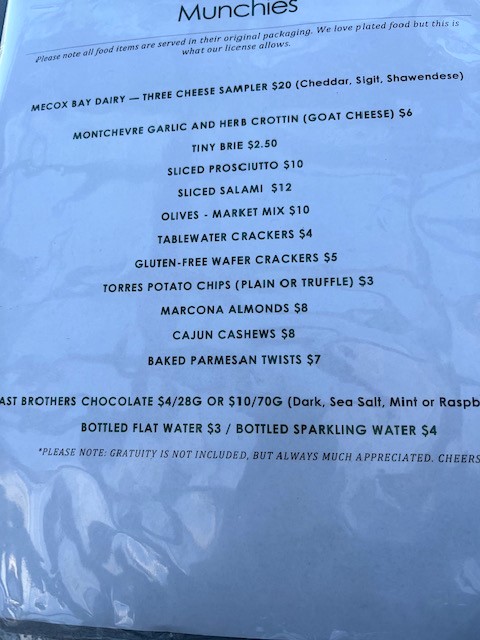
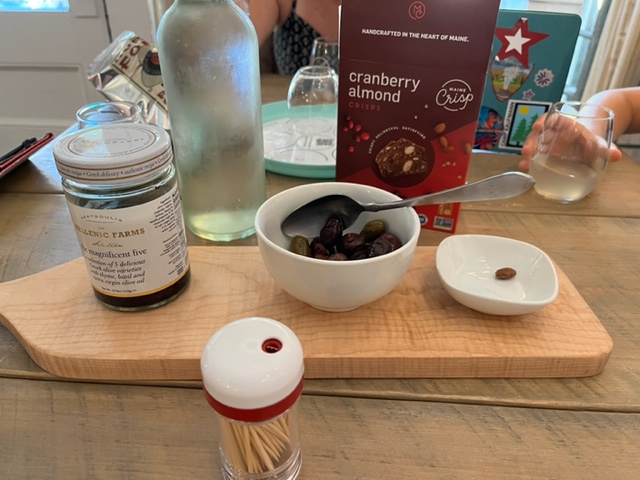
The tasting menu offers two options, a white and orange flight of five wines for $25, or a red and rosé flight of five tastes, also $25. Since we wanted to try the full panoply of their wines, we decided to share one of each flight amongst the four of us, which turned out to work beautifully. Alie brought to our table a chilled bottle of water plus a tray of empty glasses so we could share the wines without sharing a glass. We also ordered a few snacks for the girls and ourselves—a box of cranberry almond crisps, a bag of North Fork potato chips, and a jar of olives—plus lemonades for the girls, and settled in.
Snacks!
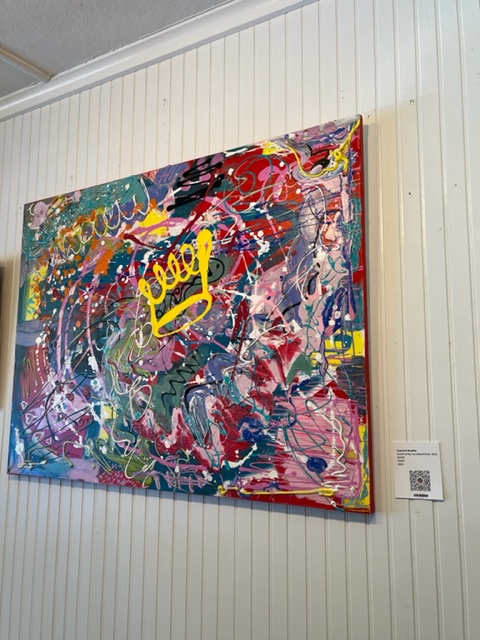
While we waited for our flights to arrive, we examined the art on the walls, as Alie and Robin make a point of featuring local artists. Today’s paintings are by Cherryl K. Bradley. The granddaughters were quick to observe that “Queen of the Scrambled Brain” contained both a crown and some hearts, and wondered whether it showed the state of mind of someone who had difficulty with love.
The Queen of the Scrambled BrainFollow the Sun
Both Robin and Alie stopped by our table from time to time to see if we had any questions and make sure we had everything we needed. Although they work together, they each have their own brands of wines: As If, Brooklyn Oenology (BOE), Chronicle, Haywater Cove, and Saltbird Cellars. The tasting included some from each brand.
2024 Chronicle Chardonnay Pét-Nat $30
Sparkling wines are always a nice way to start a tasting, as they get one in a celebratory mood. This one was no exception, having a pleasantly yeasty aroma, nice carbonation, and a taste we discussed as either lemon verbena or lemon pie. One of our guests pronounced it “lively.”
2018 BOE Pinot Gris $15 (on sale)
Even though this one is on sale, we opted not to buy any, since we found it both thin and earthy, if that makes sense. I sensed a bit of a metallic taste, or maybe minerality would be a better term.
2019 Saltbird Cellar Sauvignon Blanc $25
We sensed an aroma of lemon and green apple, and one guest opined that “it has some sort of fruit taste, but not sure which.” We laughed over our shared tendency to guess gooseberry, though none of us is quite sure what a gooseberry tastes like. This might go nicely with some gravlax.
2014 As If Serendipity White Blend $15
Our favorite of the whites, this is a blend of chardonnay, sauvignon blanc, and viognier, lightly oaked. It has more body than the others, with a “nice roundness,” according to one guest, and a thyme honey taste, while still being tart. We each buy a bottle.
2020 BOE “Broken Land” orange wine $30
You may be wondering about how the granddaughters—ages eleven and eight—are occupying themselves as we sit and sip. They have their Kindles to read and snacks to munch, but they are also taking an interest in our discussions. They sniff the wines appreciatively, and agree or disagree with our descriptions of the aromas. Dad asks the eight-year-old, who, with her sister, has been helping him with some amateur basement winemaking, if she knows what an orange wine is. She confidently and immediately replies, “It’s a wine made with white wine grapes, fermented on the skins.” Overhearing this, Alie notes that if she were eighteen she’d hire her on the spot. Meanwhile, we sip this blend of gewürztraminer, sauvignon blanc, and pinot gris, and decide we like its aroma of orange blossoms or honeysuckle better than its flavor, which is a bit thin for us.
NV Haywater Cove Rosé $15
Rosé makes a nice transition from whites to reds, since it is made from red wine grapes, but fermented with minimal skin contact. This one is a blend of merlot and cabernet franc, and is very much in the Provençal tradition of light, dry rosés. We note that it is a good wine for hot weather, and could see drinking a nice chilled glass of this on the porch. My tasting buddy likes its strawberry aroma and flavor.
2019 Saltbird Cellars “Red Skies” $30
Though we find this blend of syrah and cabernet sauvignon pleasant, we don’t feel it is a $30 bottle. The aroma is earthy, and the wine is light, with tastes of raisins and grapefruit peel.
2020 Saltbird Cellars Merlot $27
The aroma has a slight whiff of basement, and the wine is very dry and light, with a touch of cherry flavor. One of us suggests it would go well with roast chicken, to which I reply, “What doesn’t?” We have some difference of opinion over this one, which one guest pronounces sophisticated, but which I find unimpressive.
2017 Saltbird Cellars “Harbinger” $36
When a wine has a non-varietal name, that often means it is a blend, which this is: merlot, cabernet sauvignon, and petit verdot. The night before, we bought steaks at Center Cuts and cooked them on the barbeque, so we were wondering whether any of the reds we tasted today would stand up to such steaks. This one would not. It has some cherry and dark fruit taste, but is again rather light, though one guest notes it has “chewy tannins.”
2013 Chronicle Wines Red Blend, limited edition $40 (? Not sure)
Yummy aroma of dried fruits, delicious taste. And yes, this wine could stand up to a big steak. It has lots of dark fruit flavor, is dry, with a nice mouth feel. This is a Bordeaux blend of merlot, cabernet sauvignon, malbec, syrah, and petit verdot. We both buy a bottle.
Reasons to visit: Alie and Robin are eager to please, and will tell you all about their wines; pleasant small tasting room; the Pét-Nat, the As If Serendipity white blend, the Haywater Cove Rosé, and the Chronicle Red Blend; if you are interested in such things, they also sell canned wines and spritzers; dogs allowed outside.
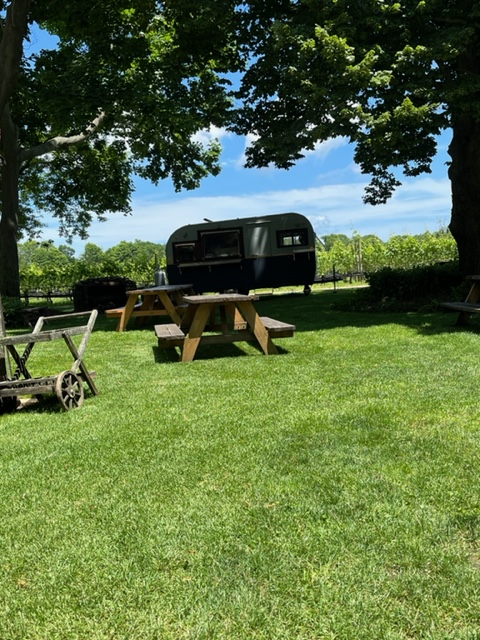
If you check out the McCall wines web site and scroll down to the bottom of the shop page, you’ll see something unusual: ground beef, $15. Huh? Yes, the McCalls raise Charolais cattle and sell the grass-fed beef, some of which can be found in the winery shop. You might also spot the white cows in one of their fields as you drive along the Main Road. As I was paying our bill after our tasting, Mrs. McCall urged us to come back on a Thursday or Friday, from 4-8, when they serve burgers made from their beef. If I do, I’ll post about it! And I already know which wine I’ll get a glass of to go with that burger: Ben’s Blend.
The outdoor setting is quite pleasant.
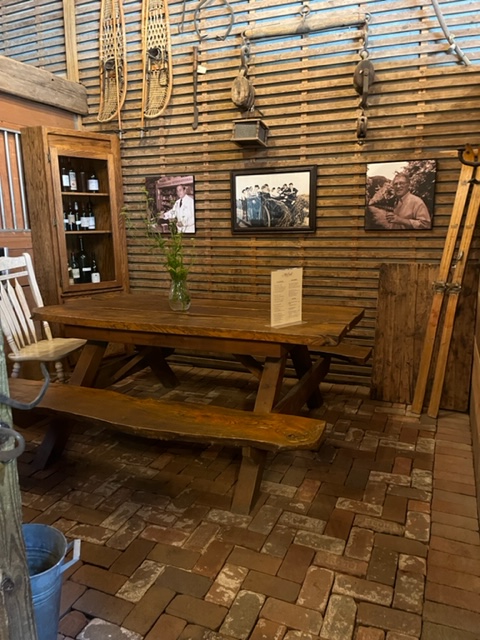
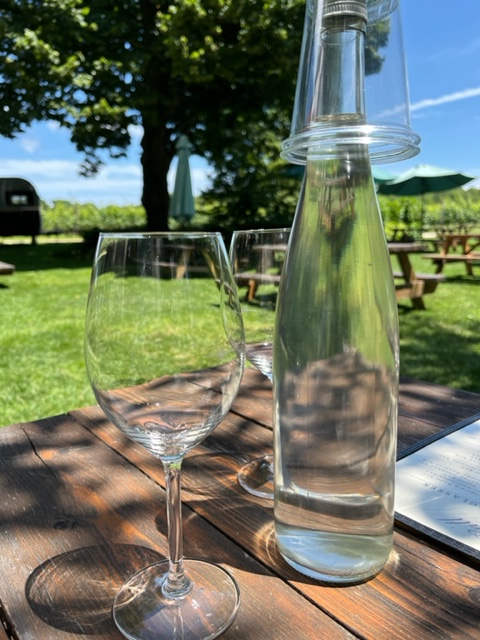
The turn-off to the McCall winery is rather subtle, and easy to miss, but it is basically across the street from Pellegrini. You drive around back to a grassy parking area, where you see a lawn dotted with picnic tables and a rustic barn. Inside, there’s a new bar, which wasn’t there the last time we came in 2018, and a couple of stalls with cozy seating areas. Since it was a beautiful day, we opted to sit outside, and Mrs. McCall supplied us with menus. In a few minutes, a server came by with glasses and a bottle of water, a nice touch.
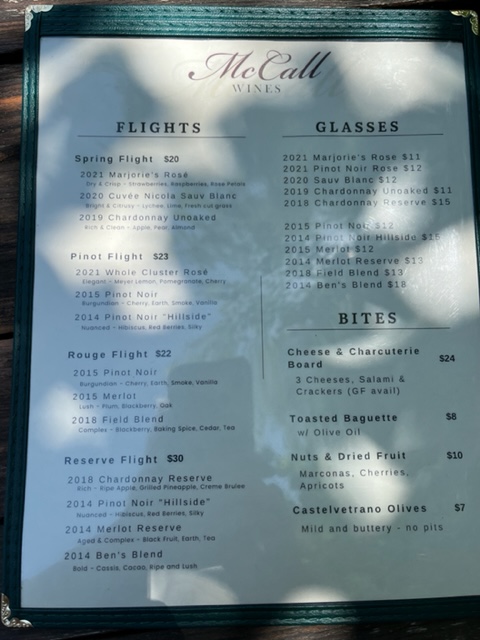
They have a fairly typical small menu of snacks, but we’d just had lunch, so we didn’t get anything. The rest of the menu listed four different flights, of three or four wines each, so we decided to share two flights, so we could try a range of their wines. Then we realized that there was some overlap, in that if we got the pinot flight ($23) and the reserve flight ($30), both included the “Hillside” pinot noir. Could we sub in the estate merlot instead? Sure. And the reserve flight includes a chardonnay aged in oak. Hmmm. A discussion ensued, in which we were assured that the chardonnay is “lightly oaked.” I really do not like those buttery, California-style oaked chards, so we shall see.
We enjoyed the dappled shade of the trees, but that might make this a bit hard to read!
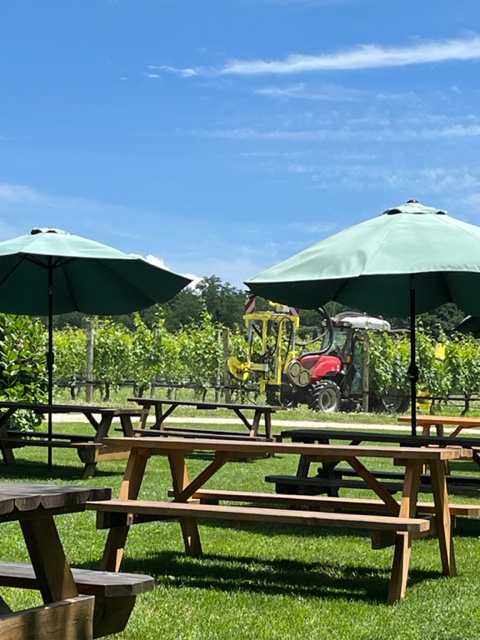
Service is friendly and informative, and we chatted with one server about how they fared during the pandemic, since we had not been there since before it. “We were busier than ever,” she informed us. People just were grateful to have someplace to go, and were very respectful, masking if they got up from their tables, for example. She noted that the outside tables are well-spaced. The view is bucolic, as you look out onto the grape vines—though the sense of country peace was temporarily marred as a trimming machine was going up and down the rows. Fortunately, it finished well before we did.
The noisy machine…well. it is a working farm.
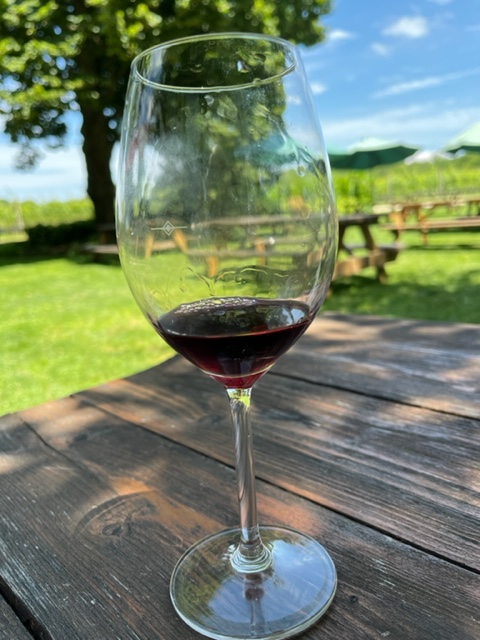
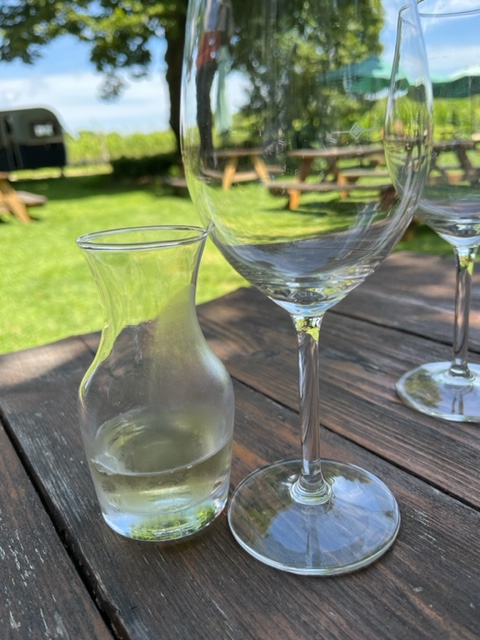
Overall, my husband commented, the place got plus marks for setting, but he was not overly impressed with the wines, which we found drinkable but not special. We did like the way the wines were served, especially since we were sharing the flights. We each got a wine glass, and then the tastes were brought to the table in little carafes, set down in the order in which they should be tasted.
Pinot Flight:
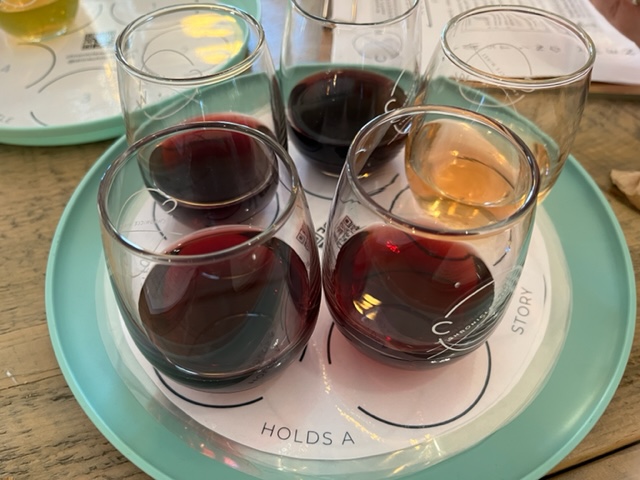
Our first flight.
2021 Whole Cluster Rosé $24
“Better than average,” opined my tasting buddy, as we sipped. This has lots of strawberry aroma, though the taste is more lemony and tart than some rosés. It definitely has some character. I said it was mouth-watering. Made from pinot noir grapes.
The warm day made our carafe of water quite welcome. We also used it to rinse our glasses between tastes.
2015 Pinot Noir Estate $30
This one had almost no aroma, and the taste was also somewhat thin. Very dry. I got some blackberry or sour cherry flavor. My husband said it was “simple, not sophisticated.” I think it would be fine with food, but it’s not a sipper.
2014 Pinot Noir “Hillside” $59
“Hillside” refers to the fact that this pinot is from a different area of the vineyard, with somewhat different terroir. We like it better than the previous one, as there is more body to it. The menu says “hibiscus,” but since I don’t know what that smells or tastes like, I can’t say if that’s accurate. I do get some berry taste, and it is very dry.
Reserve Flight:
Our second flight, after we had poured the chardonnay back into the carafe and poured the merlot.
2018 Chardonnay Reserve $39
As I feared, we do not care for this. It smells and tastes very strongly of pineapple, and is too sweet for us. It does have a pretty golden color. We pour our tastes back into the carafe.
2015 Merlot Estate $24
This is our replacement for the Hillside pinot, and we like it better. It’s a fairly typical North Fork merlot, with cherry aroma and taste, dry, with some tannins.
This is about half of what was in the carafe.
2014 Merlot Reserve $30
I always find it instructional to taste various iterations of the same grape, especially from the same winery. This merlot is “more interesting,” according to my tasting pal, with aromas of cherry, leather, and tobacco. It has lots of tannins, and we discuss that it is the opposite of “fruit forward.” Fruit backward?
2014 Ben’s Blend $58
Named for their original winemaker, who sadly died too young, this is their Bordeaux blend, a mix of 30% each cabernet franc, pinot noir, and merlot, plus 10% petit verdot. We like it the best of the day, appreciating its aromas of berries, leather, and tobacco, plus some nice blackberry fruit tastes. It definitely needs food, however.
Our “extra” taste of the chardonnay, thoughtfully served with clean glasses.
Extra! Mrs. McCall stops by our table and sees the almost full carafe of chardonnay. You haven’t tried the chardonnay yet? She asks. No, we tell her, we tried it and didn’t care for it. “Would you like to try our unoaked chardonnay?” she asks. Sure! So she brings over a carafe of it. We like it much better. It is crisp and refreshing, with tastes of citrus and green apple, and we buy two bottles, at $20 each.
Reasons to visit: pleasant outdoor setting with a backdrop of the vines; cozy interior; they allow dogs, but call first to be sure there aren’t any other canine visitors; the Whole Cluster Rosé, the Unoaked Chardonnay, Ben’s Blend; no outside food Friday, Saturday, Sunday, so I assume it’s okay during the week; lovely service; Thursday and Friday burger nights, and you can buy the beef.
The trailer from which they serve burgers on Thursdays and Fridays.
You can enter through this archway or, if you’re feeling claustrophobic, go around it.
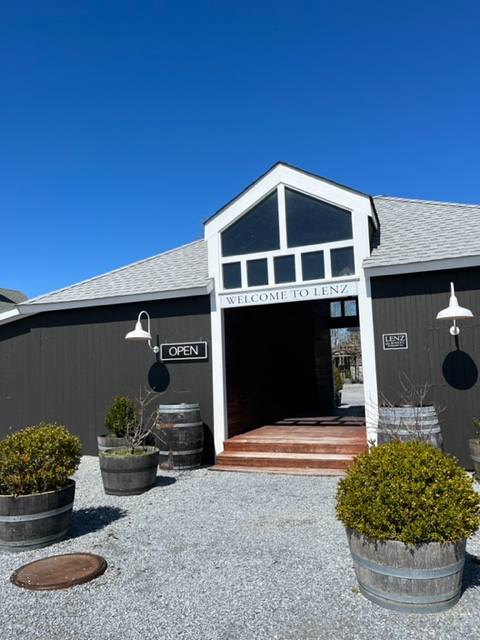
After days of rain, the sun came out and we decided to do our walk in Greenport, strolling up and down Front and Main Streets. As we did, we noted the crop of newer restaurants we had not yet tried, and vowed to return if the pandemic allows. On the way home, we stopped in to Lenz to do a tasting, and were glad we did. Founded in 1978, Lenz is the second oldest winery on the North Fork, and both the tasting room and the wines are classic.
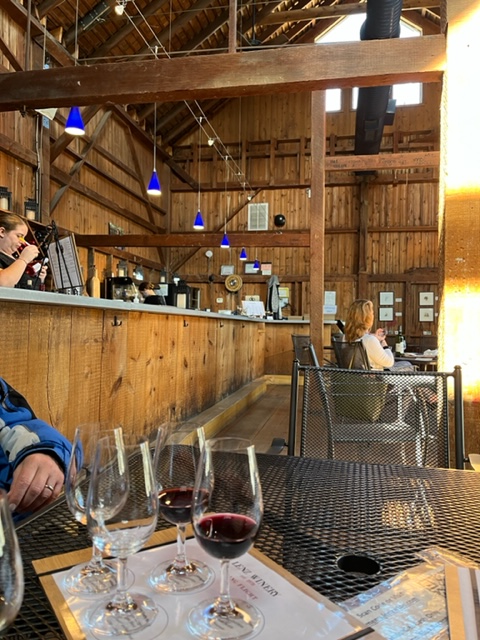
The room has the barn-like country vibe of many North Fork tasting rooms, with several tables, plus a bunch of picnic tables in the outside courtyard. Though it felt too chilly to us to sit outside, there was one couple out there, sharing a bottle of wine and some cheese and crackers. Inside, two groups talked quietly as they sipped their wines. The wines are, for the most part, good representatives of the local terroir. We liked several of them in particular.
Tastings used to be primarily stand-up, at the bar, but now they show you to a table. Lenz used to allow outside food, but now they have a menu of real foods, in addition to cheese and charcuterie items. We were not hungry, but some of the sandwiches sounded good. I almost went with the tasting menu of chocolates paired with wines…maybe next time.
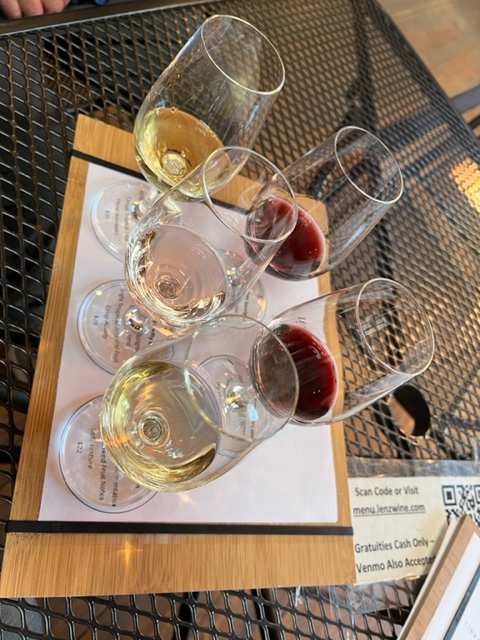
The tasting menu offers four options: the Library Flight, of their most expensive wines, one taste for $20; the Spring Flight, of a variety of wines, five tastes for $25; the Grand Flight, of some of their higher end wines, five tastes for $30; and the aforementioned Chocolate Pairing, of five wines paired with five chocolates, for $35. We decided to share the Spring Flight, as it seemed to promise the most variety and wines we might buy. Our flight arrived on a well-labeled tray, and our server gave us her well-practiced spiel about the wines.
2016 Estate Selection Gewürztraminer $20
Right from the first sniff, I loved the delicate floral aroma of this wine—orange flowers? The taste is also delicious, not at all sweet but full of fruit flavor. A few weeks ago, I had a guava, a flavor I found here, as well as perhaps a touch of nutmeg. We liked it so much, we bought a bottle.
2020 Firefly Rosé $20
A blend of cabernet sauvignon and malbec, this is a really luscious rosé, with ripe melon and citrus flavors, dry. The aroma is so faint, I likened it to driving past a strawberry field with the windows open.
Another area of the tasting room.
2016 Estate Select Chardonnay $22
Our server went into some detail in her introduction to this wine, telling us how it is made from grapes half fermented in steel and half in medium French oak, and asserting it is her favorite white. I disagree. It has some pineapple taste, which is fine, but also something else I find unpleasant, sort of a chemical or metallic note. I also don’t like the smell, which reminds me of plastics. My tasting buddy thinks it is fine. Chacun à son goût…
2017 Cabernet Sauvignon $25
Well, this is pleasanter. I smell red lollipop, though my husband says, not that sweet. Our server noted that this is her go-to red to bring to parties, and I can see why. It is a soft, very unchallenging red, with fruity flavors of red plum and berries. It would be fine to sip on its own, but would not stand up to steak. A crowd pleaser.
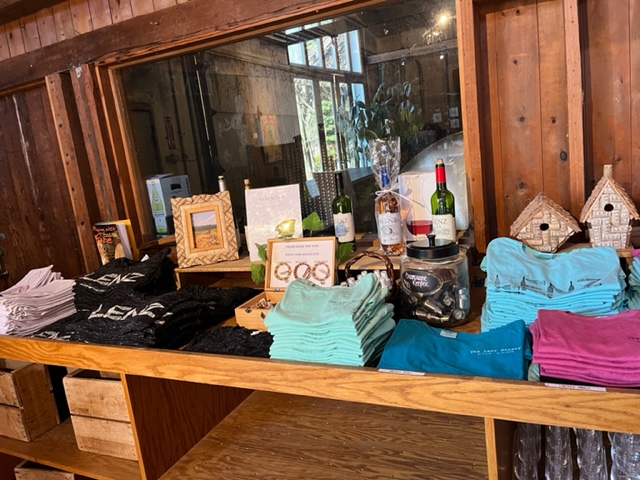
There’s a small selection of gift items, primarily t-shirts.
2015 Estate Selection Select Merlot $35
Although this is called a merlot, it is blended with some cabernet franc and petit verdot, which gives it more depth and complexity than a simple merlot. It has some tannins, and I can taste the oak and some fruit. Nice.
The courtyard will be a good place for tasting when the weather gets warmer.
Reasons to visit: a classic old-school vineyard, with solid wines and no glitz; the gewürztraminer, the rosé, and the merlot; the cabernet sauvignon if you like soft, simple reds; reasonable prices but also some VERY high-end wines (as in $130 per bottle); nice menu of cheeses and also sandwiches. Note: my husband says the restroom is very small.
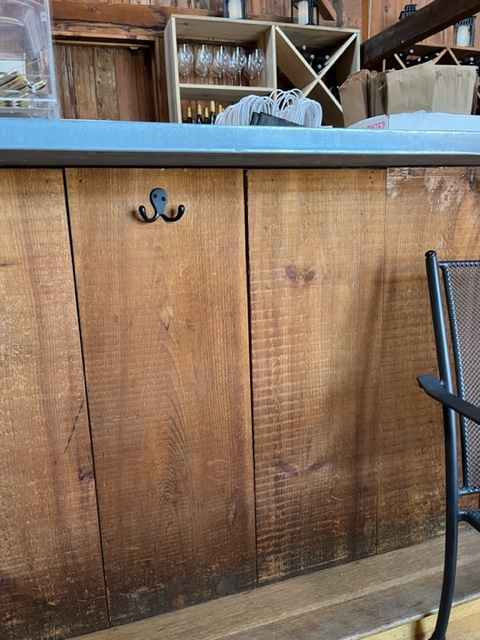
I appreciate it when bars have these hooks for one’s belongings.The vines are still bare–no bud break yet!
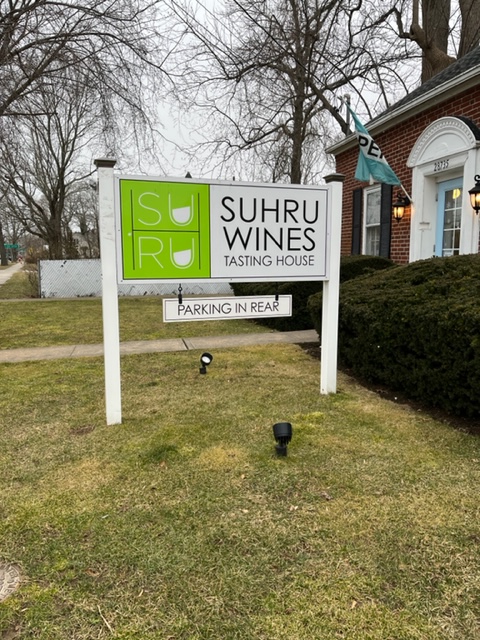
It was the type of day when, as they say, if you don’t like the weather, wait five minutes. In the morning, with some guests, we explored the Southold Winter Festival, and it was sunny though cold and windy. We admired the ice sculptures being chiseled out of blocks of ice, stopped in to a couple of our favorite shops, and headed home to warm up and have a snack. Then we ventured out again in the afternoon, as the sunny day turned cloudy, and snowflakes flew past us, to have a tasting at Suhru in Cutchogue. By the time we emerged, the storm was over and it was sunny again. (And then later another snow squall moved through!)
There wasn’t much to the first Southold Winter Festival, but the ice sculptor was cool.
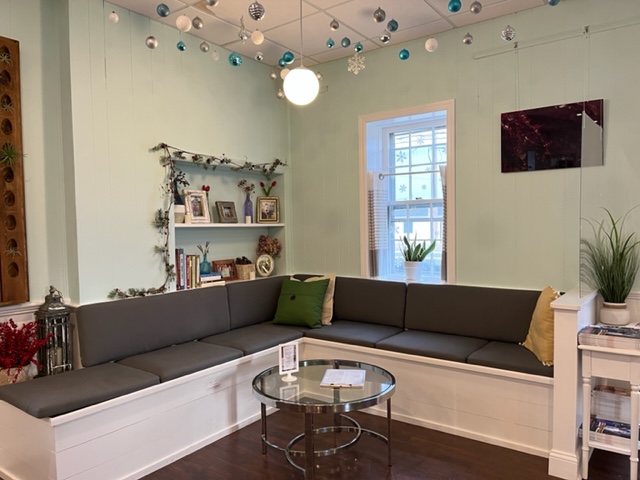
We were all glad we had ventured out, because we thoroughly enjoyed our tasting experience at Suhru’s small but well laid out tasting room, which we had to ourselves most of the afternoon. The young man in charge of the room was attentive, engaging, and well-informed about the wines, bringing us water and making sure we had all that we needed.
Suhru is a winery without a vineyard, as the winemaker, Russell Hearn (who is also the winemaker for Leib and Bridge Lane), buys his grapes each year based on whose crop he favors. For example, he makes wine from teroldego grapes, which were planted by Southold Farm + Cellar, who sadly had to move to Texas. At the moment, Russell offers ten wines for tasting, with four different flight options: February Favorites, four wines for $17; Whites and Rosé, four for $14; Red Wines, four for $21, and Choose Your Own, any four for $19. You can also ask for individual tastes, glasses, or a bottle. Our friends went with the red flight, while my husband and I decided to choose our own adventure.
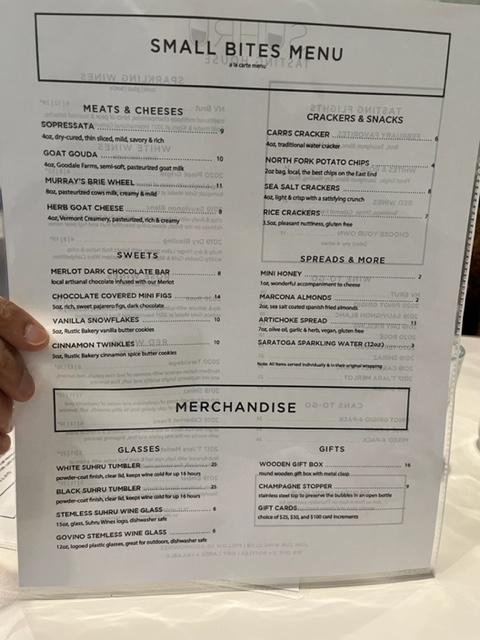
I hadn’t been here since 2018, so I didn’t know they now have a nice lttle menu of snacks, mostly cheese and charcuterie, but also a few other items. Our friends decided to have the Marcona almonds, which turned out to be a miniscule serving for $2, so we added a bag of North Fork potato chips.
Our selections arrived in a cute round tray, with each wine resting on its labeled spot, and we proceeded to taste clockwise. I’ll detail my tasting first, then the two wines they had that differed from mine.
NV Brut $29
I’ve decided to try sparkling wines everywhere they are offered—last week I tasted two at Pindar—and so far, so good. In fact, very good. We like this dry, tasty sparkler, made in the méthode champenoise, so much that our friends add a taste to their flight after we all finish. It has that lovely yeasty aroma of good bubbly, with tiny bubbles, and tastes of pear and maybe a touch of citrus. Mouth-watering. It’s a blend of chardonnay and pinot noir, according to our helpful server.
2020 Pinot Grigio $19
Although we are told that this is their “signature wine,” I am not enamored of it. On the other hand, my tasting buddy really likes it. As they say, there are no wrong answers in wine (well, there are, but, as they say in French, “Chacun à son gout.”) I get lemon and green apple tastes, but also something like cardboard. It is light and dry.
2020 Teroldego $30
Teroldego is a Northern Italian grape, not often grown on Long Island, so I ask our server where the grapes came from, which is how I learn the vines were planted by the owners of Southold Farm + Cellar. I was sorry to see that winery close, because they made some lovely wines, were very nice people, and had the most creative wine names I ever saw, but they had some sort of difficulties with local regulations and eventually closed up shop and moved to Texas, where they now have a winery. In any event, I’m glad the grapes are being used, because this is a delicious wine. It has a beautiful aroma of roses, and tastes of red raspberry and other berries. It is a somewhat light red which would go well with charcuterie, and could even be slightly chilled to accompany seared tuna. Last week I bought some fresh tuna steaks at Braun’s and my friend and I seared them with a pan sauce of capers, lemon, and garlic, and this would have gone well with that.
2019 Shiraz $25
When our daughter got married, we had a little wine tasting to decide which wines to serve. We already had the white picked out—Channing Daughter’s Scuttlehole Chardonnay—but we needed a red to go with lamb. This shiraz would definitely have been a contender. It is a bit peppery—apparently some people compare the taste to Dr. Pepper! –which would cut the fat of the lamb nicely. Good red fruit tastes plus something deeper.
2019 Cabernet Franc $30
“This tastes lighter than I expected,” opines our friend, who nonetheless finds the wine, which is in her tasting, not mine, quite pleasant. It has some teroldego mixed in, we are told. Good berry tastes. Our friends got up to peruse the display of bottles, and were charmed to realize that they have actually tasted wine from this winery, as one with the T’Jara label is carried in their local wine shop in Queens. In fact, according to a map on the wall, Suhru ships to many of the states.
2019 Ember $25
Our friends like this so much, that I add a taste of it after I finish my flight. This is Suhru’s Bordeaux blend, a merlot-heavy mixture including cabernet franc, cabernet sauvignon, petit verdot, and malbec. It is so drinkable that I resent sharing it with my tasting buddy. Kidding. Or maybe not. It is complex and balanced, with aromas of fruits, including cherry, and lots of interesting fruit tastes. The name? They had a little competition in the family, and apparently one cousin felt ember was a good name, as it evoked the long-lasting warmth of a fire. I can see that. I buy two bottles to take home.
The rather petite serving of almonds.
Reasons to visit: intimate tasting room where you can sometimes interact with the owners; all the wines are good, but especially the Brut, the Teroldego, the Shiraz, and the Ember; they have a nice little menu of snacks, but don’t bother with the Marcona almonds, unless you think $2 for about ten nuts is a good price; there is a backyard patio seating area for warm weather; if you’re planning a picnic, note that they offer several of their wines in cans.
This is a fascinating shop in the Feather Hill shopping center in Southold.Another favorite shop is About Food, where you never know what you will find.
In the midst of a week of unsettled weather, we took advantage of a sunny day to venture to the South Fork. We had two goals in mind—to have lunch with cousins we hadn’t seen in years, and to pick up our wine club selections at Channing Daughters. Lunch at Sant Ambroeus in Southampton was delicious, and we took home enough left-over pasta for dinner that night. The cousinly meeting went so well, that our cousins decided to come with us to Channing Daughters, which they had never been to. They enjoyed the tasting, so I hope this will not be the last time they trek there.
On the right, you can see two sculptures by Walter Channing, the founder of the vineyard.
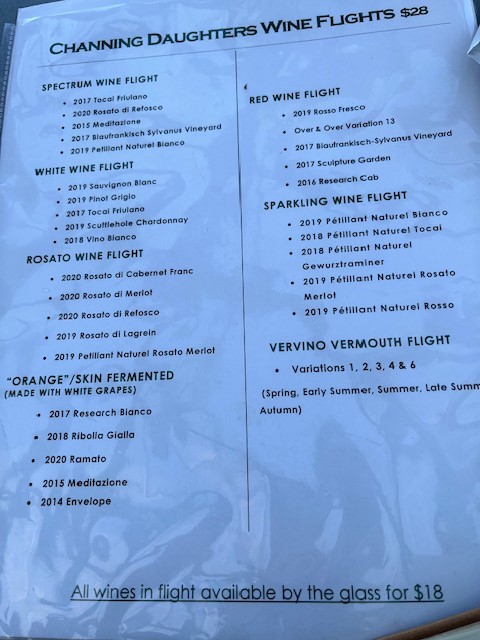
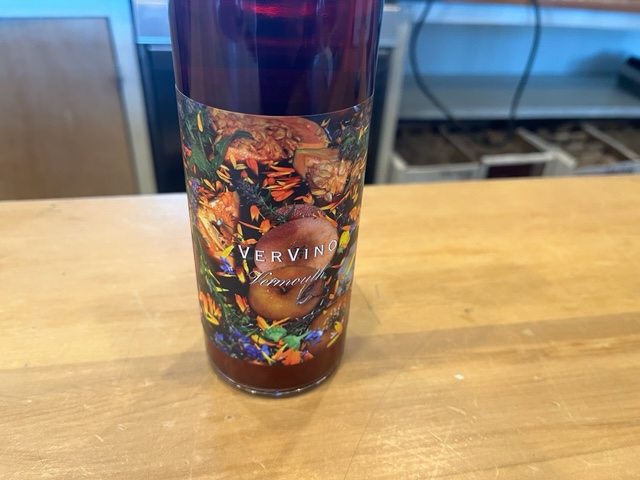
Aside from liking their wines, we admire Channing for the wide variety of their wines, the unusual grapes they grow, and their willingness to experiment. There are about thirty wines on their list, plus five different vermouths, an amazing amount for such a small winery (about 15,000 cases per year). We also appreciate how generous they are at tastings for wine club members. We had two tastings of four wines each, but then decided to try a number of other wines, plus a vermouth, and Laura, our server, was delighted to accommodate us.
We had not been there since Covid, opting to have our selections sent to us, so it was interesting to see their adaptations. The outside patio area is now enclosed in clear plastic, with propane heaters which quickly made sitting out there comfortable, though we kept our jackets on. They request that you make a reservation most days, though Tuesday is not one of them, since they are a small space. They also ask that you wear a mask inside the building, but, obviously, the masks come off when you sit for a tasting! They have clever wire racks, which hold five glasses vertically, thus making the most of the limited table space, and they also offer a menu of snacks, which is new. Our cousin picked up a bar of sea salt chocolate for us to share, since we hadn’t had room for dessert at the restaurant.
Before we left, we filled a case with a variety of additional selections, including the “Autumn” vermouth and three bottles of the Scuttlehole Chardonnay (our favorite), and our cousins bought two bottles of L’Enfant Sauvage and two of the Petit Verdot. Though we encountered some traffic as we wended our way back to the North Fork (the “back road” I discovered years ago is now well known), we felt that the trip was well worthwhile.
A standard tasting is $28 for five tastes, free for wine club members, who may also get wines not yet on the list.
Our wine club bottles.
2019 Sylvanus Petillant Naturel $28
Starting from the top of the rack, we choose this bubbly white, made from 50% pinot grigio, 40% muscat ottonel, and 10% pinot bianco. It is light, crisp, and refreshing, the sort of bubbly I could see pairing with charcuterie and some rich cheeses. Lovely.
2016 L’Enfant Sauvage $38
Some years I really love this wine, fermented with wild yeast (hence the name) and aged in oak, and other years I do not. This year’s version is…delicious. We all like it. I often don’t care for chardonnays aged in oak, but this one is not at all buttery. It smells of apples and, according to the cousin, fresh cut grass, and tastes fruity and deep. It might be nice to drink this with a dish of sauteed wild mushrooms, to match the wild with the wild.
They have just a few varieties.
2015 Envelope $42
This is one of their orange wines, made by fermenting white grapes with their skins on, as I explain to the cousins. As we chat, I realize that, over the years, I have gradually amassed a bunch of random facts about wine. What a great way to get an education! It may be psychological, based on the color, but I swear I taste Mandarin oranges plus lychees. This is a fairly tart wine, and would be good with pork belly, to cut the fatty taste.
2020 Lagrein $35
A young red that I think could use some aging, it nonetheless has a delicious aroma of fruit and tobacco. I taste dark purple plums, and could see serving this with lamb chops.
Autumn Vermouth $28
Spicy, fruity, complex, tasty—these are a few of the adjectives we share after I request a taste of this vermouth. It is made from red wine, and includes a panoply of ingredients. It will be great as a light cocktail, on the rocks.
2016 Research Cab $40
Our cousin requests a taste of this, since, she notes, she likes cabernets. Our server also brings a sample of the Petit Verdot, noting that it has more of the kind of fruity flavor those who like cabernets are looking for. And she is right. Though I like this blend of 68% merlot, 16% cabernet sauvignon, 4% petit manseng, 3% syrah, 2% barbera, 1% malbec, 1% petit verdot, 1% sangiovese, and 1% blaufrankish (I told you Channing likes to experiment!), the cousin does not. It is quite tannic and dry, and could probably benefit from a few more years in the bottle. The aroma includes berries and cherries (the merlot, I’m sure) and spice, as does the taste.
2018 Petit Verdot $38
Oh yes, very nice. How smart she was to bring us this, as I buy a bottle as well. It is deeply fruity, yet dry, with some notes of spice (anise?), cherries, and berries. Just last week I had a petit verdot at Macari which I liked, and this compares well with it. This may be my favorite red grape!
Reasons to visit: you are on the South Fork and want to try a winery (you can skip Duck Walk; Wölffer is also very good); the carved wooden statues by Walter Channing are worth looking at; knowledgeable servers who are generous with “extra” tastes; an astonishing array of wines and vermouths—plus they also carry some local gins and vodkas; L’Enfant Sauvage, Petit Verdot, Autumn Vermouth, plus most of the whites, rosés, and many of the reds; no outside food, but they do sell snacks.
Friends who are also relatively new to the North Fork—actually, unless you can trace your ancestry back at least several local generations, you are considered a newbie—invited us to do a members’ tasting at Macari Vineyards with them. We accepted happily, since Macari now requires reservations to do a tasting and we hadn’t bothered to do so. The last time we were there was October of 2019, so it was certainly time to return.
The sun was shining brightly, but the wind was cold, so we hustled inside, where we were escorted to an enclosed porch area, well heated by blowers, with chairs draped with furry throws.
Later in the afternoon, most of the tables filled up.
Each table was set with a placemat containing five circles listing wines, and three glasses. As our friends explained, a tasting consists of any three of the five listed wines, with wine club members having a few additional choices. Our waitress brought over all the wines currently on offer, and gave each of us our selected tastes, and then took our order for snacks. We got truffled potato chips, crackers and hummus, and a little cheese tray, which she characterized as a single serving, but which, with everything else, was more than enough. The chips are addictive, and the serving is large, so I definitely recommend them. The hummus was also very good, liberally sprinkled with za’atar, but the cheese tray was rather small, consisting of a chunk of brie, three slices of cheddar, a tiny jar of fig jam, and a few Marcona almonds, slices of salami, and bread.
As we sipped and munched, we engaged in getting to know each other better, and I learned to my astonishment that my new friends had been to wineries in all 48 contiguous states! They hadn’t set out to do so, but after happening to visit wineries in eleven states a friend told them to keep going, so they did. I was astonished to learn there was a winery in Wyoming, and many in Texas. Mississippi? I asked. Yes. Iowa? Uh huh. I am sure there are many stories to come of their odysseys. Meanwhile, we discussed the North Fork winery scene, and exchanged names of our favorites.
We enjoyed the Macari wines, though, due to being caught up in conversation, my notes are a bit sketchier than usual. I particularly liked the wines labelled “Life Force,” their descriptor for wines aged in concrete “eggs,” rather than wood.
2020 Life Force Sauvignon Blanc $28
Sometimes sauvignon blanc can be a bit sharp, but clearly aging in a concrete egg cures that. This is a nicely rounded wine, with an aroma of honeysuckle, and smooth citrus tastes. I like it.
2019 Cabernet Franc $38
This is a light, slightly spicy cab franc, with few tannins. My friend noted it, “Left me flat,” and I agreed. However, my husband had opted for the Life Force Cabernet Franc, which I liked much better.
Life Force Cabernet Franc $30
This was quite different, with more berry taste and aroma. I would definitely choose this one.
The view out the window.
2017 Dos Aguas $35
The name of this—and also a white blend—refers to the “two waters” of the North Fork, a factor both in the breezes we feel and the moderating of the climate. This is a Bordeaux-type blend of 60% merlot, 16% cabernet sauvignon, 15% petit verdot, and 9% cabernet franc. I would have easily guessed at the merlot, because it has a definite cherry flavor and aroma, plus a touch of tobacco from the oak aging. Nice tannins, and a better than average North Fork red.
2017 Syrah $45
Though it has a very promising aroma, I found the taste somewhat disappointing, and commented that there was not much to it.
2015 Petit Verdot (no price listed, since it is in short supply)
This was my favorite of the day, a wine aged two years in oak and quite delicious. Petit verdot is most often used in a Bordeaux-stye blend, but I often like it on its own. It had some interesting depth of flavor, some nice spice and fruit taste. We like it so much that we order a bottle while we continue chatting and snacking.
Snacks available for purchase. There’s also a little fridge with cheeses, etc.
Reasons to visit: pleasant porch seating with beautiful décor; nice view out to the vines; some good snacks, especially the truffled potato chips and the hummus; the Life Force wines, in particular the sauvignon blanc and the cabernet franc; the petit verdot, if it hasn’t sold out yet.