Pindar Vineyards: Special Day for Locals

March 31, 2023

The day was gray and chilly, but we had a good time anyway.

Pindar is proud of being one of the early vineyards on the North Fork, with their vines planted over 40 years ago.  I came by this bit of knowledge on a free tour and tasting at Pindar, part of an effort by a number of vineyards to attract locals to come and taste their wines.  Friends of ours had noted this program and invited us to join them at Pindar, whose perks seemed the best (other places offered such bargains to locals as ten percent off bottles or two for one).  Good move! We had a good time, learned a lot, and got to taste some wines we then bought and took home.

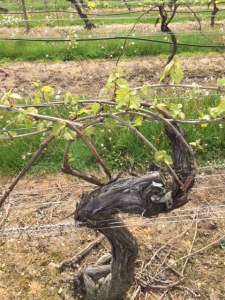
Nancy is showing us a gewurztraminer vine, one of the original ones planted at Pindar. The roots can go very deep.

Nancy, our tour guide, started us off by the vines, and then took us through all the steps of making wine, from the crush pad to the stainless steel tanks to the French oak barrels to the warehouse, and then back to the tasting room where we got to try five wines.

“Viticulture is farming for masochists,” she informed us, as she explained the work involved in pruning the vines, which she characterized as “an art and a science,” and the perils faced by grape growers.  There are migrating birds who will peck at the grapes, so they look fine but then shrivel into nothing; there are hurricanes on Long Island, whose arrival coincides with harvest season; and there is the lack of crop insurance, because how can you insure for their current value vines that have been growing for over 40 years.  In addition, you have to wait four years after you plant those vines before you can expect to harvest the grapes. The issue of birds has been taken care of, through an ingenious system of nets, which you can see in many vineyards, which remain furled up below the vines and are then raised when the grapes ripen.  As to the other issues…not much one can do about them!

Despite these problems, Pindar has 325 acres of vines, resulting in 60 to 70,000 cases of wine every year.  At first, Dr. Dan Damianos, the visionary who started Pindar (named, like one of his sons, for the classic Greek poet, in homage to their Greek heritage), planted gewürztraminer grapes, judging that the climate and soil would work well for this varietal.  Now they grow twenty-four varietals, and they list twenty-nine different wines on their tasting menu, which includes a number of blends.

The bottling machine, which is about to be replaced by an even better one.

They bottle these wines with their own bottling line, which can do 3,000 a day.  Not every winery has their own bottling facility, with many using Premium Wine Group for this.  Nancy gave a brief lecture on the issue of corks vs. screw caps, with corks reading as “better” wines, and screw caps okay for more casual, cheaper wines. Screw caps work just fine, though corks have the advantage of being biodegradable.
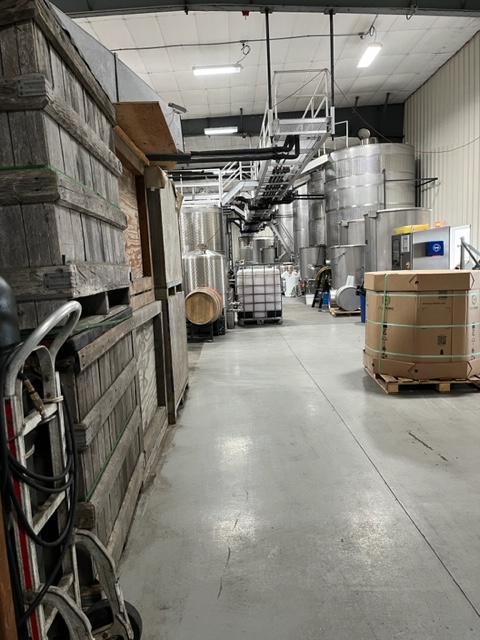
I never knew why the vats have this dimpled jacket.

We then walked into a huge room filled with vast stainless steel vats, where Nancy explained something I’d always wondered about.  The vats are partially encases in a dimpled steel jacket.  It is a glycol jacket, containing polyglycol, used to help regulate the temperature in the vats, and the dimples keep the polyglycol from settling to the bottom.  Too hot or too cold, and the wine is ruined.  They use a windmill to provide about 60% of the energy needed in the warehouse and wine “cellar”—not a cellar, because…polyglycol.  We also learned about another hazard of viticulture—carbon dioxide.  As the juice ferments into wine, carbon dioxide rises to the top of the tanks, where the solid matter must be pushed down into the liquid.  Catwalks provide access to the tops of the tanks, and open doors help dissipate the CO2.

Part of the filtration system.

She showed us their filtration system, and we learned, by the way, that Guinness Stout used isinglass, obtained from the bladders of sturgeon, to filter their brew.  I like Guinness, but I also like caviar!

She also took us outside to see the crush pad, where a machine crushes the grapes. Because Pindar is so big, a lot of the work is done by machines.
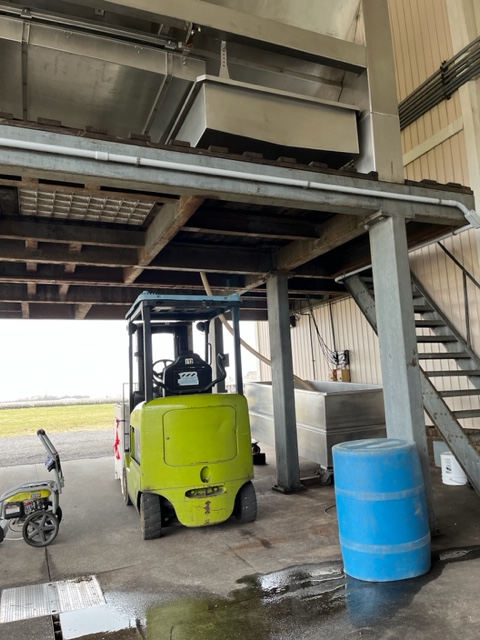
The crush pad.

The huge space where red wine ages in French oak barrels smelled enticingly like a forest or lumberyard.  We found out that there are different tastes imparted to wines by French and American oak, with some adding notes of vanilla and others cinnamon, etc.  Pindar now uses only French oak, buying 300 barrels a year, and has phased out their American oak barrels, which they sometimes sell to breweries or to people who want to use them in their gardens.  We also learn about the “angel’s share,” the wine which evaporates from the barrels, meaning they need to be constantly watched and topped up, so that too much oxygen doesn’t turn the wine into vinegar.  The angels must reserve a special place in heaven for wine makers!
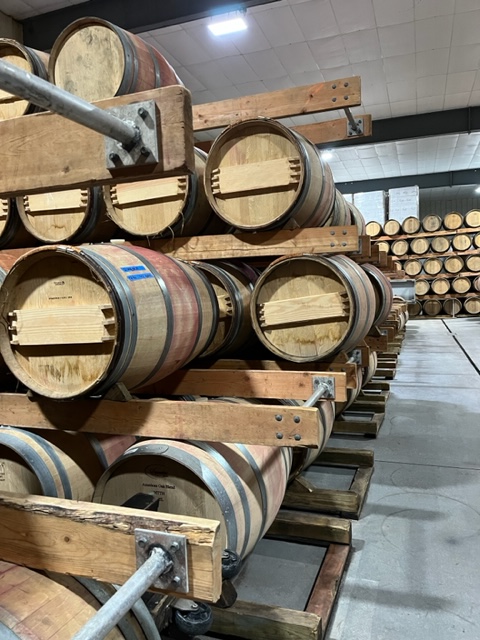
Despite the bung stopper, some evaporation is unavoidable.

Finally, our last stop before the tasting room, we saw the warehouse where cases of wine are stacked high.  Nancy held up a four-pack of cans of Winter White, and explained that Dr. Dan, noting the American taste for soda and other sweet drinks, decided to make some sweeter wines, like Winter White, which is the most popular white on Long Island.  More recently, the decision was made to offer it in cans; again, to attract those who might otherwise opt for soda or beer.

Cans of Winter White, ready to go.

Now it was time to taste the fruits of their labor!  The group of about thirty locals lined up around the bar, where glasses stood ready.  Here are my tasting notes:

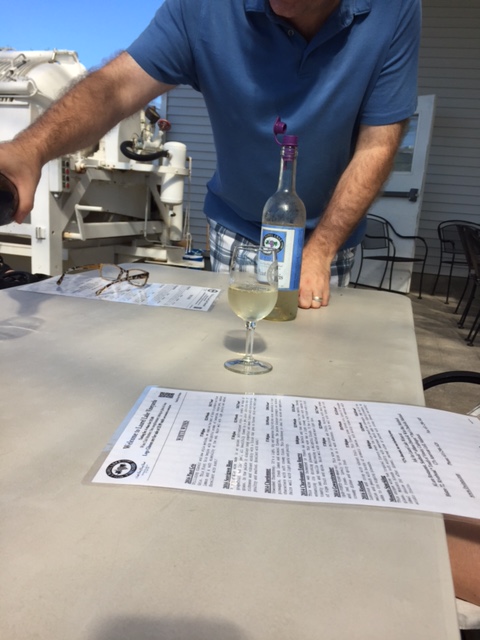
Nice sized pour.
  •  2020 Dr. Dan’s Selection White Blend      $24.99

Our first taste is a blend of, this vintage, of 53% viognier, plus pinot grigio, sauvignon blanc, and riesling.  The percentages may vary year to year.  This is a very drinkable white, with aromas of pineapple and citrus, and tropical fruit flavors like guava and pineapple.

  • 2021 Dr. Dan’s Selection Gewürztraminer               $24.99

We are quite interested to taste this, after learning the history of the vines, and we quite like it.  In fact, we and our friends each buy a bottle to take home.  It is not too sweet, which can happen with gewürztraminers, with an aroma of peaches and tastes that include tangerine and apricot.  “Yummy,” we and our friends agree.

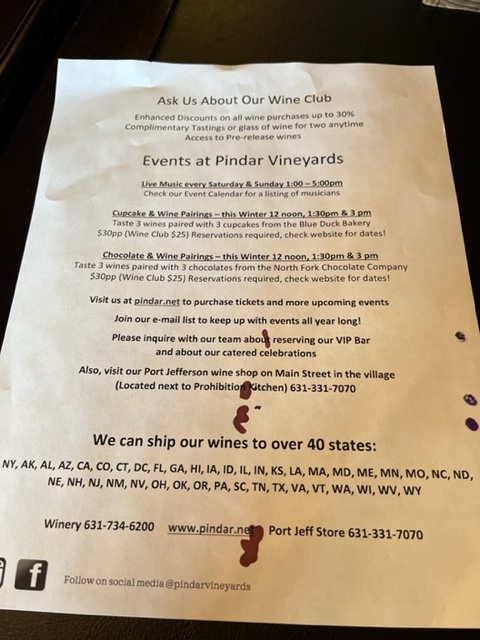
At the tasting, I turned over my menu to see the events list.
  • 2019 Mythology                $42.99

A Bordeaux blend called Meritage, this includes malbec, cabernet sauvignon, merlot, petit verdot, and cabernet franc.  Delicious.  Lots of dark fruit taste and enough tannins that one could probably age it.

  • 2019 Cabernet Sauvignon Reserve            $34.99

Nancy, who is still informing us about the wines, explains that cabernet sauvignon used to be harder to grow on Long Island, since it needs a longer growing season to mature.  However, with climate change, the growing season on Long Island has gotten longer.  I guess that’s an upside to global warming! This is another very good red, with tastes of blackberry and other fruits, and an aroma of cedar and tobacco.

Pindar Damianos chatting with a guest.
  • 2015 Cabernet Port         $28.99 for 750 ml, $16.99 for 375 ml

I’m not sure if this was in the original tasting or if it was included after our friend shared his enthusiasm for the port with Nancy and with Pindar Damianos, who was hanging around and talking to the guests.  He discovered that Pindar makes award-winning port in an old issue of a wine magazine shortly after moving to the North Fork, and was happily buying and drinking it.  I can see why.  This is a dessert wine—in English novels, they are always sipping it after dinner while they crack walnuts and chat—but it is not too sweet, with an appealing depth of flavor.  It is made 100% from cabernet franc.  We each buy a bottle to take home.

Cases filled with awards Pindar wines have won.

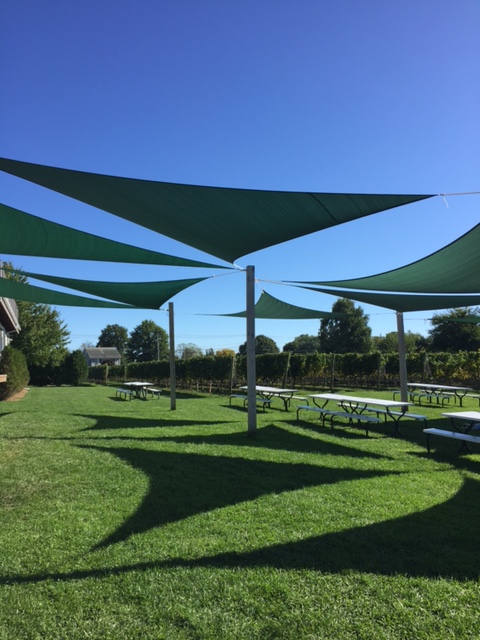
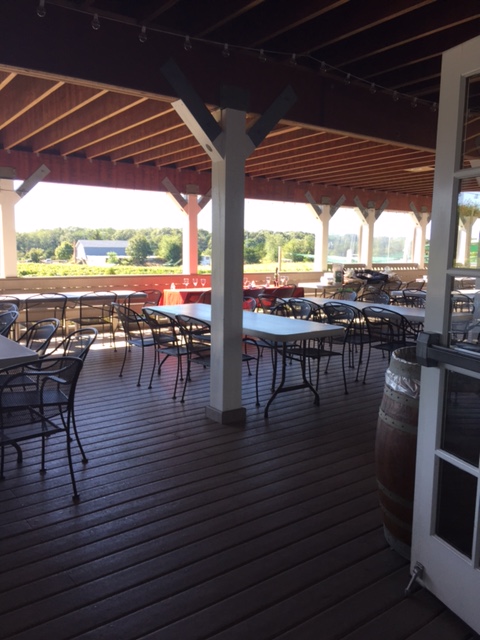
Reasons to visit:  roomy tasting room with two outside areas; a wide variety of wines for every taste, from sweet to dry, and price, from $14.99 (Winter White and others) to $42.99; all the wines we tasted—White Blend, Gewürztraminer, Mythology, and Cabernet Sauvignon Reserve—plus the port; our friends had also tasted the Gamay Noir before we went on the tour, and bought a bottle of that light red to take home; they have a refrigerated case full of cheeses, etc., to consume there; they have a variety of special events.

Pindar Vineyards: Special Day for Locals

March 31, 2023

The day was gray and chilly, but we had a good time anyway.

Pindar is proud of being one of the early vineyards on the North Fork, with their vines planted over 40 years ago.  I came by this bit of knowledge on a free tour and tasting at Pindar, part of an effort by a number of vineyards to attract locals to come and taste their wines.  Friends of ours had noted this program and invited us to join them at Pindar, whose perks seemed the best (other places offered such bargains to locals as ten percent off bottles or two for one).  Good move! We had a good time, learned a lot, and got to taste some wines we then bought and took home.

Nancy is showing us a gewurztraminer vine, one of the original ones planted at Pindar. The roots can go very deep.

Nancy, our tour guide, started us off by the vines, and then took us through all the steps of making wine, from the crush pad to the stainless steel tanks to the French oak barrels to the warehouse, and then back to the tasting room where we got to try five wines.

“Viticulture is farming for masochists,” she informed us, as she explained the work involved in pruning the vines, which she characterized as “an art and a science,” and the perils faced by grape growers.  There are migrating birds who will peck at the grapes, so they look fine but then shrivel into nothing; there are hurricanes on Long Island, whose arrival coincides with harvest season; and there is the lack of crop insurance, because how can you insure for their current value vines that have been growing for over 40 years.  In addition, you have to wait four years after you plant those vines before you can expect to harvest the grapes. The issue of birds has been taken care of, through an ingenious system of nets, which you can see in many vineyards, which remain furled up below the vines and are then raised when the grapes ripen.  As to the other issues…not much one can do about them!

Despite these problems, Pindar has 325 acres of vines, resulting in 60 to 70,000 cases of wine every year.  At first, Dr. Dan Damianos, the visionary who started Pindar (named, like one of his sons, for the classic Greek poet, in homage to their Greek heritage), planted gewürztraminer grapes, judging that the climate and soil would work well for this varietal.  Now they grow twenty-four varietals, and they list twenty-nine different wines on their tasting menu, which includes a number of blends.

The bottling machine, which is about to be replaced by an even better one.

They bottle these wines with their own bottling line, which can do 3,000 a day.  Not every winery has their own bottling facility, with many using Premium Wine Group for this.  Nancy gave a brief lecture on the issue of corks vs. screw caps, with corks reading as “better” wines, and screw caps okay for more casual, cheaper wines. Screw caps work just fine, though corks have the advantage of being biodegradable.

I never knew why the vats have this dimpled jacket.

We then walked into a huge room filled with vast stainless steel vats, where Nancy explained something I’d always wondered about.  The vats are partially encases in a dimpled steel jacket.  It is a glycol jacket, containing polyglycol, used to help regulate the temperature in the vats, and the dimples keep the polyglycol from settling to the bottom.  Too hot or too cold, and the wine is ruined.  They use a windmill to provide about 60% of the energy needed in the warehouse and wine “cellar”—not a cellar, because…polyglycol.  We also learned about another hazard of viticulture—carbon dioxide.  As the juice ferments into wine, carbon dioxide rises to the top of the tanks, where the solid matter must be pushed down into the liquid.  Catwalks provide access to the tops of the tanks, and open doors help dissipate the CO2.

Part of the filtration system.

She showed us their filtration system, and we learned, by the way, that Guinness Stout used isinglass, obtained from the bladders of sturgeon, to filter their brew.  I like Guinness, but I also like caviar!

She also took us outside to see the crush pad, where a machine crushes the grapes. Because Pindar is so big, a lot of the work is done by machines.

The crush pad.

The huge space where red wine ages in French oak barrels smelled enticingly like a forest or lumberyard.  We found out that there are different tastes imparted to wines by French and American oak, with some adding notes of vanilla and others cinnamon, etc.  Pindar now uses only French oak, buying 300 barrels a year, and has phased out their American oak barrels, which they sometimes sell to breweries or to people who want to use them in their gardens.  We also learn about the “angel’s share,” the wine which evaporates from the barrels, meaning they need to be constantly watched and topped up, so that too much oxygen doesn’t turn the wine into vinegar.  The angels must reserve a special place in heaven for wine makers!

Despite the bung stopper, some evaporation is unavoidable.

Finally, our last stop before the tasting room, we saw the warehouse where cases of wine are stacked high.  Nancy held up a four-pack of cans of Winter White, and explained that Dr. Dan, noting the American taste for soda and other sweet drinks, decided to make some sweeter wines, like Winter White, which is the most popular white on Long Island.  More recently, the decision was made to offer it in cans; again, to attract those who might otherwise opt for soda or beer.

Cans of Winter White, ready to go.

Now it was time to taste the fruits of their labor!  The group of about thirty locals lined up around the bar, where glasses stood ready.  Here are my tasting notes:

Nice sized pour.
  •  2020 Dr. Dan’s Selection White Blend      $24.99

Our first taste is a blend of, this vintage, of 53% viognier, plus pinot grigio, sauvignon blanc, and riesling.  The percentages may vary year to year.  This is a very drinkable white, with aromas of pineapple and citrus, and tropical fruit flavors like guava and pineapple.

  • 2021 Dr. Dan’s Selection Gewürztraminer               $24.99

We are quite interested to taste this, after learning the history of the vines, and we quite like it.  In fact, we and our friends each buy a bottle to take home.  It is not too sweet, which can happen with gewürztraminers, with an aroma of peaches and tastes that include tangerine and apricot.  “Yummy,” we and our friends agree.
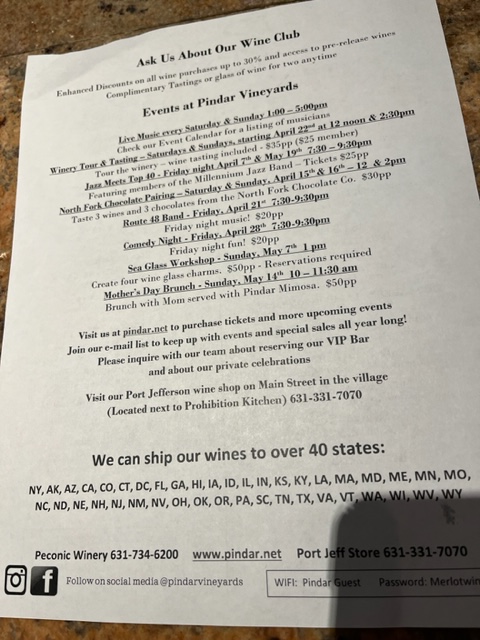
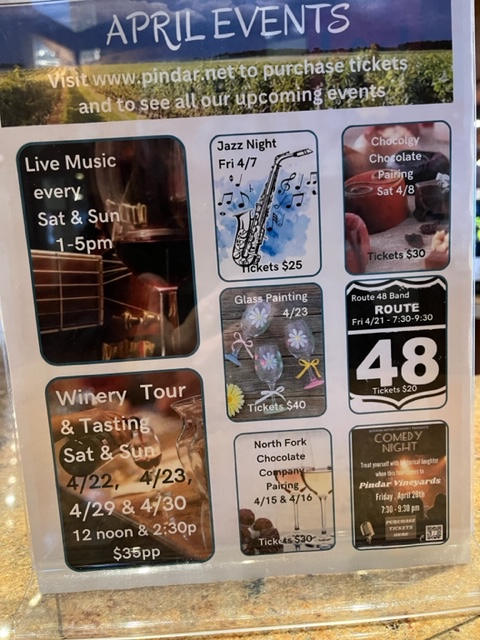
At the tasting, I turned over my menu to see the events list.
  • 2019 Mythology                $42.99

A Bordeaux blend called Meritage, this includes malbec, cabernet sauvignon, merlot, petit verdot, and cabernet franc.  Delicious.  Lots of dark fruit taste and enough tannins that one could probably age it.

  • 2019 Cabernet Sauvignon Reserve            $34.99

Nancy, who is still informing us about the wines, explains that cabernet sauvignon used to be harder to grow on Long Island, since it needs a longer growing season to mature.  However, with climate change, the growing season on Long Island has gotten longer.  I guess that’s an upside to global warming! This is another very good red, with tastes of blackberry and other fruits, and an aroma of cedar and tobacco.

Pindar Damianos chatting with a guest.
  • 2015 Cabernet Port         $28.99 for 750 ml, $16.99 for 375 ml

I’m not sure if this was in the original tasting or if it was included after our friend shared his enthusiasm for the port with Nancy and with Pindar Damianos, who was hanging around and talking to the guests.  He discovered that Pindar makes award-winning port in an old issue of a wine magazine shortly after moving to the North Fork, and was happily buying and drinking it.  I can see why.  This is a dessert wine—in English novels, they are always sipping it after dinner while they crack walnuts and chat—but it is not too sweet, with an appealing depth of flavor.  It is made 100% from cabernet franc.  We each buy a bottle to take home.

Cases filled with awards Pindar wines have won.

Reasons to visit:  roomy tasting room with two outside areas; a wide variety of wines for every taste, from sweet to dry, and price, from $14.99 (Winter White and others) to $42.99; all the wines we tasted—White Blend, Gewürztraminer, Mythology, and Cabernet Sauvignon Reserve—plus the port; our friends had also tasted the Gamay Noir before we went on the tour, and bought a bottle of that light red to take home; they have a refrigerated case full of cheeses, etc., to consume there; they have a variety of special events.

Pindar Vineyards: Plenty of Variety

February 15, 2022

The first time we went to Pindar, years ago, we did not like many of the wines we tasted.  However, in recent years, we have found much more to our liking, so on this chilly winter afternoon we brought two friends with us to do a tasting.  It took some thought to decide where to go with them, since we have taken them to a number of wineries and breweries over the years.  However, the breweries were off our list, since in the winter many of them are closed mid-week, or only open late in the day.  We also wanted somewhere we could sit at a table and chat as we sipped, and where we didn’t need to make a reservation.  If we had wanted to bring our own snacks, Pindar allows that, plus they also allow dogs, a piece of information we are storing for later.

Gina was very pleasant and attentive.

Aside from one couple, who left, we had the place to ourselves, and we joked with our friends, did they like that we had reserved a winery for their tasting.  That’s midweek in February for you.  Gina, our server, was very pleasant, and patiently answered our friend’s many questions, asked us how we were liking our tastings, brought us cups of water, and gave advice as to which wines to pick from their long list, based on our preferences.  And I do mean long—thirty wines in all!  That included three reserve reds, which usually cost extra, but, since she had the bottles open, she offered to include them in our standard flight of five.  How nice.

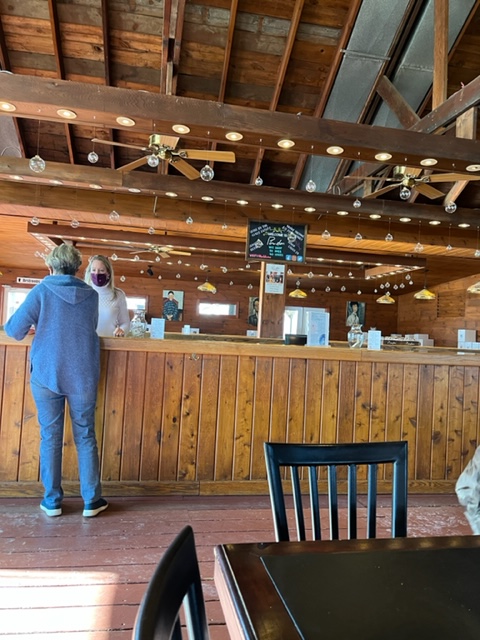
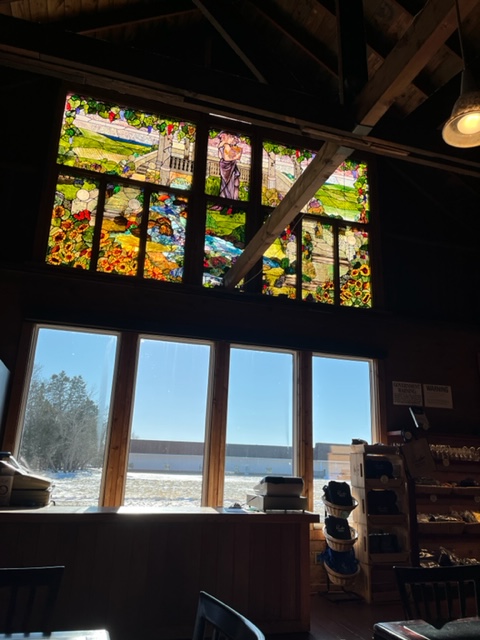
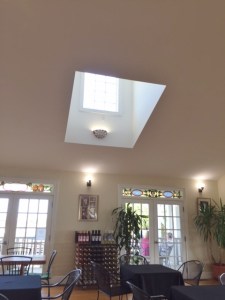
Pindar’s tasting room is in a converted barn, which has been expanded over the years, still retaining its rustic beams, with a gorgeous stained-glass window.  One not so pleasant note—the restrooms are in a separate structure, a cold walk outside in the winter, though it wouldn’t matter in the summer.  Maybe they should consider adding indoor facilities!

We got different colored Sharpies to mark up our menus.

I suggest choosing your flight carefully, as some of their wines are too sweet for our taste, but we were happy with today’s selections.  We shared three tastings amongst us, with some overlap. The tastes arrived in rustic wooden boxes, clearly labeled as to the order in which to drink them.

  •  Premier Cuvée Brut       $32.99

More and more North Fork wineries are offering sparkling wines, some made with the “méthode champenoise,” so I was curious to try theirs.  This was a nice, dry, sparkler, with lots of bubbles and some pear taste and smell.  100% chardonnay.

  • Dr. Dan’s Extra Dry         $29.99

“Dr. Dan” refers to the founder of Pindar—and also Duck Walk—Dr. Dan Damianos, who died in 2014, one of the East End wine pioneers.  His family have continued to run his wineries, though his son, Jason, who started Jason’s Vineyard, died in a car accident in 2017.  Made from a blend of chardonnay and pinot noir, this is another sparkling wine, but we didn’t like it as much.  It has some green apple taste, but also a touch of something chemical.

  • 2020 Viognier    $21.99

We decided to steer clear of the sweeter whites, so we opted for the viognier, but found it too light, with again, a bit of a chemical aroma.  It’s not bad, but there’s not much to it.

  • 2020 Sunflower Chardonnay      $21.98

According to Gina, this is one of their most popular whites, and I can see why.  It is very lightly oaked, so there are only traces of vanilla, with some nice citrus flavor and a lovely floral aroma.  However, again, it is very light, though I think it would be nice with seafood, like the steamed lobsters we plan to pick up at Braun’s later.

The Gamay is a pretty light red.
  • 2020 Gamay Noir            $21.99

The ever-attentive Gina informs us that this is their lightest red, and she is right, though is is quite tasty.  This would be a good red for someone who thinks they don’t like reds.  It has a red lollipop smell, and lots of berry taste.  It could go with roast chicken, like a Beaujolais.

  • 2017 Cabernet Sauvignon           $18.99

I teach our friends the word “petrichor,” which, I say, is the smell of this wine.  Though it is dry, it is also very light, and we don’t care for it.

Just part of the array of wines.
  • 2017 Cabernet Franc      $21.99

In contrast, this red smells lovely, like a dried fruit compote, and tastes like slightly under-ripe purple plums.  Quite drinkable, and we sense some nice tannins.

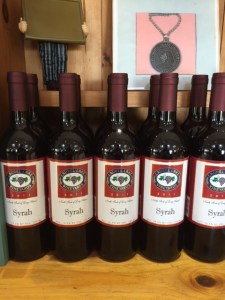
  • 2017 Syrah         $18.99

This was in my friend’s tasting, so I only got a small sip, but she compares the taste to “burnt toast.”  I say black tea?

  • 2017 Tannat      $21.99

I don’t think anyone else on the North Fork grows this grape, which usually comes from the Basque area.  It had a lovely flowery smell, like violets.  It is not unpleasant to drink, but my friend says the taste reminds her of “canned plum tomatoes,” and theorizes it would be a good wine to add to a ragu Bolognese.

  1. Pythagoras         $18.99

You may have noted that some of the wine names are a nod to the Damianos family’s Greek roots, like this one, named for the founder of that theorem you had to memorize in high school.  This is a Bordeaux blend—perhaps of three grapes? —hence the name.  I insist that this smells like that white paste we used to use in elementary school, and which some kids—not me! –liked to taste.  As it sits and we chat, it develops a better taste and smell, with some good berry flavor.

  1. 2019 Mythology              $$42.99

This wine, and the two which follow, are categorized as reserve red wines, and normally cost an extra $4.00 per taste.  We are happy to try it, and find it good, drinkable, with nice tannins which make me think it could be cellared, but not worth the cost.

  1. 2019 Merlot Reserve      $34.99

This had typical merlot cherry flavor and aroma, though it is not as big a wine as one would expect from one labeled reserve.   

  1. 2019 Cabernet Sauvignon Reserve           $34.99

It seems we saved the best for last, as we all agree we like this one the most.  It has an intriguing aroma of forest floor and berries, and plenty of interesting dark fruit flavors. 

Windmill!

Reasons to visit:  informal tasting room, with lots of room at the bar and plenty of outdoor space; they allow picnics and dogs; the Premier Cuvée Brut, Sunflower Chardonnay, Cabernet Franc, Cabernet Sauvignon Reserve (plus others we did not taste if you like sweeter wines); many different wines to fit different palates; if you live elsewhere, they ship to forty states.

They ship to forty states.

Laurel Lake: Not Their Fault, But… February 1, 2020

http://www.llwines.com/

We have had several prior visits to Laurel Lake which we enjoyed, including once in the early fall when we sat outside with some friends and experienced good table service and a leisurely afternoon, and another time in the winter when we had the tasting room mostly to ourselves and had a lovely chat with the winemaker. However, this time a very noisy crowd of women having a bachelorette party, succeeded by an even noisier group celebrating a birthday, made it hard for us to relax and enjoy our tasting. Part of the problem is that the room is all hard surfaces, promoting echoing sounds. Not anyone’s fault, but it did color our appreciation of the wines.

IMG_7489

IMG_7490

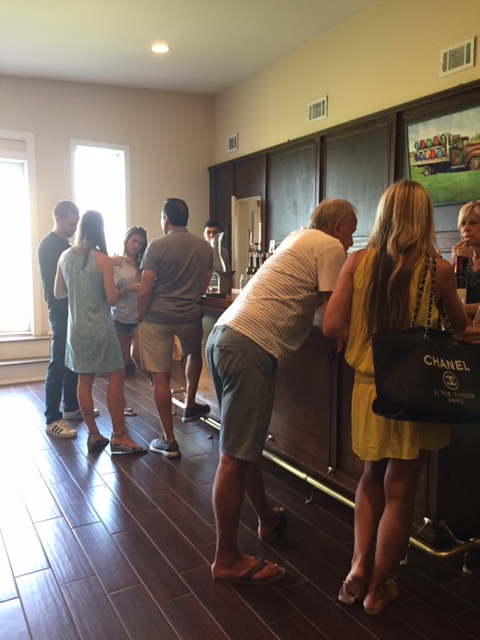
The room looks empty, but off to the left there’s a large and rather noisy group.

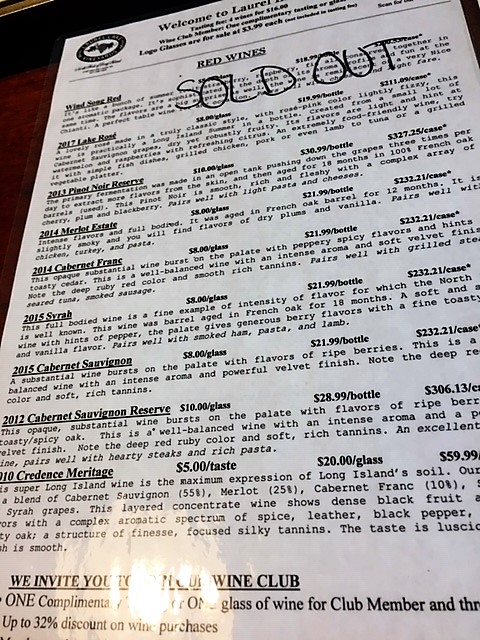
There’s plenty of room for groups—which must reserve ahead—at Laurel Lake, especially if you include the outside area, but the main tasting room is a middle size. We decided to sit at a table, and get up to ask for each of our four tastes. The menu offers four tastes for $16, from a menu of six whites and eight reds (minus the sauvignon blanc, which was used up). With some guidance from the servers—one of whom, Maureen, amazingly recognized us from our visit over a year ago—we chose our four.


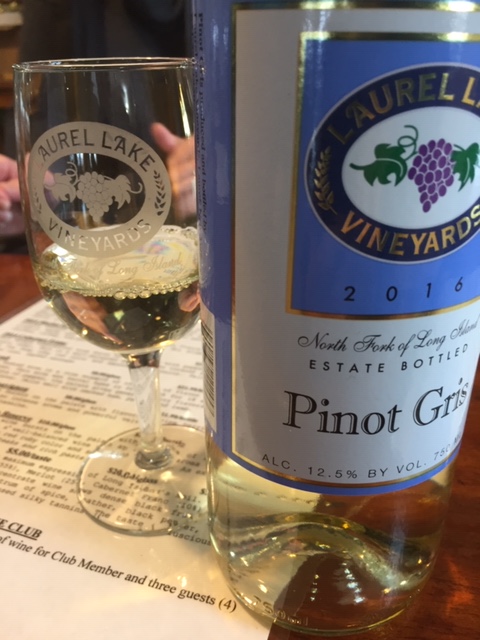
  1. 2018 Pinot Gris $23.99

A good place to start, this is a relatively simple, direct white, the French version of pinot grigio. The wine doesn’t have much aroma, just perhaps a touch of flowers and minerals. It is dry, with tastes of unripe pear, salt, and minerals. It would be fine with a delicate fish dish.

IMG_7488

  1. 2018 Gewürztraminer $23.99

The menu wisely includes a little pronunciation guide to this wine, which people might otherwise hesitate to order! And order it they should, as it is very likely a crowd pleaser. It has enough fruit to make it easy to drink, but not so much sweetness that we were put off by it. The aroma is of thyme honey and oak, and it tastes like peaches and apricots. It would be fine to sip on its own, but even better with kung pao chicken.

  1. 2015 Cabernet Franc $22.99

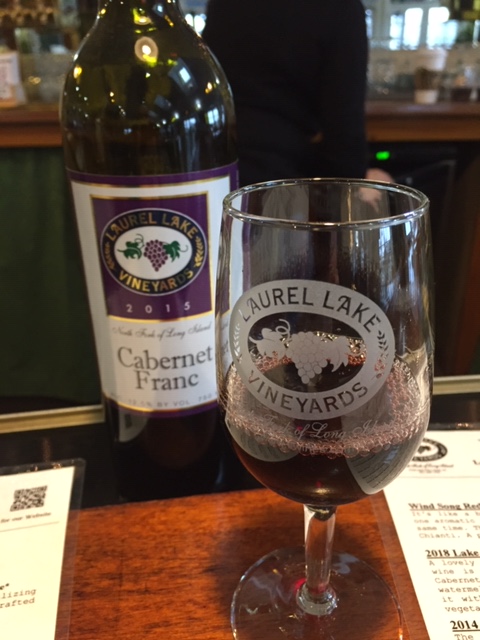
I was thinking of getting their red blend, called Wind Song Red, but the server warned me that it is “semi-sweet.” So, no. Instead I got the cab franc, which had a very promising aroma of fruit, leather, nutmeg, and plums. It is, she informed me, their most popular red. We found it pleasant, but one-dimensional, light-bodied, with slight tannins and nice acidity. I taste purple plums and maybe a touch of black olive. I could see how people would find it easy to drink. The tasting notes suggest pairing it with grilled tuna, and I agree.

IMG_7492

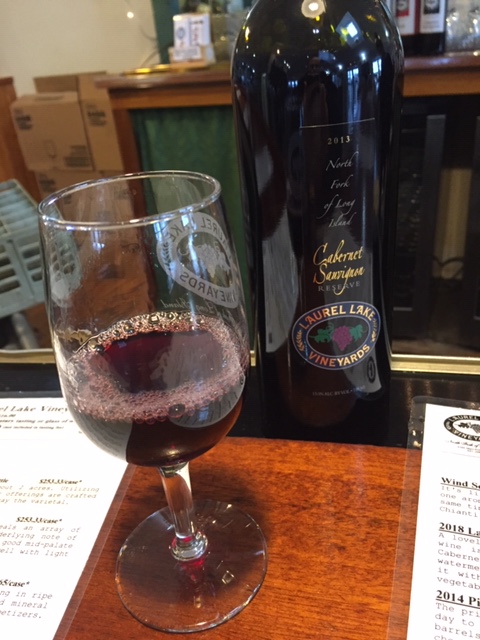
  1. 2013 Cabernet Sauvignon Reserve $29.99

The word “reserve” can mean anything a winery wants it to mean, but generally it denotes their higher end wines. All of Laurel Lake’s wines are moderately priced, with this the most expensive one on the menu. It is a dry, smooth, pleasant (there’s that word again—am I damning with faint praise?) red, with light tannins, tasting of dark fruits and berries. The menu describes it as having an “intense aroma,” but we thought not. Interestingly, the last time we were here we tried the 2012 iteration of this wine, and liked it very much. Just shows the importance of tasting each vintage.

IMG_7493

Reasons to visit: pleasant tasting room, if it’s not filled with noisy groups; nice outside area for warm weather; at the moment they allow outside snacks; the gewürztraminer and the cabernet franc, small selection of amusing wine-related gifts.


Duck Walk Vineyards: Quack Quack January 12, 2019

Duck Walk Vineyards:  Quack Quack        January 12, 2019

img_6082

https://duckwalk.com/

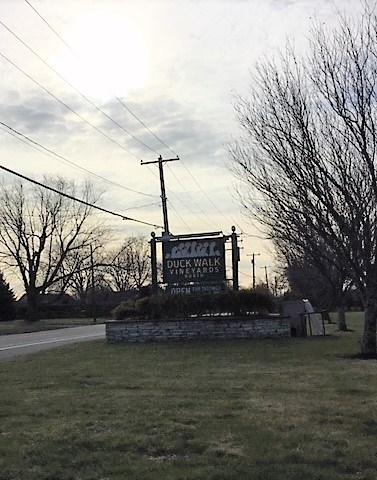
“We’ll have to stop quacking,” joked my husband, as we finished our tasting at Duck Walk Vineyards’ North Fork tasting room.  You see, the last time we went, in 2009, we disliked almost all the wines, including a red that tasted like ashes, and I had an allergic reaction (something I almost never have to Long Island wines, for some mysterious reason).  So we vowed never to return, and amused ourselves by quacking derisively as we drove past.  No more.  Though we didn’t like all the wines, there were plenty we did enjoy, and we had a great tasting experience.

img_6059

This tasting room is quite spacious, though the last time, when we came in the spring, we were in a different one that was even bigger.

Duck Walk, like Jason’s and Pindar, is owned by the Damianos family, and many of their wines are somewhat sweet for our taste, though numerous people like them.  And it is a family affair, with even a third generation possibly getting ready to join the business, according to our chatty and well-informed server.  It is always a plus to have a server who is really into the wines of the place where she works, and we appreciated our server’s enthusiasm for the wines and eagerness to share her preferences.  She also was happy with our respectful approach to the wines, and gave us some extra tastes to show off the depth of their collection.

img_6063

The tasting room we went into is to the right of the main entrance, where we had a tasting the last time, and is a smaller—though still quite large and airy—room.  A long bar dominates one end, past which are French doors leading out to the vines.  When we entered, a large group of young women were enjoying their tasting before heading back out to the limo, and the room became noticeably quiet when they left.  In the summer, we have often seen whole fleets of limos and buses parked outside, as Duck Walk is a regular on the limo circuit (another reason we haven’t been back in a long time).

Aside from feeling it was finally time to go back, I also was intrigued to taste their Absenthe, their new after-dinner “traditional distilled spirit,” whose name echoes that of the famous Czech drink, absinthe.

img_6081

Their website notes that they have snacks for sale, though we were not offered a menu, and they do allow you to bring in “light snacks.”  It also says they are “pet friendly,” which I assume means in the summer, when you can sit outside.

img_6080

A tasting consists of four tastes for $10, which you pay in advance.  You then get four tickets, which the server collects after each drink.  Since the menu includes seventeen red, white, and rosé wines, plus seven other drinks in the sparkling and dessert categories, we decided to do two tastings and share as we went along.  Though you are free to choose any four, in any order, our server did give us the standard advice to drink whites before reds, and to follow the order of their listings on the menu.

img_6064 (1)

  1. 2017 Chardonnay          $16.95

Since chardonnay is so ubiquitous on the North Fork, I felt we should include it in our tasting.  This is their steel-fermented chard, and at the moment they do not have an oaked chard, though our server says they have had one in the past.  We agree that we both prefer steel to oak.  This one has a bit of a barnyard smell, and is a touch too sweet for us.  It has tastes of pineapple and guava with some minerality.  My tasting buddy opines that it is “wine for the skittish,” by which he means it is easy to drink if you’re not a big wine drinker.

img_6065

  1. 2017 Sauvignon Blanc   $18.95

Nice.  I get a cut grass smell which my husband describes as “woodsy,” plus some rock or mineral.  The taste is fairly typical for North Fork sauvignon blancs, lemony and grapefruity, and would be fine with oysters.

img_6068

When the labels do not feature ducks they feature Gastby-themed art, like this one of what the tasting room workers jokingly named the “Hamptons hooker.”

  1. 2017 Rosé $16.95

We admire its pretty pink color and Gatsby-inspired label, which features a young woman in flapper dress standing in front of a mansion and a 1920s car.  Her provocative pose has led the winery workers to dub her the “Hamptons hooker.”  Made from the pinot meunier grape, this has a slightly funky aroma, plus the expected strawberry.  The taste reminds me of a vodka-infused watermelon I once sampled at a party (I was young.), with some sweet strawberry and lemon notes.  This would be a fine summer sipper, though it is a bit too sweet for us.

img_6067

  1. Southampton White   $14.95 for 750 ml, $18.95 for 1.5 l

According to the menu, this is made from the cayuga grape, which is often used upstate.  As we feared, it is too sweet for us, while also being light and not complex. I contemplate dumping the rest of our taste.

img_6069

  1. 2017 Pinot Meunier   $29.95

Since Duck Walk is the only vineyard that grows this grape, we decide we need to start our tasting of the reds with this wine.  My tasting pal and I agree that this smells like berries, though I say blueberry and he says raspberry.  It is a light, fruity summer red, good with barbequed chicken.  It reminds me of a Beaujolais.  This label also features an upper-crust Gatsby-esque theme, with formally clad horse riders.

img_6070

  1. 2016 Cabernet Sauvignon   $18.95

This cab doesn’t have much aroma or taste.  There is a slightly funky smell.  The wine itself is light and dry, with some tannin.  It would be okay with a burger, though I generally prefer beer with burgers.

img_6071

Do you see the duck reference in this picture? I got it!

  1. 2014 Cabernet Sauvignon Reserve   $38.95

Power of the book strikes again!  Our server, with whom we have been having enjoyable conversations about the North Fork vs. the South Fork (where she often has to travel to work in the South Fork tasting room in Water Mill), gives us an extra, a taste of the high-end cab sauv.  And it is really good!  Lots of dark fruit taste, the kind of tannins that make me think it could age even more, and some depth and interest.

img_6073

  1. 2015 Merlot   $16.95

Again, the aroma is a bit funky, plus the usual cherry smell.  This is a dry, drinkable merlot, not overpowering at all.  My husband says there’s “not a lot of stuff going on.”  It’s a fairly typical North Fork merlot, with some cherry taste.  It would be fine with pasta.

img_6074

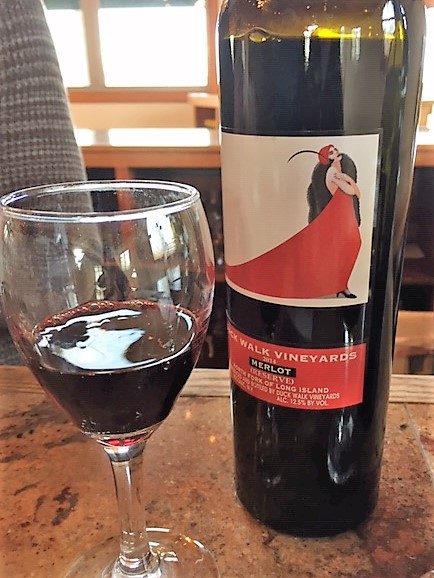
  1. 2014 Merlot Reserve   $38.95

Once again, we get an extra.  This time, a taste of the reserve merlot.  The aroma is complex, with notes of plum, cherry, and tobacco (which my husband calls ash).  However, the aroma promises more than the taste delivers, though this is a good, dry, drinkable red.  Not a lot of tannins.

  1. 2015 Malbec   $16.95

Although malbec is most often used as part of a mixture of grapes, I tend to enjoy it on its own as well.  The color of this is a beautiful dark red, and the aroma is also dark, of dark fruits like plums.  We like the taste, which is dry and tannic, with enough fruit that it would be fine to sip or have with steak.

img_6078

The White Port is so new it wasn’t on the menu.

  1. 2010 White Port

I can’t tell you the price of this because it is not yet on the menu.  Another extra treat!  Duck Walk often features their blueberry port, which is actually made with blueberries, so this is a departure for them.  The aroma is nutty, and it would actually taste good with nuts.  I taste some gooseberry taste, (and then we decide that next summer when Briermere sells gooseberries we will have to buy them again).  Nice after-dinner sipper.

img_6079

If you like Sambuca you’ll like Absenthe.

  1. Absenthe   $29.95, $5 per taste

We happen to have a bottle of absinthe we hand imported from the Czech Republic a while ago, so as I tasted this Duck Walk version, I looked forward to comparing it to the historical drink.  Supposedly, absinthe used to be made with wormwood and was highly addictive as well as causing hallucinations.  That’s no longer the case, so it is safe to sip.  In the Czech Republic there is a whole ceremony to drinking absinthe, involving mixing sugar and a bit of absinthe on a spoon, igniting it, and then, as the sugar liquifies, blowing out the flame (important step!) and pouring it into the glass.  No sweetening is necessary with the Duck Walk Absenthe, which is quite sweet, almost syrupy, and tastes very strongly of black licorice.  If you like Sambuca, you’ll like this.  After I went home—and recovered from all that drinking!—I tried our absinthe.  It is not at all sweet or syrupy, though it does have a licorice taste plus a beautiful green color, and is quite strong (70% alcohol).

img_6083

Reasons to visit:  it is winter, and you want to check out a winery that is too crowded in the summer; the Sauvignon Blanc, the Rosé, the Pinot Meunier, and the Cabernet Sauvignon Reserve; they allow dogs (outside) and snacks; pretty labels; reasonable prices; beer on tap in case you’re with someone who doesn’t want wine (why?).

Laurel Lake: Chile But Not Chilly November 18, 2018

Laurel Lake:  Chile But Not Chilly               November 18, 2018

www.llwines.com

The weather outside was chilly, and the winemaker is from Chile, but our welcome was quite warm when we walked into the Laurel Lake tasting room on a quiet Sunday afternoon. Our server, Maureen, recognized us from previous visits—especially the notebook—and had time to chat with us, exchanging bits of wine country gossip.  She also introduced us to the charming Chilean winemaker, Juan Sepúlveda, who was pleased to discuss his wines with us.

 As we stood at the bar, we noticed that behind us a large party was happily sharing a meal and some bottles of wine, and another group was out on the enclosed porch.  One of those groups was a club of classic Cadillac owners, whose cars were lined up in the parking lot. Maureen told us that they also host a group of Corvette owners who come once a year, and we remembered one time when we had thought to stop in but found the parking lot filled with Corvettes. Now we knew why.

All of these Cadiallacs were not in the parking lot by coincidence.

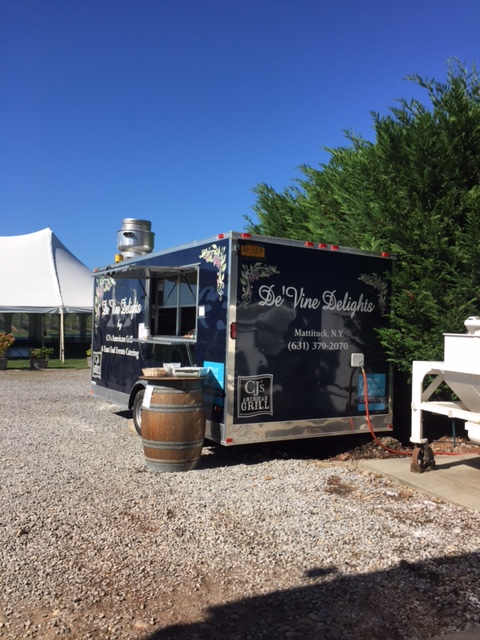
 The last time we were here it was a warm day in September,and the food truck was in operation. However, the winery is coping with Southold Town’s crackdown on food trucks, so now if you want food they will order it for you from CJ’s restaurant, just down the street in the Mattituck shopping center. 

A standard tasting consists of four wines for $16, and we decided to share a tasting, which means we could go back and do another tasting and have all different wines.  We were, however, perfectly happy with our choices.

  1.  2016Pinot Gris               $22.99                                                                               I smell citrus and flowers.  The wine tastes fruitier than some pinot gris(a.k.a. pinot grigio), but still dry and light. It is soft and tasty enough to sip on its own. 
  2. 2017Sauvignon Blanc                 $22.99

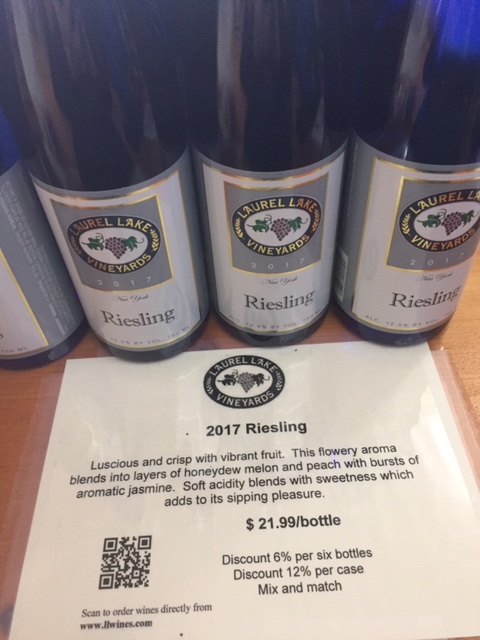
This is another light white, dry and citrusy, and, like most North Fork sauvignon blancs, would go well with oysters.  We had thought to taste the gewürztraminer, but Maureen warned us that we might find it too sweet.  She also mentioned that their best-selling white is the somewhat sweet riesling, which is why they keep a supply next to the cash register.

They keep a supply of their best seller–the reisling–next to the cash register.

3.  2014 Merlot Estate         $21.99

I feel that if there is a merlot, one should try it, since it is such a basic North Fork red.  The aroma combines the expected cherry plus a touch of smokiness.  This is a relatively light merlot, with tastes of cherry, prunes, and vanilla.  Relatively simple, it is a good burger wine.

4. 2012Cabernet Sauvignon Reserve          $28.99

Aged in French oak, this had a lovely fruity aroma and taste, with a long finish and some complexity.  It has enough tannins that I think you could age it a bit longer, and it could stand up to a nice steak.  Very drinkable, we conclude.

5.  2013 Meritage                 ($59.99on the menu for the 2010)

I know, the menu says four tastes, but once again the book and our seriousness get us an extra.  The Meritage is a combination of cabernet sauvignon, merlot, cabernet franc, sangiovese, and syrah, and she pours our taste out of an unlabeled bottle because officially the wine is still in the barrel.  Wow.  My notes characterize the aroma as “yummy.”  I taste lots of fruit, some nutmeg, and cassis.  Lots of tannins.  It is worth the price, especially if you keepit for a few years, but we are currently not in the market for a fancy red.

This is their most expensive wine, and no, they are not pouring tastes of it!

Reasons to visit:  Pleasant tasting room, and lovely outdoor area in the summer; we liked all the wines, but especially the pinot gris and the cabernet sauvignon reserve; the chance to chat with the winemaker if he is around; dogs are allowed in the outdoor area; small but amusing selection of wine-related gifts.:

They have a small selection of wine-related gifts.
This was my favorite one.
You can see the porch off to the side, and in addition in warm weather there’s a shaded outdoor area.

Pugliese Vineyards: Crowd Pleaser March 10, 2018

http://pugliesevineyards.com/

IMG_4951

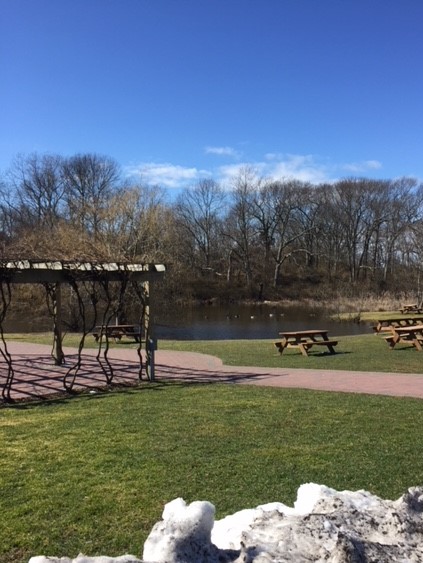
The pergola and pond make a pretty outdoor setting–but not in the winter!

We’ve driven past Pugliese many times in the summer, noting the crowds at the outdoor tables and the many limos (by appointment only) in the parking lot, and given it a pass.  But we figured a March Saturday would be safe, and indeed, when we entered, there was only one other couple there.  However, as we were leaving the first of what the servers told us would be several groups arrived, a bunch of bachelorettes in matching burgundy sweatshirts emblazoned with wine-related quips, with the bride-to-be in a matching white sweatshirt.  “Rise and wine,” read the one on a cheery woman, who informed us that this was already (at 2 PM) their third winery.

IMG_4969

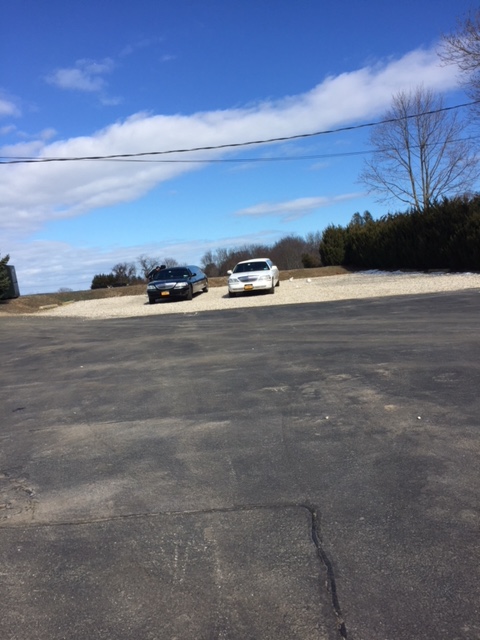
The limos were starting to gather.

If we hadn’t been on our way out, I would have recommended that they start with the sparkling Blanc de Noir, which was one of the wines we did like, and would have been a suitably festive start to their tasting.  But I would guess that many of the wines on the Pugliese menu are crowd-pleasers, as they are generally un-challenging and easy to drink, as well as moderately priced.


For $12 you can choose any four wines on their extensive menu of four sparkling wines, seven whites (including one rosé), seven reds, and five dessert wines.  We decided to share two tastings, trying one sparkler, the rosé, two whites, and four reds.  As we sipped we admired the view out the window of Pugliese’s pretty grounds, with a vine-covered pergola and a fountain-centered pond.  It would be a nice place to bring a picnic in the summer, though they discourage food in the tasting room itself (and a sign on the door admonishes “No Pets”).  (One server remembered a group that brought a huge cake with them, and left “crumbs everywhere.”)

IMG_4958

One view of the tasting rooms.

The tasting room itself is not huge, but there is a side room with tables.  That space is lined with tables laden with gift baskets, which feature the pretty flower-decorated bottles of Pugliese wines and hand-painted wine or champagne glasses, all wrapped up in cellophane.  If you need to pick up a gift basket in a hurry, this is the place.  They also have a selection of matted photographs, mostly of local nature scenes, for sale at reasonable prices.

IMG_4956

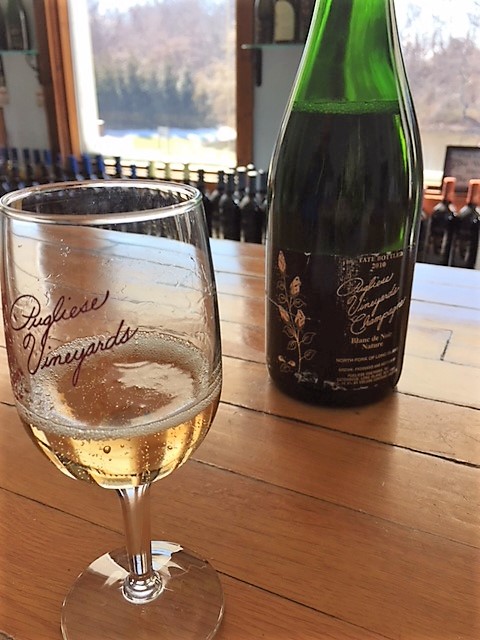
Nice bubbles in the bubbly

  1. 2010 Blanc de Noir Nature         $25.99

Made from 100% pinot noir grapes (all their grapes are grown on their estate, we were informed), this has the typical yeasty aroma of a champagne.  It is a pleasant sparkler, not complicated, with nice bubbles and a bready flavor.  It would work for a toast (no pun intended!).

IMG_4957

We enjoyed the view as we sipped.

  1. 2014 Pinot Grigio $17.99

At first, I didn’t detect any aroma, but on a second sniff I decided it smelled like clover honey, plus minerals.  It also tastes a bit like honey that has somehow had the sweetness removed from it, or like a tart dish that has been flavored with honey.  My husband complained that it was “watery,” and I agreed that it was very light.  Not a sipper, it needs to go with food, maybe charcuterie, though it has so little flavor most food would overwhelm it.

IMG_4959

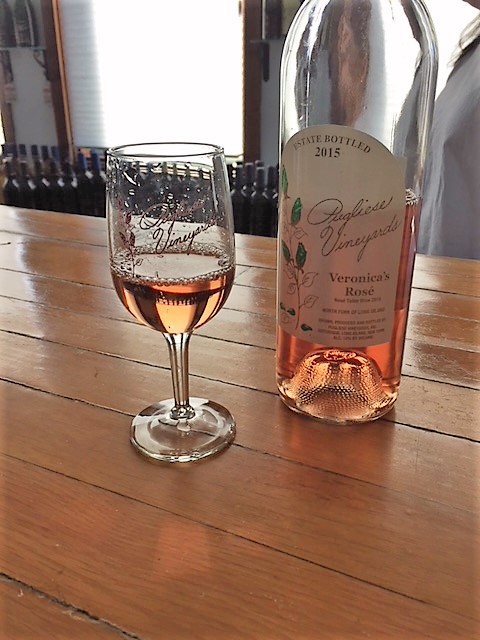
  1. 2015 Veronica’s Rosé $17.99

Why Veronica?  “I wanted to name a wine after my niece,” said one server, who was most likely a member of the Pugliese family, since they are generally in the tasting room.  This is another light, dry wine, with typical strawberry aroma and flavor, again not complex.  It has a pretty pink color from the merlot grapes.

IMG_4964

I commented on the pretty labels, and was thanked. On a previous visit I was told that Pat Pugliese painted the design.

  1. 2016 Chardonnay Gold $14.99

They have an oak-fermented chard, but we decided to go with the steel, since we tend to prefer those.  I was also thinking if we liked it we’d buy a bottle, to go with the fish we planned to buy at Braun’s later.  However, we cancelled the trip to Braun’s when we realized we’d be stuck in the Cutchogue St. Patrick’s Day parade, and, though we found the chardonnay pleasant, we didn’t like it enough to buy it.  (Instead we stopped at 8 Hands Farm and picked up some of their delicious bratwurst.)  Though the chard is a bit sweet, it is balanced by good fruit flavors of citrus, mango, and pineapple.  My tasting buddy says it would have gone well with a dish I made a couple of days ago, called Chicken Veronique, chicken breasts cooked with grapes and mushrooms.

IMG_4965

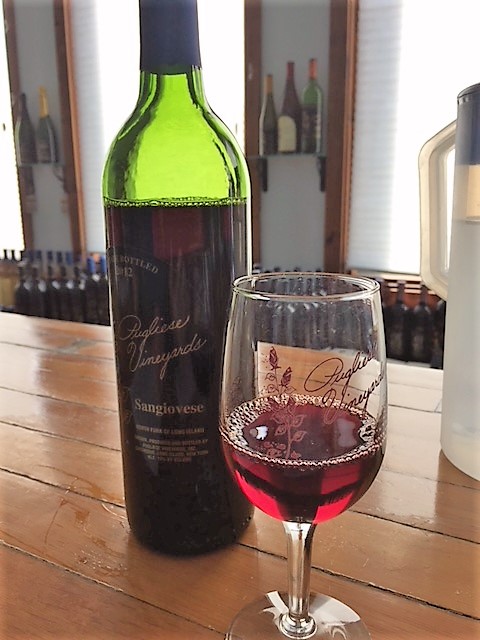
The grape is the one used to make chianti, but this is not a very chianti-like wine.

  1. 2012 Sangiovese $16.99

I was interested to taste this, as it is advertised on the menu as “Long Island’s only chianti.”  I like chianti.  I wouldn’t have necessarily identified this as a chianti, however, and, considering that 2012 was supposed to have been a good year for reds on the North Fork, this was a rather disappointing wine.  However, it is drinkable, with no tannins, very light and dry.  Not much fruit.  My husband says it has “no oomph,” sort of a “generic wine.”  It would be okay with pizza.

IMG_4966

  1. 2014 Cabernet Franc $16.99

Their reds certainly are reasonably priced for the North Fork.  This is another light, easy to drink wine, with no tannins.  You get a bit of fruit with the first sip, but the taste soon evanesces.  You could pair this with pasta with a not-powerful sauce.

IMG_4967

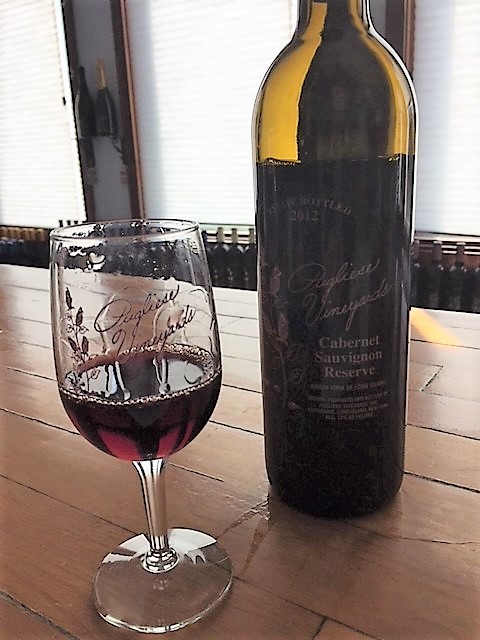
  1. 2012 Cabernet Sauvignon Reserve $16.99

Nice aroma of dark fruit and berries precedes a taste also of dark fruit and berries, with a touch of tannins.  It’s the best red so far, but again has no depth and is rather light.

IMG_4968

  1. 2013 Sunset Meritage $34.99

Why sunset?  “It’s just a name.”  You need a non-varietal name for a blend, which this is, a mixture of merlot, cabernet franc, and cabernet sauvignon.  It’s the best red of the day, which is not saying much.  Again, it is a relatively simple, light wine, “tame,” according to my drinking pal.  It is pleasant, but not worth the price.

IMG_4952

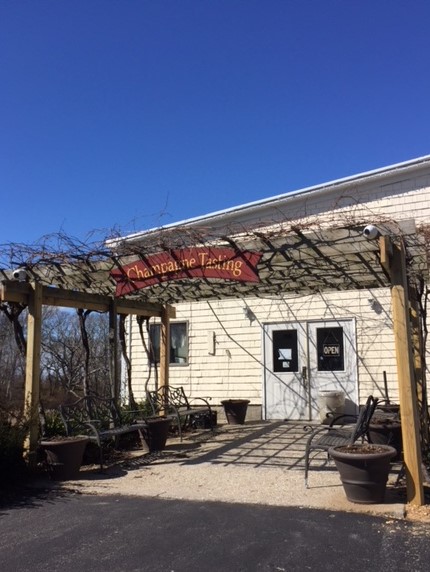
Entrance–the little signs say no food inside and no pets inside–which I assume means both are okay outside.

Reasons to visit:  pretty setting for sitting outside; very crowd-friendly if you’re coming with a limo (which I actually did one time); lots of choices on the menu; the Blanc de Noir, the Chardonnay Gold, the Sunset Meritage; you prefer light, easy-to-drink wines with no complexity; lots of gift baskets and hand-painted glasses.

IMG_4970


Laurel Lake:  A Festive Day          September 23, 2017

http://www.llwines.com/

IMG_4372

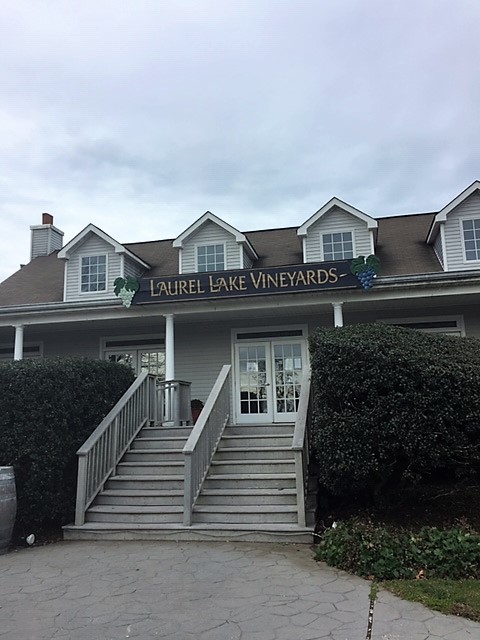
The winery building is quite pretty.

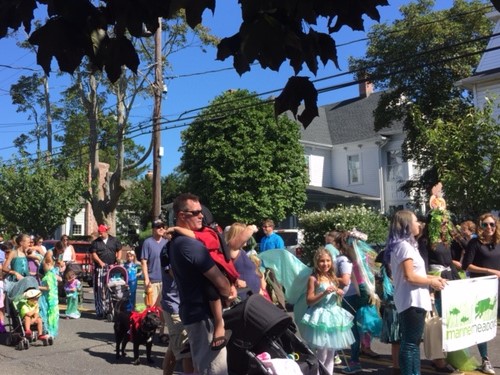
We had been to the Greenport Maritime Festival, where we watched pint-size mermaids parade and cruised past booths offering art, food, lavender, and more.  Now it was time to continue the festive mood by bringing our guests to a winery, and we decided on Laurel Lake, which we had not been to in more than a year.  One reason we hadn’t been there sooner was that the last time we tried to go they were about to close for a wedding.  This time they were also going to close for a wedding, but we had more than an hour for our tasting, so in we went.

IMG_4397

The tent was being prepared for a wedding party.

The tasting room is pleasant, with an antique bar at one end and plenty of tables, all of which were empty.  We opined that everyone on the North Fork was probably at the Greenport Festival or apple picking at Harbes.  Then the server behind the bar suggested we seat ourselves near the outside bar, where we had never been.  Out we went, to find long tables in the shade, a few more customers, and a very genial server who timed his visits to our table perfectly.  A look at the attractively rustic setting made it clear why people favor Laurel Lake as a wedding venue.  A food truck run by CJ’s restaurant was parked near us, but we had already had lunch in Greenport.

IMG_4380

There is a food truck on the premises, so they request that you not bring your own food.

Laurel Lake offers an extensive menu, of seven whites and nine reds, and a tasting consists of four tastes for $15.  By some judicious selecting and sharing, our group of six was able to taste many of the offerings.  Each couple shared a tasting, and then we gave each other sips.  Overall, we tended to prefer the whites to the reds, but the reds do have the advantage, rare on the North Fork, of being mostly reasonably priced.  One nice touch—our server brought us clean glasses for each taste.  That’s such a great idea.  So often they either pour the next taste right into your glass, where it may be affected by the previous wine, or they rinse it with water, which runs the risk of wine that tastes like chlorine.  One other clever method is when they rinse your glass with a few drops of the next taste, though that seems a tad wasteful to me.  I hate to see wine being poured into a dump bucket!

IMG_4374

The tasting room.

  1. 2016 Pinot Gris              $22.99

We hadn’t yet settled on a sharing method, so two of us ordered this.  I tend to like pinot gris (a.k.a. pinot grigio), and this one was no exception.  It smells a bit like pineapple juice, and tastes a bit like it, too. It is tart, with notes of mineral and salt.  Our daughter-in-law, who is good at thinking about wine and food pairings, thought it would go well with something made with capers.  How about smoked salmon with capers, we asked.  Yes.  Very buyable.

IMG_4378

They give you a good-sized pour, so all six of us could share tastes.

  1. 2014 Chardonnay Estate Reserve $23.99

Their oak aged chard, this has the expected aromas of vanilla and wood or caramel, with some citrus flavors.  Interestingly, this one also tasted of pineapple, but in this case of very ripe pineapple.  Food pairing?  How about pork with pineapple.

IMG_4383

The outside bar.

  1. 2016 Sauvignon Blanc $22.99

This new release is light, crisp, and lemony, with some tastes of grilled peaches.  A nice summer wine, it might pair well with a salad with grilled peaches.

IMG_4379

  1. 2014 Gewürztraminer $22.99

Our server informed us that this is their “third sweetest white.”  Though I am not a fan of sweet wines, this one is well-balanced enough that, with, let us say, spicy Thai food, it would be fine.  I smell flowers and something metallic, and taste oranges.

  1. Moscato Sparkling $24.99

One member of our group prefers sweet wines to dry, and he was very pleased with this sparkler.  It is sweet, with strawberry and melon tastes and a candy-like aroma.  Perhaps one could drink it with a chocolate soufflé?

IMG_4384

  1. Wind Song Red $17.99

Fair warning—we are told this is their sweetest red.  Our server explains that they make it by blending all the leftovers from other wines, and it has no vintage because it could contain juice from various years.  I would say this was not a successful blend, as it has a somewhat medicinal taste, like Cheracol cough syrup.

IMG_4385

  1. 2013 Pinot Noir Reserve $29.99

Another newly bottled release, this was aged in used oak barrels, so it does not have the flavors you get from oak.  Some say the nice aspect of this is you get the pure taste of the grape.  We find it rather flat and one-dimensional, though not unpleasant.  Perhaps one could drink this with molé, as it is a light red.  Not caring for this or the previous red, our guests try their own blend, mixing the two.  Not a success.

IMG_4388

My favorite of these was the Syrah.

  1. 2012 Merlot Estate $19.99

Better.  Whew.  A pretty typical oak-aged merlot, with cherry aromas and taste and some tannins.

  1. 2013 Syrah $19.99

Two-thirds of us agree that we like this one.  It has tastes of plums, pepper, and nutmeg, plus some nice tannins.  Someone suggested pairing it with moussaka.  Sounds good to me.

IMG_4398

  1. 2012 Cabernet Sauvignon $19.99

Interestingly, this is aged in steel.  It is an easy to drink, fresh-tasting pizza wine, with soft tannins, and fruity aromas and tastes.

  1. 2011 Cabernet Sauvignon Reserve $25.99

As the afternoon progressed, our server became more and more chatty, and he described the interesting method used to make this wine.  They take two-thirds of the cab sauv to make rosé, and they take the skins from that plus the rest of the grapes to make this wine, which is then aged in used oak.  It has a “dark richness,” said someone, not sure who.  It is dry, not as fruity as you might expect given how it is made, with some nice tannins.  I wonder how it would age.

IMG_4399

They have a small selection of wine-related gift items.

Reasons to visit:  pretty setting, inside and out; the Pinot Gris, the Sauvignon Blanc, the Syrah, the Cabernet Sauvignon; reasonably priced wines for Long Island, especially the reds; food truck.

IMG_4377 (1)

Our server did a good job of explaining each wine.

IMG_4401

IMG_4373

The top floor of the two-level outdoor area.

IMG_4367

Mermaids on parade!

Castello di Borghese: A Perfect Pairing     July 8, 2017

https://castellodiborghese.com/

IMG_4052

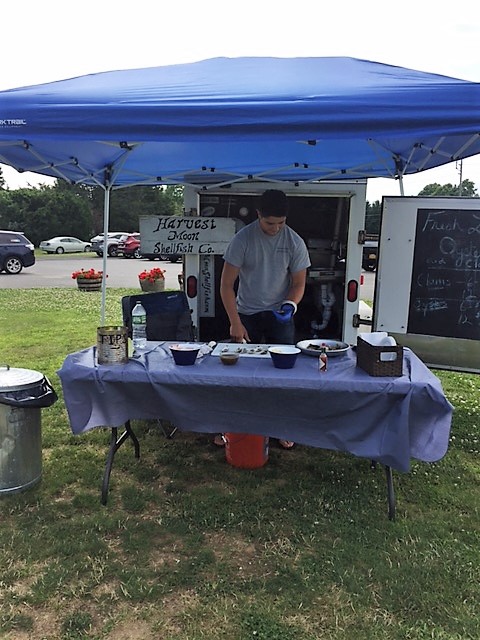
The Harvest Moon Shellfish Company truck is a sign that you should stop by Castello di Borghese for some oysters and wine.

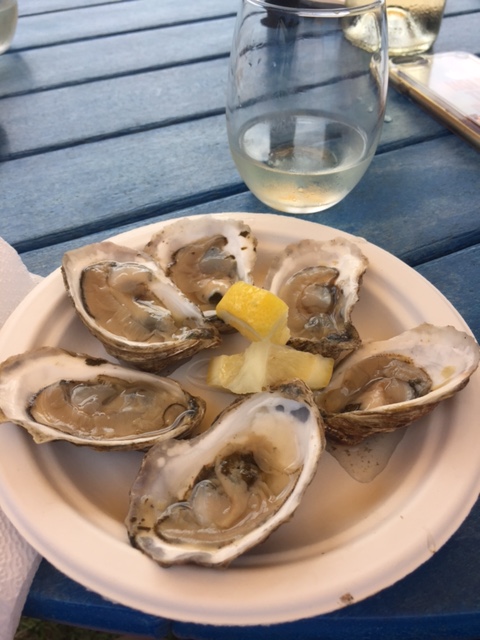
I headlined this entry “A Perfect Pairing,” thinking about the Harvest Moon oysters we had with the Borghese 2016 Sauvignon Blanc, but it could also apply to the couple we went there with—our son and daughter-in-law.  We all enjoyed the oysters, which are on offer every weekend until October 1, for $28 a dozen, and the wine, which went perfectly with them.  The oysters were small, but sweet and briny and creamy, and the lemon in the wine complemented them beautifully.  It was a perfect July day, and we were happy to sit outside near the vines and enjoy our bottle of wine and plates of oysters.  Unfortunately, they don’t do tastings outside, so we had to go in when we decided we wanted to do a tasting as well.  (I also would urge the winery to install an attractive fence to screen the hose, etc., along the wall of the building.)

IMG_4043

A view of the outside seating area.

When we went in to examine the tasting menu, we found two options:  five Estate wines for $15, or five Reserve wines for $25.  We decided each couple would share one of each, so we could taste most of their wines, though we did miss a few.  Our server was enthusiastic and knowledgeable, happy to share both what he knew and what he liked about each wine.  The tasting room is about medium in size, with a bar along one wall and barrels with tops one can stand around on the other, so if you want to sit for a tasting this is not your place.  Also, they don’t allow outside food (at least at the moment, when they are featuring the oysters).  This is a winery which takes its wine very seriously, and is happy when visitors do the same. After all, the Borgheses bought the vineyard from the Hargraves, who were the first to plant a vineyard on the North Fork, back in 1973.  The Estate wines are marked with an *.

IMG_4029

IMG_4026

The expert shucker from Harvest Moon.

  1. .* 2015 Chardonnay $18

A good place to begin a tasting is this steel fermented chardonnay which is so light and lemony you might mistake it for a sauvignon blanc.  We smelled mineral and peach and toast aromas and one of us suggested it tasted like star fruit.  Our daughter-in-law, who is thoughtful about food and wine pairings, thought it would go well with Greek food or a corn salad.  We agreed.

  1. 2016 Founder’s Field Sauvignon Blanc $29

This is not the Sauvignon Blanc we had with our oysters—that one is cheaper and we actually liked it better.  This one is fermented half in oak and half in steel.  It is light and dry, with some citrus and melon tastes and a long finish.  “Blue cheese,” we agreed, would go well with it.

IMG_4031

  1. .*2014 Riesling $26

Not unexpectedly, this smells like flowers and cat pee.  Though our server described it as “off dry,” we all found it too sweet for our taste.  Our son and daughter-in-law said it tasted just like “sweet lime,” which I’ve never had, but I trust their taste buds, and thought it could pair well with watermelon juice and tequila in a margarita-type cocktail.

IMG_4045

  1. 2014 Pinot Noir Select $50

We switched to the reds on the Reserve list, as there were no other whites we wanted to try and they have quite a few reds.  The aroma is nice, of dark fruits, and the taste is also pleasant, with some notes of black pepper as well as plums.  It reminded us a bit of a Chianti, and so we thought it would go well with pasta.

  1. .*Rosé Pinot Noir $20

At the urging of our server, our tasting companions sampled this rosé (we had been given a sip of another one as we were trying to choose a wine to go with our oysters).  However, they were “not excited” about it.  Steel fermented, this is an uncomplicated dry rosé, with a taste of macerated strawberry that, I said, “evanesces.”   We then began to apply that word to all sorts of things.

IMG_4033

  1. 2015 Merlot Reserve $36

We found lots of aromas in this one—spice, pomegranate, charred wood, prunes, and, believe it or not, barbequed chicken were some of our comments.  So then of course we decided it would pair well with barbequed chicken, one with a fruity sauce.  Nice finish.

IMG_4032

  1. .*2014 Cabernet Franc $35

Good one!  With aromas of prune plum and cedar, and tastes of blueberry and spice, this one got us thinking of food pairings again.  We thought lamb chops, and then our daughter-in-law offered flank steak with chimichurri sauce or spiced chick peas (for vegetarians).  Also good ideas.

IMG_4034

  1. .*2015 Merlot/Cabernet Sauvignon $25

A Bordeaux-style blend of 53% merlot, 44% cabernet sauvignon, and 3% pinot noir, this is, according to our server, a very popular wine.  We can see why.  The aroma is earthy and herbal, with scents of chestnuts and fruit, and the taste is equally appealing, with lots of fruit, and just the right amount of dryness.  Food pairing?  How about spaghetti with mussels in a tomato sauce.

  1. 2014 Cabernet Franc Reserve $44

You can definitely smell that this was aged in oak, with its cedar/oak aroma, plus fruit, spice, and something funky like mushrooms.  I decide it is mouth-watering.  It has lots of flavor, with dark fruits, and would go well with duck.

  1. 2014 Cabernet Sauvignon Reserve $44

Our server now gets into the whole food pairing thing we’ve been doing, and suggests this would go well with “a porterhouse on the grill.”  We talk it over, and once again our daughter-in-law has the perfect pairing idea—hamburger with truffle fries.  One of us compares the aroma to “dusty closet.”  Not sure about that.  However, this is another pleasant red, with nice fruit, though not very complex.

IMG_4048

The winery also has an art gallery.

IMG_4049

The art in the gallery.

Reasons to visit:  a place to get serious about wine; oysters from Harvest moon until October 1; the winery also has an art gallery where you can view and buy local art; the Sauvignon Blanc, the Pinot Noir Select, the Cabernet Franc, the Merlot/Cabernet Sauvignon blend, the Cabernet Franc Reserve.

IMG_4042

IMG_4053

Laurel Lake: The Personal Touch May 14, 2016

http://www.llwines.com/

IMG_2648

Juan sat down next to us at the bar and explained his ideas about winemaking.  Although there were several large groups at Laurel Lake, and Juan was actively helping to serve them, he and the servers behind the bar also took the time to answer our questions and solicit our opinions about the wines—which were largely favorable except for one, which I will discuss later.  Introduced to us as “our winemaker from Chile,” Juan told us that he enjoys talking to customers and finding out what they do and do not like about his wines.  “The wines reflect the personality of the winemaker,” he told us, including whether the winemaker is a man or a woman.  If so, then Laurel Lake’s wines should be outgoing and friendly and easy to like.

The main tasting room manages to be both spacious and cozy.

The main tasting room manages to be both spacious and cozy.

The menu offers flights of four tastes for $15, of a fairly generous pour, out of seven whites and nine reds.  We opted to share a flight of whites and a flight of reds, skipping, for example, the rosé and the moscato.  We also skipped the riesling, which we noticed comes in a pretty blue bottle.  That price has actually gone down from our last visit, in 2014, when it was three tastes for $15.  In general, the prices for the wines are quite reasonable.  We noticed people eating snacks brought from home, although once their food truck arrives Laurel Lake no longer permits outside snacks.

The music group on the porch, with a view of a group enjoying the warm weather outside.

The music group on the porch, with a view of a group enjoying the warm weather outside.

As we sipped, a music group set up in the large porch to one side of the attractive tasting room.  The large groups also headed outside, so the main room remained relatively calm.  We also noted a small but amusing collection of wine-related gifts.

Some of the gift items

Some of the gift items

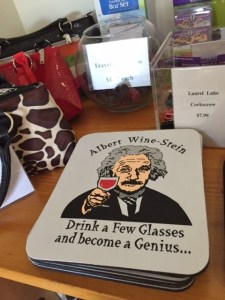
We don't need a mouse pad, but if we did...

We don’t need a mouse pad, but if we did…

  1. 2015 Pinot Gris                                $21.99

Pinot Gris is the French equivalent of Pinot Grigio, one of my frequent choices when opting for a glass of house white, as it tends to be reliably dry.  I would be perfectly happy if I had gotten this as a glass of house wine, as it is dry and mineral-y, with a touch of sweet fruit.  It smells a bit like asparagus, we decide, wondering if our current diet of local asparagus has influenced that thought.  Lobster bisque, we decide, would be a perfect pairing.

  1. 2014 Chardonnay $18.99

This is their steel fermented chard, with an aroma of not-quite-ripe pineapple and some mineral.  The taste is again a combination of dry and a touch of sweetness, and fades quickly.  Evanescent, we say.  As the wine warms a bit in the glass we also taste a hint of pineapple or tropical fruit.  We note that people coming to the bar are quite insistent about wanting their wines really cold.  We prefer wines not quite as cold, so you can really taste them.  I decide that chicken cordon bleu would be a good accompaniment.

The pour is fairly generous.

The pour is fairly generous.

  1. 2013 Chardonnay Estate Reserve $23.99

The tasting notes inform us that this spends 12 months in oak, and we have a discussion with one of our servers about preferences for oaked vs. non-oaked chards.  “Which do you like?” she asks, and we realize that it depends.  In general, we don’t like the really heavy buttery taste and texture of a heavily oaked chard, but a bit of oakiness is often quite pleasant.  As is this wine.  If you like Long Island chardonnays you should like this one, with its slightly vanilla smell and touch of citrus and tropical fruit taste.  Nice long finish, too.

  1. 2014 Gewürztraminer $22.99

It could be an aperitif wine, or a dessert wine, or a wine to have with blue cheese and charcuterie, we decide, but it is a bit too sweet to enjoy just by itself.  The tasting notes say to have this with spicy food, a frequent recommendation for sweeter wines, but we feel you’d lose some of the subtlety of this wine if you did.  The aroma is complex, as is the taste.

  1. Wind Song Red $17.99

The tasting notes say this is “like a nice Chianti.”  I don’t think so!  We feel quite misled by the note, which is an issue we take up with Juan, who sheepishly admits they were written for a previous iteration of this blend.  They needed an inexpensive red crowd pleaser for the menu, hence this wine, the only one that has us looking around for a dump bucket.  A blend of merlot, syrah and a “mystery ingredient,” which, after a guessing game, Juan admits is chardonnay (!), this is quite a sweet red.  We compare it to red candy or fruit salad.  Fresh glasses with most tastes, by the way.

IMG_2641

  1. 2012 Pinot Noir Reserve $29.99

We’ve been on a raspberry pie kick at Briermere recently, with raspberry peach last week and raspberry plum this, and the wine smells to us like those pies.   With 18 months in oak, this has some tannins at the end, and is a fairly light red.  I could see it with veal chops.

  1. 2011 Syrah $19.99

My husband refrains from singing “Que sera, sera” when we choose this wine, for which I am grateful.  This is our favorite of the day, with delicious aromas of dark fruit and rich tastes of dried plum (a.k.a. prune) and other fruits.  It would go well with pastas and meats, and we decide to buy a bottle.

One cabernet

One cabernet

And the other cab

And the other cab

  1. 2011 Cabernet Sauvignon and 2011 Cabernet Sauvignon Reserve $25.99

Our server, having engaged us in various discussions of our choices, asks if we would like to divide our final taste between the steel fermented cab sauv and the oaked one.  Sure, we’re always up for that sort of interesting comparison.  The steel cab has a funky aroma and is very dry and tannic, really rather austere.  The Reserve is interesting and complex, also dry and tannic, with tastes of black raspberry and maybe a few other flavors.  We buy a bottle of that, too.
Reasons to visit:  an intimate space that also has ample room on the porch and outside for groups; the chance to chat with Juan or the very friendly and knowledgeable servers; the Pinot Gris, the Syrah, and the Cabernet Sauvignon Reserve; reasonably priced wines for Long Island.  While we were there, the owner of CJ’s American Grill came in and we noted that we like their wine policy, which is to feature local wines at a moderate price.  Oh, and yes, the wines are outgoing and friendly and easy to like.

Nice decor

Nice decor

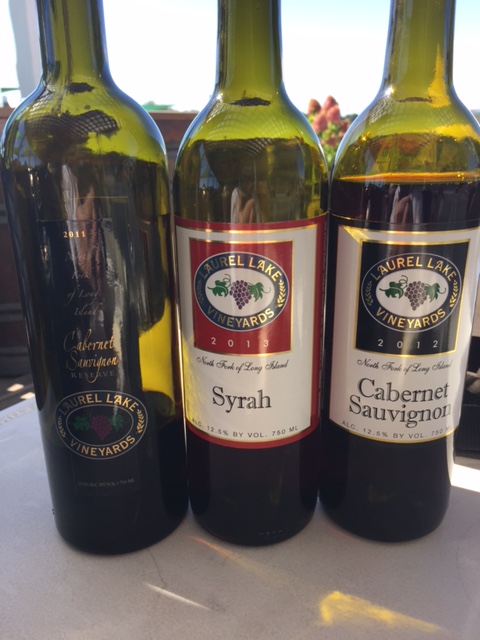
We liked the syrah.

We liked the syrah.

We indeed felt welcome.

We indeed felt welcome.

IMG_2651

Sign of spring!

Sign of spring!