RGNY: On a Winter’s Day

February 19, 2024

It is quiet on the North Fork in February. Snow fences stretch across fields, farm stands have “See you in the Spring” signs, and roadside platforms have little stacks of firewood, $5 per pile. However, our visitors found plenty to do, including a trip to Tanger and an odyssey to the end of the island, where we had a cold, windy, but invigorating hike along the trail in Orient Point County Park and participated in the Great Backyard Bird Count (34 seagulls, three little ducks, and two immature cormorants).

The end of the North Fork and some birds.

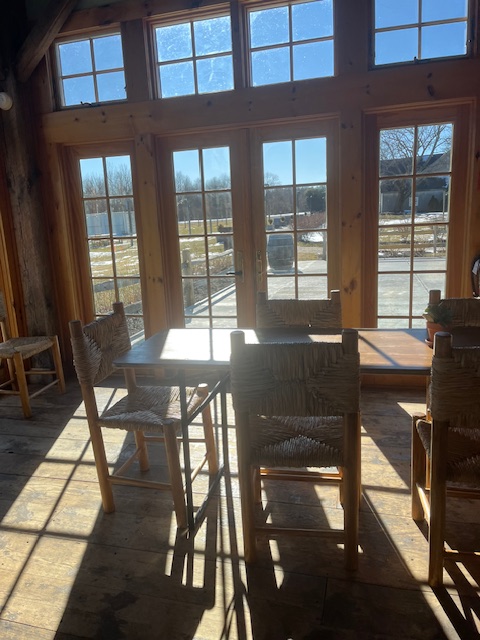
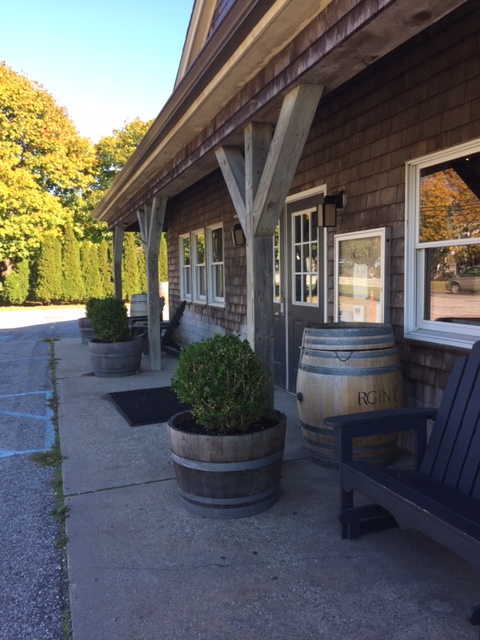
Then it was time to do a wine tasting.  Where to go?  I realized we hadn’t been to RGNY since 2021, and it is close to our house, so off we went.  The main entrance now seems to be the one to the right, as you face the building, so we opened that door and were greeted by John, whom I recognized from other wineries!  He quickly showed our party of six (4 adults, 2 children) to a nice round table in the high-ceilinged, wood-beamed tasting room (which one young guest noted “smells like wood”—sort of like a cabin on a lake), where a QR code on the table sent us to the menus.    

Don’t be fooled by that sunshine; it was cold outside!

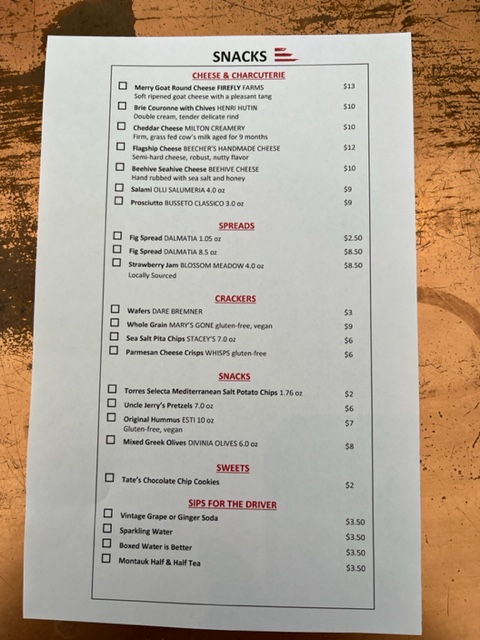
There is a fairly typical menu of snacks, with more substantial choices available on the weekend, but we had just had a delicious and very filling lunch of sandwiches from Ammirati (on Love Lane in Mattituck), so we went straight to the menu of flights.  There are four choices of flights, all featuring four wines: the RG Reserve for $34, the Scielo for $24, the White Wine for $27, or the I (Heart) NY for $27.  Since the last one includes non-North Fork wines, we opted for the first three, planning to do some sharing of tastes.  Well, even with sharing we left some wine in the glasses, because you get a VERY generous pour there.  The youngsters in the group were not forgotten, as Donna, our pleasant waitress, offered them glasses of orange juice—served in tall sparkling-wine glasses—as they had leftover OJ from a brunch on Sunday (no charge!).

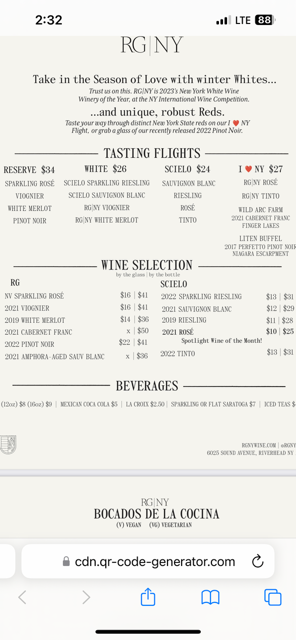
Donna gave us a quick overview of the wines in our tastings—there were a couple of overlaps—and then left us to ourselves, checking back at regular intervals.  At the end, we had an interesting discussion with John about the wine philosophy of RGNY—low intervention, nature-friendly practices.  Overall, there were no wines we disliked, and several we liked very much, though our group had some differences of opinion (As the French say, to each his own.).

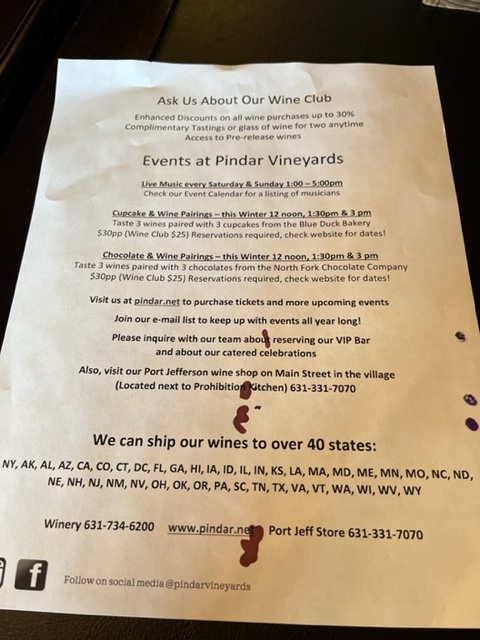
Some of the special events that are available at RGNY.

I started out trying to keep the wines from each tasting separate, but that didn’t work out, so here are the wines as I took note of them.

Tiny cacti decorate every table, perhaps a nod to the Mexican origins of the Rivero Gonzalez family.
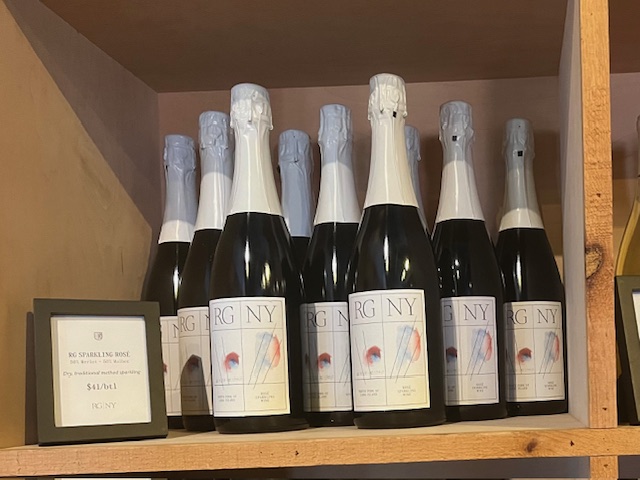
  •  NV Sparkling Rosé        $41

I like starting a tasting with a sparkler, as it feels very festive.  This has the typical rosé aroma and flavor of strawberry, and is dry, with definite minerality and tiny bubbles.  There’s also a slight flowery aroma.  This is a pleasant, cocktail-time bubbly, though I think the price is a bit high.

The Reserve flight
  • 2021 Sauvignon Blanc  $29

“Melon on the nose,” says one of our guests, and I agree, though I try to eschew “wine words.”  Speaking of “eschew,” he also describes the wine as a bit chewy.  It has more body than one would expect from a sauvignon blanc, with what I describe as a silky mouth feel, and a taste of lemon zest.  It is aged in neutral oak. I like it, but our other guest says her appreciation of this wine is lessened due to “unmet expectations,” as it lacks the grassiness she likes in New Zealand sauvignon blancs.  Not being a cow, I’m perfectly happy to drink this. 

  • 2022 Sparkling Riesling               $31

However, she very much likes this next wine, a cloudy (because not disgorged) sparkler with lemon/lime and kiwi flavor, very dry.  I am not as fond of it, but agree it would be good with some local oysters (like the Peconic Bay ones we had the night before) or even fried calamari or fish and chips.

The Scielo flight
  • 2021 Viognier    $41

Donna explained to us that most of the wines here that are aged in wood are aged in second use (also described as neutral) oak barrels, which means that the wood plays less of a role in the taste of the wines than if they had used new barrels.  Though this is only slightly oaked, which smooths it out, it also has not much taste.  I say it is inoffensive.

  • 2019 Riesling    $28

I will almost never order a riesling unless I have tasted it before, since they can be too sweet for me, but this is a riesling I would order.  It is dry, with pleasant minerality and some taste of herbs.  We discuss the typical “cat pee” smell, which one guest suggests could more appetizingly be described as “musky.”  I compare it to the smell of water in which cut flowers have sat perhaps a day too long.  Fortunately, it doesn’t taste like that!

The White Flight: note the cloudiness of the Sparkling Riesling on the left.
  • 2019 White Merlot         $38

We have quite a divergence of opinion on this wine, a white wine made from red wine grapes (Wine color comes from the grape skins, so if you don’t let red wine grape juice sit on the skins at all, you get white wine; sit briefly, rosé; longer, reds.).  My husband doesn’t like it at all, I think it is nice, and one guest notes it has some of that “Long Island foxiness” one used to get more frequently with merlots.  It does have lots of flavor, including some earthiness and an aftertaste of mandarin orange.
  • 2021 Rosé          $25

Strawberry aroma and flavor, light, dry, minerality, pleasant…I say meh.  Still prefer Croteaux!

  • 2022 Pinot Noir               $41

Because this is fermented in steel, not oak, it has a pure, clean taste.  It has a light red color, with surprisingly nice tannins and an aroma and flavor of cherries.  I say this is easy to drink, and it would go well with roast duck, one of our mutual favorite dishes.  Our guest agrees, and notes that “pinot noir and duck are best friends.”

  • 2022 Tinto          $31

Donna rattled off all the grapes in this blend, but I don’t remember them all, or the proportions:  cabernet franc, cabernet sauvignon, merlot, malbec, etc.  This is a lovely red, very refined, with flavors of blackberry and currant, and lots of tannins.  This could definitely stand up to a hearty beef stew, or even a burger.  I could see ordering it if it appeared on a wine list.

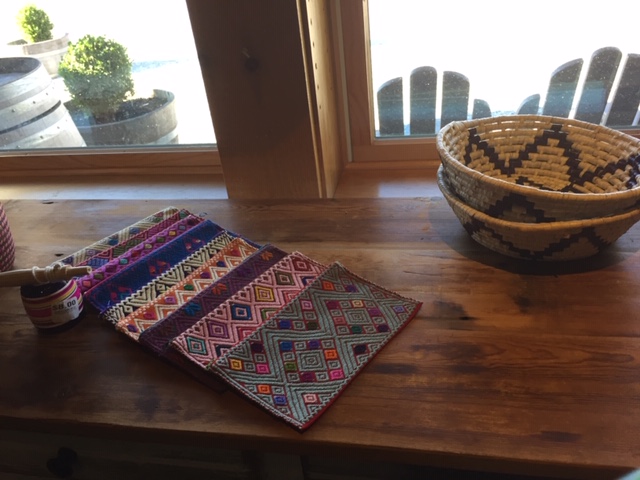
The little gift shop features some objets from Mexico.

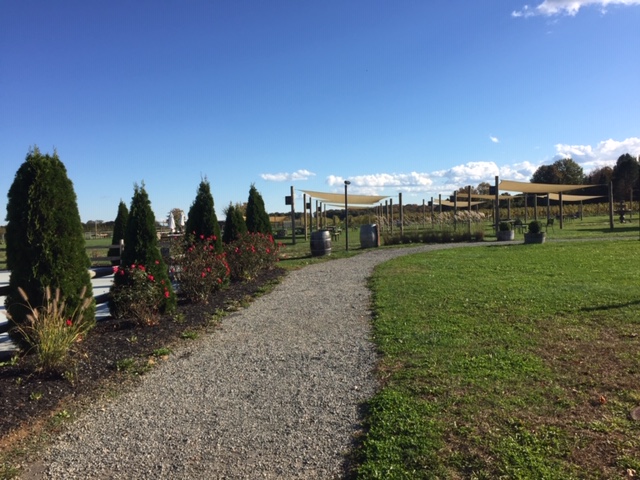
Reasons to visit: spacious tasting rooms, plus ample outdoor areas; child-friendly atmosphere (we were not the only ones there with youngsters); some very good wines, all very drinkable; I especially liked the White Merlot, the Pinot Noir, and the Tinto, while our guests bought to take home the Sparkling Riesling and the Pinot Noir; very generous pour; good menu of snacks and other dishes.  If you do the math, you may be wondering how we had three tastings of four wines each, and I only ended up describing nine of them.  Some wines appeared in more than one tasting!

Here’s a great gift idea–a “blending kit,” so one can produce one’s own blended red. Like a chemistry kit for grown-ups, noted John, who nodded when I compared it to the blend-your-own gin experience at Matchbook Distilling Company.

Pindar Vineyards: Special Day for Locals

March 31, 2023

The day was gray and chilly, but we had a good time anyway.

Pindar is proud of being one of the early vineyards on the North Fork, with their vines planted over 40 years ago.  I came by this bit of knowledge on a free tour and tasting at Pindar, part of an effort by a number of vineyards to attract locals to come and taste their wines.  Friends of ours had noted this program and invited us to join them at Pindar, whose perks seemed the best (other places offered such bargains to locals as ten percent off bottles or two for one).  Good move! We had a good time, learned a lot, and got to taste some wines we then bought and took home.

Nancy is showing us a gewurztraminer vine, one of the original ones planted at Pindar. The roots can go very deep.

Nancy, our tour guide, started us off by the vines, and then took us through all the steps of making wine, from the crush pad to the stainless steel tanks to the French oak barrels to the warehouse, and then back to the tasting room where we got to try five wines.

“Viticulture is farming for masochists,” she informed us, as she explained the work involved in pruning the vines, which she characterized as “an art and a science,” and the perils faced by grape growers.  There are migrating birds who will peck at the grapes, so they look fine but then shrivel into nothing; there are hurricanes on Long Island, whose arrival coincides with harvest season; and there is the lack of crop insurance, because how can you insure for their current value vines that have been growing for over 40 years.  In addition, you have to wait four years after you plant those vines before you can expect to harvest the grapes. The issue of birds has been taken care of, through an ingenious system of nets, which you can see in many vineyards, which remain furled up below the vines and are then raised when the grapes ripen.  As to the other issues…not much one can do about them!

Despite these problems, Pindar has 325 acres of vines, resulting in 60 to 70,000 cases of wine every year.  At first, Dr. Dan Damianos, the visionary who started Pindar (named, like one of his sons, for the classic Greek poet, in homage to their Greek heritage), planted gewürztraminer grapes, judging that the climate and soil would work well for this varietal.  Now they grow twenty-four varietals, and they list twenty-nine different wines on their tasting menu, which includes a number of blends.

The bottling machine, which is about to be replaced by an even better one.

They bottle these wines with their own bottling line, which can do 3,000 a day.  Not every winery has their own bottling facility, with many using Premium Wine Group for this.  Nancy gave a brief lecture on the issue of corks vs. screw caps, with corks reading as “better” wines, and screw caps okay for more casual, cheaper wines. Screw caps work just fine, though corks have the advantage of being biodegradable.

I never knew why the vats have this dimpled jacket.

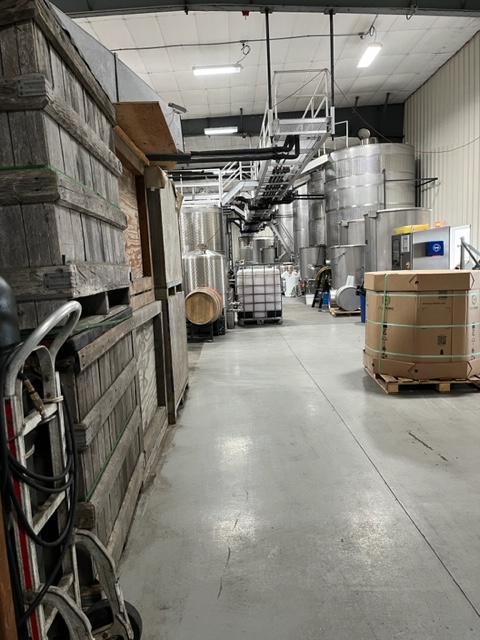
We then walked into a huge room filled with vast stainless steel vats, where Nancy explained something I’d always wondered about.  The vats are partially encases in a dimpled steel jacket.  It is a glycol jacket, containing polyglycol, used to help regulate the temperature in the vats, and the dimples keep the polyglycol from settling to the bottom.  Too hot or too cold, and the wine is ruined.  They use a windmill to provide about 60% of the energy needed in the warehouse and wine “cellar”—not a cellar, because…polyglycol.  We also learned about another hazard of viticulture—carbon dioxide.  As the juice ferments into wine, carbon dioxide rises to the top of the tanks, where the solid matter must be pushed down into the liquid.  Catwalks provide access to the tops of the tanks, and open doors help dissipate the CO2.

Part of the filtration system.

She showed us their filtration system, and we learned, by the way, that Guinness Stout used isinglass, obtained from the bladders of sturgeon, to filter their brew.  I like Guinness, but I also like caviar!

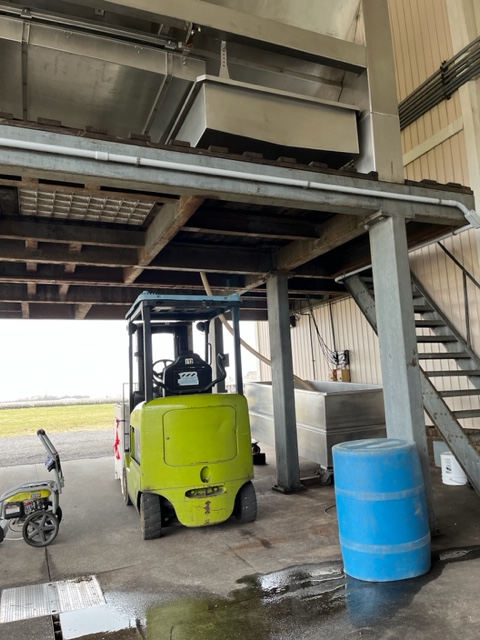
She also took us outside to see the crush pad, where a machine crushes the grapes. Because Pindar is so big, a lot of the work is done by machines.

The crush pad.

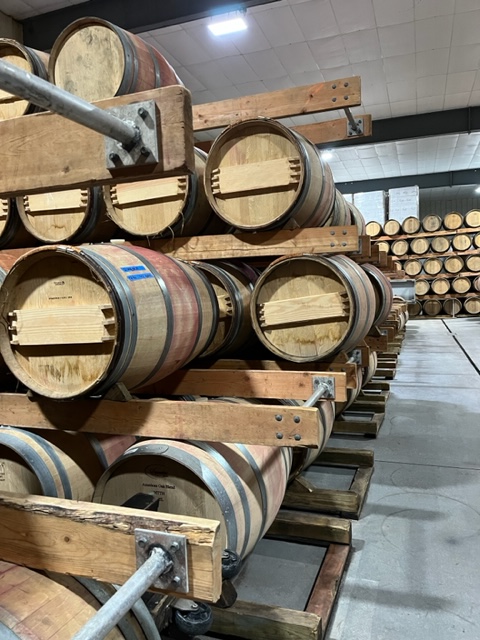
The huge space where red wine ages in French oak barrels smelled enticingly like a forest or lumberyard.  We found out that there are different tastes imparted to wines by French and American oak, with some adding notes of vanilla and others cinnamon, etc.  Pindar now uses only French oak, buying 300 barrels a year, and has phased out their American oak barrels, which they sometimes sell to breweries or to people who want to use them in their gardens.  We also learn about the “angel’s share,” the wine which evaporates from the barrels, meaning they need to be constantly watched and topped up, so that too much oxygen doesn’t turn the wine into vinegar.  The angels must reserve a special place in heaven for wine makers!

Despite the bung stopper, some evaporation is unavoidable.

Finally, our last stop before the tasting room, we saw the warehouse where cases of wine are stacked high.  Nancy held up a four-pack of cans of Winter White, and explained that Dr. Dan, noting the American taste for soda and other sweet drinks, decided to make some sweeter wines, like Winter White, which is the most popular white on Long Island.  More recently, the decision was made to offer it in cans; again, to attract those who might otherwise opt for soda or beer.

Cans of Winter White, ready to go.

Now it was time to taste the fruits of their labor!  The group of about thirty locals lined up around the bar, where glasses stood ready.  Here are my tasting notes:

Nice sized pour.
  •  2020 Dr. Dan’s Selection White Blend      $24.99

Our first taste is a blend of, this vintage, of 53% viognier, plus pinot grigio, sauvignon blanc, and riesling.  The percentages may vary year to year.  This is a very drinkable white, with aromas of pineapple and citrus, and tropical fruit flavors like guava and pineapple.

  • 2021 Dr. Dan’s Selection Gewürztraminer               $24.99

We are quite interested to taste this, after learning the history of the vines, and we quite like it.  In fact, we and our friends each buy a bottle to take home.  It is not too sweet, which can happen with gewürztraminers, with an aroma of peaches and tastes that include tangerine and apricot.  “Yummy,” we and our friends agree.

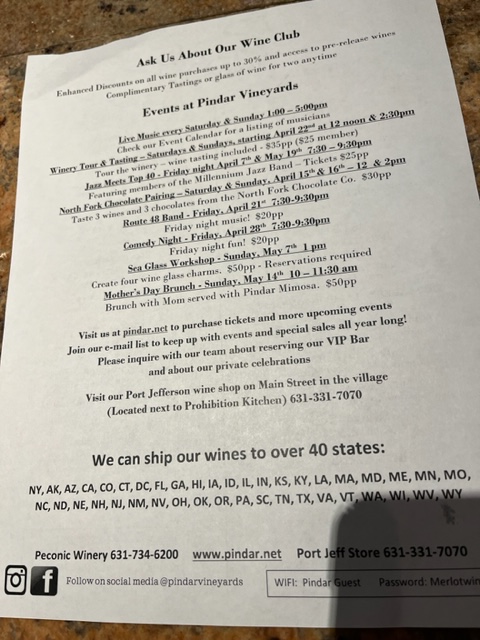
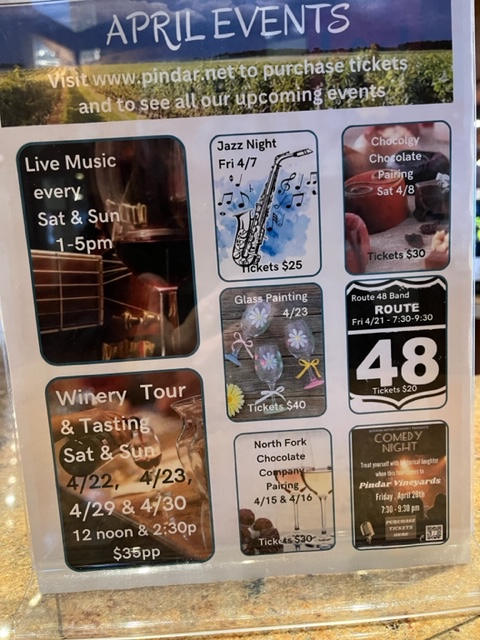
At the tasting, I turned over my menu to see the events list.
  • 2019 Mythology                $42.99

A Bordeaux blend called Meritage, this includes malbec, cabernet sauvignon, merlot, petit verdot, and cabernet franc.  Delicious.  Lots of dark fruit taste and enough tannins that one could probably age it.

  • 2019 Cabernet Sauvignon Reserve            $34.99

Nancy, who is still informing us about the wines, explains that cabernet sauvignon used to be harder to grow on Long Island, since it needs a longer growing season to mature.  However, with climate change, the growing season on Long Island has gotten longer.  I guess that’s an upside to global warming! This is another very good red, with tastes of blackberry and other fruits, and an aroma of cedar and tobacco.

Pindar Damianos chatting with a guest.
  • 2015 Cabernet Port         $28.99 for 750 ml, $16.99 for 375 ml

I’m not sure if this was in the original tasting or if it was included after our friend shared his enthusiasm for the port with Nancy and with Pindar Damianos, who was hanging around and talking to the guests.  He discovered that Pindar makes award-winning port in an old issue of a wine magazine shortly after moving to the North Fork, and was happily buying and drinking it.  I can see why.  This is a dessert wine—in English novels, they are always sipping it after dinner while they crack walnuts and chat—but it is not too sweet, with an appealing depth of flavor.  It is made 100% from cabernet franc.  We each buy a bottle to take home.

Cases filled with awards Pindar wines have won.

Reasons to visit:  roomy tasting room with two outside areas; a wide variety of wines for every taste, from sweet to dry, and price, from $14.99 (Winter White and others) to $42.99; all the wines we tasted—White Blend, Gewürztraminer, Mythology, and Cabernet Sauvignon Reserve—plus the port; our friends had also tasted the Gamay Noir before we went on the tour, and bought a bottle of that light red to take home; they have a refrigerated case full of cheeses, etc., to consume there; they have a variety of special events.

Pindar Vineyards: Special Day for Locals

March 31, 2023

The day was gray and chilly, but we had a good time anyway.

Pindar is proud of being one of the early vineyards on the North Fork, with their vines planted over 40 years ago.  I came by this bit of knowledge on a free tour and tasting at Pindar, part of an effort by a number of vineyards to attract locals to come and taste their wines.  Friends of ours had noted this program and invited us to join them at Pindar, whose perks seemed the best (other places offered such bargains to locals as ten percent off bottles or two for one).  Good move! We had a good time, learned a lot, and got to taste some wines we then bought and took home.

Nancy is showing us a gewurztraminer vine, one of the original ones planted at Pindar. The roots can go very deep.

Nancy, our tour guide, started us off by the vines, and then took us through all the steps of making wine, from the crush pad to the stainless steel tanks to the French oak barrels to the warehouse, and then back to the tasting room where we got to try five wines.

“Viticulture is farming for masochists,” she informed us, as she explained the work involved in pruning the vines, which she characterized as “an art and a science,” and the perils faced by grape growers.  There are migrating birds who will peck at the grapes, so they look fine but then shrivel into nothing; there are hurricanes on Long Island, whose arrival coincides with harvest season; and there is the lack of crop insurance, because how can you insure for their current value vines that have been growing for over 40 years.  In addition, you have to wait four years after you plant those vines before you can expect to harvest the grapes. The issue of birds has been taken care of, through an ingenious system of nets, which you can see in many vineyards, which remain furled up below the vines and are then raised when the grapes ripen.  As to the other issues…not much one can do about them!

Despite these problems, Pindar has 325 acres of vines, resulting in 60 to 70,000 cases of wine every year.  At first, Dr. Dan Damianos, the visionary who started Pindar (named, like one of his sons, for the classic Greek poet, in homage to their Greek heritage), planted gewürztraminer grapes, judging that the climate and soil would work well for this varietal.  Now they grow twenty-four varietals, and they list twenty-nine different wines on their tasting menu, which includes a number of blends.

The bottling machine, which is about to be replaced by an even better one.

They bottle these wines with their own bottling line, which can do 3,000 a day.  Not every winery has their own bottling facility, with many using Premium Wine Group for this.  Nancy gave a brief lecture on the issue of corks vs. screw caps, with corks reading as “better” wines, and screw caps okay for more casual, cheaper wines. Screw caps work just fine, though corks have the advantage of being biodegradable.

I never knew why the vats have this dimpled jacket.

We then walked into a huge room filled with vast stainless steel vats, where Nancy explained something I’d always wondered about.  The vats are partially encases in a dimpled steel jacket.  It is a glycol jacket, containing polyglycol, used to help regulate the temperature in the vats, and the dimples keep the polyglycol from settling to the bottom.  Too hot or too cold, and the wine is ruined.  They use a windmill to provide about 60% of the energy needed in the warehouse and wine “cellar”—not a cellar, because…polyglycol.  We also learned about another hazard of viticulture—carbon dioxide.  As the juice ferments into wine, carbon dioxide rises to the top of the tanks, where the solid matter must be pushed down into the liquid.  Catwalks provide access to the tops of the tanks, and open doors help dissipate the CO2.

Part of the filtration system.

She showed us their filtration system, and we learned, by the way, that Guinness Stout used isinglass, obtained from the bladders of sturgeon, to filter their brew.  I like Guinness, but I also like caviar!

She also took us outside to see the crush pad, where a machine crushes the grapes. Because Pindar is so big, a lot of the work is done by machines.

The crush pad.

The huge space where red wine ages in French oak barrels smelled enticingly like a forest or lumberyard.  We found out that there are different tastes imparted to wines by French and American oak, with some adding notes of vanilla and others cinnamon, etc.  Pindar now uses only French oak, buying 300 barrels a year, and has phased out their American oak barrels, which they sometimes sell to breweries or to people who want to use them in their gardens.  We also learn about the “angel’s share,” the wine which evaporates from the barrels, meaning they need to be constantly watched and topped up, so that too much oxygen doesn’t turn the wine into vinegar.  The angels must reserve a special place in heaven for wine makers!

Despite the bung stopper, some evaporation is unavoidable.

Finally, our last stop before the tasting room, we saw the warehouse where cases of wine are stacked high.  Nancy held up a four-pack of cans of Winter White, and explained that Dr. Dan, noting the American taste for soda and other sweet drinks, decided to make some sweeter wines, like Winter White, which is the most popular white on Long Island.  More recently, the decision was made to offer it in cans; again, to attract those who might otherwise opt for soda or beer.

Cans of Winter White, ready to go.

Now it was time to taste the fruits of their labor!  The group of about thirty locals lined up around the bar, where glasses stood ready.  Here are my tasting notes:

Nice sized pour.
  •  2020 Dr. Dan’s Selection White Blend      $24.99

Our first taste is a blend of, this vintage, of 53% viognier, plus pinot grigio, sauvignon blanc, and riesling.  The percentages may vary year to year.  This is a very drinkable white, with aromas of pineapple and citrus, and tropical fruit flavors like guava and pineapple.

  • 2021 Dr. Dan’s Selection Gewürztraminer               $24.99

We are quite interested to taste this, after learning the history of the vines, and we quite like it.  In fact, we and our friends each buy a bottle to take home.  It is not too sweet, which can happen with gewürztraminers, with an aroma of peaches and tastes that include tangerine and apricot.  “Yummy,” we and our friends agree.

At the tasting, I turned over my menu to see the events list.
  • 2019 Mythology                $42.99

A Bordeaux blend called Meritage, this includes malbec, cabernet sauvignon, merlot, petit verdot, and cabernet franc.  Delicious.  Lots of dark fruit taste and enough tannins that one could probably age it.

  • 2019 Cabernet Sauvignon Reserve            $34.99

Nancy, who is still informing us about the wines, explains that cabernet sauvignon used to be harder to grow on Long Island, since it needs a longer growing season to mature.  However, with climate change, the growing season on Long Island has gotten longer.  I guess that’s an upside to global warming! This is another very good red, with tastes of blackberry and other fruits, and an aroma of cedar and tobacco.
Pindar Damianos chatting with a guest.
  • 2015 Cabernet Port         $28.99 for 750 ml, $16.99 for 375 ml

I’m not sure if this was in the original tasting or if it was included after our friend shared his enthusiasm for the port with Nancy and with Pindar Damianos, who was hanging around and talking to the guests.  He discovered that Pindar makes award-winning port in an old issue of a wine magazine shortly after moving to the North Fork, and was happily buying and drinking it.  I can see why.  This is a dessert wine—in English novels, they are always sipping it after dinner while they crack walnuts and chat—but it is not too sweet, with an appealing depth of flavor.  It is made 100% from cabernet franc.  We each buy a bottle to take home.

Cases filled with awards Pindar wines have won.

Reasons to visit:  roomy tasting room with two outside areas; a wide variety of wines for every taste, from sweet to dry, and price, from $14.99 (Winter White and others) to $42.99; all the wines we tasted—White Blend, Gewürztraminer, Mythology, and Cabernet Sauvignon Reserve—plus the port; our friends had also tasted the Gamay Noir before we went on the tour, and bought a bottle of that light red to take home; they have a refrigerated case full of cheeses, etc., to consume there; they have a variety of special events.

Jason’s Vineyard: Ahoy, Matey!

December 7, 2022

The nautical theme begins outside; note the roped pilings.

As we settled ourselves around Jason’s ship-shaped bar (mast and all), I joked, “And it’s not a pirate ship!”  I expected the server to agree, and explain that its design is a reference to the famous Greek ship, the Argo, whose captain was the hero, Jason.  Instead, he offered, “It’s a Viking ship.”  Assuming he was kidding, I laughed—but he wasn’t.  Though he’s worked for the Damianos family for years (They also own Pindar and the two Duck Walk tasting rooms.), no one had ever explained to him the mythological inspiration for the bar.  Jason Damianos, sadly, died in an auto accident not long after opening the tasting room, but the family continues to run it.  Though pleasant and attentive, our server was similarly not informed about the wines.  I hope after our gentle teasing he will be better informed for the next visitors.

The mast is designed like a classic Greek sailing ship‘s mast.

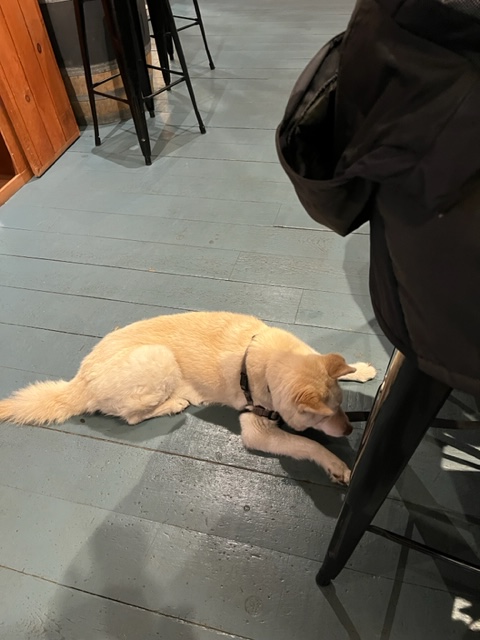
We had chosen to go to Jason’s because our visitors brought with them their very well-behaved pooch, and, according to the web site, they welcome dogs.  Then the sign on the door said, “No Pets.”  What to do?  I poked my head into the empty room, and asked, and the server welcomed us in, doggie and all. Whew. 

Our visiting pup.

We hadn’t been to Jason’s since February 2019, both due to the pandemic and because we had found the wines overall too sweet for our taste.  They seem to have partially corrected that, although Golden Fleece (a reference to the object of Jason’s quest), their most popular wine, is still much too sweet.  By the way, if you like to look at animals, you can stop outside to see the sheep and alpacas, another reference to the famous quest.  Oh, and the rest rooms are labeled Gods and Goddesses, reinforcing the mythological theme.

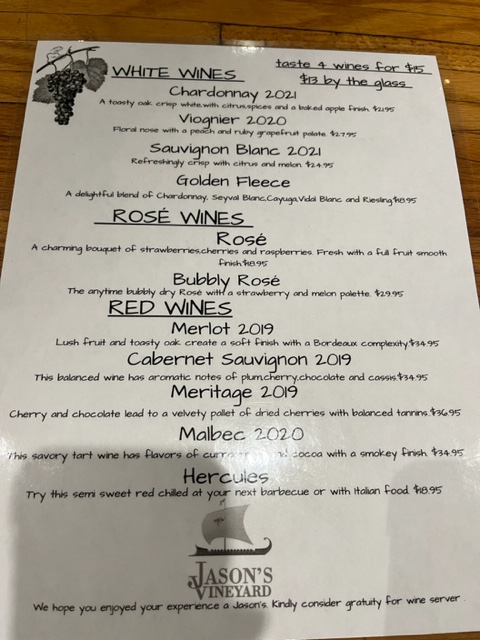
A tasting consists of four wines for $15, chosen from the list of eleven, served in little plastic cups on a labeled tray.  The servings were adequate for each couple to share a tasting.  We decided to mostly have the same wines, so we could compare notes, and all decided not to buy any wines to take home. They allow you to bring in snacks, and also sell a selection of crackers and cheeses.  Our guests bought a package of crackers as palate cleansers.

  • 2020 Viognier   $27.95

I often find viogniers quite pleasant, and this one was okay.  The aroma reminded me of fresh-cut grass, and the taste was somewhat grassy as well, with some herbal notes.  However, one guest found it somewhat vinegary, and too sharp for her taste.

The plate has an insert of numbers, and our server explained to taste them in a clockwise order.
  • 2021 Sauvignon Blanc    $24.95

Consulting my notes, I see that the last time we were here I characterized the sauvignon blanc as watery, and it still is.  It’s a very light white, with some notes of melon with lemon squeezed over it.

  • Golden Fleece    $18.95

Our guests ordered this one, and gave us a sip to taste as well.  A blend of chardonnay, seyval blanc, Cayuga, vidal blanc, and riesling—according to the tasting menu, though our server was unable to tell us in what proportions—this tasted mostly like a rather sweet riesling.  Not my type, though, as I mentioned above, this is apparently their most popular wine.

There’s an outside porch area, though not for a chilly rainy day.
  • 2019 Merlot       $34.95

“This is a competent merlot,” opined one guest, and I agree.  It is dry, with some cherry taste and aroma, somewhat light, with some notes of oak and smoke.  As we were sipping, we got into a discussion with our server, who by this time had exactly one other group to attend to, about how the Damianos family run three separate wineries.  He explained that, in addition to the eleven wines at Jason’s, the other two places offer thirty different wines each, with each meeting different requirements as to taste.  However, the same winemaker does them all.  That’s impressive, and part of why I find wine so fascinating.  The same grape, grown in the same area and type of soil, can end up tasting quite different, depending on time of harvest and after harvest treatment.

The bottles are adorned with an image of the Argo. It was manned by a group of heroes dubbed the Argonauts.
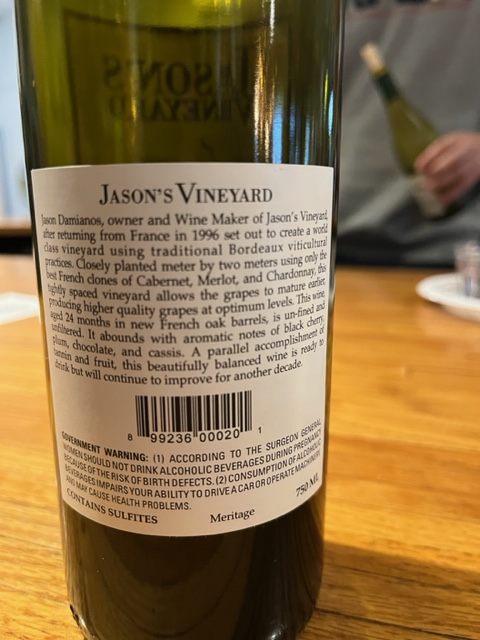
  • 2019 Meritage   $36.95

Although this is their Bordeaux blend (again, I don’t know proportions or grapes), it is thin, almost watery, with a slight taste of black olives.  Meh.

Reasons to visit:  you like to look at sheep and alpacas; you are fascinated by Greek mythology; you need to bring a dog with you (despite the sign on the door, the website does say, “Pets are welcome!”); you like sweet wine.

This alpaca seemed quite curious about us.

Kontokosta: For the Sophisticated

April 20, 2022

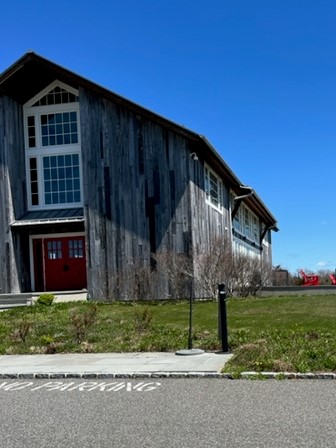
The exterior is deceptively rustic.

This time, our guests were a pair of sophisticated Manhattanites, who spend weeks at a time in Italy, where they often visit wineries, so we knew we needed to find a winery that was equally sophisticated.  We also needed a place where we could offer them lunch with their tasting, plus they had almost never been to the North Fork, and we wanted to give them a bit of a tour.  After some cogitation, we decided Kontokosta, just a little bit past Greenport’s Main Street, fit the bill in all particulars.

You can see the Long Island Sound in the distance.

They arrived before noon, giving us plenty of time before our reservation—which is required, and is held with a fee of $5 per person—to have a leisurely drive east.  (Reservations are via Tock, which seems to work about the same as Open Table, etc.)  As I drove, I pointed out the various wineries and other sites along Sound Avenue, giving a bit of information about each, feeling very much like a tour guide.  Our guests noted how rural it is out here, and admired the beginnings of spring blooms.

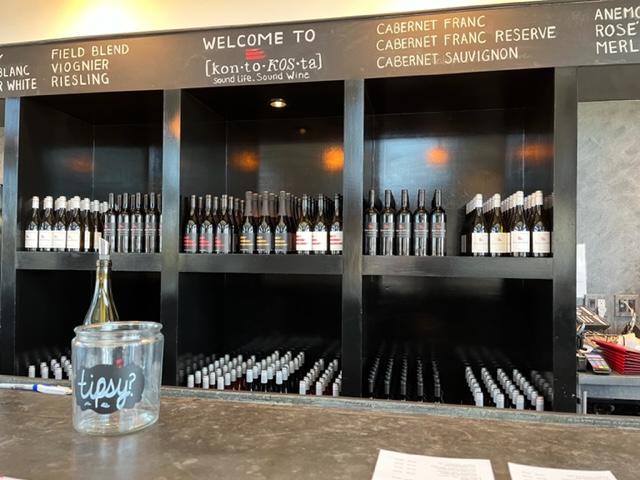
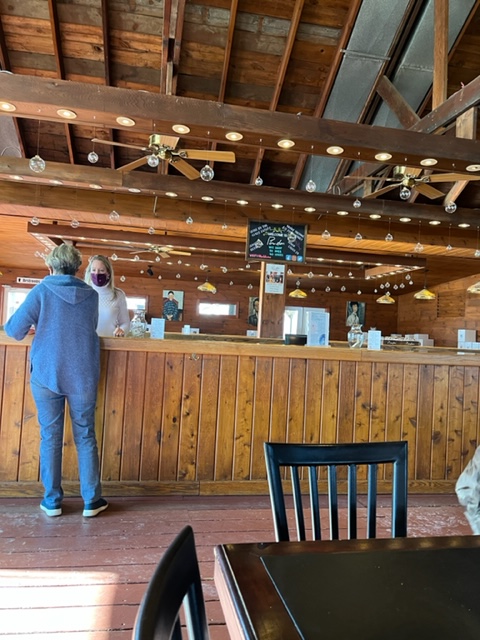
The inside is quite modern and sophisticated.

One aspect of Kontokosta I appreciate is their eco-consciousness.  They use a windmill to generate electricity, and serve their wines in those corn-based “non-plastic plastic” cups, also used by Old Field.  Snacks are served on bamboo plates, with bamboo utensils (though the bamboo knife did not do a great job of slicing the cheese).  They say they farm “sustainably,” whatever that means.

The outside of the tasting room is deceptively rural, looking like an old barn, while the inside is sleek and modern, in stark black and white.  We were greeted at the door, where our reservation was confirmed, and we were each given a wine glass to keep.  So I guess each glass cost $5!  We were directed to the bar, at the far end of the room, where a friendly server guided us to a snack menu and a tasting menu.  We ordered two cheeses, some crackers, and a plate of sliced salami while we perused the wines.

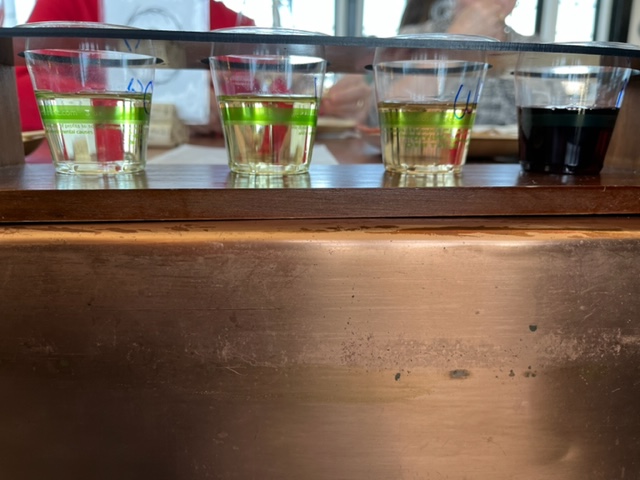
A tasting consists of three wines for $18, but on this day they added either of the rosés for free, since they are having a special sale on the rosés.  It was hard to choose from the menu of thirteen wines, but my husband and I and our guests decided each couple would share one tasting, and mostly got the same wines so we could discuss.  I may go back some time to try more of their wines.  Our tastings were delivered to our table in small cups, in a wooden holder, with each cup labeled as to the wine in it.  The taste is rather small.

We spent a pleasant afternoon sipping and tasting, and the snacks proved more than adequate for lunch.  Afterwards, we took our guests for a brief stroll around Greenport, and then drove home via Main Road, so they could see the towns of Southold and Cutchogue and Mattituck.

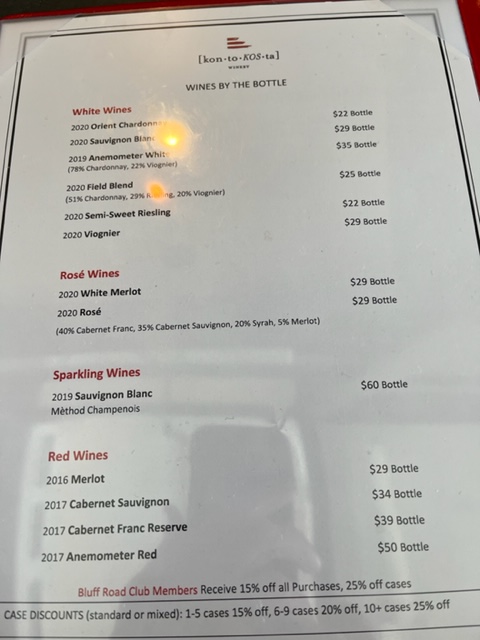
  •  2020 Orient Chardonnay            $22

We all liked this interesting chard, with its lovely flowery aroma and tastes of peach and citrus.  I mentioned that I thought it went very well with the cheddar and salami.  I used to think that cheese and charcuterie demanded red wines, but I have come to prefer whites.  My friend called it “vibrant.”  Nice description.

  • 2020 Viognier    $29

We differed on our second white, since they got the Field Blend.  I liked the viognier, too.  It has some taste of nectarine, and smells flowery.  It has a touch of lime at the end, and I think it would be good to have with seafood in a cream sauce.

  • 2020 Field Blend             $25

Our guests described this as “light and summery.”

  • 2020 White Merlot         $29 (half off if you buy six bottles)

We were somewhat disappointed in this wine, since white merlots are often quite tasty.  This was extremely light, and, as my tasting buddy noted, “monochromatic,” one of his favorite wine description words for wines he finds boring.  It tasted more like a white than a rosé, and even with a 50% discount, neither of us was interested in buying it.

  • 2016 Merlot      $29

Since merlot is the most characteristic red wine on the North Fork, we decided to have that as our final taste.  This is a fairly typical NoFo merlot, with cherry taste and aroma, dry, with a touch of oak/tobacco.  One guest called it “chewy.”

  • 2020 Rosé          $29
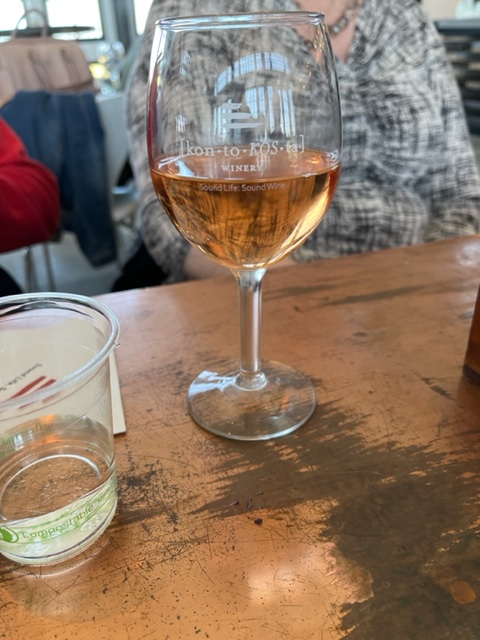
This is the glass of rose, which, unlike the white merlot, at least looks like a rose.

Since this rosé is also half off if you buy six, our guest decided to try a glass of it, pouring off a sip for us to taste.  We liked it better than the white merlot, as it has more strawberry taste and aroma, but not enough to get six bottles.

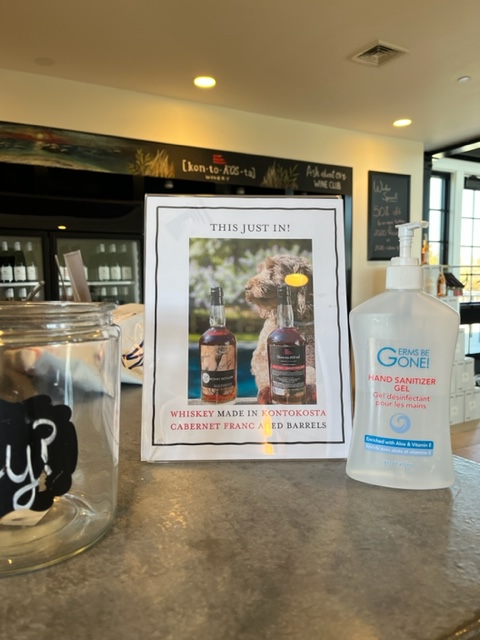
Hmm…whiskey? Maybe next time.

Reasons to Visit:  you want a winery close to Greenport; you want to have some snacks with your tasting; the Orient Chardonnay, the Viognier, and the Merlot; the property overlooks the Sound, and you can stroll down to a bluff overlooking the water.

They have plenty of outdoor tables, though it was a bit too chilly to sit outside when we were there. The Sound is in the distance.

Pindar Vineyards: Plenty of Variety

February 15, 2022

The first time we went to Pindar, years ago, we did not like many of the wines we tasted.  However, in recent years, we have found much more to our liking, so on this chilly winter afternoon we brought two friends with us to do a tasting.  It took some thought to decide where to go with them, since we have taken them to a number of wineries and breweries over the years.  However, the breweries were off our list, since in the winter many of them are closed mid-week, or only open late in the day.  We also wanted somewhere we could sit at a table and chat as we sipped, and where we didn’t need to make a reservation.  If we had wanted to bring our own snacks, Pindar allows that, plus they also allow dogs, a piece of information we are storing for later.

Gina was very pleasant and attentive.

Aside from one couple, who left, we had the place to ourselves, and we joked with our friends, did they like that we had reserved a winery for their tasting.  That’s midweek in February for you.  Gina, our server, was very pleasant, and patiently answered our friend’s many questions, asked us how we were liking our tastings, brought us cups of water, and gave advice as to which wines to pick from their long list, based on our preferences.  And I do mean long—thirty wines in all!  That included three reserve reds, which usually cost extra, but, since she had the bottles open, she offered to include them in our standard flight of five.  How nice.

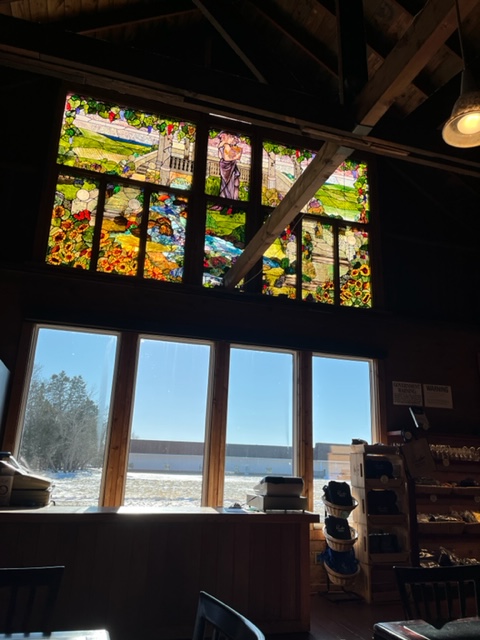
Pindar’s tasting room is in a converted barn, which has been expanded over the years, still retaining its rustic beams, with a gorgeous stained-glass window.  One not so pleasant note—the restrooms are in a separate structure, a cold walk outside in the winter, though it wouldn’t matter in the summer.  Maybe they should consider adding indoor facilities!

We got different colored Sharpies to mark up our menus.

I suggest choosing your flight carefully, as some of their wines are too sweet for our taste, but we were happy with today’s selections.  We shared three tastings amongst us, with some overlap. The tastes arrived in rustic wooden boxes, clearly labeled as to the order in which to drink them.

  •  Premier Cuvée Brut       $32.99

More and more North Fork wineries are offering sparkling wines, some made with the “méthode champenoise,” so I was curious to try theirs.  This was a nice, dry, sparkler, with lots of bubbles and some pear taste and smell.  100% chardonnay.

  • Dr. Dan’s Extra Dry         $29.99

“Dr. Dan” refers to the founder of Pindar—and also Duck Walk—Dr. Dan Damianos, who died in 2014, one of the East End wine pioneers.  His family have continued to run his wineries, though his son, Jason, who started Jason’s Vineyard, died in a car accident in 2017.  Made from a blend of chardonnay and pinot noir, this is another sparkling wine, but we didn’t like it as much.  It has some green apple taste, but also a touch of something chemical.

  • 2020 Viognier    $21.99

We decided to steer clear of the sweeter whites, so we opted for the viognier, but found it too light, with again, a bit of a chemical aroma.  It’s not bad, but there’s not much to it.

  • 2020 Sunflower Chardonnay      $21.98

According to Gina, this is one of their most popular whites, and I can see why.  It is very lightly oaked, so there are only traces of vanilla, with some nice citrus flavor and a lovely floral aroma.  However, again, it is very light, though I think it would be nice with seafood, like the steamed lobsters we plan to pick up at Braun’s later.

The Gamay is a pretty light red.
  • 2020 Gamay Noir            $21.99

The ever-attentive Gina informs us that this is their lightest red, and she is right, though is is quite tasty.  This would be a good red for someone who thinks they don’t like reds.  It has a red lollipop smell, and lots of berry taste.  It could go with roast chicken, like a Beaujolais.

  • 2017 Cabernet Sauvignon           $18.99

I teach our friends the word “petrichor,” which, I say, is the smell of this wine.  Though it is dry, it is also very light, and we don’t care for it.

Just part of the array of wines.
  • 2017 Cabernet Franc      $21.99

In contrast, this red smells lovely, like a dried fruit compote, and tastes like slightly under-ripe purple plums.  Quite drinkable, and we sense some nice tannins.

  • 2017 Syrah         $18.99

This was in my friend’s tasting, so I only got a small sip, but she compares the taste to “burnt toast.”  I say black tea?

  • 2017 Tannat      $21.99

I don’t think anyone else on the North Fork grows this grape, which usually comes from the Basque area.  It had a lovely flowery smell, like violets.  It is not unpleasant to drink, but my friend says the taste reminds her of “canned plum tomatoes,” and theorizes it would be a good wine to add to a ragu Bolognese.

  1. Pythagoras         $18.99

You may have noted that some of the wine names are a nod to the Damianos family’s Greek roots, like this one, named for the founder of that theorem you had to memorize in high school.  This is a Bordeaux blend—perhaps of three grapes? —hence the name.  I insist that this smells like that white paste we used to use in elementary school, and which some kids—not me! –liked to taste.  As it sits and we chat, it develops a better taste and smell, with some good berry flavor.

  1. 2019 Mythology              $$42.99

This wine, and the two which follow, are categorized as reserve red wines, and normally cost an extra $4.00 per taste.  We are happy to try it, and find it good, drinkable, with nice tannins which make me think it could be cellared, but not worth the cost.

  1. 2019 Merlot Reserve      $34.99

This had typical merlot cherry flavor and aroma, though it is not as big a wine as one would expect from one labeled reserve.   

  1. 2019 Cabernet Sauvignon Reserve           $34.99

It seems we saved the best for last, as we all agree we like this one the most.  It has an intriguing aroma of forest floor and berries, and plenty of interesting dark fruit flavors. 

Windmill!

Reasons to visit:  informal tasting room, with lots of room at the bar and plenty of outdoor space; they allow picnics and dogs; the Premier Cuvée Brut, Sunflower Chardonnay, Cabernet Franc, Cabernet Sauvignon Reserve (plus others we did not taste if you like sweeter wines); many different wines to fit different palates; if you live elsewhere, they ship to forty states.

They ship to forty states.

RGNY: Many Changes

November 3, 2021

From the outside, the winery that used to be called Martha Clara looks much the same, but as soon as we stepped inside, we saw that it looks very different.  And once we tasted the wines, made by winemaker Lilia Perez, we knew that it was not at all the same.  I find it so interesting that the same grapes, grown in the same vineyard, can yield such different-tasting wines.  Martha Clara’s wines, for example, definitely tended to feature some sweetness, while the RG wines (named for the Rivero Gonzàlez family) we tasted were dry.

The shop inside the entrance used to have all sorts of items, including snacks, while now it is much simpler, with just the RG wines and a few Mexican items, such as baskets.  Then we walked into the large tasting room, which used to feature a huge bar, which more or less snaked through the entire room.  Now the bar is only on one side, with the rest of the space taken up by some small round tables with comfy chairs and some couches.  The walls are bare, and the overall effect is rather stark.  I think they could do more to warm up the space, and suggested to my husband that a pot-bellied stove would be a nice focal point.  He looked skeptical.  The side room (where the restrooms are located) is still pretty similar, filled with tables and chairs.    

We were greeted by a friendly server who asked us if we had a reservation.  We looked around the large room, empty except for one other couple, and asked in mock concern, “Oh no, should we have made one?  Will you have room for us?”  She laughed, as did we, and explained that she actually had three reservations for that afternoon, and so wanted to be sure that she honored the process.  (Quite a few wineries are continuing their pandemic-caused practice of requiring reservations, so be sure you check websites before you go.)  Then she presented us with a QR code to scan in order to read the menu.  

We had intended to sit at the bar, but found the chairs there not comfortable, and so moved to a table, where we liked the chairs very much.  We recently had been shopping for new dining room chairs, and my husband commented that these would have worked nicely.  The menu features three different flights, labelled Scielo, White, and RG.  The RG flight, for $22, seemed the most varied, so we opted to share it.  We were glad we were sharing, since the pour, of four wines, is quite generous, and we actually left over some wine!  There’s also a short but creative menu of food items, including chicken tacos, a Mexican PB&J, and paletas, which, Google informed me, are a kind of Mexican ice pop.

With our flight she brought a bottle of water and two cups, a nice touch, and asked if there was anything else we wanted.  We asked her to turn down the very loud music, which she immediately did.  Whew.  Then later, I asked about the vintages of the wines, since that information was not anywhere to be seen.

  •  2019 Sparkling Rosé      $30

Sometimes sparkling rosés are too sweet, but this one is just right, with a refreshing taste of strawberries and pink grapefruit and moderate bubbles.  We like this, and decide that if we wanted a celebratory pink wine, we might get this one.

  • 2018 Viognier    $33

Many of the wineries on the North Fork that grow viognier use it in blends, so I don’t often see it on its own.  Again, this is a dry wine, mouth-watering, with tastes of spice and pears.  The aroma is a bit funky, with some scent of stewed pears.  We like it.

  • 2018 White Merlot         $32

White merlot?  You may ask, I thought merlot was a red wine grape.  And so it is.  But if you ferment it without the skins, you get a white wine.  Anthony Nappa used to make a wine called Anomaly, a white pinot noir, which we liked very much.  This is also good, and is a nice, light, good sipping white, though not very interesting.  I say it tastes like gooseberries.  Some day I will buy gooseberries again and see if the taste I remember is correct…

  • 2019 Cabernet Franc      $37

Lovely aroma—chocolate covered cherries!  This is another easy to drink wine, with soft tannins, dry, and a flavor that makes me think of dried fruit compote, or maybe stewed prunes (which I happen to like very much). 

Reasons to visit:  large venue with plenty of room for groups, including outside areas; pleasant wines and a large pour; the sparkling rosé and the viognier, though all the wines were easy to drink; an interesting food menu.         

Peconic Bay Vineyards: Under New Ownership

October 21, 2021

I expect I will be able to use the subtitle “under new ownership” quite a few times this year, as recently a number of wineries have changed hands.  In some cases, already existing wineries have expanded by buying their neighbors, while in others new owners have entered the North Fork wine scene.  Peconic Bay is a case of the latter, as the Soloviev family has been actively investing in the North Fork over the past few years.  Peconic has been officially closed for about eight years, though we stopped in there in 2017 when it was briefly open, as the previous owner was, according to our server, trying to sell out his stock.

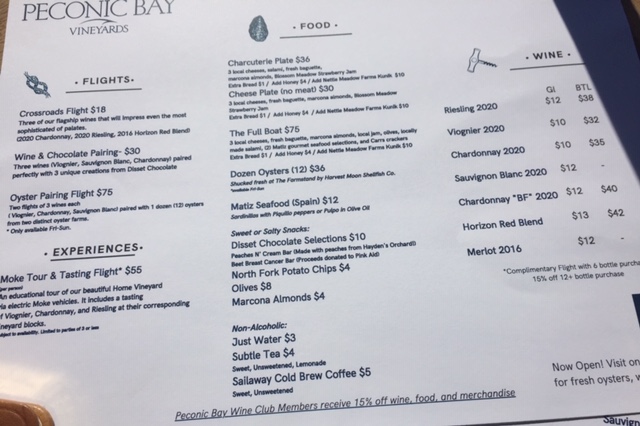
Since they have been closed, they have been selling their grapes to other local wineries, which is why they only have limited quantities of certain varieties.  However, we were told by Sam, our charming and chatty server, those contracts are about to end, so she is looking forward to seeing what their winemaker—who is the same one who worked at Peconic before—will come up with.  For now, they offer seven wines, though two of them—the sauvignon blanc and the merlot—are in such limited quantity that they are not selling them by the bottle. 

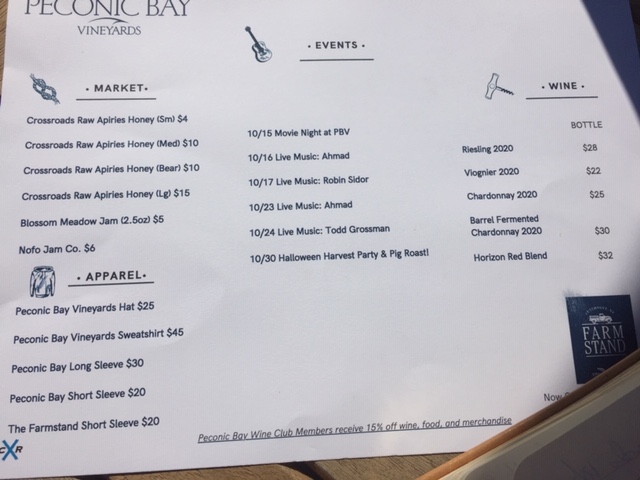
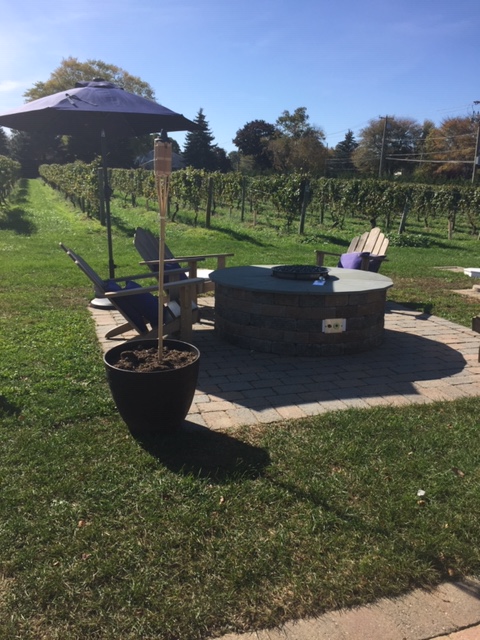
It was another beautiful warm day, so we planned to sit outside wherever we went, and when we walked into Peconic we were sure, as the inside area is quite small, with uncomfortable-looking stools at the bar.  Outside, however, featured a roomy patio, with nice wooden chairs (maybe they could add seat cushions in the future?) and comfy Adirondack chairs grouped around fire pits.  The fire pit areas, we were told, are all reserved already for “movie night,” when they will be showing Hocus Pocus.  They also plan to have live music at various times.  However, today we and one other couple were the only visitors, though Sam assured us it was busier on the weekends.

The menu offers a flight of three wines, called the “Crossroads Flight” for $18, and seemed to be limited to just the chardonnay, riesling, and red blend.  However, Sam told us we could substitute any other wines if we preferred, and after she described the riesling as semi-sweet, we did prefer—not to have it—so we opted for the viognier instead.  Good choice.  After we shared the small flight, we decided we would like to sit and enjoy the beautiful afternoon a while longer, so we shared a glass of the sauvignon blanc and a bag of North Fork potato chips.  The food menu features the usual cheese and charcuterie choices, as well as a chocolate tasting from Disset, a new fancy chocolatier in Cutchogue, and, on the weekends, local oysters.   As we contemplate the menu, Sam brings us a carafe of chilled water, always a nice touch.

  •  2020 Viognier   $22

I get a touch of kerosene and metal when I sniff, but fortunately it tastes of pineapple, not gas!  We like it.  It is dry with nice fruit tastes, refreshing, and different from most North Fork wines.

  • 2020 Chardonnay           $25

Sam informs us that this is the “musque” clone of chardonnay grape, which I have not knowingly encountered before.  In any event, the taste is quite distinct, a smooth, mellow sip that reminds me of thyme honey, though it is not sweet.  Most local chardonnays have a citrus flavor, but this does not.  The menu suggests pairing it with hard cheese, and I think it would go well with a truffle-infused pecorino we had from the Love Lane Cheese Shop recently.

  • Horizon Red Blend          $32

We decided to describe this as a “starter” red, or in other words a red for someone who is not yet into reds.  It is light and dry, with soft tannins, and tastes of wood and cherry.  Sam suggests calling it a “summer” red.  A blend of 73% malbec, 18% merlot, and 9% cabernet sauvignon, the aroma, of cherry, wood, tobacco, and coffee, promises more than the wine delivers.

  • 2020 Sauvignon Blanc

As I mentioned, we decided to share a glass of wine, and, based on a discussion with Sam, we opted for the sauvignon blanc, at $12 for a glass, plus a $4 bag of North Fork potato chips.  Again, this is a different-tasting sb than the usual out here.  It is mellow, not citrusy, with an almost thick mouth feel, and a trace of saltiness and fruit.  We chuckle over the observation that it actually goes very well with the chips.

Reasons to visit:  someplace new; nice outdoor area, with firepits for colder weather; local oysters on the weekend; the viognier and the sauvignon blanc; oh, and for $55 per person you can tour the vineyard in the Moke, an adorable electric vehicle that looks like a mini safari car, with tastings of three wines next to the vines where they grow.

The Moke!

Peconic Cellar Door: Women Rule December 20, 2019

https://www.peconiccellardoor.com/peconic-cellar-door

IMG_7352

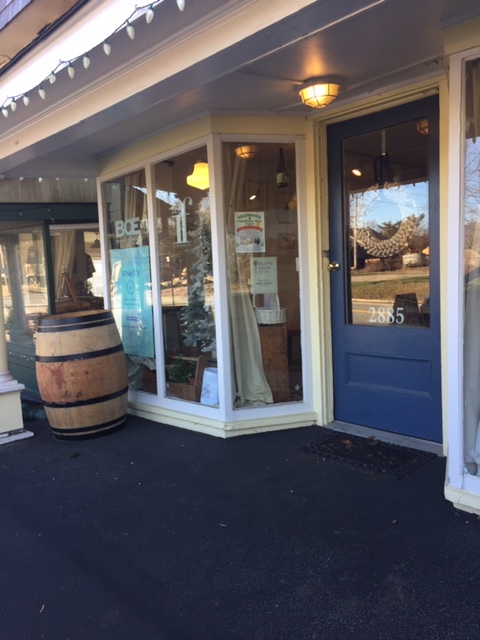
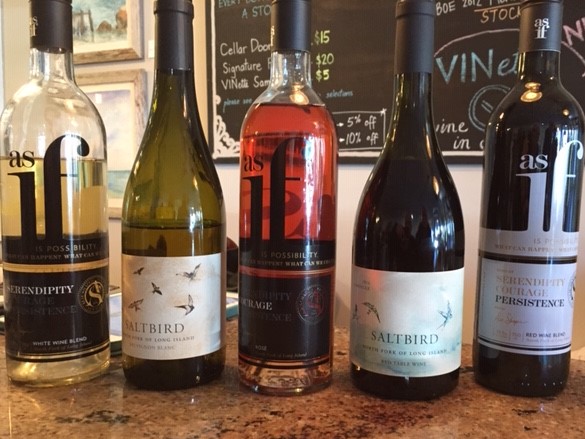
Unlike most wineries on the North Fork, Peconic Cellar Door is owned and run by women: Alie Shaper and Robin Epperson-McCarthy. It is another of the very small tasting rooms, and in fact adjoins last week’s site, The Winemaker Studio, but is even smaller. Despite its small size, however, it offers quite an array of wines to taste, under four labels: As If Wines, Brooklyn Oenology, Haywater Cove, and Saltbird Cellars. All the wines are now under the umbrella name Chronicle, with the tag line, “Every bottle holds a story.” Ask Robin (or whomever is behind the counter) about the logo, because it tells a story, too.

IMG_7356

Robin was our server, and since there were no other customers, we had time to chat. There were a couple of visitors who came by just wish Robin and Alie happy holidays. Robin told us about her travels around the world to learn the craft and art of wine-making, particularly her six months in New Zealand, which influenced the style of some of her wines. She is clearly passionate about wine-making, and she and Alie have their own original ideas about it. We enjoyed all of their experiments.

The menu offers two flights, the Cellar Door flight, of five wines for $15, and the Signature Flight, of five higher-priced wines for $20. We decided to share the Signature Flight, and perhaps return for the Cellar Door, though Robin cautioned us that they change the options every month. Given that the price list includes 28 wines, I guess they can come up with quite a few permutations. We may have to go back more than once…

IMG_7366

Though they don’t allow outside food (or pets), the only snack on offer is packs of cookies from local baker Ali Katz. I do recommend a visit to her little bakery and food shop in Mattituck (only open Fridays, Saturdays, and Sundays). We’ve only been there a couple of times, but found her baked goods excellent.

IMG_7355

  1. 2014 As If Serendipity $35

If the name of this wine describes how it came to be, it was a fortunate accident indeed. A blend of sauvignon blanc, chardonnay, and viognier, it is aged more than one expects for a white, particularly on the North Fork, where most whites are from the most recent vintage. This wine has a floral and mineral aroma, and is nicely dry. Some notes of lemony citrus, but also more depth than one expects from a white. As we sip, I find the viognier taste, which I quite like, coming through.

IMG_7359

I thought this label was particularly pretty.

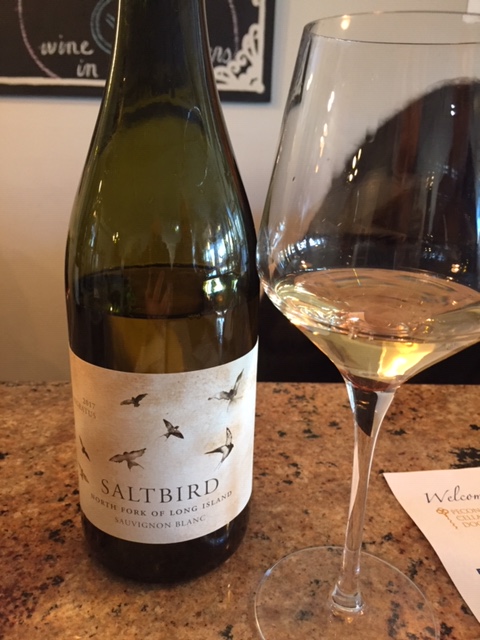
  1. 2017 Saltbird Migratus $27

Of course, I have to ask about the name of this wine, which comes in a bottle with a very pretty painting of birds in flight. Robin explains that it is a reference to her own migrations, away from the North Fork and back, but also to the birds she loves. The making of this wine was influenced by her time in New Zealand. Though plenty of cheap sauvignon blanc comes here from there, the wines they keep for themselves tend to be made like this one, spending six months on the lees and aged in oak. When I note a faint oak taste, she mentions that “one of the barrels” was new oak, so it came out a bit oakier than she wanted. Overall, it is a good wine, with a nice mouth feel and a taste my drinking buddy compares to “drinking flowers.” Well, it does have an aroma that combines something vegetal with flowers.

IMG_7360

This rose is almost like a light red.

  1. 2016 As If Courage $28

Robin calls this a rosé made from a Meritage blend. I guess it does take courage to make a rosé from merlot, cabernet sauvignon, cabernet franc, petit verdot, and syrah, a classic Bordeaux blend. She compares the aroma to buckwheat honey, and I agree. This is almost as much a very light red as it is a rosé. It has some strawberry and citrus tastes, but more depth (again) than your typical rosé. She suggests serving it with a pork roast, an excellent idea.

IMG_7362

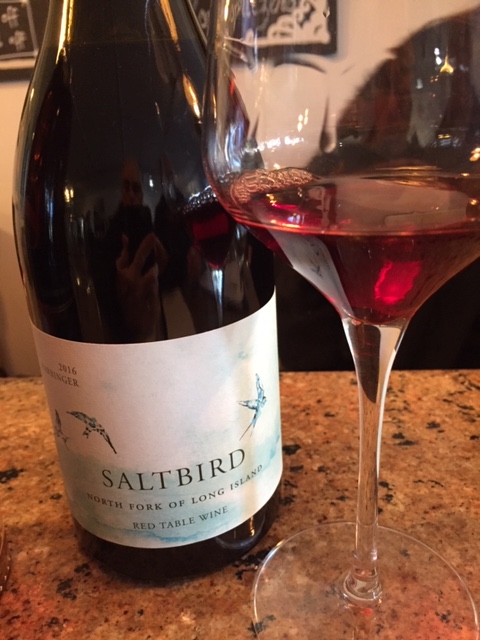
  1. 2016 Saltbird Harbinger $36

A blend of cabernet sauvignon and merlot, this is a wine they only make in good years, so there is no 2018 but will surely be a 2019. I’ve heard in several tasting rooms that this was a very good year on the North Fork, with the right amount of warm days and rain. It has some cherry taste, but is not really fruity, dry, with some tannins. Nice legs, if that means anything!

IMG_7367

The array of our tasting.

  1. 2014 As If Persistence $40

I’m glad they persisted with making this wine, a blend of cabernet franc, petit verdot, and cabernet sauvignon. Despite the price, we decide to buy a bottle to save in the cellar for a special occasion. I think it could age a few more years, but it is also delicious to drink now. Fruitier than the previous wine, it has some interesting flavors, and could stand up to a steak.

Reasons to visit: another small winery, where you can talk to the winemakers and learn about what inspired them and how they made each wine; we liked all the wines, but especially the Serendipity and the Persistence; they change their offerings periodically, so you can go more than once; though they don’t allow groups larger than six, if you happen to be with a group you can split up, with some going to the Winemaker Studio, connected by an open doorway and a window in the wall.

IMG_7357IMG_7369


Macari Vineyard: No Tricks, Several Treats October 30, 2019

http://macariwines.com/

IMG_7216

It was the day before Halloween, and oddly warm, when we drove over to Macari. We had the tasting room to ourselves, so it wasn’t surprising that there were no pre-made cheese trays available. (No outside food allowed.) However, we could have bought any package of cheese on display, plus some crackers, and our server would have supplied us with a knife and cheese board.  We decided to content ourselves with a bag of very tasty black truffle-flavored potato chips. Then I worried that they were interfering with the tasting, so I requested a glass of water, which was quickly forthcoming.

The tasting room on Bergen Road is large, with a beautiful stone fireplace on one side, and ample displays of their wines all around. There is also a second large room filled with tables, and seating on a veranda off to one side. We stood at the bar and shared an Estate tasting, of five wines for $30. The other flight is called Vintage, and also includes five wines for $30. My tasting buddy complained that it was a small pour, though I noted that the glass was large.

IMG_7218

The main tasting room.

When you stand at the bar you have a clear view of the huge steel vats in the wine-making area, and we watched with interest as a worker tethered himself with a safety harness before checking on one vat. Makes sense, I suppose. What a way to go, drowned in a vat of wine!
In general, we have liked Macari wines, and often buy a bottle with dinner in local restaurants. Today was no exception, though in general we liked the whites better than the reds, and really liked the rosé we tried.

IMG_7221

  1. 2018 Katherine’s Field Sauvignon Blanc $24

Why Katherine’s Field? All our server could tell us was that the grapes for this wine all came from an area of the vineyard called Katherine’s Field, and that it is the part closest to Long Island Sound. Perhaps that closeness to the water accounts for the slight note of saltiness I detected. The wine is light and easy to drink, with tastes of green apple, mineral, and pineapple. Like many NoFo sauvignon blancs, it would go well with local oysters. Good.

IMG_7227

  1. 2017 Dos Aguas White $22

Dos Aguas is, of course, a reference to the two waters which surround the North Fork: the Sound and Peconic Bay. This is a blend of 52% grüner veltliner, 27% viognier, 10% sauvignon blanc, 7% pinot gris, 3% friulano, and 1% gewürztraminer. It smells very much like honeysuckle, which I think might be due to the grüner, and also gets some of its fruitiness from that. My husband thinks it is too sweet, but I argue what he’s tasting as sweet is actually fruitiness. It has some lemon taste, as well as gooseberry. I would buy it, and it would go well with spicy food, but he doesn’t like it as much as I do.

IMG_7228

Even visually, you can tell this rose is more robust than most.

  1. 2018 Lifeforce Rosé $28

The term “lifeforce” in the title of a Macari wine refers to the fermentation method used. Instead of steel or wood, these wines are fermented in a concrete “egg.” They used to explain that egg on their website, but I couldn’t find that information now. In any event, this rosé is made from cabernet franc grapes, and was described by our server as their “fall rosé.” It is heavier and darker than a typical rosé, and as we discussed it he told us that what had happened was that in 2018 they were not happy with the way the cabernet was turning out, so rather than make a red from it they decided to turn it into a rosé. We are happy they did, as we quite liked it. Though it has some typical strawberry aroma and flavor, it has more oomph than many rosés. We bought a bottle. I think it will go great with seared rare duck breasts, which we get at Bayview farm stand.

IMG_7229

By this time our server–a bright young man–had figured out how I like to pose these photos. We had a nice chat about how he has learned to like wine.

  1. 2014 Merlot Reserve $40

Our server tells us this in aged twenty months, 9% in new French oak, so it is not super oaky or tannic. It smells fruity, like black cherries. The taste is soft and pleasant, but rather unidimensional. At that price, I’d want a more exciting wine. However, it is quite drinkable.

IMG_7230

  1. 2016 Dos Aguas $35

This is another blend, this time a Right Bank Bordeaux blend of 62% merlot, 14% cabernet sauvignon, 10% malbec, 8% petit verdot, and 6% cabernet franc. I like the aroma of red raspberries, but again the taste is good but not exciting. Dry, soft, with no tannins, this is an everyday type of red that you could even have with roast chicken. It would not stand up to a steak.

IMG_7217

Reasons to visit: spacious tasting room; the sauvignon blanc, the Dos Aguas white, and the Lifeforce Rosé; we often get the Sette in restaurants, a nice blend of half and half cabernet franc and merlot; no food allowed, but they do have a large selection of snacks and will do cheese trays on busier days.

IMG_7233

The grapes have been picked, and soon the leaves will be gone as well, leaving the vines bare until spring.